Toward the end of the eighth season of Murphy Brown, the 1990s CBS sitcom about a broadcast journalist at a 60 Minutes-like TV magazine, the titular news anchor runs into real-life Newt Gingrich. Brown, played by Candice Bergen, has been hosting the “Press-capades,” a dinner where members of the media lightly roast their audience of politicians. She is dressed as Hillary Clinton, having just wrapped up a skit in which she and Bill ran around the Oval Office chasing a greased pig labeled “Newt.” The House Speaker seems unperturbed by his portrayal. “Last I checked, the First Amendment still gives all journalists the right to say pretty much whatever they want,” Gingrich jokes. “Although, you do make me wonder if we ought to look into changing that.”
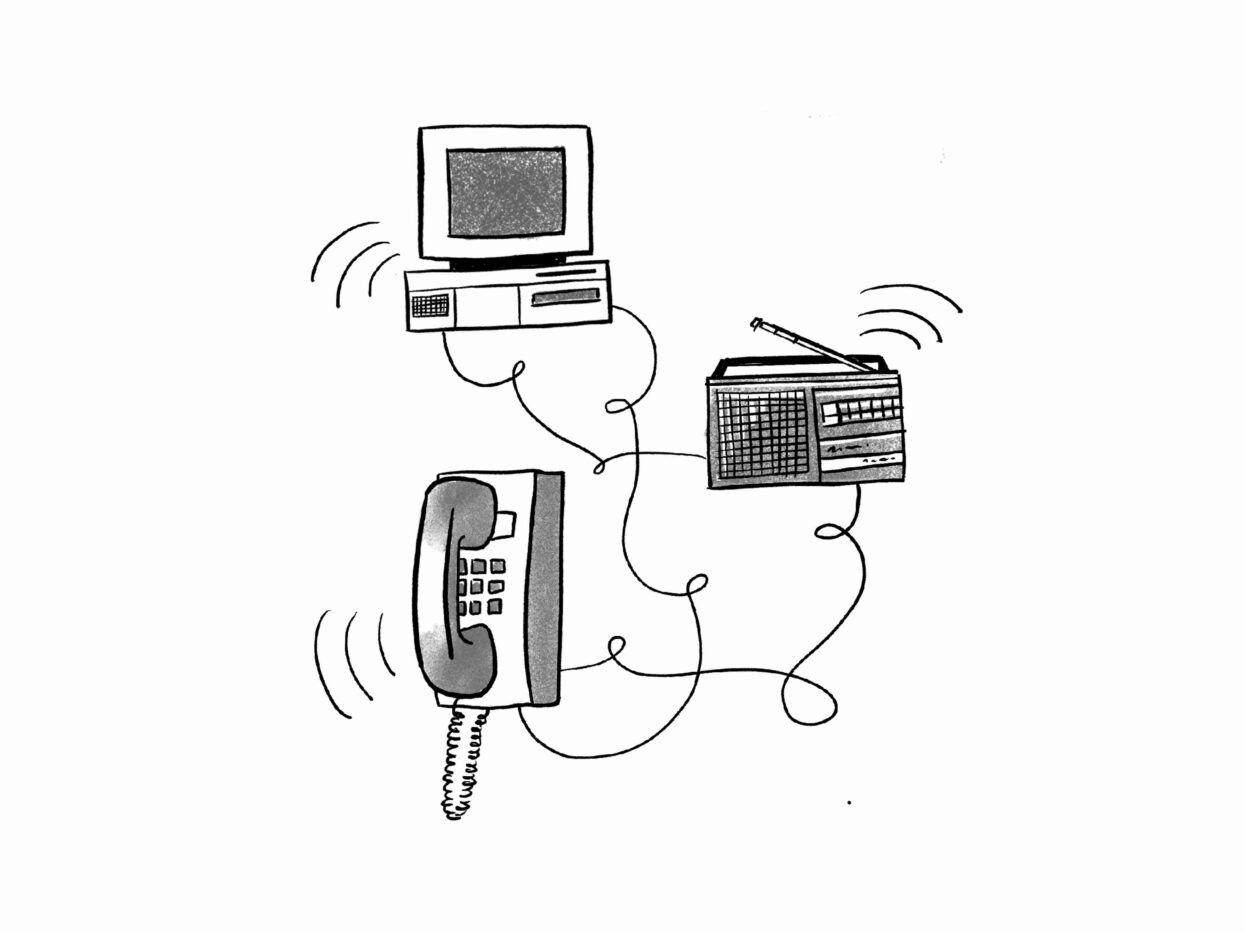
The chummy scene proved more prescient than its writers could have predicted. Shortly after shooting it, Gingrich appeared in a different television special: a quasi-variety hour that celebrated the signing of the Telecommunications Act of 1996, a bill that would have profound repercussions for American journalists’ ability to say “pretty much whatever they want.” The bipartisan legislation — which represented the biggest overhaul of the Federal Communications Commission since the Communications Act of 1934 — promised to “promote competition and reduce regulation in order to secure lower prices” by radically loosening the regulatory system governing cable television, video and radio broadcasts, phone services, and the new terrain of the internet. The bill passed both chambers of Congress with just 21 holdouts (among them: then-Representative Bernie Sanders). In honor of the signing, Vice President Al Gore staged a skit with comedian Lily Tomlin. “Two days ago when I was taping Murphy Brown,” Gingrich cracked afterward, “I little appreciated I’d be on The Al Gore Sitcom here in Washington.”
The new bill was “like the space program,” Tomlin said, with Clinton and Gore as its “infonauts.” Her fellow presenters were similarly hyperbolic. Representative John Dingell “thanked God” for the bill. The act’s sponsor, Senator Larry Pressler, compared it to “a gun going off in the Oklahoma land rush.” Per South Carolina Senator Ernest F. Hollings (the year’s top recipient of telecoms campaign contributions): “The Berlin Wall on telecommunications has been demolished.” Clinton signed a copy of the bill in e-ink to “send it into cyberspace.” “I can just see the headlines,” Tomlin swooned: “‘Bill Signs Bill.’”
But there weren’t many headlines, at least outside of the finance pages. The bill was as consequential a surrender to market forces as NAFTA, essentially ceding communications oversight to the invisible hand. But few in the press hailed it as such. The debate around the bill was a “farce,” media critic Robert McChesney wrote that summer, treated as a “business story, not a public policy story.” The meager public pushback primarily criticized the bill’s obscenity provisions, which aimed to restrict children’s exposure to “sexual or excretory activities or organs” but also snuck in a clause making the transmission of information relating “directly or indirectly” to abortion a felony. (Much of that section was later struck down for violating the First Amendment.) “I have never seen anything like the Telecommunications Bill,” career lobbyist Charles Bien said. “The silence of public debate is deafening. A bill with such astonishing impact on all of us is not even being discussed.”
Perhaps for good reason: in what The Washington Post called “among the most expensive and contentious lobbying wars ever waged on Capitol Hill,” telecoms companies alone funnelled some $16.6 million into campaign donations that cycle, nearly double their spend on the prior presidential election; the legislation was “essentially bought and paid for by corporate media lobbies,” as Fairness & Accuracy in Reporting (FAIR) put it. These days, the Telecoms Act is best known for its controversial Section 230, which indemnified internet platforms from the liabilities applied to other publishers. But the act also drastically eased regulations on media mergers — including acquisitions of local outlets. The new law “opened the floodgates on mergers,” FAIR wrote, prompting a wave of consolidation across the industry.
Radio bore the brunt of the carnage. The year prior, no company could own more than forty radio stations nationwide; the Telecoms Act eliminated the national cap. Within a year of its passage, a fifth of all American commercial radio stations changed hands. Radio’s low maintenance costs had traditionally made it a home for independent and alternative media — a place where Art Bell’s paranormal Coast to Coast AM existed comfortably alongside Ohio’s modern rock bastion 97X WOXY and Phil Hendrie’s parody talk show (featuring fake guests like the horny kidney patient possessed by Satan or the children’s party planner who reenacts celebrity deaths). But by 2002, according to a study from the Future of Music Coalition, ten companies controlled two thirds of the national radio audience; news radio was dominated by just four. No company benefitted more than a chain called Clear Channel, which soon expanded its portfolio from 40 stations to 1,240. By 2005, the company had grown so unwieldy that it spun off its live events business into a new company, Live Nation, now itself a shorthand for industry dominance. Two decades later, Clear Channel remains both the largest radio owner and the largest podcast producer in the country, though it operates under a different name: iHeartMedia.
The collapse of independent radio merely foreshadowed the fate of other media. The Telecoms Act required the FCC to review its ownership policies every two years, and each review period the agency seemed to roll back a new rule. In 1999, the limit on owning multiple local TV stations in the same market was overturned, which ushered in Viacom’s acquisition of CBS. Two years later, the FCC permitted the “big four” TV networks — ABC, CBS, FOX, and NBC — to acquire stakes in emerging networks, allowing, for example, CBS Corp (via its subsidiary UPN) to stealthily team up with Warner Bros and form The CW. The ungodly sums getting swapped on TV properties attracted the eye of private equity, which promptly bought up behemoths like Clear Channel and Univision, only to gut many of these companies in the wake of the financial crisis. By the time Trump entered office in 2017, the concentration of corporate media was already a punchline. But his FCC took it even further, eliminating many constraints on cross–media ownership — now, TV owners were free to gobble up radio, and broadcast networks could swallow newspapers. Thirty years after the Telecoms Act was signed, ninety percent of media consumption has been captured by just six mega-conglomerates. And now it’s poised to become more concentrated still.
In a matter of months, the second Trump administration has ushered in a speed round of consolidation. In 2025, David Ellison’s Skydance officially bought Paramount, which is now buying Warner Brothers; a group of investors led by Ellison’s father, Larry, bought TikTok in January. In March, the FCC waived one of the last remaining ownership limits, clearing Nexstar, the largest owner of TV stations in the U.S. — the one that pulled Jimmy Kimmel off the air over a non-joke involving Charlie Kirk — to buy its rival Tegna, the fourth-largest TV owner, whose portfolio includes 64 TV stations in 51 markets. The $6.2 billion merger, which closed in late March and is currently being challenged in the courts, would give Nexstar control of 265 TV stations, covering as much as eighty percent of American TV households. The last bastions of public media, NPR and PBS, have lost their federal funding, while newspaper owners from Jeff Bezos (The Washington Post) to Patrick Soon-Shiong (L.A. Times) to Alden Global Capital (Chicago Tribune, New York Daily News, Orlando Sentinel, among others) have decimated what remained of their staffs.
The case for antitrust enforcement has, at least, returned to polite conversation, if mainly on the left (and, intermittently, the Bannon right). Under Lina Khan, the Federal Trade Commission brought landmark cases against Google and Amazon, signaling a revived willingness to challenge monopoly power in the tech sector. But the concentrated ownership distorting the traditional media ecosystem has done no less damage to the digital public sphere, and the next administration needs to look beyond Silicon Valley. It should be prepared not just to rein in Big Tech, but to overhaul corporate media itself: dismantle the remaining giants, reinstate meaningful limits on media mergers, and reinvest in public media. Some Democrats have begun preparing, or at least pretending to prepare; in February, Senator Chris Murphy promised that the party, once empowered, would “break up these anti-democratic information conglomerates. All of them.” But doing so will require repudiating the Clintonite politics that permitted the conglomerates in the first place. The Telecoms Act treated the airwaves as real estate; the next overhaul to media policy should treat them instead as public infrastructure — a system that must not only be protected, but rebuilt.