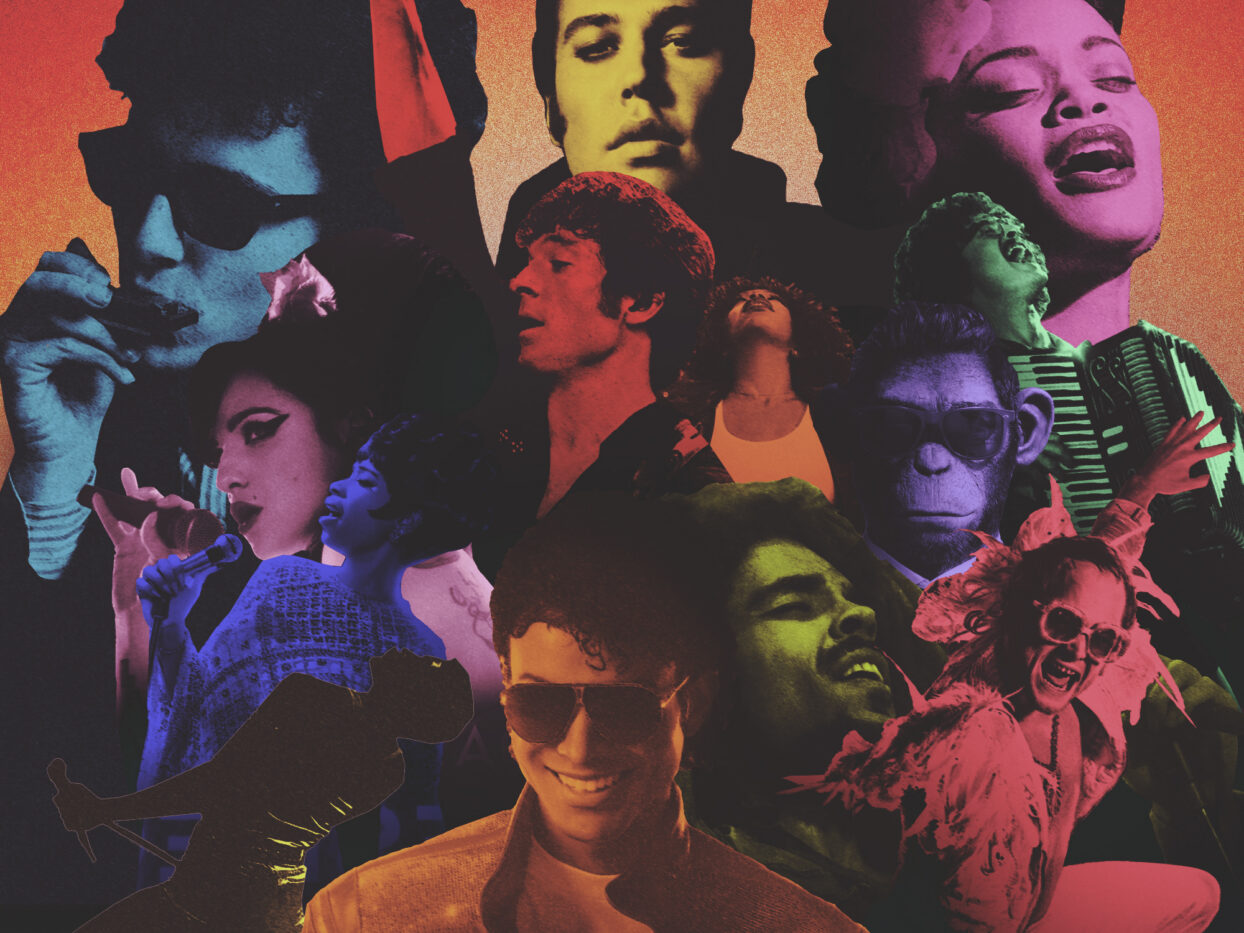
It can be tough to remember now, but there was once a time when people had to outgrow superheroes. Fortunately, for generations of kids entering puberty, there was another place to turn for flashy costumes, goofy nicknames, personal logos, and childhood hardships channeled into special abilities by beloved figures who played by their own rules: rock ’n’ roll. When “famous musician” replaced “Batman” as the answer to the question “What do you want to be when you grow up?” it wasn’t just about sex and drugs. For the back half of the twentieth century, musicians represented a self-made ideal, as seen through Ray-Ban colored glasses. These stars were rebellious freethinkers who maintained a steadfast belief in their talent — and their novel ideas — when everyone else doubted them. Their genius was recognized with rewards so vast that they spawned new demons to battle, thus fueling another cycle of creativity and adoration.
So it’s fitting that, as Hollywood has increasingly turned to I.P. fare — churning out a seemingly endless stream of movies rehashing familiar plotlines and featuring recurring characters — studio executives have set their sights on the major label cinematic universe. The past decade has seen the release of biographical films about Michael Jackson (Michael, 2026), Bruce Springsteen (Springsteen: Deliver Me from Nowhere, 2025), Bob Dylan (A Complete Unknown, 2024), Amy Winehouse (Back to Black, 2024), Robbie Williams (Better Man, 2024), Bob Marley (Bob Marley: One Love, 2024), Whitney Houston (Whitney Houston: I Wanna Dance With Somebody, 2022), Elvis Presley (Elvis, 2022), Weird Al Yankovic (Weird: The Al Yankovic Story, 2022), Aretha Franklin (Respect, 2021), Billie Holiday (The United States vs. Billie Holiday, 2021), Elton John (Rocketman, 2019), and Freddie Mercury (Bohemian Rhapsody, 2018). Rumored to be in the works are movies about Prince (produced by Ryan Coogler), Ozzy Osbourne, Snoop Dogg, The Replacements (written by a guy from Stranger Things), Joni Mitchell (directed by Cameron Crowe and starring Meryl Streep), and Frank Sinatra (directed by Martin Scorsese and starring Leonardo DiCaprio). We may officially reach peak biopic on April 7, 2028, with the release of The Beatles — A Four-Film Cinematic Event, which will include individual movies about each Beatle.
The formulaic nature of music biopics was already ripe for parody in 2007, which saw the satirical Walk Hard: The Dewey Cox Story take aim at the 2005 Johnny Cash film Walk the Line. In the opening scene, we’re told that “Dewey Cox needs to think about his whole life before he plays.” We then see a younger Cox accidentally cut his brother in half with a machete — a nod to the gruesome sawmill death of Cash’s better-behaved brother. Walk the Line, in turn, followed 2004’s Ray. “It took thirteen years to get Walk the Line made,” producer James Keach told Vanity Fair, “and it was only because of the success of the Ray Charles film that it got made.” Still, another decade passed before the genre fully took off. As reliably profitable franchises usurped original material at the box office, formulaic became exactly what Hollywood was looking for.
It’s a familiar tune. We open at a key career moment, often backstage: Freddie Mercury at Live Aid; Whitney Houston at the 1994 American Music Awards, where she won a record eight trophies; Michael Jackson on his Bad tour; Elton John at an A.A. meeting. Flash back to childhood, where we glimpse the talents and traumas that will become pivotal. Typically, youth lasts around twenty minutes before the musician, like Jesus, reappears as an adult on the cusp of becoming a star. We watch them pick out the strains of what will become a timeless classic. Elton John figures out the tune to “Your Song” in his bathrobe. Bob Marley puts together “Exodus” upon hearing the soundtrack to the Paul Newman movie of the same name. It’s 3 a.m. when Aretha Franklin reworks Otis Redding’s “Respect” into the song that makes her famous. Bob Dylan pays a late-night visit to Joan Baez at the Chelsea Hotel, then abandons her in bed as he writes “It’s Alright, Ma (I’m Only Bleeding).” The speed with which these songs come together feels implausible, but then again, the Beatles documentary Get Back famously shows Paul tossing off the titular song in a matter of minutes. Maybe the songwriting process is just a lot more compelling than the essay writing process.
The musicians’ formative struggles and inspiration are sourced from the same well of lingering paternal resentment. Elton John’s father is emotionally distant; Springsteen’s father is emotionally distant and drinks. This need for love gives both acts the wistfulness that salts their syrupy choruses. Franklin’s controlling father wakes her up to sing at a house party. “She’s ten, but her voice is going on thirty, honey,” remarks one guest. Eight-year-old Michael Jackson, possessor of perfect pitch, practices late into the night with his brothers at the command of his strict father, who whips him with a belt. Marley is abandoned as a child by his white British father and teased for being biracial. Presley feels the power of gospel music and is hipped to hip shakes when his father is jailed and the family has to move into a black neighborhood.
If a withholding or domineering father is unavailable, sometimes a manager or label representative will suffice. In Elvis, Tom Hanks plays Colonel Tom Parker, the crypto-European manager who traps Presley in a Vegas residency and uses the proceeds to fuel a gambling habit. Ed Norton’s Pete Seeger is the closest thing A Complete Unknown has to a villain-father, though he’s not the strict kind of father figure who must be killed, but a loving one who must be disappointed. In some films, the suits are so distrustful of the musician’s vision that it’s unclear why the rocker was ever signed in the first place. Elsewhere, like Clive Davis’s appearance in Whitney Houston: I Wanna Dance with Somebody, the label is the artist’s most-trusted relationship. (Davis was a producer on the film.) In the case of female musicians, wounds made by fathers are sometimes reopened by husbands. Respect sees Franklin escape her father’s dominion only to marry an abusive man with misguided ideas about the direction of her music. In I Wanna Dance with Somebody, Houston’s manager-father tries to break up her lesbian relationship and tells her to be seen dating men. She falls for notorious bad boy Bobby Brown, who accompanies her in the drug addiction that ultimately kills her. (Both men siphon money from her.)
The quest to defeat the father is arduous, and sometimes victory is not achieved until the end of the film, like when Springsteen’s dad has adult Bruce sit on his lap and finally apologizes for past parenting mistakes. Otherwise, the musician’s obstacles are primarily internal. Substance abuse and mental illness remain defining forces for many: they either heroically recover or painfully succumb, as spelled out in the written epilogues that often end these films. “Elton has been sober for 28 years and counting. But… he still has issues with shopping.” “Bruce Springsteen continued to struggle with depression but never again without help or hope.” “Amy Jade Winehouse was found dead on July 23, 2011.” “Whitney Houston passed away February 2012 from a drug-related accidental drowning.” Roll credits.
Fittingly, a film helmed by a veteran director of superhero films can claim much of the responsibility for the recent spate of music biopics. Bohemian Rhapsody (2018), from Bryan Singer (X-Men, Superman Returns), earned star Rami Malek an Academy Award, won the Golden Globe for Best Motion Picture – Drama, and made $911 million at the box office. It was the sixth-biggest movie of the year worldwide, behind the comic book movie Avengers: Infinity War, the comic book movie Black Panther, a Jurassic Park sequel, an Incredibles sequel, and the comic book movie Aquaman. Mercury — who was gay or bisexual, belonged to a family of Indian Zoroastrians, spent his first seventeen years in Zanzibar, and had four extra teeth — was an atypical figure in the 1970s British rock scene. Nevertheless, Bohemian Rhapsody hews closely to the formula. There’s the early rise, followed by the inevitable struggles with Queen’s label. (Mike Myers, in a nod to the “Bohemian Rhapsody” sing-along in Wayne’s World, plays a record executive who refuses to release the song as a single. Speaking of formulaic: Myers reprises his role as a label head in Michael; likewise, Marc Maron plays a producer in both Respect and Springsteen.) Mercury’s massive success curdles into substance issues and sexual excess, followed by a redemptive arc in which he reunites with the band for Live Aid. Along the way, Mercury and his father come to a mutual appreciation.
“For many years, artists didn’t want to make films that depicted their life story because they were afraid of how it would come out,” Larry Mestel, CEO of music publisher and talent management company Primary Wave Music, told Vanity Fair in 2024. Megastars have net worths that rival the GDPs of small nations: in 2024, Queen sold the rights to their catalog for a billion pounds — a value boosted by the hit film and the resultant album sales spike. Legacies of this magnitude are far too valuable to jeopardize with truly honest renderings. Instead, music biopics become opportunities to rewrite the narrative, paper over scandals, and settle scores. According to Billboard, the Bohemian Rhapsody process began a decade before the film’s release, when Queen’s remaining members, Brian May and Roger Taylor, linked up with screenwriter Peter Morgan. Graham King, who later made Michael, was on board to produce, and Sacha Baron Cohen was set to star. But by 2013, Baron Cohen was out; Deadline reported that “the band wanted to make more of a P.G. movie about Queen while Cohen was counting on a gritty, R-rated tell-all centered around the gifted gay singer.” Baron Cohen later told Howard Stern that he’d split over creative differences with the band members, who were more interested in protecting their legacy than in depicting the “amazing stories about Freddie Mercury.” The singer “was wild,” Baron Cohen recounted. “There are stories of little people walking around parties with plates of cocaine on their heads!” The project seemed unlikely to go forward until Singer and Malek signed on, along with a new screenwriter.
In the end, the presence of May and Taylor, who both consulted on the film, is heavily felt. The band is shown to be deeply involved in the formation of hit songs and infinitely patient with Mercury’s behavior. When the frontman, in his period of debauchery, is tardy to a rehearsal, May leads the other members and their wives in a stomp-clap session that becomes the indelible backbone of “We Will Rock You.” Mercury finally shows up and demands to know what’s going on. The guitarist tells him, “I want to give the audience a song that they can perform, all right? Let them be part of the band.” Later, Mercury apologizes for his bad behavior and his solo albums. “I need you,” he says. “And you need me.”
2026’s Michael, from Training Day director Antoine Fuqua, is an even more conspicuous example of reputational rehabilitation. Michael Jackson’s estate and the Jackson family were closely involved in its production — the film even stars Michael’s nephew, Jaafar Jackson, in the title role. Michael plants explanations and excuses for the major scandals that plagued the King of Pop — the plastic surgery and skin whitening, the child sexual abuse accusations, and the painkiller addiction. We see him inform a nurse about the vitiligo cream that “helps even out my skin tone,” and, later, tell a doctor that he doesn’t want to take painkillers after his hair catches on fire during a shoot for a Pepsi commercial. “I have to be honest, Mr. Jackson,” the doctor responds. “You’re gonna need them.” In one scene, Jackson and his bodyguard go on a shopping spree at a toy store. When the outing turns into a massive autograph session, Jackson connects with a boy over a new Atari game, reinforcing the oft-repeated defense that the singer’s desire to consort with children was merely the result of his having been robbed of his own childhood.
Despite — or because of — its moonwalking over Jackson’s many peculiarities and alleged felonies, the film was a hit. To date, it has brought in over one billion dollars, making it the highest-grossing biopic ever. It’s safe to say that, having survived the waves of heightened cultural sensitivities in the early 1990s and the 2010s, Jackson’s music will be heard in supermarkets until at least the midpoint of the Ocasio-Cortez administration. At the screening I attended, there were audible oohs and aahs when Jackson held his pet chimpanzee, Bubbles. (Yet another indicator of Hollywood’s devolution: Bubbles was clearly CGI. Two decades ago, they used a real chimpanzee for Dewey Cox’s pet in Walk Hard. And Bubbles is not the only CGI chimpanzee in the recent batch of music biopics: throughout 2024’s Better Man, British pop star Robbie Williams is depicted as an anthropomorphic ape among humans. In one scene, the distraught primate escorts his pop-star girlfriend to a medical clinic for an abortion.)
Baz Luhrmann’s Elvis (2022) brings a similarly revisionist lens to rebut the criticisms that have hounded the King in the half-century since his death. The popular line against Presley is that he ripped off black music, deracinating songs like Arthur Crudup’s “That’s All Right” to make them salable to white audiences. The movie repositions appropriation as appreciation — even verging on activism. “The colored folks have been singing and playing it just like I’m doing now, man, more years than I know,” Presley says. He heads to Beale Street to watch Little Richard perform, and at one point a Presley concert is posited as counterprogramming to a segregationist rally. Elsewhere, the manipulation of facts is merely the result of practical necessity. Timelines are warped or truncated; people are invented, combined, or disappeared, as with the scrambling of Bob Dylan’s relationship timelines in A Complete Unknown. Throughout the film, Timothée Chalamet’s Dylan is simultaneously involved with Joan Baez and Sylvie Russo, who is based on a real person with a different name, but the real Dylan was already with his future first wife — who isn’t in the film at all — by the time of the climatic scene at the Newport Folk Festival. “Let’s say 40 percent of the movie is music, right?” the director James Mangold, who also directed Walk the Line and multiple Marvel movies, told Rolling Stone in 2024. “Now you only have 75 minutes left, including credits, to tell the human story. It’s incredible how fast you have to pick and choose what you investigate.” Springsteen: Deliver Me From Nowhere, on the other hand, fabricates a love interest out of whole cloth — presumably to provide a hook for viewers less invested in the sixteenth-best-selling Springsteen album. To quote Mangold again: “You can’t make it like a Wikipedia entry.”
But maybe you can. Even though USA Today described I Wanna Dance with Somebody as “a Wikipedia entry come to middling life on screen,” and the film underperformed at the box office, it still paid off. “The biographical film seems to be the biggest driver of opportunity for artists. Our Whitney Houston film allowed us to make countless brand deals, and streams went up significantly,” Mestel, the Primary Wave CEO, told Vanity Fair. “With a successful biographical film, you reengage fans, there’s a new youth culture for that artist, and the brand itself dramatically increases.” Earlier this year, Warner Music Group, which represents legacy acts like the Eagles, Led Zeppelin, and Fleetwood Mac, signed a partnership with Netflix to develop movies about their artists.
Music biopics pay off for their casts, too. According to the newsletter “Stat Significant,” the films offer the second-highest average return on investment, behind horror, and are five times likelier than the average movie to culminate in an acting Oscar win. And even when the films are panned, the actors themselves often still earn raves for the accuracy of their portrayals. ABC film critic Peter Travers asserted that A Complete Unknown “trips up badly on biopic banality,” but accurately called Chalamet a shoo-in nominee for Best Actor: “It’s a great, soon-to-be legendary piece of acting, with Chalamet channeling Dylan in looks (that curly hair!), sound (he did his own singing), and iconic smirk without ever stooping to party trick mimicry.” In The New York Times, Alissa Wilkinson denounced Michael for its revisionism and for being a “standard-issue musician biopic, so familiar you can plot it in your sleep,” but still noted that “Jaafar Jackson dances like he is possessed by his uncle’s talent.” Indeed, the wonder of watching one celebrity transform into another has been part of the music biopic’s appeal from the early days of the genre. A 1946 review of The Jolson Story, about blackface vaudevillian Al Jolson, called star Larry Parks “uncanny” and wondered “whether Jolson could have played Jolson as well.” For viewers of these films, good acting becomes an almost objectively measurable fact. While critics can disagree on the believability of the fictional ping-pong playboy Marty Supreme, it’s hard to deny that Chalamet looks and sounds like Dylan.
This kind of praise often goes hand-in-hand with promotional campaigns that emphasize the physical dedication actors undertake in order to do justice to their subjects, as if time spent preparing were directly proportional to quality of performance. Chalamet went so far as to take lessons from a professional harmonica coach. Speaking like a player on his beloved Knicks, Chalamet told CBS, “I give 170 percent in everything I’m doing, no, ‘But,’ there. I’m giving it my all. Something like the Dylan project, these aren’t watered-down experiences. I’m going Daniel Day-Lewis on all of them.” Elvis’s Austin Butler used the extra time afforded by pandemic shutdowns to get deeper into character, imagining “what the first thing” Presley “thinks of when he wakes up and what’s going through his mind when he goes to sleep at night,” according to The Hollywood Reporter. Jeremy Allen White spent months learning to sing and play guitar once he found out Springsteen wanted him for the part. Jackson detailed the grueling preparation to play his uncle: “I started to rehearse for hours and hours upon hours until one single move was right. Dancing until my feet would bleed or go numb.” Tempted to take a break, he’d instead ask himself, “What would Michael do?”
The major label cinematic universe wasn’t always so safe. Oliver Stone’s 1991 movie The Doors is a product of a time with different ideas about image management. (And better production values: it’s nice to see real crowds, rather than shadowy audiences rendered by special effects.) Jim Morrison is pretentious and abusive, at one point trapping his girlfriend (played by Meg Ryan, as the world’s least-convincing flower child) in a closet he then sets on fire. He’s a cautionary tale about what can happen when a hot buffoon is given psychedelics and beat poetry. Still, The Doors trusts its audience to properly contextualize the material. The movie makes the band’s music seem cooler, no matter that the singer comes off as a jerk.
But musicians, like other celebrities, have become hyperconscious of their public personas. No longer are they jester figures, rewarded for breaking taboos. As the twentieth century waned, cultural mores loosened; libertinism decayed into toothless provocation. In The Doors, the police who hassle Morrison are undoubtedly portrayed as defenders of a repressive regime, i.e. the bad guys. But I wonder if audiences today would think it was actually good that the Lizard King (note: if you are a famous musician hoping for longevity, you do not want a royal moniker) was arrested for allegedly showing concertgoers his penis.
The inevitable downsides of excess are now too well documented to ignore. On the whole, this shift toward moderation is probably for the best — boundaries can only be pushed so far before such behavior becomes either tedious or genuinely threatening — but it means that pop stars have become dull. Everything from album rollouts to new relationships seems as if it’s first approved by a team of brand managers. Young people are drinking, taking drugs, and having sex at historically low rates; if their idols are any different, we’re not hearing about it.
Today’s famous musicians have fully abandoned the rock star mold; the old model of individualistic heroism (hedonistic or otherwise) is no longer desirable. Most contemporary major label musicians have the risk tolerance of a large corporation, which is what they are. The BTS ARMY invests in the band’s label on the South Korean stock market. Stan groups buy multiple copies of the same album and leave music streaming around the clock in an effort to juice chart placement. The defining saga of Taylor Swift’s career has been her quest to possess her masters. Younger audiences posit commercial success as the ultimate validation. The kind of reckless behavior valorized by a previous generation is now seen as pointless.
Which means that, despite the upcoming glut, we may not be fated to forever roll our eyes at music biopics. There are a dwindling number of active artists who have both the broad appeal and narrative arc that might qualify them for a classic silver-screen treatment. This decline of the rock star was overdetermined: the demise of radio and MTV; streaming algorithms; self-releasing; the mass adoption of camera phones; Jack Antonoff and Max Martin; Live Nation; diminished record sales. Now that nearly all recorded music is immediately accessible to everyone, it is harder than ever for an individual musician to sustain a lasting relationship with an audience. Those who succeed, like Taylor Swift and Beyoncé, can keep releasing concert films and self-produced documentaries that offer the illusion of unmediated access their fans demand — no need for writers or actors to get in the way.