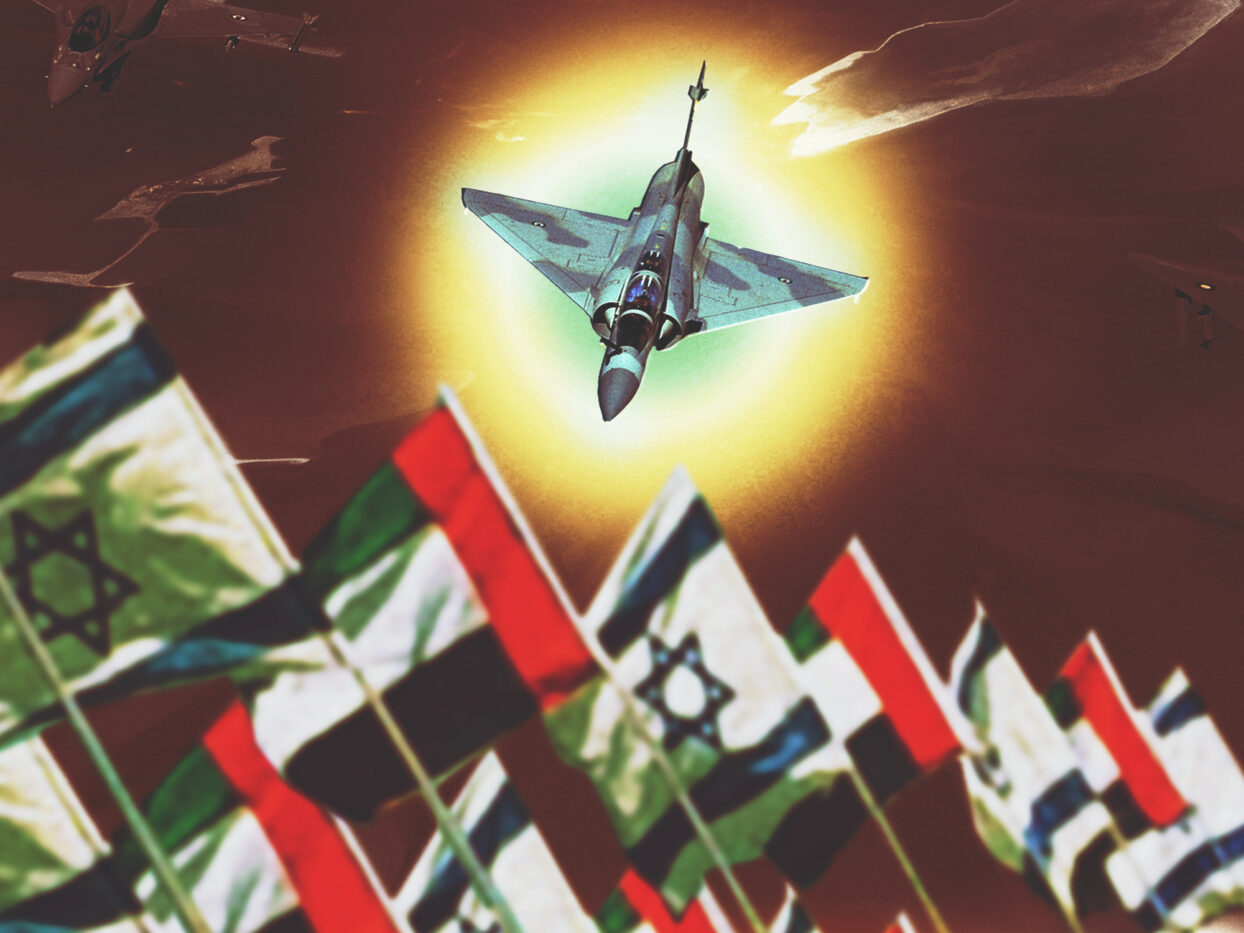
On May 4, the United Arab Emirates’s Ministry of Foreign Affairs issued a condemnation of recent Iranian strikes on Emirati territory. The UAE “will not tolerate any threat to its security and sovereignty under any circumstances,” the Ministry promised, and “it reserves its full and legitimate right to respond to these unprovoked attacks.” The communiqué came less than a month after the UAE’s air force had partially disabled, via airstrike, the oil refinery on Lavan, an island in the Persian Gulf and one of Iran’s major oil export terminals. An Iranian media report had initially pinned the attack, which took place only hours after the U.S. and Iran had declared a ceasefire on April 8, on the Emiratis. The Wall Street Journal corroborated that account in mid-May, but the UAE’s Ministry of Foreign Affairs has thus far declined to comment directly on the strike. It was an attempt at deniability that mirrored those regularly deployed by another adversary of Iran: the State of Israel. In 2020, after news broke of a mysterious fire at the Natanz nuclear facility in Iran’s Isfahan province, then-Israeli Defense Minister Benny Gantz remarked that “a nuclear Iran is a threat to the world and the region, as well as a threat to Israel.” He continued: “We will do everything possible to prevent Iran from spreading terrorism and weapons, but I do not refer to any individual event.”
Since Trump launched his war against Iran, the country has struck American assets throughout the region. No Arab state hosting those bases has done as much to retaliate as the UAE, whose air force has not only bombed critical energy infrastructure inside Iran but has done so with Israeli coordination. Early in the war, Abu Dhabi was by far the most vocal proponent, outside of Tel Aviv and Washington, of immense military pressure on Iran. UAE diplomats argued about a month into the conflict that a ceasefire would not be enough to curb Iran’s threat to the region; instead, Iran’s military capabilities needed to be crushed. Such overt aggression has marked a sharp change, at least in public, from the national image the UAE has long tried to broadcast on the international stage: one of stability, levelheadedness, and forward-thinking strategy.
According to The Wall Street Journal, the U.S. “has quietly welcomed the participation of the UAE.” So has Israel; per the recently deceased U.S. Senator Lindsey Graham in February, Israeli Prime Minister Benjamin Netanyahu considers the UAE a “stalwart partner.” Other Arab countries have taken notice. “This war has revealed in a cartoonish manner that the UAE serves as Israel’s claw,” former Tunisian president Moncef Marzouki remarked on Egyptian opposition television on May 12. “For me there are two Israels: western Israel, whose capital is Tel Aviv, and eastern Israel, whose capital is Abu Dhabi.”
Marzouki is undoubtedly correct in some respects: like Israel, the UAE has welcomed foreign capital and rapidly developed its economy while signaling its willingness to serve as an outpost of American empire. But relative to Israel, the UAE does not have a strong American lobby ensuring its protection; nor does it receive unlimited military support from the United States. When the UAE is hit by Iran, it’s rarely front-page news in American papers, let alone an automatic trigger for military action.
For decades, the UAE has tried to have it both ways, reaping the benefits of friendliness with the West while still maintaining the appearance of solidarity with its fellow Arab countries — and with the Palestinian cause. The result has been a skyrocketing GDP, the ascendancy of Dubai and Abu Dhabi as global commercial centers, and a state-of-the-art air force. But as the ceasefire with Iran has burnt to a cinder, and the effects of the October 7 attacks continue to reverberate, the country’s schizophrenic strategy has become increasingly untenable.
When the Abraham Accords were signed in September 2020, American officials and Western think tankers heralded the agreement to normalize relations between Israel, Bahrain, and the UAE as a massive step toward peace in the region. But it was hardly a sudden move for the Emiratis. In many ways, the Accords only brought their government’s covert cooperation with Israel out from behind the veil of rhetorical opposition. Since the UAE’s founding, even while it claimed to oppose Israel and its deeds, the two states had worked together frequently.
The UAE gained independence from Britain in 1971; that year, its first president, Zayed bin Sultan al Nahyan, told the Egyptian newspaper Akhbar al-Youm that “no Arab country is safe from the perils of the battle with Zionism unless it plays its role and bears its responsibilities in confronting the Israeli enemy.” The UAE signed onto the Arab League boycott of Israel in 1972, agreeing, alongside its Gulf Arab neighbors, to prohibit any business dealings with Israeli citizens, companies, or government bodies, as well as companies that did business in Israel. The leaders of the seven emirates that make up the country, though, did not send their troops to fight in the wars against Israel that would play out over the course of the seventies. When Egypt and Syria attempted to take back the Sinai and the Golan Heights from Israeli occupation in 1973, Zayed bolstered the effort with more than a hundred million dollars. The UAE also participated in the oil embargo against the U.S. and other countries that had supported Israel, with Zayed swearing that “Arab oil can never be dearer than Arab blood.” Traveling to Damascus after the war’s close, he praised the Syrians as having “preserved the dignity of the Arab nation through their sacrifices.”
Despite Zayed’s money and words, his country would forge a clandestine relationship with Israel under his leadership. The Israeli journalist Yossi Melman claims that intelligence links between the Emirates and Israel date back to the seventies. These connections eventually turned into business relationships; Melman told The Washington Post in 2020 that, especially since the mid-nineties, there has been a “revolving door” between Emirati corporations and Mossad, with former Israeli intelligence officials going “into security businesses that found ways of selling goods and services to the Emirates and creating some of the first and most important commercial ties between the countries.” In 1994, the Gulf Cooperation Council withdrew from the terms of the Arab League boycott — never scrupulously enforced — that required its members to avoid dealings with any companies that did business in Israel, and over time, the connection between the UAE and Israel continued to grow, largely through private forces.
By 1994, relations between Israel and the UAE were so comfortable that when the U.S. consulted with Israel about whether to allow the Emiratis to buy eighty American-made F-16 fighter jets, Prime Minister Yitzhak Rabin did not object. One of the Israeli diplomats involved, Jeremy Issacharoff, later wrote that he supported the arrangement because the “overlap of regional interests between UAE and Israel was significant.” According to a 2018 piece in the New Yorker, a senior Emirati leader who privately met with leaders of the American Jewish community over the sale of the jets went further behind closed doors than any Arab official was willing to go in public. “I can envision us being in the trenches with Israel fighting against Iran,” the leader reportedly said.
Indeed, the UAE had long sought to cultivate whatever allies it could find in its inchoate conflict with Iran. After overthrowing the American-backed Shah in 1979, the leaders of the Iranian revolution began to support Shia opposition groups throughout the region. The new anti-monarchical Islamic Republic was not only antagonistic to the old regime in Tehran, but also more than willing to cast aspersions on the royals who inhabited the palaces of Riyadh, Manama, and Abu Dhabi. After successfully sparking a popular rebellion against the ruling dynasty at home, the new government of Iran hoped to inspire similar efforts in the Arab countries. This threat weighed heavily on Zayed, who had recently put down a Nasserist coup led by the deposed leader of the Emirate of Sharjah.
When Saddam Hussein invaded Iran just over a year and half after the revolution, the UAE sent between two and four billion dollars into his coffers, far outstripping the amount of money it spent to support the Arabs fighting Israel in the 1970s. Though some of the emirates, including Dubai, had close economic ties to Iran, the Abu Dhabi-led government gave Iraq millions in loans and even allegedly allowed Iraqi military helicopters to secretly take off from the port city of Ras Al Khaimah to attack Iranian territory. But Iran’s government did not fall, and by the 1990s, it remained deeply antagonistic to American influence in the region — an influence the UAE was increasingly interested in courting.
In 1990 the UAE invited U.S. forces to use Emirati air bases, and during the Gulf War that year, it even contributed its own soldiers to the U.S.-led effort to free Kuwait from occupation by Iraq, the very same state it had once given billions to support against Iran. Throughout the 1990s, American companies flocked to the Emirates, with McKinsey and Microsoft setting up Dubai offices in 1999 and 2001, respectively, the latter year seeing IBM launch the Middle East’s first data center in Dubai’s “Internet City” special economic zone. As the UAE positioned itself as a regional business hub, gigantic cities sprang up in what were once the pearl-trading backwaters of Abu Dhabi and Dubai, with plans to build the world’s tallest buildings and largest malls. The UAE became a global powerhouse, and for a while, it appeared poised for full acceptance as a U.S. vassal state. But, as the UAE would soon learn, there was still something holding it back, despite its extraordinary overtures to the West: its Arabness.
In 2005, Dubai Ports World, the Emirates’s state-owned maritime logistics company, sought a takeover of a British logistics firm. Such a consolidation would have placed the Emirati company in the position of managing major ports in the U.S., including a terminal in New Jersey. Despite President Bush’s approval of the plan, much of Congress objected on the grounds that an Emirati megacorporation posed an obvious threat to the homeland. Senator Richard Shelby claimed that even though Dubai was an American ally, any company from a region where “support for Al Qaeda is very strong” warranted suspicion. “We must remain particularly vigilant about young male Arab nationals as potential terrorists,” former Defense Department official Frank Gaffney Jr. said in his submitted testimony to the House Armed Services Committee. “It makes no sense to provide legitimate grounds for such individuals to be in and around some of this country’s most important strategic assets.” In the end, the House of Representatives voted to block the deal.
According to King’s College London security expert Andreas Krieg, the saga marked a turning point in the UAE’s conception of itself: “it showed the Emiratis that they were being perceived as just another Muslim — or just another Middle Eastern — country,” despite their financial might. In response, the UAE began to project a sense of what has been called “Emirati exceptionalism.” Over time, the UAE would shed any remaining pan-Arab solidarity in favor of positioning itself as an American ally. “The UAE is the only Arab country to participate in six coalition actions with the U.S. since the First Gulf War,” a 2015 security report by the U.S.-UAE Business Council noted. The country even bombed another Arab state as part of a NATO attack, a first in Emirati history, when it participated in the U.S.-led intervention in Libya in 2011. Throughout the 2010s, the contingent of U.S. soldiers who were stationed at Emirati bases grew to the thousands.
The UAE’s collaboration with Israel also deepened, though more gradually. By 2011, the UAE was having secret meetings with the Israelis and White House officials in American hotel rooms. That year, it spent hundreds of millions of dollars in a deal with a former Israeli intelligence agent to set up a national surveillance system called Falcon Eye. In 2015, the UAE stopped refusing entry to travelers with Israeli stamps on their passports, and allowed Israel to establish a mission at the International Renewable Energy Agency, based in Abu Dhabi. The following year, the Emirati and Israeli air forces participated in joint training exercises in the U.S. and Europe, alongside a host of other nations. At the time, a senior officer in the Emirati Air Force told the press that the U.S. was like the “big brother” of Israel and the UAE, mediating their differences.
The UAE’s desire to follow Israel’s lead, both by thoroughly ingratiating itself to the United States and by becoming a technological and economic innovation hub, was obvious. But as Iran gained strength and Saudi Arabia’s shadow grew, Israel’s military doctrine — its ability to strike other countries unilaterally at great distances and use of the rhetoric of “defense” to subjugate other states in the region — was also increasingly attractive to the Emiratis. The UAE introduced conscription in 2014, seeking to mobilize its citizens and build up its defenses for the wars that were sure to come. In 2017, a Center for Strategic and International Studies report funded by the UAE’s embassy in Washington determined that, as the nation built up its new national service program, it should learn from the ways in which Israel had mobilized its citizens and built a collective identity.
It took a new spat between the two countries to move normalization from de facto to de jure. When Netanyahu proposed annexing the West Bank in June 2020, Emirati Ambassador to the United States Yousef al Otaiba took to the pages of Yedioth Ahronoth, a right-wing Israeli newspaper, to write a Hebrew-language op-ed. “Annexation,” he explained, would “harden Arab views of Israel just when Emirati initiatives have been opening the space for cultural exchange and broader understanding of Israel and Judaism.” Touting the construction of a new complex featuring a mosque, a synagogue, and a church, and the launch of a kosher caterer in Dubai, he urged the deepening of relations: “In the UAE and across much of the Arab world, we would like to believe Israel is an opportunity, not an enemy.” Two months later, Trump announced that the UAE and Israel would sign a normalization deal. Bahrain, a small island monarchy with diminishing oil reserves that also considered Tehran an existential threat, followed its more powerful neighbor’s lead; in September 2020, the Abraham Accords were signed, and the UAE and Bahrain became the first Arab countries to formally normalize relations with Israel in a quarter of a century.
The Accords signaled a desire for active partnership, one which the UAE insisted, implausibly, would include the taming of Israeli expansionism. Emirati Minister of State for Foreign Affairs Anwar Gargash, arguing that the UAE was acting in the interests of not only the Arab states but the Palestinians as well, described the Accords as a “death blow” to Israel’s hopes of annexing more territory. But the agreement represented only a temporary halt to the country’s land grabs. In practice, the deal signaled to Palestinians that whatever diplomatic support from the Arab world they still had was being blown into the wind.
The Abraham Accords unleashed a bonanza of military investment, technological trade deals, and open and unabashed displays of alliance. The UAE began to express a greater ideological alignment with Israel than any other Arab state had ever shown. For the first time in an Arab capital, Yom HaZikaron, a commemoration of “fallen soldiers and victims of terror,” was observed; the Israeli ambassador to the UAE said in a speech that even in Abu Dhabi, Israelis “bow our heads and we honor those whose deaths have allowed us to live.” In 2023, just months before the October 7 attacks, the Israeli Embassy held an Independence Day celebration at its new embassy in Abu Dhabi. Hundreds of attendees, including UAE officials, watched as an Emirati and an Israeli singer proudly belted out a duet of “Hatikvah,” the Israeli national anthem. The event marked a departure from the tone of the early 2000s, when blood drives and community events were held throughout the UAE to commemorate the Palestinian Nakba.
While Hamas condemned the Emiratis as “Arab Zionists” for their normalization deal, the U.S. and Israel saw the UAE as a potential model for the rest of the Arab and Islamic world. Morocco joined the Accords in December 2020, and Sudan also agreed to sign, though the latter’s ratification of the treaty has been prevented by civil war. There were signals that Saudi Arabia, too, might join in, if not under the banner of the Accords, then through another normalization deal. If the Palestinians sat by while more of their erstwhile defenders established friendly political and economic relations with Israel, the hope for a Palestinian state would enter its darkest stage yet. After the attacks of October 7, senior Hamas official Ghazi Hamad told Time magazine, “Israel thinks it can make peace with anyone, it can make normalization with any country, it can oppress the Palestinians, so we decided to shock the Israelis in order to wake up others.”
When Hamas launched what it called the “Al Aqsa Flood” against Israel, news outlets owned by Emirati royals were quick to accuse Hamas of “nihilism,” claiming that its actions lacked strategic purpose. Throughout the genocide Israel has carried out in retribution for the attacks, the UAE has held its line. In February 2025, Gargash blamed Hamas for instigation. “The resulting war that destroyed the Strip and tore apart its human and social fabric is a result of their decisions,” he said. A 2025 op-ed in the Emirati newspaper The National declared that “Hamas betrayed Palestinians both during its rise and then during its downfall, as its hollow ideology and destructive tactics brought death, hunger, and ruin to Gaza.”
In seeking the blessing of Israeli and American money, the UAE has adopted Western talking points about the nature of Palestinian resistance. When plans emerged from the Trump administration for a “Gaza Riviera,” the UAE barely seemed to object, maintaining that they did not “see an alternative to what’s being proposed.” This January, when many Gulf states responded to Trump’s rumblings of war with Iran by exerting heavy diplomatic pressure in the opposing direction, the UAE was nowhere to be found. It knew what was coming, and it wanted to be on the winning side.
The UAE’s participation in the war with Iran constitutes one of the closest instances of military coordination between Israel and an Arab state in history. Soon after the U.S. dropped the war’s first bombs on February 28, the IDF sent Iron Dome batteries to the UAE, along with soldiers to operate them. According to Bloomberg, on May 6 the Emirates and Israel conducted joint strikes on Iran’s largest petrochemical facility in the coastal city of Asaluyeh. Mossad director David Barnea reportedly visited the UAE multiple times in the spring, sharing intelligence and collaborating on the selection of targets. In March, Emirati President Mohamed bin Zayed al Nahyan tried to bring Gulf states together to create a coalition against Iran, but they all refused: Israel was the UAE’s only stalwart ally. “We need a conclusive outcome that addresses Iran’s full range of threats: nuclear capabilities, missiles, drones, terror proxies, and blockades of international sea lanes,” al Otaiba, the Emirati ambassador to the United States, wrote in The Wall Street Journal on March 25. “Forty miles away, the UAE stands on the front line of this conflict.”
The UAE’s closeness with Israel and the U.S. has been rewarded by Iran launching the majority of its counterstrikes in the first phase of the war against American assets on Emirati soil — more than were sent to Bahrain, Kuwait, and Qatar, all of which host critical bases. In August, Iran struck multiple Emirati ships attempting to pass through the Strait of Hormuz. “We knew we would be Iran’s first choice of targets,” Ambassador al Otaiba continued in his March op-ed for The Wall Street Journal, because “the UAE is a modern, progressive, prosperous Muslim society that delivers for its people.” He made tired exceptionalist arguments, noting that people in the UAE “empower women and welcome all faiths.” This rhetoric is not meant solely to separate the UAE from its Arab peers, implying that its neighbors are backward in comparison; it also sounds a lot like how the alleged “only democracy in the Middle East” describes itself.
Yet it has been difficult to emulate the national cohesion forged by Israel’s military in a country where, at least according to 2021 estimates, less than one percent of the population serves. (Only about 12 percent of the population are even citizens; the other 88 are expatriates, guest workers, or stateless.) The very idea of Emirati national pride is seen as something of a novelty even by the UAE’s officials. The UAE’s residents, despite the government’s tight embrace of Israel since the Abraham Accords and throughout the current war, have largely soured on normalization since the Accords. In late 2020, 47 percent of the UAE’s population supported the Accords; by 2022, it was only 25 percent. The war against Gaza has only exacerbated this societal frustration: in 2024, the Israeli rabbi Zvi Kogan, a representative of Chabad in Abu Dhabi, was kidnapped in Dubai and murdered.
As the war stretches on, the UAE finds itself in a difficult strategic position. For all its obedience to the United States, the country has received little protection in return. According to The Telegraph, the U.S. has encouraged the UAE to seize the Iranian island the UAE bombed on April 8. But would the U.S. commit its own resources to the effort? Not a chance. Nor is the UAE strong enough to beat Iran by itself. Iran’s military has over ten times the number of ground troops that the UAE’s does, to say nothing of its thousands of ballistic missiles and drones. And the UAE can hardly look to its neighbors for help. At the end of April, Gargash criticized the “weak stance” of both the Arab League and his fellow Gulf states on Iran; the next day, the UAE announced it would leave OPEC.
Throughout the monthlong ceasefire that ended in July, Iran was unable to strike Israel with regularity and instead struck Emirati economic infrastructure, like its crucial oil port in Fujairah. The UAE could do little to stop it. U.S. Chairman of the Joint Chiefs of Staff Dan Caine, when questioned on May 5 about the rash of strikes that not only included the attack on Fujairah but those on American naval vessels as well, said that the actions were “below the threshold” to restart the war. When war did restart in July, the Emirati Ministry of Foreign Affairs implored all parties to instate “an immediate halt to the escalation and to avoid exacerbating tensions.” But American airstrikes on Iran have continued, and the UAE has continued to encourage other Arab countries to take action against Iran, sending intelligence to Kuwait and Bahrain to aid the latter countries’ own strikes on Iranian territory.
As much as the UAE would like to be an “Eastern Israel,” there can only be one Israel in the American foreign policy imagination — one that, to paraphrase Joe Biden, would have to be created if it didn’t already exist. The United Arab Emirates cannot shed its history and its nature, no matter how hard it tries. It is an Arab nation, and Arabs, in the Western political calculus, are profitable at best, disposable at worst. “We have defanged Iran,” Senator Roger Marshall told CNN in July, after the UAE had been struck more than 2,800 times. “Now it’s their turn to go in and finish the job that they need to finish.”