

The Bad Patient

In July of 2022, a woman we’ll call F. logged onto Instagram and posted a selfie from the hospital. “Just been told I’m on life support for my blood pressure,” she wrote, tagging the post with various medical terms and conditions: #gastroparesis, #addisonsdisease, #pancreatitis, #fullbowelobstruction, and even #lifesupport. Three days later, she said she was out of the I.C.U. but still struggling. By September, she was dead. 

A scroll through F.’s Instagram profile reveals a mix of selfies, dog pictures, and inspirational quotes. She was alternately crushed and defiant. “Chronic pancreatitis you have taken so much from me these last months and there have been moments that I have no longer wanted to live but I will be not let you win even with pain and tears in my eyes I still want my life,” she wrote in April 2022. A few days later, she had taken a turn for the worse: “I really don’t know how much longer I can hold on anymore.” Like a lot of sick people, she apparently used Instagram as a way of connecting with others in her situation, building a virtual community of fellow sufferers who commented things like “stay strong” and offered their prayers. 

F. had become a subject on another virtual community, the subreddit r/illnessfakers, which also includes many chronically ill users (or so they claim), but is dedicated to unmasking the supposedly sick for “lying, feigning or exaggerating illnesses and medical crises for attention and/or profit.” Months before her death, she had become one of the group’s subjects. “She’s doing all this to her self,” went one authoritative declaration. “She was never in ICU on life support. That’s just her fantasy.” In a different thread, another user snarked, “For someone who is really suffering 24/7, she really takes the time to add a lot of hashtags. She should have added #INeedAttention.” When F. died, they appeared unfazed. “She was genuinely striving to be the sooper sick, but she did it to herself,” a user wrote. “Unfortunately this girl met an end that she designed.”

Like the TikTok and Instagram influencers they despise, the users of r/illnessfakers seek to raise awareness of what they consider to be a dangerous, underdiagnosed disease: factitious disorder, more popularly known as Munchausen’s syndrome, or, in the subredditors’ lingo, munching. They believe we live in the age of Munchausen’s: people are willing, quite literally, to die for attention, and all that stands between them and their goal is a brave crew of vigilante detectives. These amateur investigators style themselves as scientists, policemen, and doctors all in one. And they believe — or they claim, or they claim to believe — that they are, sincerely, here to help.

Let’s be clear: F. was, as far as I know, a real person, who was really sick, and who really died. I have no reason to believe she was at any time a fraud, and I do not believe that she was. Though I have read many forum posts promising that evidence of her depravity was behind the next hyperlink, all she ever seemed to do was post online about being in pain.

Even outside forums for obsessives, most of us want to believe there’s a bright line between the really sick and the fake sick, between the sincere expression of suffering and the over-the-top, between the patient in need and the attention seeker. But I am not so sure that such a line exists. I am “really sick” — not that I intend to provide a doctor’s note; you’ll just have to trust me — and the sicker I have become, the more one thing has become clear to me: every sick person is, in some way, an illness faker.


Once upon a time — it was 2019 — I did not feel well. I didn’t know why. About once a month, I experienced extreme pain that I could mostly relieve only by forcing myself to throw up. I saw my doctor. I saw a gastroenterologist. I told him, truthfully, that when I was sick, I felt like I was being snapped in half. My primary care doctor had me cut out dairy and gluten; the gastroenterologist had me try a low-FODMAP diet, which prohibits, among other things, onions. I had a colonoscopy. I tried intermittent fasting and four different medications. Things would help for a little bit, and then they would stop helping. All the tests came back normal. 

Eventually, I received a diagnosis: irritable bowel syndrome. I knew enough to know that this meant I was being written off. Though my doctor was willing to run other tests if I wanted him to, as far as his own ideas went, he had hit a dead end. IBS is what’s known as a “functional” disorder, in which nothing can be detected on standard tests like MRIs and blood work, even though the patient displays clear and consistent distress. (Other functional disorders include fibromyalgia and chronic fatigue syndrome.) 

Another way of putting it is that functional disorders tend to be popularly regarded as — well — fake. Chronic fatigue has been nicknamed “yuppie flu” for a reason. If doctors can’t find a problem, the reasoning goes, then there probably isn’t one. And the line between a “functional disorder” and the simply psychosomatic is thin. In her book on treating people with such disorders, It’s All In Your Head, neurologist Suzanne O’Sullivan notes that IBS is considered by some “a disorder of perception.” Sufferers might be “overly observant of every internal sensation and change in their bowel motions.” By perceiving their symptoms, they conjure them into being. “They are reacting to symptoms that others might dismiss, and those reactions serve to heighten the symptoms and awareness of them,” she writes.

Here’s the thing: that my problem might be psychosomatic made sense. If you’d asked me what my big fear was, I would have said I was afraid my doctor would stop believing me. But the truth is, as the evidence that I was just fine piled up, I had stopped believing me. Even when I found myself curled up on my bathroom floor, I was still wondering if this was real, or a kind of tantrum I was throwing at myself. I had nagging questions: didn’t I drink too much? Wasn’t my diet subpar? And didn’t these episodes, if I was honest, occur suspiciously close to big events (a flight home for Christmas, a deadline, moving day)? I didn’t learn to ask myself these questions from browsing subreddits like r/illnessfakers. They seemed inherent in my position. I discovered the subreddit in the first place because I was searching reddit for gut disorders I should get tested for — which is, incidentally, classic faker behavior. 

When told that there are forums where people accuse complete strangers of lying about their suffering, a normal person — I have found — reacts with disgust. What kind of vicious losers spend their time like this? (Follow-up question: by the way, why are you spending your time like this?) But though its language is offensive, the sentiment expressed on r/illnessfakers isn’t so out of the ordinary. It’s rare to accuse people of outright lying about their health, but believing that they are telling the truth (to others or to themselves) is another matter. 

In recent years, mysterious, chronic ailments — chronic Lyme, chronic fatigue, fibromyalgia, and a whole host of auto-immune diseases — have become household names. Hot girls have IBS (or so the meme goes), and singers as varied as Lady Gaga, Selena Gomez, and Shania Twain are open about their struggles with chronic illness. As the visibility of these sicknesses has seemed to increase, so too has popular skepticism — ranging from casual dismissal to outright denial. In The Atlantic, Helen Lewis diagnosed a Tourette’s-esque set of symptoms commonly posted about by teens on TikTok as a “mass psychogenic illness” spreading through the platform. Over on the Substack Common Sense (now the website The Free Press), Suzy Weiss wrote a much-shared piece about chronically ill posters called “spoonies,” who, she felt, seemed to revel in being sick and encourage one another to get sicker. 

The rise of long Covid has fueled yet more skepticism. An article by Jeff Wise for New York Magazine recommending that long Covid be treated through cognitive behavioral therapy and exercise was widely interpreted as casting doubt on the newly minted chronically ill. In a controversial essay for The New Republic, “We Might Have Long Covid All Wrong,” Natalie Shure argued that the illness should be understood as a kind of functional disorder: “A chronic illness that appeared to be triggered by viral infection could just as easily have been triggered by the trauma of the pandemic itself.” Cool and compassionate, Shure sounds like somebody who really does want to help you, if only you could understand what the problem really is. 

Shure’s piece is emblematic of a broader, more progressive, more compassionate approach to calling the reality of illness into question: no moral blame is assigned, and great pains are taken to point out that just because something’s “in your head” doesn’t mean it isn’t real. It’s just that all the things you might have considered signs of your conscientiousness — tracking your symptoms, monitoring your diet, finding other patients for mutual support — were actually ways of feeding your disease.

To other people, this line of argument might sound very familiar, something almost worse than simply not being believed. It’s the tone of a doctor who starts to ask you questions you already recognize as the diagnostic criteria for depression or anxiety. The doctor isn’t dismissive. He (or she) believes you feel all the things you feel. You just don’t understand those feelings. And as you insist on your version of events, you feel increasingly conscious of how much more convincing the doctor’s story is. The weird truth is that I still find the psychosomatic explanation of my own troubles vastly more satisfying than what my illness turned out to be. It provides a bad guy: me.


Illness is a matter of testimony. You tell somebody else — generally, somebody who has more degrees than you — how you feel, and they, ideally, have the ability to recognize in your testimony something you lack the expertise to identify. And often the body itself testifies: a doctor runs a scan or tests your blood and gets an answer. You have information, and the doctors have understanding. But this dynamic, in practice, is rarely so simple. Illness is also a social negotiation between what you have to say and what your doctor is willing to hear — and the diagnosis that results from this dynamic isn’t exactly your illness, but a mutually agreed-upon fiction. 

As the only person in a position to testify about how he or she feels, the patient is the victim, neutral witness, and scene of the crime. Which role to play and when and how, what to emphasize and what to downplay — these are all decisions with real consequences. Something I’ve been amused to note, when reading through my own medical records, is that whenever I’ve answered “no” to a doctor’s question, what’s been written down is “patient denies.” This is understandable — people lie, or misunderstand a question, or remember something later — but it makes clear that a patient’s testimony is always somewhat suspect.

Sitting and talking to a doctor, a patient might make a point of maintaining a calm affect, downplaying or dismissing symptoms, just to get the feeling of being on the same team as the doctor: Yeah, I don’t trust her either — that whiner. This behavior is the instinctual and rational response to somebody who has a lot of power to help or hurt. Patients establish that they are — or can be — good, rational, and believable. Divided internally, the sick person gangs up on an imagined, pathetic version of himself: the bad patient. But the bad patient is also the one who is sick: he carries all the stigma and the suffering. It’s this bifurcation, the way in which sick people must learn to manipulate doctors, that makes them fakers — even of illnesses they legitimately have.

Overcoming the bad patient isn’t as simple a process as disowning your internal self-hatred. Patients are manipulative for very good reasons, particularly when it comes to things like pain, where the treatment is heavily rationed and stigmatized. Women are more likely to get written off as attention-seeking than men; black people are more likely to be neglected than white people. The ubiquitous pain scale (from one to ten) is understood to be subjective — sort of. The practical fact is that patients have to figure out not what these numbers mean in their own experience, but what the numbers mean to their doctors and nurses. Even on r/illnessfakers, users recognize that from time to time it’s necessary to manage doctors. On one thread, several posters confessed that they, too, had sometimes been guilty of faking — or of being “OTT” (over the top), playing up legitimate symptoms. One vented, “Like I know I have to say I’m a 6 on the pain scale when I’m actually a 4 because you’re gonna send me home to die.” She went on: “I can’t tell you when I’m genuinely an 8 because now you think I’m drug seeking even though the opioid epidemic completely skipped Black people because y’all refused to prescribe us pain meds when we actually needed them.”

This admission, and others like it, were met with surprising levels of sympathy. “It can be rough finding the line between dealing with something difficult and being OTT at the end of the day,” another user commented elsewhere. “Most medical ‘professionals’ assume everyone there is faking,” a user lamented in a more recent thread, apparently without a sense of irony. “It’s awful.” In a third thread, another user, who claimed to be a nurse, demonstrated the veracity of this claim. She wrote that whenever a patient who seemed “totally settled” reported high pain scores, her “favourite thing” was to respond, “Oh okay, so if a limb was cut off you wouldn’t be in worse pain?”

The distrust built into the exam-room dynamic is something neither patient nor doctor can ignore. Like the user who had to tweak her pain scores, many sick people have to be a little bit of a bad patient and good patient at the same time — a squeaky wheel. “I’m just so tired of always feeling like a criminal when I go to the doctor,” the poster wrote, “and it’s hard for me to reconcile that my OTTness was my way of navigating this system, but I just straight up feel like a liar.”

As for me, I went on as I was until the spring of 2022. I had stretches where it seemed like I was completely fine. I put my experiences down to the mysteries of the human body. Then I went to a party, and by the time I got back, I was feeling miserable again. Once that week I tried to walk to my street corner, only to turn around, dizzy and sick. I started to plan days around not eating. One night in June, when the pain was extreme, when I kept on vomiting, I called an ambulance.

I learned what was wrong with me — something neither functional nor mysterious. I had gallstones, a very common ailment, easily dealt with by simply removing the gallbladder. This is probably what I had been suffering from all along, though nobody ever said the word “gallstones” to me that I can recall, nor do I remember it showing up as a possibility in any of my online diagnosis-hunting expeditions. In any case, gallstones were no longer my biggest problem. Without treatment, I had developed necrotizing pancreatitis, which was much more serious: parts of my pancreas were dying.

Suddenly, it didn’t matter how I felt about things. In fact, none of it had ever mattered: the self-doubt, the dieting, the medicines, the supplements, going to the doctor. It had all amounted to kicking the can down the road. A weekend hospital stay stretched out to a week, then to two. My prognosis was unclear.

Since then, I’ve sometimes had a weird wish: that I’d recorded my own voice at the time, just to know what being in that much pain sounds like. It’s with a similar interest that I’ve since read the notes from the doctor who first examined me in the E.R., a person I can’t remember speaking to, who wrote that my mood was normal, my pain moderate, and that I was not “ill-appearing.” This version of me in crisis: what did she look and sound like? Was she so good at being good, at looking reasonable to a doctor, that, even then, she seemed fine?

This was how I found F., incidentally: because she had pancreatitis, too. As I continued to go in and out of the hospital thanks to further complications, she was dying. I didn’t know any of that until later. When I read her Instagram posts now, knowing how it feels, they strike me as very brave.


In recent years, a burgeoning group of memoirists, influencers, and ordinary posters on one platform or another have taken up the task of testimony. There is now a tall bookshelf and an endless feed of content meant to educate the general public on what it is like to have a chronic, often unrecognized disease. In the course of writing this essay, I have read memoirs about either having or observing Crohn’s, extreme sensitivity to light, epilepsy, pancreatitis, mold toxicity, chronic fatigue disorder, chronic inflammatory demyelinating polyneuropathy, chronic Lyme, Morgellons, and even Munchausen’s itself. At this point, I am familiar with their often identical narrative beats: the promising young life, the hidden danger, the precipitous decline. The rapid exhaustion of mainstream medical resources, the turn to community support. There are many ways to be healthy, just one way to be sick.

Sometimes an illness memoir is a way of arguing for the legitimacy of an entire disease. Morgellons, a condition recognized as legitimate by basically nobody, sits uneasily next to the not-legit-but-more-legit diagnoses of chronic Lyme and mold toxicity, which are popular in alternative medicine without having official mainstream recognition. These memoirs strive to counteract the disbelief of individual doctors by appealing to a wider audience: surely all this suffering couldn’t be a normal life of feeling tired, could it?

Most of these books are written by good patients. But all of them worry about how they might find themselves demoted to crank. In her best-selling 2021 memoir The Invisible Kingdom, writer Meghan O’Rourke recounts her fear of becoming a “heartsink patient” who “seems to ask too much.” Among the things she learns not to do: list all her symptoms, mention having seen other doctors, or “show up prepared with prior medical records.” A doctor might feel like a detective, expertly and even kindly investigating the crime scene of your body, or they might seem like the irritated prosecutor, leaping on slips you hadn’t realized you’d made.

Like all witnesses, patients have their credibility assessed in the familiar ways: by gender, race, class. In The Deep Places, a memoir of chronic Lyme, New York Times columnist Ross Douthat acknowledges that his bona fides as an established, successful, conservative white man will get people to take him seriously. Sure, you associate the chronically ill with people like his mother, who spent his childhood going to “Pentecostalist healing services where people spoke in tongues” and “chiropractors and naturopaths and other purveyors of holistic medicine,” but it can happen to people like him, too.

O’Rourke and Douthat are lucky to ultimately find sympathetic doctors. Even if these doctors don’t necessarily think that chronic Lyme, say, is real, they believe in the suffering of the patients before them. But, as chronicles like Douthat’s and O’Rourke’s attest, sympathy is often all they have to offer. If you’re stuck in a gray area that leaves you incapacitated for no single reason, the very structure of medical science, in which specialists are divided from each other and don’t necessarily operate with a holistic understanding of your condition, can work against you. Patients, in turn, are often left looking for help from one another, which isn’t easy to do. You only have to dip a toe into the illness internet to learn that a lot of its members aren’t reliable. 

“I read online patient boards, hoping to learn something useful from my fellow patients, but I was put off by all the ridiculous treatments people discussed seriously,” science journalist Julie Rehmeyer writes in her memoir of mysterious illness Through the Shadowlands. “A woman wore magnets in her underwear to balance her hormones; a man was shining a red light up his nose; someone even contemplated drinking cow urine.” Entering this world — not to mention writing about it — requires a particularly delicate highwire act: conveying your real suffering but also your fundamental sanity. And, to some degree, your superiority over your fellow sufferers. As Douthat writes, “I tried to distinguish myself from those other sick people, more desperate than I was, who were trying truly crazy things while I was proceeding sensibly and moderately along the path to health.”

But ultimately, everybody tries something crazy. Rehmeyer, following advice from a particularly insane-seeming forum poster, ditches almost all her possessions and moves to Death Valley to see if she suffers from a sensitivity to mold. (It works.) Against the wishes of his wife, Douthat purchases a “Rife machine,” a device that supposedly uses electromagnetic frequencies to kill diseased cells. (It works, too.) O’Rourke describes trying out a potentially dangerous procedure called chelation, in which “a synthetic amino acid is injected into the body to help draw heavy metals out of the tissues.” (It makes her smell like garlic.) Rhetorically, these admissions convey the desperation of the writers’ situations, while stopping short of actively advocating for the treatments they underwent. As Douthat writes, “My descriptions of symptoms varied so much, the explanations of how the infection persisted sounded so baroque, my mood swings were so palpable and my desperation so intense as to make me seem the most unreliable of narrators where my own condition was concerned.”

Many of the memoirs I read acknowledge the difficulties and dishonesties inherent in the patient position, but acknowledgement is not the same as a way out. They contain sweeping, systemic indictments: everything is making you sick. The medical system that divides the body into fictional specialties, the food that’s ruining your gut biome, the stress of contemporary life, the mold you never knew was there. This depersonalizing of the subject matter is also a bid toward legitimacy: these writers are not asking the world to slow down and take note of their particular suffering; they are presenting themselves as symptoms of a larger disease, a sickness that threatens everyone. In the introduction to The Invisible Kingdom, O’Rourke argues that we are in “a silent epidemic of chronic illnesses that are often marginalized, contested, or even unrecognized.” She writes, “If every age has its representative signature disease, I contend that this type of chronic illness is ours.” 

Reading these books, I found myself wondering what would happen if their authors found themselves in a situation like mine: discovering that the roots of their troubles actually weren’t mysterious. What if they, too, were suddenly confronted with the possibility that nothing they had done mattered? O’Rourke notes that alternative medicine is “in thrall to one of the most powerful contemporary Western delusions,” that “we can control the outcomes of our lives, in this case through self-purification.” Yet, like so many things involving serious illness, this delusion can be recognized but not entirely shaken.


In his own memoir of chronic illness, Teach Us To Sit Still, the novelist Tim Parks remembers reading a medical booklet that described people with one of his conditions as “restless, worrisome, dissatisfied individuals who drag their miseries around from one doctor to the next in search of a cure they never find.” It cautions the doctor to “be careful not to let himself be demoralized by these people and their intractable pathologies.” 

By the time I read this, I had spent quite a lot of time in the hospital, and met patients who ran the misery gamut, from a cheery, laid-back grandmother to an angry woman who would start to call for the nurse the moment he turned his attention to somebody else, then abuse him when he came over. And so reading this induced an instant grimace of recognition — of myself, certainly a person now doomed to drag my miseries around, but also of how I had felt about everybody else.

Most of the staff who handled all these miseries were kind, and when I think about certain nurses, I feel gratitude so intense I want to cry. Yet I still feel resentful, too; I still feel angry. Shouldn’t somebody have to pay for this? Somebody other than me? I can see how I could follow that thread somewhere dark; how I could end up scrutinizing and mocking the people online who remind me what being sick looks like, how all the other bad patients out there might become impossible to tolerate, much less believe.

The would-be detectives of r/illnessfakers are right: sick people are annoying. They are annoying to be around and they are certainly annoying to be. The subreddit pounces on subjects who come off as manipulative, embittered, and attention-seeking. But all of these negative adjectives also describe a lot of truly sick people, who are likely to have adapted to needing to get things, being ignored, and being neglected. 

The glut of illness testimonies — the memoirs, the blogs, the TikToks — try to rescue all the bad patients by redeeming them: by showing how good they really are. One after another, they take the stand and present the evidence. See, they really do believe in science and avoid gluten and tell the truth. But one of the reasons witesses are coached on how to testify is that we judge truthfulness by many proxies, many of which may have nothing to do with the facts at all. People are backed into corners where the only way to communicate the truth may be to fudge the details: medicine is just one example. And people are also forced into circumstances where the real vagaries of their stories sound like lies, just as poorly localized pain or shifting symptoms make their victims sound dishonest.

In one sense, the good patients lie, maintaining the facade of normalcy and health, while the bad patients, by lashing out, tell the truth. The bad patients need the good patients to represent themselves — need the good patients’ sense of decorum, image, and control — but the good patients need the bad patients, too. The screamers, the whiners, the cranks. They blow their deadlines, flake on their friends, show up to events loudly explaining their food restrictions. They can’t go a minute without mentioning how sick they are. They make such a big deal out of everything, as if other people care. They’re sick without apologizing for it at every opportunity. I hate them, I envy them, and I wish that we could all, for a moment, let them — and me — be blissfully, totally annoying.
Customs / Psychological

CUSTOMS

Julio was halfway through a text to Deja when the guard scanning his passport ordered him to follow. It was a slow, excruciating text, typed into the phone bought for him after the mugging, a brick, eight bucks, courtesy of the Foundation, i.e., one blue-eyed program coordinator who had taken pity on him, him and Sadiya both — Do you need a new one, the coordinator said, come with me. Sadiya in her notebook on the lap of her gray dress took down the names of those who needed replacements, thirteen in all. Then she and Julio splintered from their peers and milkshakes at Doodles and got into the coordinator’s Etios, Julio the back left seat, beside a large box of water bottles bearing the Foundation’s logo — Sorry about that, the coordinator said, and Sadiya the front, straight ahead. He saw her jawline when she looked out the window at the beach, saw her eyes behind her glasses, the frames perfectly round, the eyes bigger when seen from that angle, bigger but somehow more private — You may feel nothing now, the coordinator said, muting the voice on the radio, which spoke of recent xenophobic attacks in Greenmarket Square, but don’t be surprised if in three months you find yourself suddenly crying. Julio imagined himself ambling through Riverside Park at sunset and wiping a tear from his face, found solace in that fantasy of release, how good it would feel to bathe beneath the showerhead of his victimhood — This is an annual ritual for me at this point, Sadiya said — I recommend therapy, the coordinator said — Been there, Sadiya said, healed that, got the invoice.

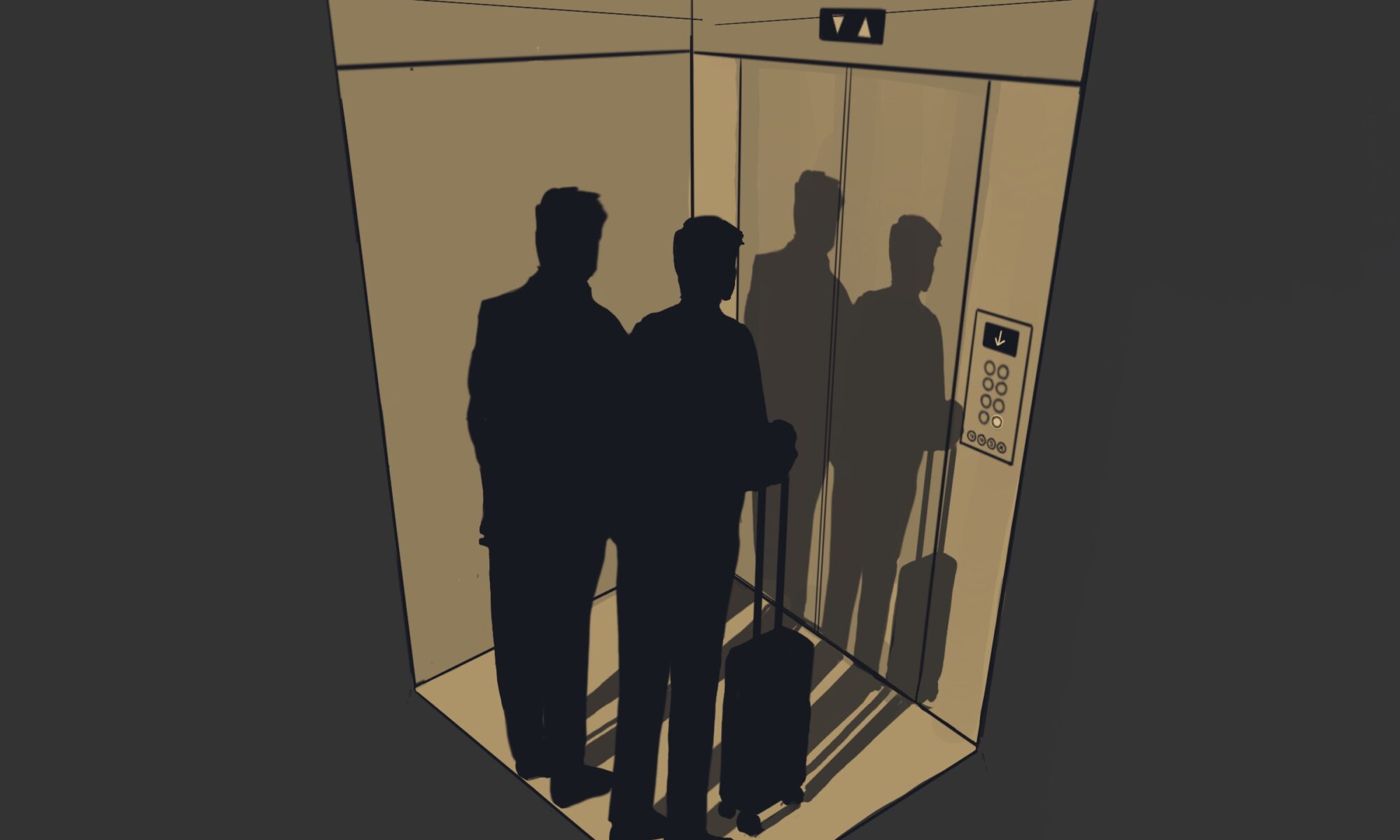
The customs guard stood and fixed his belt, frayed at the holes, and led Julio to the elevator, where he scanned his card and pressed what looked like a blank space beneath the lowest button — I’m sorry, said the guard as the doors touched, they’re looking for a guy with your face — What, Julio said — With your micro-expressive inclinations, said the guard, you know, your involuntary muscular responses. Julio sunk his thumb into the button of his suitcase handle, which was sticky — For what it’s worth, said the guard, I don’t think it’s you — Thanks, Julio said — Don’t thank me, said the guard, shrugging, chewing a piece of gum that Julio hadn’t seen him put in his mouth, I have no say in the matter. Julio released the handle — I understand, he said — And if I did, said the guard, almost to himself, well, who’s to know what I’d say, you see things otherwise when you’ve got skin in the game — You can say that again, Julio said — You see things otherwise when you’ve got skin in the game, said the guard, elbowing Julio with centripetal force in the ribcage, then cackling. Julio resisted the urge to clutch at his ribs and tried to reciprocate the laugh — Look, kid, it’s not you, said the guard, but they’ve got to make sure. Julio said nothing — Will you declare anything? asked the guard — No, Julio said, well, biltong — Bilwhat, said the guard — Beef jerky, Julio said — Might I have a look? — Right now? — At your earliest convenience. Julio drew from his backpack the yellow packet of biltong, which the guard removed from him, examined, tore open, dug his hand into, sniffed, and, apparently having swallowed his gum, ate of — Not bad, said the guard, not beef jerky — I compared it so you would have a sense, Julio said — Comparison is dangerous business, said the guard, and lying will get you in trouble — I’m sorry, Julio said — Do you feel better, said the guard, having apologized? — Not really, Julio said — Then why did you? — I don’t know. The guard laughed, and Julio felt his stomach turn on him though the screen above the buttons indicated no descent. He belched wet and deep, despite himself — Phew, said the guard — Sorry, Julio said — Now that apology was warranted, said the guard in a nasal register, pinching his nose. Julio held his fist to his mouth as if to cough into it, then let slip a loose gurgle from the bed of his gut — Release the kraken! said the guard, that Rigatoni-Nudeln mit Tomatenauberginensauce will do, hey — Ha ha, Julio said — I always say ulcers are caused not so much by what we eat, said the guard, as by what is eating us.

Deja was waiting in arrivals, or had promised to be, though Julio had told her she didn’t have to pick him up, of course she didn’t have to but she wanted to, it had been two months dude, she wanted to see him, unless he like actively didn’t want her to, no, of course he wanted her to, he just didn’t want her to feel pressure bc the nj transit is a schlep, I don’t feel pressure why would I feel pressure, idk lol boarding now tho noodle love u, safe flight bb see you in 15 hrs 45 mins please don’t die. It would have been easiest, dying. What other way out. He wrote her an email on the tray table, a letter to himself, really, that, once finished, or abandoned, like most of the others, he could not send, not that she would write back if he did — Yet I don’t want my letters to keep remaining unanswered, Freud wrote his fiancée, and I shall stop writing you altogether if you don’t write back — Are you scolding me with a Freud quote — Perpetual monologues apropos of a loved being, Freud wrote, which are neither corrected nor nourished by that being, lead to erroneous notions concerning mutual relations, and make us strangers to each other when we meet again, so that we find things different from what, without realizing it, we imagined. Julio wasn’t sure what he imagined, but it was probably erroneous — Dear Deja, is it possible to both apologize & explain oneself? — Dear Deja, I know you’ll ask me why I — Dear Deja, do you remember our last night together (of course you do, you remember everything) — Dear Deja, I still think of what you told me that last night before break, you pressed your ear to my chest, My fear is that people only pretend to like me, you said. Well, my fear in writing this is that once you read it you’ll think I’ve only pretended to like you too. The truth: he had pretended to like her, on occasion. Increasingly, perhaps. He loved her, though, loved her steadily, at least when they were together, not that he was entirely sure what that love was, or was worth. Whatever it was, it wasn’t a feeling, it was something you did, and therefore something you disciplined yourself into.

The elevator plunged. The guard nibbled at the biltong that clogged the distal edges of his nails — My girlfriend and I used to play a game, he said, the aim of which was to be the last person to press the button outside the lift before getting in, I prefer that word, lift, she used to mock me for saying it, she said I thought I was British, she was right, or rather, right she was! In any event I can hardly remember why or how the game began, let alone went on as long as it did, ditto the relationship, all I remember is that this game, the state of nature, as we called it, became a nasty, brutish compulsion that seized us any time we approached a lift, which in my case meant that I tried to distract what-was-her-name with a story, to press the call button with great nonchalance, so as to make her forget that we were playing in the first place — I don’t get it, Julio said — Look, said the guard, it’s not supposed to make any sense. Only after we had gotten in, only after the doors had closed, would I announce my victory, at which point, assuming we were alone, she’d flare her nostrils and open her mouth and let a high-pitched whisper-shriek sound from the back of her throat (the guard here demonstrated) soon swallowed by my laughter, which was diabolical, if rare, considering that she almost always won, especially as time wore on, she almost always pressed the call button last, and when the doors opened, she’d gesture for me to get in, and if I resisted, she’d push me in, and if I got in first but tried to sneak out after we’d both gotten in, she’d grab me by the crook of the elbow or block my exit or get out with me and await my re-entry. Sometimes, just to avoid losing, to the extent that such an action constitutes an avoidance of loss, I’d take the stairs, my heart racing, racing her to our floor. My sole hope of victory, as things were, was the presence of others, in front of whom I could perform the chivalric gesture of inviting her to get in first, not that she accepted such indications, agh, inclinations, no, oh this is our floor. 

The doors parted, now on the opposite side, and Julio saw that the guard had at some point turned around and left the elevator, which was closing, nor did the doors recoil when Julio wedged his American Tourister into the gap, but rather tightened their grip, so that a loud crack emanated from the hard shell of his suitcase, which wasn’t really his, but his father’s, on loan. The guard pried the doors open, leaving space for Julio to push the suitcase out and duck underneath the overpass of his savior’s armpits, which stunk — Welcome to the bowels of the airport, said the guard, it’s just had an enema. Julio followed him to a big gray room lined with dozens of seats — Someone will be with you shortly, said the guard, then left. In his absence the stench of fish wafted up from the old leather seats, fish and dust, the latter from the carpet, faded as if overexposed to sun though there weren’t any windows. Seated behind the desk at the center of the room, her back perfectly erect, an agent eye-lasered her monitor, which flashed blue against her blank face, and tugged with thumb and forefinger at a fold in her neck as if to remove it. From his pocket Julio unsheathed the brick phone and clacked at the ancient keypad to inform Deja, to whom he had still not sent his half-composed message of arrival, of his situation — In customs, he said, sry for delay, be there soon — only to realize that he was without reception, whether because he was underground or because the phone lost service in the U.S. he wasn’t sure, no matter, he put the phone away and sighed, rubbed his hands against his biceps in a show of warming himself, tapped his foot, cleared his throat, all efforts to be noticed by the agent. He felt that if he simply stood up and made his way to the elevator, a guard or two would appear from nowhere and grab him by the scruff of his neck, or else he would have no I.D. to scan once inside the elevator, or else he would arrive upstairs and be rejected by the same guard and or subjected to quote unquote removal processes, not that he was a noncitizen absconder, not that he was entirely legitimate either. Besides, it was sort of titillating, being oppressed. He’d write about it. He’d wait. One fat wait his life was, here and at the Table View Community Police Forum, in a chair equally awful, while Sadiya gave her affidavit and he read from a book she’d given him, or pretended to read, distracted as he was by her eyes, which, unrefracted by her glasses, were not merely private, he decided, but tender, vulnerable, as if the glasses were there not to help her see but to shield her eyes from ugly sights, not least him, whom she beamed at when she caught him staring at her over the top of his book — The SAPS will find my phone, right guys? she said as they left the station for the coordinator’s Etios — My phone has not been dismembered and sold on the black market, right guys? Julio said — I do not use my phone to fill the lack, right guys? — I do not derive the will to live from intermittent dopamine rushes, right guys? — Right guys, am I right?

Julio burping heavily withdrew his cold slab of laptop from the cracked husk of his American Tourister and opened it — Updates Available, said his laptop — Remind Me Tomorrow, Julio decided. He drafted two emails in his notes app — Dear Ade, Julio wrote, I hope you’re home safe, or well on your way. I enjoyed our conversations in Cape Town and hope we continue them here. If you could point me to any of your favorite readings in black radicalism, affect theory, etc., I’d appreciate it — Dear Sadiya, Julio wrote, despite all our Discourse, fond memory of which sustained me through the rather turbulent flight, I left Unmasking Historical Legacies having caught only the edges of your research interests, so am writing to ask you, should you be keen, to be a sort of Manic Pixie Dream Classicist. Of course, we need not talk only research. Yours. Julio thus invited his colleagues to further the intellectual friendships they’d started over the course of the previous ten days, clear as he had been with Sadiya, after what had happened, that friendship was his sole intention, as it was with Ade, for whom he had no romantic feelings and to whom he was reaching out as well, though he of course wasn’t asking Ade to be a manic pixie dream anything, he had that to account for, yes, the note to Sadiya was perhaps charged with a kind of potential, but even now, as throughout the conference, he exercised restraint to the point of syntactical awkwardness (a, not his dream classicist) so that if Deja saw the email (unlikely but not impossible, considering that she’d confessed to going through his notes before and vowed to never do so again) he’d have deniability, though it sounded political when you put it that way, and he was nothing if not apolitical to the core of whatever semblance of a spine erected him. Oh but it didn’t matter whether Deja saw the email, she’d know as soon as she saw him that he had strayed, he’d betray himself, not that she’d say anything, not that she’d have to.

— She never accepted my invitations to precede me in boarding the lift, said the guard, who from nowhere appeared in the chair beside Julio, one shoe off, a rank sock inside it, right ankle on the left kneecap, eating a boiled potato and picking at a black wart on the sole of his foot. Okay so she humored my chivalric inclinations a few times, early on, out of feminine social obligation or whatever. It was when others boarded the lift that I went for the kill: After you, m’lady, I’d say, at once garnering the approval of the strangers and cornering her into submission beneath their noses. She’d relent, she’d get in first, not without a fight, no, she’d grin and insist that I get in first, and I’d grin and insist harder, and we’d go on doing this until everyone in the lift, however humored they were by my initial bit, glared at us, at which point she’d give in and get in and I’d smugly tap the call button and get in after her. Soon, said the guard, his mouth stuffed with potato, and this was my doom, she no longer cared for dignity, she’d push me or pull me into the lift and slam the button behind me whether we had an audience or not, as there was now something desperate in our playing, something greater at stake, and we kept playing or pretend-playing though we knew there was absolutely no chance of my ever winning again, and I kept laughing though I was terrified by the loop we’d gotten stuck in, this performance of a game, where she always won and I always lost. One evening, as the lift doors sealed shut, I cut her off while she spoke of how difficult a day she’d had in the lab to announce my victory. A look of disgust briefly occupied her face before she recomposed herself into the blankness she otherwise subjected me to, said the guard, and although I took a filthy, secretive sort of pleasure in seeing her express any feelings at all, if only because I myself was incapable of doing the same, I resolved then to never defeat her in the game again, and to never make this resolution known. I can’t remember whether I stuck to it, said the guard, but I remember being haunted by it, that brief loss of facial composure, and I wondered how long that look of disgust had remained buried and what other faces she kept tucked away. He held out the potato. Would you like a bite?

— I’m okay, thanks, Julio said, closing his notes app — Kid, I know you’ve been carousing in Africa, said the guard, retracting his potato, but that’s no reason to go on metamorphosing into a poster child for kwashiorkor — I’m not hungry, Julio said, though he was thinking already of what he would eat when he reunited with Deja, thinking of the wilted vegetables endemic to the dining hall, or maybe they’d go out for ramen and despite her better knowledge she’d order the spicy tonkotsu because life is suffering and while she ate she’d drink three to five glasses of water and in the wake she’d cup her hand to her food baby and say I’m sloshy, and when they got back to her room she’d press his ear to her belly and rapidly inflate and deflate herself to show him the slosh, and when their stomachs settled, if their stomachs settled, he’d press his lips to the warm spot his ear had made and blow until her skin made a trombone, and they’d make love in the dim glow of her string lights, which hung low from the ceiling, so low he had to be careful when removing his shirt not to hook his arm on one of the cords, careful not to wreck that delicate configuration of tape and thumbtack she had constructed again and again on his behalf. Tonight, perhaps, he wouldn’t have to estimate his wingspan, because tonight they’d undress each other, as they tended to after a stretch apart, and with bare bodies they’d envelop themselves in a blanket that smelled of her — Is it the ulcers, said the guard, again mining his foot crater, having wiped the final smidge of potato from his lips, or do I simply disgust you — I’m sorry, Julio said, I’m just tired and my partner is waiting for me in arrivals and I have no way of contacting her — You look just like her, said the guard, I mean, you look at me like she did. The guard let his leg fall, re-socked himself, and retrieved his sideways shoe, well-shined. The scent of shoe polish reminded Julio of his father, a flight attendant who always shined his shoes vigorously before work. The guard attempted to slot his foot in. The heel caught on the collar, which resisted him even as he dug his foot in, so he had to remove the shoe and untie the laces and stretch the opening and pull the tongue to really insert himself — I’m saddened to hear of your former relationship, Julio said, but it sounds like you found a way out of something that was causing you both a lot of pain — I found nothing, said the guard — In any case, Julio said, you’re free now. 

— I don’t mean to be callous or impatient, Julio said after a few minutes had passed in silence, but I do want to move on with whatever search you’re subjecting me to, and if it’s going to be a while, then I’d at least like to be given a phone call or, I don’t know, is there Wi-Fi? — She killed herself, said the guard, don’t speak to me of freedom. And keep your filthy apologies to yourself, said the guard as Julio began to speak, you should have seen how she looked at me. Only now do I see that I was as easily repulsed, that she too feared the arsenal of faces I concealed or failed to conceal from her. Yes, one night, during a break from a show we were watching about a manga artist unstuck in time, we went to the kitchen and repopulated our bowls with the bibimbap she had prepared earlier in the evening, and as she scooped the cooled beef into her bowl, a sliver fell onto the wet, dirtied edge of the sink, and she picked it up and ate it anyway. She asked me then whether she disgusted me, and I asked her what she was talking about, of course not, and she said that I had never looked at her that way, and I regretted my lapse immediately, said the guard wiping a tear from his eye with his wart-flaked index finger, and I privately vowed to gain better control of my face, but it was too late, the damage had been done, she would hold this day against me as long as we remained together. So when it finally happened that I crushed her once and for all in the game and her face betrayed her, I kept my observation to myself, I kept her from herself, if only because I loved her, and because it would have pained her to know how she had loved me back. Now, said the guard, bringing himself to his feet and refastening his belt, you and your Wi-Fi can go fuck yourselves.

And as abruptly as he had reappeared the guard was gone. Julio’s laptop pinged and in the upper righthand corner of his screen he saw an email alert from Deja with the subject line Uhh the conference… but when he clicked the banner the mail app did not yield and when he tried to open the internet his laptop seppuku’d itself with the rainbow ring of death. He knew what the email said       I can’t believe       what does she       I don’t think       he knew what it said even though he could not open it and already he was composing his       sorry       there is no       I can explain       — JULIO PEÑA called the neck-tugging agent at the desk ahead and he shut and stowed his laptop and ejected himself from the seat and scurried to the desk — Your baggage, said the agent — What about it, Julio said — Baggage and personal belongings are not to be left unattended, said the agent — Yes but I can see it right over there, Julio said — Any baggage or personal belongings left unattended will be confiscated, said the agent, that is our policy — So you’re saying you’d like me to walk the twenty feet to my bags and bring them back here? — What I desire is irrelevant, said the agent — Look, Julio said, I’ve been waiting here for God knows how long and my partner is waiting for me on the other side of, excuse me, you are wasting her time — It is the time you have wasted for your rose that makes your rose so important, said the agent — All I’m asking, Julio said, is that you see me out of this place — That much I can guarantee, said the agent, but I ask you in turn to consider the terms on which you’d like to be seen out, and the place you’d like to be seen to, and whether it would serve your interests to disregard the policy, which knows nothing of your so-called partner. 

Julio gut gurgling left for his baggage, heaving the backpack onto himself and inducing that familiar compression tingle in his spine. His thumb ached at the joint crease as he depressed the sticky button of his father’s fractured American Tourister and his elbow cracked as he tugged it back to the agent who was again absorbed by the monitor, which blued her perfectly round glasses, inside of which Julio saw reflected the text of a note he recognized from his digital diary — if we could agree to allow outside sex by which I loosely mean sexual activities particularly in the context of conferences the parameters of which we could more clearly define should you be interested — Hey where did you — blue light glowing slick on the agent’s teeth — Hey do you think he jerked himself while conjuring her in that gray dress after she left his room that night he was too pusillanimous, said the guard who from nowhere bent over the counter to get a good look at the agent’s monitor — Without question, said the agent, what is less clear to me is whether said wanking occurred before or after the composition of his petition for permission to wet his proverbial tea stick (actual size) in another proverbial — Precisely, interjected the guard, as in, did said nut originate from the boner sustained by the goodnight hug at the door to Room 616 or did the sheer act of writing the letter, you know, activate him — In which case he was not so much hardened by the thought of outside sex as by the thought that he might for once in his life not behave as an utter coward — Otherwise the letter was merely the fruit of post-nut remorse, said the guard — The likely scenario given his proclivity for behavior evocative of, in the words of his brother, a bitch ass bitch — Utterance of which occurs nine times in their Messages thread and fourteen times in Photos and Videos, said the guard — Excuse me, Julio said — Please shut your face, said the agent, adjusting the lens of the scanner on her desk while the guard adjusted Julio’s face, pulling delicately at the chin with his meaty fingers — Letting the peach fuzz grow out are we, said the guard — And you wonder why she never puts out, said the agent — Almost as if she doesn’t want sandpaper in the fold of her — Ingrown hair on the upper lip too that’s cute — Let’s just say it’d take a lot more than a clean shave to make you a good — This spherical turd of a scanner it won’t even turn on — Let me have a — Looks like we’re going to have to do this the old fashioned way, said the agent, abandoning the scanner and gloving herself, empty your pockets and set your bags here, and while the guard busied himself with the scanner the agent tapped twice with the latexed palms of her hands on the wide flat surface of the table beside her desk, onto which Julio heaved backpack and suitcase before ridding himself of wallet and phone — That’s your phone? — My smartphone was stolen — Under what circumstances? — Gunpoint — Violence is man recreating himself, said the agent, is there anything I should know about? Deja might put it that way, assuming he committed himself to silence about Sadiya and climbed into his shame cubby. Deja with her hair up, sporting the scarf his mom had knit her during their freshman year, pacing through arrivals with her phone in hand, was she waiting for him still? — No, he said — Good, said the agent, almost as an afterthought. She had already torn open the American Tourister. She pulled out a pair of underwear, held them to the light, the ass patch yellowed, crusted spots on the frontal slot, holes throughout, and shook her head, several undershirts, the underarms darkened, rank bunches of socks, a spare packet of biltong, a hard drive, corrupted, a copy of Disgrace, which she held with two fingers by the front flap, then tossed onto the table, a stuffed African penguin, five loose ultra-thin condoms nearing expiration, some used notebooks, one of which (the stenographer’s notepad he had filled with lecture notes during Unmasking Historical Legacies) she opened and flipped through — That’s private, he said — I thought you had nothing to hide, she said, reading on — Cogito, ergo sum, she read aloud, people are dying of loneliness because — Please, he said, esophageally wetting himself with the acid content of his stomach — Your handwriting is fecal, she said. She shut the notebook, dropped it onto the table, grabbed the diary, a green hardback sealed with an elastic band, then opened, leafed, and read aloud, in an earnest, poetical voice — Blaauwberg cocktail lounge tn, 1st enjoyable convo of the conf, w Sadiya (classics, UCT, quoted Carson’s Antigone over lavender G&T: O one and only head of my sister whose blood intersects with my own in too many ways / the dead are cold / they’ll welcome me // Ismene: You are a person in love with the impossible). We talked still when it was just us 2 left in the booth for 8. Hardline face. Round glasses do her nice. Roommate joined & we left — Why are you — Do I feel guilty about reading what was not intended for my eyes? wrote Sontag, said the agent, No. One of the main (social) functions of a journal or diary is precisely to be read furtively by other people, the people (like parents + lovers) about whom one has been cruelly honest only in the journal — But you aren’t — Superficial to understand the journal as just a receptacle for one’s private, secret thoughts, wrote Sontag, said the agent, like a confidante who is deaf, dumb, and illiterate. In this journal I do not express myself more openly than I could do to any person; I create myself — Clearly the confessional sap sac here missed the memo, said the guard from his station at the spherical turd, which resisted his attempts at repair until the agent, briefly pausing her inspectorial work, smacked it. The scanner whirred. Julio reingested the preejaculate of his stomach — Missed the memo doesn’t begin to describe, said the agent, tossing the green hardback in the other hand onto the table and unzipping the backpack, which contained the journals still in use, and pulling out a red Cuaderno BALBOA — a) say & do nothing, she read, & let the ambiguity mutate into flat out infidelity; marry D, become cheating husband, b) ask D for open, risk hurting her, prepare for series of long, excruciating convos, what if she says no, c) break up (what if she says no), d) say nothing & change behavior: do not allow women in your room alone with you, do not create situations in which you fuck up, feel uncomfortable, or confuse other people — I’m getting bored, said the guard, cut to the juice will you? The agent flipped through some pages — Thank you for stretching my heart — Enough, Julio interjected, and he had hardly reached for the journals when the guard grabbed him by the scruff of the neck and pressed his face to the cool hard table — I recommend obedience, said the guard, your noncompliance only increases D’s wait — If even she’s waiting still — If even she came in the first place — Can’t make her come to the airport, can’t make her come. Julio’s stomach compressed against the edge of the table — Pipe down, said the agent to the guard, you’re going to ruin him for Psychological, then went on reading — Sat in backseat, next to large box of water bottles. At mall, realized I needed bathroom (milkshake). While Karen & Sadiya bought phones I went. On the way there I kept checking over my shoulder. Weight of the incident making itself known to me — That’s cute he thought he was traumatized, said the guard — Opted not to speak to federal agents from U.S. Embassy, or to disclose my information. Was not clear how doing so would help, since Embassy cannot assist w civil action (which in any case does not interest me) That’s cute he thought he was defunding the police — Long afternoon & eve sitting in conf room w Sadiya waiting to be questioned by SAPS, then she came over. Roommate was out. I asked her what she wanted to do & she said maybe we could watch a show or something. We sat on my bed. Gray dress & that lavender sweater overlaid. 1st couple episodes of Final Space. She laughed hard during 1st, hardly at all during 2nd. Maybe wondering why I hadn’t kissed her — Maybe wondering how breath could smell like that — Around midnight the laptop died & we packed up. Hugged her near the desk. She threw herself at me, I think. I thought of Deja. Walked her to the door. Another hug there. They were long & it seemed clear to me what they meant — Suspect is a confirmed Cheater McCheatster, said the agent, despite his inability to quote unquote round third or second was it — Allow me to instruct you in that art you’re too pussy to practice, said the guard, giving Julio’s rump a robust spank — Steve, said the agent — Yeah baby yeah, said the guard, giving Julio another vigorous spank, bet she found herself one who gives it to her how she likes while you were gone — thwack — Steve he’s puking, said the agent — Oh my god my shoes, said the guard, recoiling from Julio, who turned from the surface where his things lay strewn amid the first barrage, then retched onto the guard’s well-oiled shoes — What the — and fell to his knees whereupon his stomach declined yet more of his dinner, which clawed at his throat on the way up while his ribs still sore from the guard’s centripetal elbow contracted forcefully with each expulsion — Bad chihuahua! said the guard, grabbing him by the ear and pressing his cheek to the foul red clumpy pool — That Rigatoni-Nudeln mit Tomatoauberginensauce will do, hey, said the guard, who with his free hand unfastened his belt and held it by the buckle over his head, set to flagellate — Stephen, said the agent from behind her desk, one hand on it, as if to moor herself — Oh they’ll clean him up at Psychological, Steve said, lowering his belt, speak of the devil! Two new guards were standing before them, one scratching at his patchy scalp, the other tightening his lips into a kind of disappointed welp — Papa, said Julio, is that you? Steve bent over Julio and set a hand on his shoulder, then used a sleeve to wipe his face — Hey, kid, Steve said, time to go, come on now, your Deja awaits you. Julio was convulsing — Papa, he said, I’m really sorry about the suitcase. I know it cost you a lot.


PSYCHOLOGICAL

Q: I’d like to begin by apologizing on the half of my colleague.

A:

Q: It’s just, the shoes. He’s sort of peculiar about them. One guy spilled applesauce, never used his legs again.

A:

Q: I’m not like that. I’ve been trying to get him — well, there are some things I shouldn’t say on the record.

Q: [Through the half-silvered mirror] What sorts of things, Pepe?

Q: Steve, go. The suspect won’t open with you here.

Q: I’m not there.

Q: [Massages eyebrows, sighs] I’m sorry we can’t have more privacy, Mr. Peña. Rest assured, he can’t hurt you from back there.

Q: I would never hurt you, Mr. Peña.

Q: I hope at least the wipes have helped you catch your bearings.

Q: I think it’s get your bearings.

Q: Damn you.

Q: I’m just saying. The suspect needs to trust in the intelligence of his confidant. He needs to know his confidant has a basic understanding of the English language. Do you have a basic understanding of the English language?

Q: For reasons that are obvious to us both, Mr. Peña, neither of us wants to be here. This will be easiest if you talk. So, please, tell me the purpose of your travel.

A:

Q: Look, I’m not going to, for instance, waterboard you. But I can’t do this on my own.

Q: He’s not going to speak, Pepino. Administer already.

Q: It’s too early.

Q: You said that last time.

Q: Because it was too early.

Q: And look at that guy. He ended up just fine.

Q: He ended up like Applesauce.

Q: Yeah — just fine.

Q: I’m not going to administer. It’s not my way.

Q: Let’s admit it: guys like me make guys like you possible.

Q: Whatever. I won’t.

Q: Suit yourself. One of us will have to. And you know I’m not, how do you put it, suave.

Q: Hey. Hey! Stop. He’s not even supposed to know you’re here. He won’t open.

Q: Remember: by not doing it, you’re basically doing it, through me, but worse.

Q: Fine.

Q: Fine what?

Q: I’ll do it.

Q: Good on you.

Q: Your arm, Mr. Peña.

A:

Q: [Restrains Julio]

Q: [Administers]

A: [Convulses]

Q: Merlin’s beard. Don’t you think you gave him a bit much?

Q: Hijo de tu puta madre, you said to.

Q: I said to do it. I didn’t say to nuke his median cubital.

Q: Oh my dog.

Q: Relax. He’s acclimating. See, he’s looking better already. There, there. [Pats shoulder, gives light faceslap] Now, now. Let’s try this again. It’s simple. Pepe’s going to ask a question, and you’re going to answer it, or we’re going to administer. Do you understand?

A: Yeah.

Q: Purpose of travel.

A: What could I tell you that you don’t know?

Q: You’re right. Surveillance capitalism is, like, a godsend. I know what kind of toilet paper you beat off into. But it can only get us so far, you know? We still rely on human probes to reach the hidden crevices of the human soul.

Q: Don’t get pedantic on him. Purpose of travel.

A: A conference.

Q: Which?

A: The 2020 Felton Jonson conference, Unmasking Historical Legacies.

Q: This fellowship, is it anything in the realm of, say, nuclear engineering?

A: No. It’s an experiential learning program for students of color in the humanities at partner universities in the U.S. and South Africa. The January program in Cape Town hosts Fellows from both countries.

Q: There must be ethnic baddies by the boatload.

A: Um, yeah, I guess.

Q: You’re making him uncomfortable.

Q: He’s not fooling anyone with that doe-eyed babyface. You get around, hey? [Bites lip, gyrates]

Q: Don’t answer him. What was the subject of this year’s conference?

A: I already told you. Unmasking Historical Legacies.

Q: What does that mean?

A: I don’t really know. I wasn’t paying much attention.

Q: Because your true purpose was involvement in covert drug operations?

A: What? No.

Q: Are you being human trafficked?

A: No.

Q: Have you witnessed or participated in gang violence?

A: No, nothing illegal. I was just, I don’t know, distracted. For personal reasons.

Q: He’s withholding. Give him more.

A: No, please.

Q: You’re really tearing Pepe up, kid. The whole truth, nothing but. You know the deal.

A: Okay. I met this girl. But I have a girlfriend. But I really liked this girl. So, yeah.

Q: Was it a lust thing?

A: I don’t think so. I mean, I would have loved to. But it wasn’t about that. It was more like: she’s pretty, I should talk to her. I talk to her. She talks to me. She’s sweet, she likes film and literature. I should keep talking to her. I should not mention that I’m in a relationship because then maybe she won’t want to talk to me. So we go on talking. One day we’re talking about the flora and fauna of Oceania and she says her dad told her the tenderest part of the human body is the sole of the foot, a delicacy among the remaining cannibals of Papua New Guinea. Not to say that the indigenous are part of the flora and fauna of Papua New Guinea. I can’t remember how it all came up. This is all to say the more we talk the softer we get. But neither of us mentions a current relationship. It’s like a black hole, that potential relationship, like Schrödinger’s cat, it threatens to spiralize everything, it’s there and not there. So I go on talking around it. I ride with her on the bus, orbit her at the Zeitz MOCAA, sit with her on the balcony ottoman watching the sunset kind of thing. One evening I ask her what she feels like doing. She says she’s down for a movie or a show. I offer my room. Before you know it we’re sitting on my bed. The hotel’s bed. I’m looking at the screen but I’m not really seeing it. I’m thinking about this advice my dad gave me. He said half the battle is not putting yourself in a compromising situation. I don’t want to get into that though. It’ll sound like I’m blaming. Not the advice. Him. The point is, I’m thinking of his advice, and I’m thinking should I kiss her. So I guess it kind of was a lust thing.

Q: It’s never just a lust thing.

Q: Nor is it always so romantic.

A: That’s what I didn’t know how to explain. I wasn’t sure sex was what I wanted. That kind of sex, anyway. You feel empty.

Q: Speak for yourself.

Q: He’s a sex addict.

Q: What did you want?

A: I don’t know. I can tell you what I didn’t. I didn’t want to sleep with her and never talk to her again.

Q: You wanted to fuck around but you didn’t want the old ball and chain to do the same.

A: That’s not true.

Q: Why didn’t you just break things off with her?

A: Because I love her.

Q: [Laughs] You hear that? He loves her.

Q: Love never dies a natural death. Saw that on BrainyQuote.

Q: The record indicates you have a special talent for manufacturing these situations. But you don’t usually let it go so far. This, my friend, constitutes a lapse in what diagnosticians call edging.

Q: You need to go all the way. Bear out the consequences.

Q: That’s shit advice. Just dump Deja.

Q: A band-aid at best. He needs to cut to the root.

Q: Let’s talk about your dad.

Q: Your dad would have kissed her.

Q: Not just that.

A: I did kiss her. Just not then.

Q: Why not?

A: I thought she’d be like, Woah there.

Q: But there were cues out the wazoo, bro.

A: I guess you could say that. Long eyes, long hugs, heart emojis. Naturally things get awkward. I think she’s like, What the fuck is this guy doing? I want her to know I like her even if I won’t do or say anything about it. So I’m asking her about her grandma’s childhood and how her parents met and whatnot. We’re having these really deep conversations and the FaceTimes with Deja are getting tense. She asks if I’m all right and I’m like yeah and that’s the end of it. Well, not really. She says she just doesn’t want me to keep secrets. She doesn’t want me to have someone on the side and not tell her because I feel bad or afraid of hurting her. That would make her feel like an idiot. She speaks about this all in the future tense, like it’s something that might happen.

Q: The future’s already here just not evenly distributed.

Q: Honestly I don’t see what the big whoop is.

Q: A kiss of that sort is like a slap — a slap is the threat of violence, a kiss the threat of intimacy.

Q: All right, Alain de Botton.

A: The thing is, I didn’t realize I meant it that way. But a part of me knew, even as I kissed her, that I was going to do the rom-drama I-can’t-do-this thing and tell her about Deja post-kiss. What I didn’t expect was for her to basically not care. She said she’d be there if I wanted to talk to her about things with Deja and I said I wouldn’t but that I wanted to be her friend. That’s where we left things. But I didn’t feel bad, kissing Sadiya. I felt bad for not feeling bad, which I understand is quintessentially not a good sign.

Q: You don’t want to go further back.

A: I don’t.

Q: You’re not not blaming the father by not talking about him. If anything you’re leaving a blame-shaped slot to fit him into.

Q: Don’t get all psychoanalytic on him, man.

Q: You know what they say. The apple doesn’t fall far from the knee.

Q: The tree.

Q: Fuck you.

Q: Just saying. Anyway, at some point he’s got to move on. Look, kid. Deja, she’s a lovely girl. Trust me I’ve seen her nudes. But she’s not it for you. This is harder to hear but you’re not it for her either. So do yourselves a favor and dump her. Let her off easy. Take her out to a nice lunch, a sunny walk through the park. Have your little cryfest, wipe each other from all socials, and move on with your lives. As for Sadiya, she’s nice too. God, she’s nice. But she’s eight fucking thousand miles away. So snap out of it or get serious. You want a South African honey? Fine. A lot of us do. But you’ve got to walk the walk. Fly her out, man. Show her a good time. Then fucking fuck her brains out. None of this wishy-washy shit. You’re wasting everyone’s time.

Q: You need help, Mr. Peña.

A: I need to get the fuck out of here.

Q: Easy. You’ve got to think about what it’s like for us down here. Fucking lonely.

Q: At some point the human touch becomes about more than glassing the last frontier. It’s also for us.

Q: We have your mother on record as saying that most relationships fail because 90 percent of men can’t be faithful, so he cheats and brings all this shame into the relationship and everything goes to shit. Let me ask you this: what’s to prevent it from happening again?

A: I don’t know. I’ll get therapy.

Q: The worst kind of sin is premeditated sin.

Q: Therapy isn’t premeditated sin.

Q: Therapy is just the confessional with a makeover. You err, repent, rinse, repeat.

Q: That kind of meta-analysis is a little commonplace. He won’t get help so no one should.

Q: Some people are past help.

Q: You’ve taught me that.

A: Can I leave now?

Q: I don’t know. Can you?