


Fraud Everywhere

On July 18, 2019, I dialed the National Visa Center 53 times. If the queue was full — it often was — the automated system played a short message, then ended the call. If it wasn’t, the system played a short message and placed me on hold. After two and a half hours, the person I eventually reached couldn’t solve my problem. Afterwards, I wept as hard as a despairing toddler. 

I am an American citizen, by birthright and blood. On April 8, 2016, I married a citizen of the United Kingdom. He had been living in the U.S. for two and a half years, and we’d been dating for one. We wouldn’t have gotten married had his visa not been set to expire. A friend who worked for the Citizenship and Immigration Services (USCIS) warned me never to tell an immigration official that our cheerful, efficient City Hall ceremony had been occasioned by the opportunity to gain permanent legal status for my husband. We were madly in love, the story had to go, and therefore we married. Any other rationale would endanger our application, making us look potentially fraudulent. So we participated in the pervasive fiction that love is the only motivation for marriage — and never, say, health insurance, lower taxes, cheaper rent, living in one country rather than another. 

Before we married, I understood my husband’s plan to immigrate as part of the promise of “life, liberty, and the pursuit of happiness”: to choose a partner freely, and to live with that partner in my country of birth and residence. I was naive. I had no idea how hard the path would be, or how many years of my life would be consumed by it. Redialing. Being on hold. Paperwork.

Which has a greater claim to reality — the life you have on paper, or the one you have in the world, made possible by its attendant papers? The question has already been answered, and not by you. By the time I was calling and calling the Visa Center, we’d spent more than two years mastering the intricate details of the immigration process, and more than a year making decisions on how to best collate our paper life to meet the requirements of the process. I’d signed a form assuming financial responsibility for my husband until he left the U.S. or became a citizen, even if we broke up. We’d mailed USCIS a massive packet of further forms, affidavits from friends and family, an album of photos of us together, and printouts of our shared travel itineraries. 

My husband would not gain permanent residency until the end of January 2020, by which point we’d spent nineteen consecutive months living in different countries. We are no longer together. When the process was still dragging on — when I would panic-dream of choking on a thick roll of inky paper — I blamed the dull brutality of bureaucracy for a large part of our relationship’s gradual fracturing. 

Now this explanation seems both true and false — the kind of answer one can never give on a form or to a skeptical interviewer. There was the assault of paperwork, but there was also the way that the relationship had to accommodate suspicion of its own legitimacy. All marriages are throuples: the third partner is the state, paranoid and heartless. In the “green card marriage,” intense government scrutiny takes this dynamic to an extreme. It’s possible to start seeing yourself and your relationship through the ungenerous eyes of officialdom, as if you might at any moment uncover the fraud you didn’t know your life contained. 

But fraud is everywhere in modern love: in the Vows columns; in Instagram wedding carousels; in the stories lovers tell each other, of each other. Even if you acknowledge myriad structural constraints on your behavior, there is still the temptation to believe that you choose your intimacies more freely than you choose anything else. The truth requires admitting something that threatens more than a soft-focus image of marriage or romantic commitment — admitting something that threatens an image of the self.
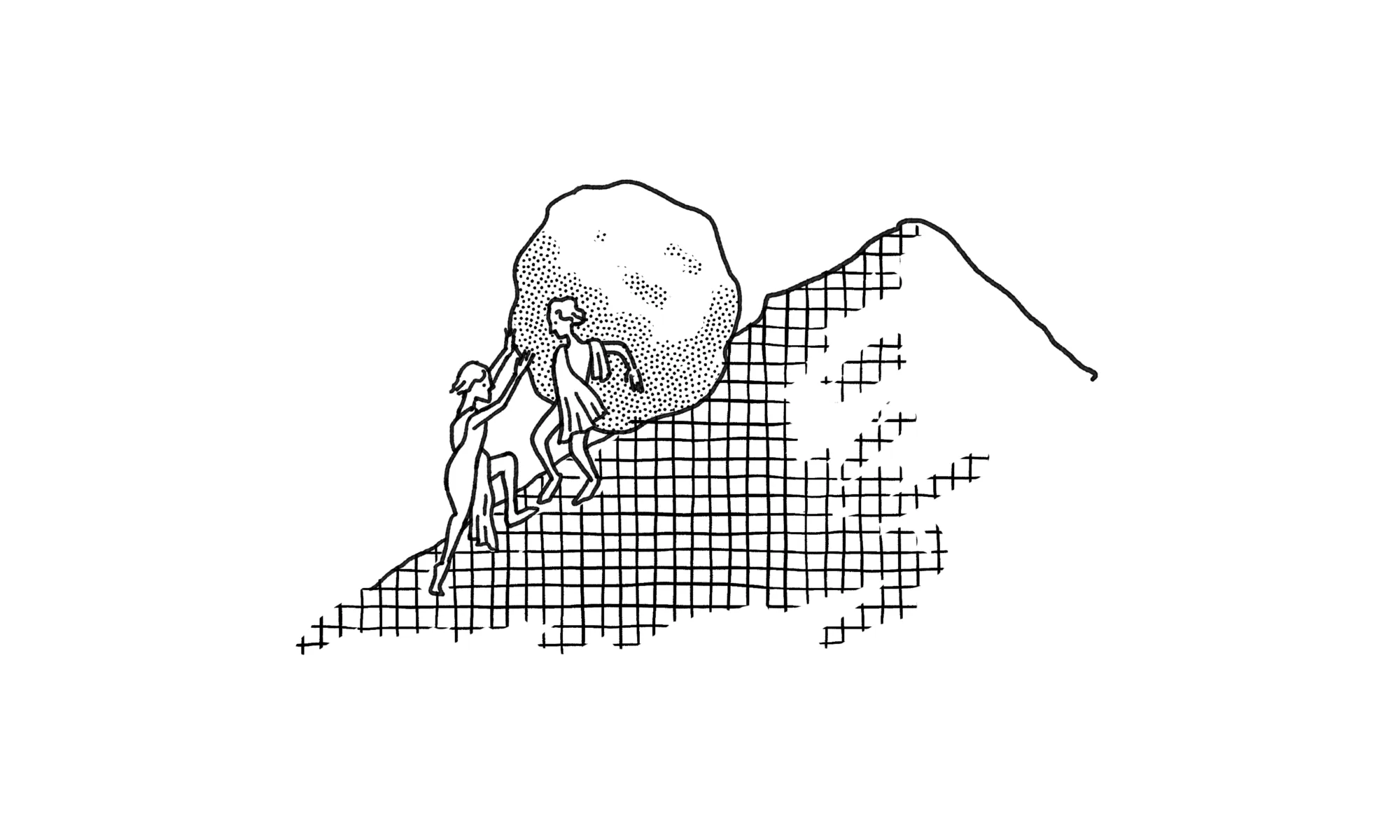
Help Each Other Up the Hill

American economists are arguing about whether the economy is good or bad: if the numbers look good, but the people feel bad, who is correct? Family policies are one place where the numbers are undeniably bad — unaffordable childcare, horrible gun and traffic violence, intensifying mental health crises. But since the birth rate is also bad, it’s bad form to focus on these bummers, from a demographer’s perspective, lest we scare potential parents. I often find myself in the doomer camp, which I resent. I am a mother, and I love the small people my husband and I are raising. I don’t, however, feel that it’s ethical to make some obfuscatory pitch about this role to the next generation.

By now my demographic — educated elder millennials — has been largely deprogrammed of the having-it-all dogma we once imbibed like mother’s milk. “Work won’t love you back,” we know, whether we hear it as a defeatist platitude that lures (or forces) women out of the workplace, or as the powerful animating cry of a labor movement that has made huge gains in dark years. But there are other facts about labor, compensation, and power that have not yet risen to the level of either platitude or slogan. “The day care waiting list is 100 infants long.” “School gets out at 2:15 p.m.” “Many childcare workers are food insecure.” “The child and dependent care tax credit is the same now as it was in 2001.” 

I live in Portland, Oregon, where a sometimes fractious coalition including the DSA, labor unions, community groups, elected officials, and volunteers like me midwifed a universal preschool measure onto the 2020 ballot; it won by a large margin. It’s a phased program, with every three- and four-year-old eligible by 2030, paid for by a small tax on the highest incomes in the county. Only three years into its existence — three years in which nearly 1,400 more kids have attended tuition-free preschool than would have otherwise — a local newspaper published a cover story pointing out that not all of the money raised had been spent, that the rollout had been slow, that the entrenched capacity problems of creating new spots persisted (namely, a long-standing lack of facilities and workers). “What are they going to do with all that money?” became the leading complaint, voiced with all the suspicion that generally accompanies a tax hike. Portland’s version of a chamber of commerce is hard at work trying to prevent the program’s next scheduled tax increase and instead direct funds to “revitalize” Portland’s downtown — a euphemism for sweeping unhoused people from the streets.

In November, Portland public school teachers went on strike for the first time ever. Families were out in the streets, marching and bringing food to picket lines. United Auto Workers President Shawn Fain, on the heels of his October contract victory, was tweeting about our school district. Bernie Sanders made a video. Nonetheless, by Thanksgiving, even supportive parent chat groups were aflame with competing budget analyses and innuendoes about the strike’s efficacy. The teachers settled their contract after nearly four weeks of negotiation and eleven days of missed school; they secured substantial raises, funds for upgrading decrepit buildings, and gestures toward smaller class sizes. But the local news stayed laser-focused on signs of infighting within the union, rather than on the fact that Oregon’s schools are underfunded by more than two billion dollars. Even in Portland, which has felt like a bright example of what collective action can do for parents and the people who teach and care for our children, success feels like pushing a massive boulder up a hill.

Parenting is also a lot like pushing a boulder up a hill, except lots of other people are doing it too, and everyone’s on a different part of the hill, and each boulder is a different size and shape. I watch other people struggle over whether to have a baby with the sort of patronizing smile that older people in turn direct at me as I thrash over my particular stage of parenting. “You’re not having a baby,” I want to tell them. “You’re going to have a person.” As if that’s a helpful intervention. A better approach would be to try to smooth the path as I go — take shifts with someone else’s boulder, coordinate our breaks, push in tandem, help each other up the hill. Maybe the moral here is that parenting is like political struggle: perplexing, grinding, necessary, and joyful work that is never truly finished. It’s also work you can’t do alone.