

Maud

What I really want to talk about is the work. 

Of course. 

If we have to talk about something, it might as well be the work. 

Well, we don’t have to talk about anything. 

But you’d like to, right? So you have something to write about. 

I’m open to discussing anything that interests you. 

Okay. I don’t know. It’s just been a lot. I’d just like — I mean, we talked about this on the phone. But I’d prefer we stay focused on my professional life. 

I understand. 

Anything else, I don’t know. It’s not really your business.

I get that.

Is that an alarm? 

What? 

The chirping. Is that a smoke detector or something? 

That’s just Inez. My bird. She’s in the kitchen. 

Oh, really? We used to have a parrot. 

She’s a cockatiel. My sister had her, but then she got a cat. 

Ah. Well, why don’t we start with the show. This was a big one for you — your first with a major gallery. How are you feeling? 

Good, I think. Good. What did you think? 

I enjoyed it immensely. I wouldn’t usually say that — but I already told you. The way you’re working with oils, it’s really quite distinctive. 

Thank you. That’s nice to hear. I was a little worried about going so big. Bigger gallery, bigger canvases. It was like I took this leap, from those small, little still lifes into these grand figural pieces, on this grand stage. 

But it seems to be working for you. The critical response has been —

Yes, I’m really grateful. 

It’s bold to present figures like these, on this sort of scale. “Maud,” in particular. That massive canvas of the girl with a frog down her throat. I loved it. I meant what I said on the phone. 

Thanks, yeah. 

Could you speak more about this shift in your work? Navigating this new step in your career. 

Well, the switch to figures was a big one. I hadn’t expected it to be, really, because I always felt, even in school, like there wasn’t much difference between painting a bowl of fruit and painting a face. People just get tripped up because they get so absorbed by the person behind the body, but I’ve never really had that issue. I’m generally good at seeing the surface first, then working my way in. 

Which was really why I started on the new series in the first place. I think I was feeling a little bored with all the daisies and the baby’s breath and the way they were being covered. And I knew I was lucky, at that age, at such an early stage, to get any coverage at all. But I could tell people wouldn’t really take me seriously until I found a different subject. And of course, I’d never go full-blown abstraction. That’s just not the kind of painter I am.

Instead you landed in this surreal territory. 

Yeah, I started by trying out these portraits of friends, or people I met at parties. But I always ended up twisting them in some way. I kept wanting to push real faces into this heightened dimension. 

Is that how you started on “Maud”? 

No, actually. That one’s funny. It’s based on a poem. 

Interesting. 

Yeah, it’s, like, this poem my dad would read to us growing up. Kind of weird, in hindsight, but it’s always stuck with me. I can’t remember the title, but it’s by Galway Kinnell. 

Wonderful poet. 

Oh? I wish I could remember what it’s called. But it’s about this dinner party, I think. And there are these children. A boy and a girl with these old fashioned names. Maud and Fergus. 

His children. 

Oh, I didn’t know that. Well, it’s the one where they show up naked in this doorway, draped in, like, garter snakes. And you can just sense that something is wrong. The nudity of the children, the sensuality of the snakes. It’s like sin in the air. And then Maud, she pulls open the jaw of one of the snakes to show the speaker —

Her father

Yes, or some other adult, and inside a frog is being swallowed. But when he tries to save it, she says: “Don’t. Frog is already elsewhere.” 

Wow. 

It’s wild. Do you know that one? 

I’m not sure. It sounds familiar. 

I wouldn’t have connected your work with Kinnell, but I see it now. I love his writing, and “Maud” was actually the first piece of yours I saw. I think I came across it on your Instagram. 

Oh? 

But, I mean, it was even more impressive in person. This giant girl, shining in this deep, dark pool. I was so moved by the artistry. It meant a lot to me. 

Well, thank you. I’m glad it resonated. But, like, that’s also been a part of all this. Navigating other people’s opinions. Mediating these external voices —

By external voices, you mean —

I don’t know, people like you. The press. Professors. Mentors, you know. The comparisons. It’s been a whole thing, sifting through those. Because of course, like, on some level, it’s always flattering to be compared to someone famous. To someone very successful. But it also makes it harder, I think, to see your work clearly after those connections are drawn. 

I had this whole period last summer where I completely lost track of my sensibility. It was around the time I signed with the new gallery, which was this great moment. A great success. But then I think I was so bogged down by these lofty comparisons — I got this one artist just, like, lodged in my head. I think subconsciously I was trying to be like him. And I won’t tell you who, that’s not the point. But, I mean, I was working the whole summer on this piece. Just couldn’t get it right. Every day, just trying and failing to finish it. 

And then this one night, I was working really late, and I let myself step away for a second. I drank a couple glasses of wine, and I was just, like, scrolling on TikTok and I came across this clip of, like, a lynx in some woman’s home, eating a whole raw chicken off a paper plate. But it wasn’t brutal at all. You’d expect it to be brutal, but it was, like, weirdly polite. He was just gnawing at this drumstick, shaking it every once in a while to get the meat into his mouth. It was visceral, yeah, but it wasn’t really violent. And this woman had almost a hundred videos of this big cat, trapped in this beautiful suburban kitchen, feeding itself. 

When I came back to the painting, it was like I could finally see it clearly. I’d been working for months, entirely in someone else’s style. You know that triplet scene? I’d painted this massive, hyperrealistic ribbon of blood to sort of be trailing behind them. But it didn’t need the blood at all. It didn’t need to be that extreme, you know? It wasn’t me. 

Do you need to get that? 

No, it’s alright, thanks. They’ll call back if it’s urgent. 

Okay. Yeah, I think it’s all just been a process. 

And how would you describe your sensibility now? 

I mean, I’ve always been interested in roundness. I think that’s a throughline from the earlier work to this most recent show. There’s something about the roundness of vases, the roundness of bodies, that suggests all this potential energy. The surface is stretched taut, like a balloon about to pop. That’s what got me started with “Fat Pig.” 

How did that piece come about? 

It’s funny, actually. It was one of my first figural pieces, although I didn’t think of it that way then. I was living in Nolita. I’d just quit my assistant job and was hoping that I could sell enough of the flower pieces to just paint for a few months, along with some help from my parents. I’d wanted time to work, but it made me so anxious, I barely slept. I’d wake up really early, and I couldn’t stand sitting alone in my tiny place, wondering when inspiration would strike. So I’d get out and walk around Little Italy. It was always so quiet in the morning, except for the rumbling trucks, men shouting, restocking all the butchers and the restaurants. 

There was this one truck, from a supplier in Jersey. On its side it had this giant bubblegum-pink pig, stretched out like a pinup. Its little tongue was sticking out and it was wearing this tiny white t-shirt with “EAT ME” in green writing. The poor pig was bursting out of this shirt, and there was something about it that was just, like, charged. The image was so full — sexual and demeaning and so palpably round

I really wanted to capture that bluntness, the erotic cruelty of it, so one morning I took, like, a million pictures of the truck, and that night I started sketching, turning the pig into a girl, the girl into a pig, back and forth until I found something. Someone exactly in between pig and girl with “eat me” carved into her chest.

It’s an incredibly unnerving image

That’s what I’m going for. I mean I’m not trying to be unnerving, but I’m always aiming for the uncanny. How can I take this image, or this person, that feels familiar, and shift it just slightly to make you look more closely. 

Like with “Crybaby.” 

Yes, exactly. It should take a second to realize there’s no water coming from the showerhead or the faucet. That the pool at her feet must have come from her, although she doesn’t appear to be crying. It’s a delicate balance — don’t you need to get that? 

Please, what were you —

Really, I don’t mind. 

Okay. 

What’s up? 

I can’t come. I’m working. 

Is he sick? Does he have a fever? 

Maria vouched for you. You said you’d be able to handle a few hours solo. 

He’s just saying that for attention. 

I’m telling you, it’s fine. Make some hot cocoa. Leave it on the counter. He’ll walk back down in his own time. I have to go. 

What’s wrong? 

My son — it’s alright. Sorry about that. 

That’s okay. I don’t mind. You’re sure he’s fine? 

Yes, yeah. Sorry for the interruption.

Were you, um — were you always interested in the uncanny?

I think so, yeah. As a little kid, I had this sense that, like, something was wrong with me. Something deeply and profoundly wrong. And I know tons of people feel that way, and as you grow up you come to see, like, “Oh, I wasn’t the problem, necessarily.” Like, the world can be stifling, even for — I don’t know. For someone like me. But once you have had that belief or that feeling, it always kind of lingers in the background, although you might come to understand it better. 

I mean, even within my family I could feel that way, and I was always loved and cared for. We often went camping, just my parents, my sister, and me. We’d go fishing, out on a small lake, us girls waddling around in these bright red life jackets. Two little blondes in red, a white boat, the green-blue of the water — I can find you a photo. It was all very idyllic.

Usually, we’d just throw the fish back, but my mom would complain. She thought it would be better to eat the fish, instead of just torturing them. 

So on this one trip, when I caught a trout, my dad told me not to throw it back. We got to shore and my sister and I watched as he sliced the fish open, all this blood oozing out of its belly. He cracked the jaw, stuck his hand into its guts, ripping them out, then tossed them straight into the woods. My sister squealed and she started laughing so hard, but for some reason I felt very calm. My dad set the fish back down on the tarp, and it looked just like it had with all of its organs. Nearly the same, except for this thin, red line at the base of its belly. 

I think about that fish a lot. It feels ridiculous — I mean, it really is ridiculous to say, and maybe, I don’t know, I feel obligated to give you something. Some nice little story, to sum me up or something. But, like, I’ve often felt that way. A person can be gutted and no one will notice. 

It’s interesting you raise this. Because I think a lot of the questions, a lot of the interest in your personal life, has to do with this concern — with not wanting to miss, maybe, if there’s something going on beneath the surface that we can’t quite see. 

Really? I think people are just pervs. Curious pervs. 

You’re probably right. And a lot of the commentary, to be sure, has been pretty blatantly sexist. But I do think it’s — I mean, you were speaking earlier about the difficulty of navigating influence. And I think it’s a real question for young artists of any gender, new to the art world — of how to discern who to trust. 

But you wouldn’t be asking me that if I weren’t a woman. Or if I didn’t look the way I do. All this “concern,” honestly it’s just patronizing. I’m talking about my artistic challenges, about learning to trust my intuition with a canvas. But that doesn’t mean I, like, take candy from strangers. 

And honestly, like, I think it’s a real loss when mentorship or protection — even if that sounds icky, protection is often what young artists really need — isn’t offered to young women because there’s this fear of looking like a predator or having your intentions misinterpreted. I mean, that’s fucked up, too. That neglect. And — I think this is really important — I have power, too. And not just privilege, or whatever. I have my own power, real power, as an artist. And I use it in all kinds of fucked-up ways. Like, I’m not a saint, like, that’s evident in my work. And these girls — they’re my objects. It’s cruel to place them on a razor’s edge all the time. Like with “Showpony,” the pigtailed girl impaled with a carousel pole. I’ve made life very difficult for her. I wield power over her in a more total way than anyone has ever held power over me. 

But they’re not in real danger. 

And I am?

Maybe not danger. But, let’s be honest — you’re in a relationship with the man representing you. A very powerful, influential man, nearly thirty years your senior. That can’t be simple. 

It’s not simple. I never said it was! But that doesn’t mean it’s wrong. It doesn’t mean I’m being hurt, and it also doesn’t mean I’m, like, a whore, either. Not that there’s anything wrong with that. Sex work. But that’s not what I’m doing. 

Nevertheless, since you signed with him, you’ve experienced a real boost. Your prices at auction have skyrocketed. 

But it’s not like I see any of that money. It’s not like I’m “selling out,” or some bullshit. Like, we all have, none of us have. I don’t know. 

But isn’t there also the question of his ethics? His assets, his investments in various, somewhat questionable regimes, a certain willingness to work with perhaps less-than-angelic characters —

And? He’s a businessman. Businessmen do all sorts of shit. That’s what they do. It doesn’t mean I — I don’t condone anything. It’s just — I’m my own person. It’s fucked up to suggest I’m not. It’s actually pretty deeply sexist. We’re separate people.

Honestly, Jesus Christ. I said I didn’t want to talk about this. 

I’m not trying to —

It’s hard, though, isn’t it? This whole thing. Because obviously I want you to write that I’m very charming. That I’m an open book. Or we can pretend I say revealing things despite myself. But it’s clear you want things from me that I don’t want to give. 

I

Like, what do you want me to say? What do you want to know? You think we, like, chitchat about war crimes? I do like fucking him, if that helps. He’s old, but he’s good in bed. I don’t call him Daddy or anything like that. Is that what you want to know? Or maybe I should say that every night, without fail, he puts on way too much La Mer. That he has these incredibly soft hands. I mean what level of detail do you think would be sufficient? 

I’m really not trying to this isn’t personal. It’s my responsibility, as a journalist, to ask. 

But that’s bullshit though, right? Of course you’re interested.

I’m sorry, I just — she keeps calling. 

Take it, whatever. 

Let me just

What’s up? 

I really need you to get a handle on —

What’s wrong? 

My son. Everything’s fine. He can be a lot. 

Please, please don’t go. I’ll make it up to you — I’m in the middle of a very important — No! Really, please, I can’t just —

He can come here, if that helps. 

What?

No problem. Love kids. Really.

Are you sure?

Yes, I’m sure.

Thank you so much, that’s actually really so — we live in the neighborhood, so this really helps, thank you. 

I’m just a few blocks away, you can drop him with me. I’ll text you the address. 

I am so sorry. This is so unprofessional. I wouldn’t usually —

Is he okay? 

He’s fine. 

How old is he? 

Eight. 

Yeah, so, um — I really don’t want you to think I’m trying to sniff out anything salacious. I so admire your work, and I just feel obligated to —

What’s wrong with him? 

What?

With your son? I mean, like, why is she freaking out? 

There’s nothing wrong with him.

I mean, there’s maybe something a little off, but we don’t know what, exactly. They say it’s not developmental, but he’ll have these really bad tantrums. I have an older daughter and she had tantrums. But these aren’t like that. He doesn’t get loud or upset. He just gets very quiet. I can handle him. But it can be unsettling for other people when they first meet him. 

I feel like eight is such a hard age. You’re just starting to see how scary the world is, but you still don’t quite understand it. You’re weirdly aware there are things you’re not being told. 

Yes, exactly. We’ve taken him to specialists and that’s kind of what they’re saying. That by acting out in this way, he’s grasping for control. So we try to find ways to give him more agency. We have him pack his lunch, put himself to bed, that sort of thing. He can only use his iPad for thirty minutes a day, but he gets to decide when those thirty minutes are. 

How is he acting out? 

We really don’t have to talk about this. We’re supposed to be discussing your work. 

It’s interesting. 

I don’t know that I’d call it interesting. But it’s hard for me to talk about, with people in my life. I don’t want them to be afraid of him, or think I’m this awful mother. 

He’ll threaten, sometimes. He does this thing where he’ll threaten to throw himself down the stairs. He’ll sit on the top step, all calm, his palms resting on his little knees. And he’ll say, “Mom, I’m going to do it.” And I’ll say, “No, Elliot. It will hurt. Please come down and sit with Mommy.” And he’ll say, “I mean it. I’m going to do it, and when I do, I’m going to break my neck.” And the therapist, she says not to engage with this directly, to try to address the feeling behind the statements, instead of engaging with the threat. And so I’ll say, “Are you feeling anxious, sweetheart? Let me give you a hug.”And sometimes that works, but a lot of times it doesn’t. At a certain point, I have to walk away. Sometimes hot chocolate helps. 

But not today? 

Not today. 

I think sometimes it can be hard for people to remember how difficult it was to be a kid. Like, I think by the time most people have had kids, by necessity, they’ve forgotten how it feels to be so powerless. But you’d know better than me, I guess. 

I think I know what you mean. After having his sister, I honestly felt invincible. I’d expected to be humbled by birth, and in a way I was. I was pushed down to that lowest, most animal part of myself. But then I just kept on living. And while I knew that pain, the humbling force of it, was still there — I could press on it when I wanted to, like a bruise — I was also finally a mother. I had waited so long for that title. Years of IVF. A lot of money. And when Elliot was conceived it was like this miracle. Natural conception, natural birth — all of it. He felt like this prize, for everything we’d gone through. 

That’s special

It was! It is. But with these threats looming in the air, it’s like all that power I felt has been degraded. He’s constantly forcing me to get down to his level. 

It’s funny — I first came across your paintings when all of this started. He began acting so strangely and it was just so distressing. I took some time off work. I was having trouble sleeping. And I guess when I saw “Maud” I was really so moved by it that I started having this recurring dream. I’m at my parents’ place, near the woods in Connecticut. It’s just stopped raining, and I’m walking through the grass to an old shed. When I open the door, Elliot is standing there. My son, but he’s an adult. He’s even older than I am now. And all he does is stand there, but somehow, I know he’s done it. To the girl. And the frog. 

Done what? 

Fed her the frog. Shoved it down her throat. 

That’s funny. I never imagined someone had done it to her. I think I thought she’d done it to herself. 

Fascinating. 

I don’t know. People do all sorts of things to themselves. 

Is she alright? 

Who? 

Your bird. She keeps chirping. Is she hungry? 

She’s just talking. 

You know, it’s odd. “Maud” is one of his favorites, too, but I’m not sure I like it very much. 

Why is that? 

I’ve always been kind of embarrassed by it. 

Embarrassed? 

Maybe, like, embarrassed for her, somehow. Like she’s done this strange thing to herself just to put it on display. Like she thinks it’s so interesting, you know? I can’t stand that. When people are like that. 

But I mean — if someone had done it to her? 

Well, didn’t you? 

What do you —

Like you said before, with “Showpony.” You’ve made the image. Aren’t you the one who’s put her on display?

Yes, technically. I mean, I guess that’s what I was saying. 

But that’s also — like, that’s not all of it. Not exactly. I don’t know. These pieces exist outside of myself. I can’t always determine how they come to me, or why, or how the image will end up. If I interrogate it too much, it kills the thing. Like, in the corner, over there, that stack of canvases. The one in the front.

Yeah?

I’d been working on that girl for a while. I love her face. The pale sheen of it. The craters in her cheeks. Like if the moon had acne scars, or something. I was so caught up in the piece, and it was moving quickly, until my mom visited. We’re just standing here, drinking coffee, and she goes, “Is that Janie?”  

That’s the buzzer? 

Yeah, they must be downstairs.

I can set him up with a book in the kitchen and we can keep talking

Sure.

Your place really is gorgeous. These windows!

Thank you, yeah. It’s special. 

I’ll grab the door.

Hi honey! You doing okay?

You can go, we’ll talk later. Thanks for bringing him. 

Elliot, sweetie, this is Olivia. She’s an artist. 

Hi, Elliot. 

You’re feeling shy, love? 

We have cocoa in the kitchen, Elliot, if you’d like some. 

That’s sweet, Olivia, thank you. 

You can meet my birdy! Her name’s Inez. 

We’d love that, wouldn’t we, sweetheart? 

Actually, sorry — I need to take this. The kitchen’s just through there, and the cocoa’s in the cupboard to the left of the sink. 

Of course, yeah, thank you! Take your time! 

Hello? Hi baby. 

Oh! I completely forgot, thank you. Yeah, I’ll be there. Maybe a few minutes late, though, I’m wrapping this up. 

It’s been fine. Mostly respectful. A little unprofessional, some trouble with her kid. 

How’s the install? 

God, he’s just an asshole, isn’t he? I mean, of course he’s a genius. But I never would have imagined he’d act like this. After everything you’ve told me this month alone, I’m like —

She’s in the kitchen. I’m not an idiot, okay? 

Very funny. 

Okay, I’ll see you soon. Love you. 

Sorry, didn’t mean to interrupt. 

Oh, you’re fine. We’re done. 

Okay, I think he should be good in there. He’s very happy with his cocoa, thank you. 

Good. 

So sorry again about this. You were saying, about the girl?

Yeah, this girl Janie, she lived down the street. People — they weren’t very kind. She had, like, a rolly backpack and stuff. But it really does look just like her. She had this round face and these huge cheeks, just pitted with purple acne. I must have been thinking of her on some level, without realizing it. But when my mom pointed it out, that was just — it all became too obvious. There was no mystery anymore, nothing left to discover. 

Still, I love that piece. I want to try to finish it, at some point. I just love that face. It reminds me how I used to feel. I was so lonely all the time. And I don’t feel that as much anymore, or with the same sort of intensity.

It seems like you develop this really intimate, emotional understanding of your figures. They become very real to you, even when they’re not based on real people. 

You’re right, yeah. I really care about my girls. Even though they’re not, like, real. And even though, like I said before, I do all sorts of things to them. I have to respect them if I’m going to spend all that time with them, trying to get it right. Maybe that’s part of what I struggle with, with Maud. For some reason I find it kind of hard to respect her.

You know, I’m thinking back to that poem, the genesis for this piece, and, I’m sorry, I wish could recall the specific one you were thinking of —

That’s okay. It’s great that you even, like, know who I’m talking about, I don’t know. 

Well, thanks. But I mean, in many of Kinnell’s poems, he’s really thinking about both of the children. You know, the pair, both Maud and Fergus. And I guess I wonder when Fergus fell away, for you. Why the image, for you, was the girl and the frog, instead of, like, the boy and the snake. 

I don’t know. I mean, I was always going to be interested in the girl. That’s just what I like to paint. 

But did you imagine, in the poem, that Maud had fed the snake? Did you think she was responsible?

I don’t know. I’m not sure that’s really the question. 

I guess, if I’m being honest, some part of me feels like I’ve always been that girl. Like I’m trying to crack the world open, so we can see the half-living thing inside, the other animal inside us. 

Did you hear that? 

Hear what? 

That sound.

It’s just Inez. 

But she sounds — doesn’t she sound —

She gets like that. I’m sure she’s fine. 

But there’s —

Really, she’s fine. 

You know, sometimes I feel like people want to punish me for that impulse, or something. That urge to prod and provoke. It’s too much for them. But I guess I bring it on myself. By insisting, you know. By always looking, by seeing the truth, for wanting to show and —

What was that?

— tell. 

Oh no, he could’ve knocked something over.

Just go check on him. 

Elliot? 

He’s not in there? 

No, he’s — Why is it so quiet?

Inez?

Elliot? 

Check the hall. 

What? 

The hall. The stairwell. Check the hall. 

I can’t. Your door —

It jams, let me.

It won’t — 

I think I —

Elliot!

— got it.

Oh, Olivia. 

What is it?

Oh my God. I’m sorry, I’m so, so sorry —  

What happened?

Get out of the way. I can’t —  

I can’t believe — He’s never — I’m just so —

I can’t see if you’re in the way.
A Bullshit Genius

On a friendly stroll somewhere in Colorado in the summer of 2004, Steve Jobs asked Walter Isaacson if he would consider writing his biography. Isaacson, a journalist, academic, and policymaker who was then CEO of the Aspen Institute, an influential think tank, had just published a six-hundred-odd-page study of Benjamin Franklin, and was at work on another about Albert Einstein. “My initial reaction was to wonder, half jokingly,” Isaacson later reflected, “whether he saw himself as the natural successor in that sequence.”

Isaacson did not take Jobs up on the offer until 2009, when he learned that the Apple boss was dying of pancreatic cancer. When Steve Jobs was published in 2011, just a couple of weeks after its subject passed away, it became clear that during his years of reporting the book, Isaacson had been convinced of what had first struck him only in jest. The front cover, designed with input from Jobs himself, featured a black-and-white photograph of the tech guru gazing knowingly at the camera, his thumb on his chin in contemplation: here is Jobs as world-historic genius, Silicon Valley successor to Franklin and Einstein. The narrative resonated with a public still enthralled by the misfit, college-dropout tech genius. That year was a kind of high-water mark for techno-optimism; the Arab Spring protests were still bringing democracy to the Middle East one tweet at a time; Google, with its ping-pong tables and massage rooms, was still widely considered the best place to work in the world. Isaacson’s portrait of Steve Jobs played to this market, selling around 380,000 copies in its first week.

A decade later, Isaacson was casting around for the next genius to include in his rarefied canon, which had grown to include Leonardo da Vinci, too, and was being sold as a “genius biographies” box set. What was kindred among these men, according to Isaacson, was not necessarily high I.Q. but an original spirit. They thought differently than others did — hit targets, as Schopenhauer put it, that no one else could see. This quality often put them out of step with the prevailing attitudes of their time, but these men did not acquiesce to ideological pressure or subscribe to social mores. The Isaacson genius was an avatar of intellectual freedom, a kind of liberal humanist hero who flourished in the West’s innovative meccas: Renaissance Florence, revolutionary America, prewar Western Europe, Silicon Valley.

As Isaacson surveyed the landscape in search of a new genius, one name kept coming up: Elon Musk. He was, without a doubt, a man with grand vision — electric cars, space travel, telepathy. He was unyielding in this vision, too, sometimes belligerently so. In Isaacson’s telling, he arranged a call in 2021 with the help of some mutual friends, and the two spoke for an hour and a half. (Musk has also taken credit for the idea.) Musk, unsurprisingly, was enthusiastic about the prospect of being written about. Isaacson, in turn, demanded full access to his subject, and the freedom to make up his own mind. “You have no control,” he reportedly told Musk. Over the next two years, the biographer followed the Tesla boss around, spoke to his family, friends, and colleagues, and received Red Bull-fueled text messages from Musk late into the night. During this period, Musk’s already bizarre life devolved into pandemonium. He bought Twitter at a massive loss, intervened in the war in Ukraine, spawned offspring with otherworldly names, and challenged Mark Zuckerberg to a cage match. A Fox News segment compared the two men by height, weight, age, and I.Q.: Zuckerberg, 152; Musk, 155. A battle of the geniuses, and also one of the dumbest spectacles of all time.

Nevertheless, when Musk was published in September of last year, it was clear from the dust jacket alone that the book would situate Elon in the Isaacson lineage, painting him as the true heir to Jobs — a brilliant, if troubled, Silicon Valley genius. The cover features a head shot of Musk staring directly into the camera, fingers on his chin — like Jobs, in a thinking position — and the epigraph consists of two quotes, the first from Musk: “To anyone I’ve offended, I just want to say, I reinvented electric cars and I’m sending people to Mars in a rocket ship. Did you think I was also going to be a chill, normal dude?” Directly below it is one attributed to Jobs: “The people who are crazy enough to think they can change the world are the ones who do.”

This time, the pitch didn’t quite land. Mainstream liberal attitudes toward Silicon Valley culture had cooled since the Jobs era, in large part due to a perceived rightward lurch among its upper echelons during the Trump years. Musk had emerged as the poster boy for this shift; he shared a meme that compared Canadian Prime Minister Justin Trudeau to Hitler, and frequently posted about the “woke mind virus” and Covid vaccines. Isaacson’s book was panned by many; some critics accused the author of engaging in access journalism. In a combative interview, tech reporter Kara Swisher repeatedly asked Isaacson if he had come to “like” Musk. You can hear her frustration and bewilderment. How could Isaacson, her old friend and fellow liberal stalwart, not see Musk for the “asshole” he is, and, in fact, try to rehabilitate his image and burnish his legacy? Jill Lepore posed a similar question in her New Yorker review. Isaacson, she wrote, is “a gracious, generous, public-spirited man and a principled biographer.” Why did he write this apologia for a “supervillain”?

But within the context of Isaacson’s nine books, Musk is not an anomaly. In method and thesis, it is perfectly in line with a career built on promoting elite interests under the guise of biographical neutrality and insipid humanism. This time, though, his “genius” subject is idiotic enough to throw the bullshit at the heart of the project into stark relief. Musk is not just the natural successor to Isaacson’s genius canon; he may be its necessary conclusion.


Isaacson’s first book was not a biography, but a collection of essays entitled Pro & Con: Both Sides of Dozens of Unsettled and Unsettling Arguments. Published in 1983, when Isaacson was an up-and-coming editor at Time magazine, it lays out opposing positions on controversial topics like gun control, abortion, and smoking. Isaacson acts as a kind of referee, mediating impartially in order to allow his readers to come to their own conclusions. It is a role that Isaacson would later leverage to great effect — as a neutral observer floating above the political fray — but this early attempt went mostly unnoticed. He had more success with his second book, coauthored with Newsweek editor Evan Thomas, which told the story of the coterie of East Coast statesmen who crafted U.S. foreign policy during the Cold War. But his breakout achievement came in 1992, with his next project, a biography of Henry Kissinger. The book was an amalgam of his first two works. Isaacson sought to present both sides of the bloody machinations of one of America’s most notorious statesmen — to produce, as he put it, “an unbiased biography that portrayed Kissinger in all of his complexity.” While The New York Times called it a “devastating portrait of Mr. Kissinger,” Christopher Hitchens felt that Isaacson’s fealty to “the tradition of New York-Washington ‘objectivity’” led him to grossly euphemize Kissinger’s war crimes. Isaacson, Hitchens wrote in the London Review of Books, “moves in a world where the worst that is often said of some near-genocidal policy is that it sends the wrong ‘signal.’”

Isaacson’s interest in power, and his commitment to that “New York-Washington objectivity,” made him particularly at home at Time, where he was promoted to managing editor in 1996. Under his leadership, the magazine pivoted away from hard news to entertaining profiles of prominent figures across the political and cultural spectrum. Isaacson had a knack for covering the influential in affable, entertaining prose that gently probed entrenched hierarchies, but did little to upset them. (Kissinger, for instance, still accepted invitations to Isaacson’s Time gala dinners after that supposedly “devastating portrait.”) Isaacson’s magnanimity was less usefully deployed at CNN, where he was made CEO in the summer of 2001. He arrived at a network under attack from an ascendant Fox News, which had been pitched by Rupert Murdoch as an alternative to the hegemony of the liberal media. Isaacson aimed for principled impartiality — or he played both sides, depending on how you look at it. One of his first moves as chairman was to meet with Republican lawmakers to discuss how the network could cover conservative perspectives with balance. The strategy backfired. Liberal viewers thought Isaacson was pandering to the right, while conservatives still preferred Fox, particularly after 9/11, when Roger Ailes expertly appealed to patriotic bloodlust. In 2002, Fox eclipsed CNN in the ratings, and Isaacson left the following year.

His next job, as president of the Aspen Institute, was a far more comfortable fit. The organization was established in Colorado in 1949, by a wealthy industrialist named Walter Paepcke, who enlisted the future curator of the Great Books of the Western World series to put together a continuing education program for business leaders with limited reading habits, composed of the most significant works in the Western canon. Paepcke’s hypothesis was that mountainside discussions of the likes of Sophocles, Adam Smith, and Herman Melville — interspersed with picnics and the occasional afternoon white-water rafting trip — would help the upper crust “gain access” to their “own humanity by becoming more self-aware, more self-correcting, and more self-fulfilling.” Over the decades, the Institute grew into a kind of nonpartisan paradise, where participants from various, and sometimes opposed, political backgrounds could think out loud and learn from their differences. Aspen was a neutral zone, an intellectual Switzerland, facilitating the peaceful transmission of ideas among people of goodwill. But if Aspen encouraged collegial disagreement, it wasn’t a place for true dissent. With professed neutrality, the Institute quietly pushed its own agenda — to imbue participants with the feeling that they were rightful heirs to and custodians of the Western intellectual tradition, of which their wealth and power were somehow natural outgrowths.

Isaacson took to this agenda gladly, and his biographical works began to reflect the values and style of the Institute. He published his biography of Benjamin Franklin during his first year as president, presenting the founding father as the type of guy who would have felt right at home in the mountain seminars. Isaacson writes that he could “easily imagine having a beer with him after work, showing him how to use the latest digital device, sharing the business plan for a new venture, and discussing the most recent political scandals or policy ideas.” A few years later, Isaacson framed Einstein, too, in the mold of a liberal think-tank fellow of the late 2000s. What made Einstein’s insight into the fabric of the universe possible, Isaacson proposes, was a “nonconformist” spirit, unbounded curiosity, and an appreciation for the arts. (He makes much of the physicist’s prowess on the violin.) Isaacson trumpets not just Einstein’s scientific virtues, but his liberal values, too: “Tyranny repulsed him, and he saw tolerance not simply as a sweet virtue but as a necessary condition for a creative society.” As with Kissinger, Isaacson narrates the two men’s lives in impressive detail, and without too much editorializing. When he does intervene, the analysis is banal, platitudinous, and sentimental. Einstein teaches us, for example, to “question every premise, challenge conventional wisdom, and never accept the truth of something merely because everyone else views it as obvious.”

Isaacson also sought to modernize Aspen for the 21st century. If, in Paepcke’s era, the elites were capitalists who wanted to delve into Goethe, by Isaacson’s time they were increasingly tech investors and founders who wanted to pontificate about the future. The tech scene was one that Isaacson was already familiar with and enamored by. In the 1990s, he had briefly left Time to work as the new media editor for Time Warner, where he helped develop Pathfinder.com, a web portal that aggregated content from across the media company. This early attempt at digital journalism failed, costing the company over a hundred million dollars. Isaacson was sent back to edit the magazine, where he satisfied his entrepreneurial urge by establishing a new section covering science and technology, with a focus on the wunderkinds of Silicon Valley. By the time he arrived at Aspen, Isaacson knew how to appeal to this crowd, and one of his first major initiatives was to establish the Aspen Ideas Festival, a weeklong event where “thought leaders’’ gathered to give TED-like talks to card carriers and members of the public who paid the price of entry. The conference fulfilled the Aspen remit to a tee, but with a modern twist, providing the ruling class with an opportunity to broaden their horizons not by reading ancient tracts, but by listening to snappy presentations from the likes of Colin Powell, Jane Goodall, and Jeff Bezos.

Under Isaacson’s leadership, the new Aspen ideal was to be as interested in Goethe as in quantum computing. Amusingly, Isaacson also retrospectively imposed his admiration for tech innovators onto his historical subjects. Franklin is not just a “successful publisher and consummate networker with an inventive curiosity,” but a man who “would have felt right at home in the information revolution.” And although Einstein was not, like Franklin, much of an inventor — he was more prone to theorizing in the abstract than to patenting — “his fingerprints,” Isaacson emphasizes, “are all over today’s technologies. Photoelectric cells and lasers, nuclear power and fiber optics, space travel, and even semiconductors all trace back to his theories.” There was, clearly, a taste for this kind of thing in the 2000s, when the phrase “techno-enthusiast” could still be uttered with a straight face. Both biographies were best sellers.


With Franklin and Einstein, Isaacson was simply rearticulating the achievements of canonical geniuses in the vernacular of his time. Jobs represented a different challenge: because he was still alive, a case had to be made for his inclusion in Isaacson’s coterie of polymaths. Following some two years of reporting, Isaacson wrote a fluent narrative about Jobs that, at least superficially, depicted a man with two sides. Sometimes he is a brilliant, intense, eccentric creative with an uncompromising aesthetic vision. Jobs drops acid and travels to India. He takes a course in calligraphy and later uses what he learned there to help develop the Mac’s font range. He sees a Cuisinart food processor at Macy’s and has the idea to encase his computers in molded plastic. Other times, Isaacson shows Jobs as volatile and cruel. He gets his girlfriend pregnant, then denies it. He betrays old friends (including his Apple cofounder, the true engineering genius Steve Wozniak). He parks in handicapped spaces. He screams at subordinates. He cries like a small child when he does not get his way. But whenever Jobs behaves badly or demands too much of his staff, or loses himself in perfectionistic pursuit of some detail, Isaacson demonstrates how the unwieldy parts of Jobs’s temperament allowed him to create world-changing products. The cruel and authoritarian impulses were established, in other words, as necessary components of his creativity. “His personality and passions and products were all interrelated,” Isaacson writes, “just as Apple’s hardware and software tended to be, as if part of an integrated system.”

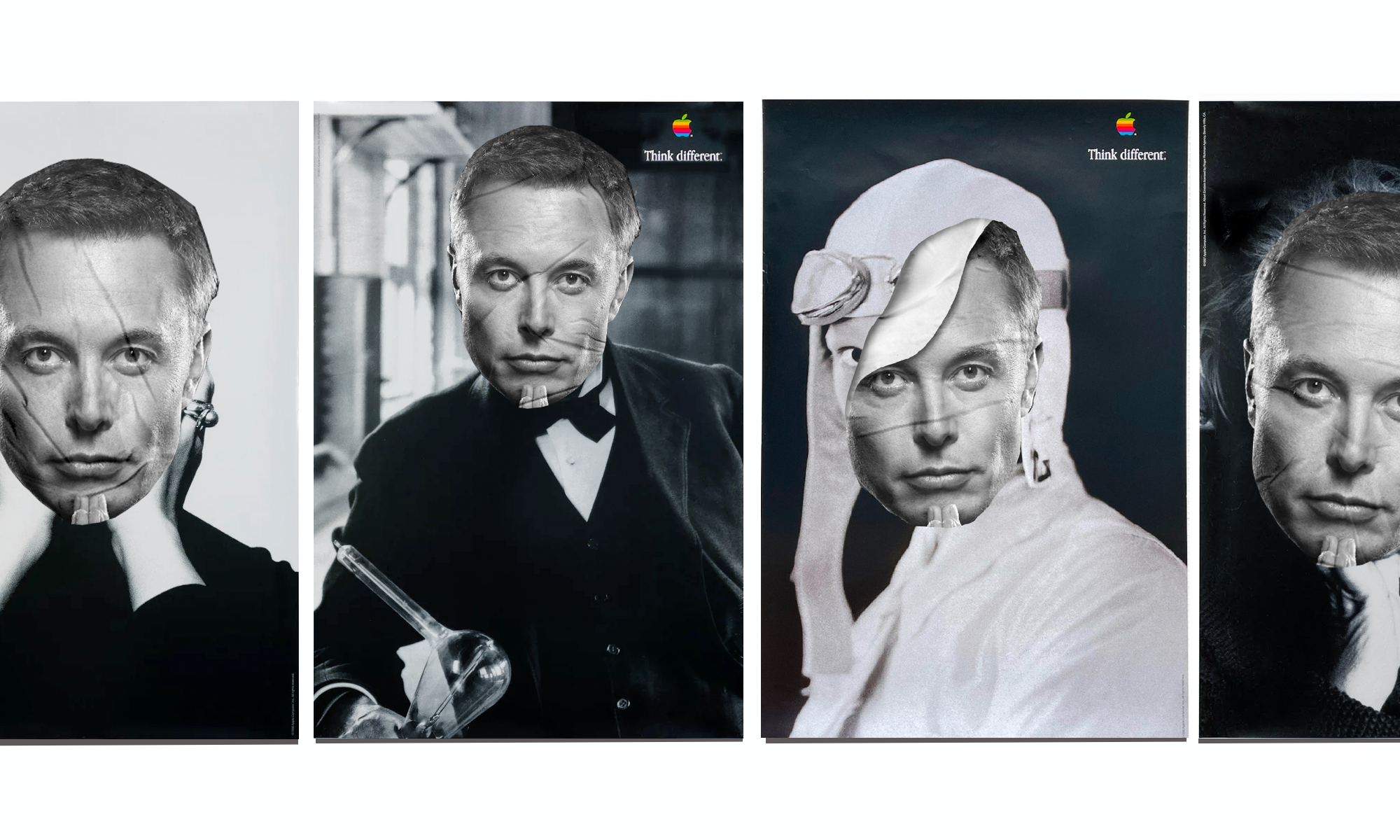
It is a classic stereotype: the flawed genius, wherein the flaw is the essence of the genius. It is also a pose that Jobs had previously adopted to market Apple products. In 1997, Apple launched the “Think Different” ad campaign, which featured black-and-white footage of iconic twentieth-century geniuses — Einstein, Picasso, Edison, Martin Luther King, Jr. — as well as a spoken-word poem that, according to Isaacson, Jobs helped draft. Isaacson buys right into the conceit. Instead of offering critical reflection on what type of person invokes Martin Luther King, Jr. to advertise computers, he recapitulates the ad campaign wholesale, concluding the biography with a quote directly from the spoken-word copy (the same one that would later appear in the epigraph of Musk): “While some may see them as the crazy ones, we see genius. Because the people who are crazy enough to think they can change the world are the ones who do.”

“Think different” encapsulated Isaacson’s idea of genius in two words, and became one of his mantras. After the biography was published, the chairman of the firm that created the ad accused Isaacson of “revisionist history.” It is true that Jobs had been involved in overseeing the ad, but he had not been the mastermind, as Isaacson portrayed him. In fact, Jobs had initially described the copy for the ad as “shit.” This corrective notwithstanding, Isaacson would continue to attribute the slogan to Jobs alone, and also apply it to his own subjects, even retrospectively. “Einstein had the elusive qualities of genius, which included that intuition and imagination that allowed him to think differently (or, as Mr. Jobs’s ads said, to Think Different),” Isaacson wrote in a 2011 New York Times editorial. “Like Mr. Jobs, Franklin enjoyed the concept of applied creativity — taking clever ideas and smart designs and applying them to useful devices.” What’s remarkable here is that Isaacson compares Einstein and Franklin to Jobs, instead of the other way around: with Isaacson’s spin, Jobs becomes their apotheosis, and Silicon Valley begins to look something like the genius promised land.

Of course, Isaacson’s Jobs biography did not inaugurate the Silicon Valley myth. It was evangelized throughout the 1990s, when tech founders were framed as geek heroes who were engineering machines that would one day turn libertarian principles into social facts. What Isaacson did in Jobs was repackage the folklore for a mainstream audience and focus it on one person. The pitch worked — and the book’s success transformed Isaacson into a star biographer. In 2012, he was named to Time’s list of influential people for writing a “trio of brilliant works about men of genius.” Isaacson later referred to himself as a Boswell for Silicon Valley, a shadow-like scribe who exists to record how the ingenious live for posterity. A more apt analogy, though, might be Giorgio Vasari, a prominent architect and mediocre artist who lived some five hundred years ago in Florence. In 1550, Vasari published Lives of the Most Eminent Italian Architects, Painters, and Sculptors, a group biography of Italian artists. A seminal work, it originated the concept of the “Renaissance” and its association with Florence, where Vasari’s benefactors, the Medicis, ruled. It also featured the first full account of the life of Leonardo da Vinci. “So great was his genius, and such its growth, that to whatever difficulties he turned his mind, he solved them with ease,” Vasari writes. Indeed, it was Vasari who established the endlessly repeated trope that it was ingenious Renaissance Men like da Vinci who led Florence, and then all of Europe, out of the darkness and into the light. The book made Vasari’s reputation, too, forever linking his name with this period in history. With the Jobs biography, Isaacson’s project began to bear a distinct resemblance to Vasari’s; Palo Alto became a kind of American Florence, the home base of the 21st-century Renaissance, leading the world towards a brighter, enlightened future. Isaacson was the court biographer.

In his next book, The Innovators: How a Group of Hackers, Geniuses, and Geeks Created the Digital Revolution (2014), Isaacson traces the lineage of Silicon Valley, a place where “authority should be questioned, hierarchies should be circumvented, nonconformity should be admired, and creativity should be nurtured.” The first forebear of the digital revolution, according to Isaacson, was Ada Lovelace, the mathematician daughter of Lord Byron who developed a theory for programming a prototype computer called the Analytical Engine. Isaacson uses her poetic pedigree and unconventional approach to mathematics to make the argument that, like the Renaissance, the digital age was a product of irreverent creatives who embraced the marriage between the arts and humanities. “I was struck by how the truest creativity of the digital age came from those who were able to connect the arts and sciences,” Isaacson writes. Each subsequent figure is cast in this mold. Claude Shannon is “the eccentric information theorist, who would sometimes ride a unicycle up and down the long red terrazzo corridors while juggling three balls and nodding at colleagues.” Alan Kay builds graphical user interfaces and plays in a jazz band. Sergey Brin and Larry Page attend Montessori schools.

This angle may have sold in 2011, but by 2014 perceptions about tech culture were just beginning to shift. The book’s publication coincided with the beginning of the so-called “tech-lash,” heralded by The Economist the year before as a “revolt against the sovereigns of cyberspace.” Pundits were panicking about device addiction and misinformation; the internet, where knowledge was supposed to be free, was beginning to reveal itself as a giant surveillance engine that accumulated wealth and power for the few, while fragmenting society into increasingly antagonistic and paranoid groups. The tech industry was dominated by megacorporations — Amazon, Facebook, Apple, Google — that tried to ameliorate concerns about their consolidation of wealth and power with noble slogans like “Don’t Be Evil.’’ Critiques emerged from Silicon Valley stalwarts, like virtual reality pioneer Jaron Lanier, who lamented how the hyper-successful tech lords had lost touch with their formerly radical, free-spirited values. Tristan Harris, a tech entrepreneur who began to freak out about the fiendishly addictive affordances of social media, established a Center for Humane Technology. Others, like Peter Thiel, thought the problem was that the bloated tech giants had become enfeebled by establishment politics and liberals more concerned with effecting social change than fortifying American power with new technology. Donald Trump’s populist, antiestablishment posturing only emboldened Thiel’s reactionary grievances. Meanwhile, disinformation-obsessed liberals blamed social media and iPhones for rending the fabric of our shared reality — and for bringing about Trump’s election.

If the tech-lash caused Isaacson’s faith in the Silicon Valley model of genius to wobble, he didn’t show it. In 2017, he published a biography of Leonardo da Vinci in which he described the original Renaissance man as innovative — an outsider, the noble bridge between science and art. This was almost indistinguishable from how he wrote about his coterie of hackers, geniuses, and geeks. He went so far as to invoke Jobs’s advertising slogan “Think Different,” this time to capture the spirit of the man who painted the Mona Lisa. “The fifteenth century of Leonardo,” he writes, “was a time of invention, exploration, and the spread of knowledge by new technologies. In short, it was a time like our own.” He continues with a lesson: “Above all, Leonardo’s relentless curiosity and experimentation should remind us of the importance of instilling, in both ourselves and our children, not just received knowledge but a willingness to question it — to be imaginative and, like talented misfits and rebels in any era, to think different.”

After the da Vinci biography, Isaacson left the Aspen Institute, became a history professor at Tulane University, took a consulting role focusing on “technology and the new economy” at a global financial services firm, and launched a podcast in partnership with Dell called “Trailblazers,’’ which looked at “digital disruption and innovators using tech to enable human progress.” He also continued working in policy, something he had intermittently done for decades. (Isaacson advised the Bush administration on U.S.-Palestine relations, for example, and under Obama, he was appointed to the Defense Innovation Board.) His next biography, The Code Breaker (2021), was about Jennifer Doudna, one of two winners of the 2020 Nobel Prize in Chemistry for her work on CRISPR gene-editing technology. Although it reprised some themes from his previous works — maverick scientist, innovation, code — it was a departure, too. This was Isaacson’s first full-length work about a woman, and it contained extensive deliberation about the ethics of biomedical technologies. It was also timely. In it, Isaacson reports on how Doudna and her collaborators assisted in the development of the mRNA Covid vaccine. The savior in that moment was not some tech maven, but an international conglomerate of scientists who collaborated extensively with global public health institutions. Was Isaacson taking a step away from the hyper-individualistic Silicon Valley and towards a broader, more complex conception of scientific innovation?


Not quite. A few months after the Doudna book came out, Isaacson spoke to Elon Musk on the phone. Musk was, at the time, on the cusp of becoming the richest man in the world, a position consolidated during the pandemic. For some, this made Musk a hero: a brazen, freethinking visionary, leading humanity into a brighter future. For others, Musk became a symbol of everything that was wrong with Silicon Valley: he was the mad king of a high-tech feudal state. In any case, he was the object of our collective fascination, a walking headline. Isaacson embraced the opportunity to get close to this powerful and polarizing figure, and he produced a biography of astounding access and significant detail. If you’re curious about what Musk’s life looks like day to day, Isaacson paints a vivid picture of the chaos — all laid out in highly consumable prose. As usual, Isaacson promises to be objective — to show all sides of the man while withholding judgment. This may have worked with Einstein, da Vinci, and even Jobs. But Elon Musk was like cable news come to life; he may have once appealed to CNN viewers, but was now looking more and more like a Fox guy. And Isaacson did not learn his lesson from his time at CNN. In his effort to appeal to Musk’s lovers and haters, he ended up making himself look like an apologist.

To begin, Isaacson delves into Musk’s upbringing in apartheid South Africa. Two formative experiences are recounted. The first is veldskool, a sadistic militant survival camp for boys, where Musk learned “that if someone bullied me, I could punch them very hard in the nose, and then they wouldn’t bully me again.” The other comes courtesy of Errol Musk, the psychologically abusive father who berates Elon after he is awfully beaten by another boy at his school. Evidently, Musk internalized the savagery of his early years; Isaacson could have offered a psychoanalytic reading of how this prepared him for the cutthroat, domineering, hyper-capitalist world of Silicon Valley. But Isaacson would rather view his high-tech Florence as a creative utopia. Accordingly, he frames Musk’s trauma in cartoonish, Marvel-like terms: Musk is beset by demons, but like Jobs, he ultimately channels them to “nurture the flame of human consciousness, fathom the universe, and save our planet.” In one scene, Musk challenges the CTO of PayPal, Max Levchin, to an arm wrestle to resolve a disagreement about operating systems. Musk wins and enlists a team of engineers to rewrite the existing code. The effort takes an entire year and achieves nothing other than distracting engineers from a dire fraud problem on the service. But Isaacson ties this up in a mini-redemption arc: Levchin is seen marveling at Musk’s technical expertise. As in Jobs, Isaacson employs his troubled-genius bait and switch, recounting an unhinged Musk anecdote and then justifying it with a moment of brilliance.

The trouble is, there is very little in Musk’s early life that offers any evidence of genius, creative talent, or even above-average intelligence. He is an emotionally detached child who sits in class staring into space. He likes computer games and The Hitchhiker’s Guide to the Galaxy. He gets As and Bs. The only evidence of superlative capability that Isaacson can conjure is that Musk read his dad’s encyclopedias and made small rockets with chlorine and brake fluid. What does stand out among this otherwise entirely unremarkable youth are stories in which Musk succeeds through dumb luck and aggression. In one, Musk competes in a Dungeons and Dragons tournament with his brother and cousins. The game master tells them that their mission is to identify the bad guy among the opposing players. On the first move, and without any evidence, Musk correctly guesses that the game master himself is the bad guy. The others accuse Musk of cheating. How did he know? “These guys were idiots,” Musk explains to Isaacson. “It was so obvious.” Any reader can see that this story is just Musk being a cocky teenage boy. Isaacson, however, takes it as proof that Musk could “think different.” Musk’s big break comes when he sells his first company, Zip2, at the height of the dot-com boom for $307 million. Zip2 is a searchable business directory that uses map software to give users directions. It’s not exactly the Mona Lisa, but, as Isaacson insists, “some of the best innovations come from combining two previous innovations.” Musk parlays the capital from that sale into an online-payments business that, fortunately, merges with PayPal. What does he contribute? An idea that new users could sign up with their email addresses instead of their Social Security numbers. Isaacson: “Like Steve Jobs, he had a passion for simplicity when it came to designing user interface screens.”

If there is anything remarkable that emerges about Musk in the biography, it is his grandiose, cosmic sense of mission — his obsession with making humanity multi-planetary, for example — and his absurd appetite for risk. The combination could be inspiring for those Musk worked with — and it certainly makes for good marketing. Like Jobs, Musk’s great talent is in self-mythologizing. He builds his cult of personality not around the guru-creative ideal, as Jobs did, but as a crazed, workaholic, alpha-male superhero: a manic Iron Man sending a Tesla Roadster into space. Isaacson credulously regurgitates Musk’s lore, just as he did in Jobs, recounting an anecdote in which Musk plays a game of Texas Hold ’Em and goes all in on every single hand — losing, doubling up — until he eventually wins. “It would be a theme in his life,” Isaacson writes. “Avoid taking chips off the table; keep risking them.”

To redeem Musk as a Jobs-like genius, Isaacson leans heavily on the “crazy” element of the “think different” campaign. It is the “crazy ones,” the ones who go all in at poker, who change the world. The problem is, as the biography progresses, the craziness intensifies even as it bears little connection to the genuine achievements of Musk’s companies, which are adeptly run by very talented employees who do their best to keep Musk out of the way. Isaacson tries to craft a coherent narrative out of such life events as: Musk accusing a British caver who helped save trapped Thai soccer players of being a “pedo guy”; smoking a fat blunt on Joe Rogan’s podcast while talking about our coming A.I. overlords; naming his son with the musician Grimes X Æ A-Xii. Isaacson attempts humor at times, affecting the befuddled tone of a naive grandfather regaling internet drama. When Musk takes over Twitter, Isaacson frames the chaos as a kind of clownish farce.

The contrived goofiness distracts from the troubling reality that, as Musk grew more deranged, his power increased. By 2021, when Isaacson began reporting the book, Musk was running two of the world’s most important companies: Tesla and SpaceX (including its subsidiary Starlink). Isaacson got to see in real time how Musk wielded his influence. One evening, in September 2022, Musk messaged Isaacson to tell him that Ukraine was planning a surprise attack on a Russian naval fleet in Crimea with Starlink-connected submarine drones. Musk told Isaacson he believed there was a “non-trivial possibility” that such an attack could trigger nuclear war, so, as Isaacson tells it, “he reaffirmed a secret policy that he had implemented, which the Ukrainians did not know about, to disable coverage within a hundred kilometers of the Crimean coast.” But Isaacson got the facts wrong. There was no Starlink coverage enabled all the way to Crimea to begin with. The Ukrainians asked Musk to switch it on for their drone attack, but he declined. Much was made of this error after Musk was published, but more concerning than Isaacson’s errant reporting was his indifference to the fact that, whether Musk made the order directly or simply affirmed the preexisting geographical limit, the final decision was still ultimately his alone, giving Musk almost state-like authority. Isaacson fails to call this for what it is: a completely undemocratic consolidation of power. Instead, Isaacson tempers the whole terrifying ordeal by assuring us that Musk never sought such power. “Starlink was not meant to be involved in wars,” Musk told Isaacson during a late night phone call. “It was so people can watch Netflix and chill and get online for school and do good peaceful things, not drone strikes.” Once again, Isaacson’s performance of neutrality precludes him from a clear-eyed assessment of his subject. If Kissinger was a serial killer dressed up as a peacemaker, Musk is a mad, petulant oligarch dressed up as a genius.

Isaacson is fond of concluding his books with pithy parting phrases that capture, and also reduce, his subjects. Einstein, we’re told, is the “locksmith of the mysteries of the atom and the universe.” Da Vinci is “the epitome of the universal mind.” Jobs is one of the “crazy ones” who “push the human race forward.” He makes no such attempt to summarize Musk. This biography ends at a Starship Launch on 4/20, Musk’s favorite day, because of its associations with weed. He is hyped up on Red Bull with Grimes and three of his eleven kids by his side. He whistles “Ode to Joy” and then gives the command for his rocket to self-destruct after it fails to get into orbit. It is a scene of almost fantastical madness, but Isaacson can’t tell what it all means. In part, this is because Musk just doesn’t fit within the rubric of Isaacson’s new Renaissance Man. It’s also because, as Isaacson was writing the draft, and also after the book was published, Musk continued to unravel publicly, doing dumb things and posting about it for us all to see. In fact, the sense I got, on finishing the book, was that if Musk’s life signifies anything it is how the Vitruvian sense of ourselves as heroic creatures about whom coherent biographies may be written disintegrates online. Life on the platforms unfolds in a fractious and disorienting present tense, never cohering into a meaningful narrative. It is all crisis and reaction, grist for the content mill.


There must be a valuable lesson in the material of Musk’s life — a metaphor for the false promise of Silicon Valley, maybe, which was always the veldskool painted as utopia. But Isaacson has made himself a main character in this tragedy (or is it by now a farce?). Like Vasari to the house of Medici, Isaacson has tied his name to the house of Palo Alto. He is unable to unveil its darker truths without implicating himself.

In the book’s penultimate chapter, Isaacson is summoned to meet Musk in Austin, where the purported genius waxes lyrical about how human intelligence is leveling off while digital intelligence increases exponentially. The A.I. overlords are coming. Musk feels it is his duty to intervene, to develop A.I. according to the principles of rationality and truth, so that our civilization may endure — which is why, Musk tells Isaacson, he is starting an A.I. company. This is right out of the Silicon Valley marketing playbook: by framing the algorithms in folkloric terms of good and evil, tech companies distract from the ways in which they are leveraging mass-surveillance apparatuses, accumulating our data and selling it back to us in the form of supposedly super-advanced A.I. that sometimes gets basic math wrong. Isaacson, as always, repeats the tale dutifully, with little critical intervention.

All this suggests that Isaacson’s next project might just be a ham-fisted biography of A.I. itself — the genius machines created in our image. After all, Isaacson is perfectly placed to whitewash power with the language of humanism. It’s been his project all along. Though Isaacson’s biographies have become so predictable, his style so platitudinous, that we could probably just do it for him, with a bit of help. Computer: write a genius biography of A.I. in the style of Walter Isaacson.