

Borderlands, Betrayed

In February, before the Democrats swapped candidates, Joe Biden and Donald Trump separately visited Texas on the same day to present their respective plans for cracking down on border crossing. In Eagle Pass, Trump walked along a razor-wire fence, telling Border Patrol agents — and TV cameras — that the country was “being overrun” by “Biden migrant crime.” Biden, standing in front of another Border Patrol group a few hundred miles away in Brownsville, blamed Republicans in Congress for blocking the Senate compromise bill that originally included twenty billion dollars for border enforcement. “The bipartisan border security deal is a win for the American people,” he said. “That’s a win for the people of Texas. And it’s fair for those who legitimately have a right to come here to begin with.” 

Republicans never took the deal: the sections on border security were removed from the bill, and the issue remained a liability for Kamala Harris when she took Biden’s place on the Democratic ticket. Trump’s first line of attack was to slam the new nominee as the so-called “border czar” who had allowed migrants to flood the country — a refrain he repeated at the candidates’ September debate. Harris, who had never been given such a title, had been tasked with addressing what the White House called the “root causes” of migration, like food insecurity and job scarcity. Still, she responded to her right-wing critics with an ad boasting that she had “backed the toughest border control bill in decades” — referring to the failed compromise bill, which she pledged to revive — and promising that she would hire “thousands more border agents.” Only a few years earlier, Harris had called Trump’s proposed border wall “a complete waste of taxpayer money” and a “medieval vanity project.” But now, following Biden’s lead, she was supporting a bill that would allocate hundreds of millions of dollars to extend the wall. Like Biden, Harris carved out a rhetorical exception for what Biden had framed as “legitimate” arrival; at the Democratic National Convention in August, she affirmed her intention to simultaneously “create an earned pathway to citizenship and secure our border.” 

Harris’s attempt to sound tough without verging into outright Trumpian xenophobia speaks to the Democratic Party’s anxiety about losing once-dependable Latino voters, especially those in border communities. Since the 1960s, Mexican Americans have largely supported Democrats in national elections, and South Texas counties, where the population is 85 percent Latino, have been reliably blue. But in 2020, Trump picked up significant support in the heavily Mexican American Rio Grande Valley, a shift that disoriented political analysts. In 2021, Texas Monthly warned that Democrats had “a deep problem” in South Texas. After the 2022 midterms, in which Republicans made further inroads, the Texas Tribune announced a new electoral reality in the region: “Gone are the days of unquestioned Democratic control.” This election, South Texas races are highly competitive, and an October New York Times/Siena College poll found Harris “underperforming the last three Democratic candidates for the White House” among Latino voters nationwide. 

In response, some commentators have cautioned that Mexican American communities in Texas have always been fundamentally conservative. Earlier this year, a New Republic piece warned that voters in the Rio Grande Valley have “views closely aligned with the Republican Party, especially on immigration and border control.” To refer to “South Texas Democrats,” the Texas Observer wrote, “is to say, conservatives on issues ranging from guns to fossil fuels to abortion.” The same assumption seems to be guiding the Biden-Harris administration’s shift to the right on immigration and border politics. 

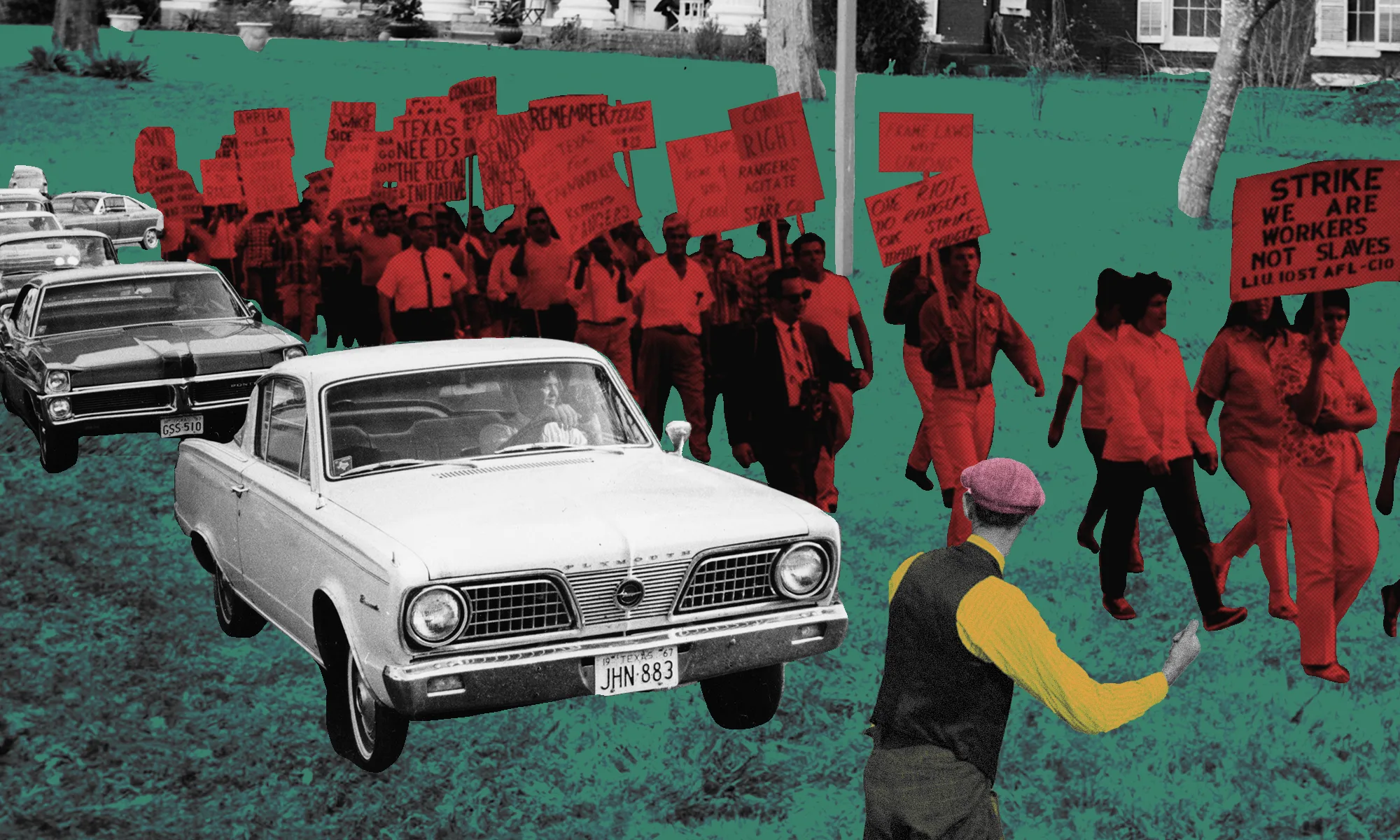
In adopting this strategy, however, Harris is following a decades-old playbook — one I know firsthand from growing up in El Paso, where my dad was involved with the Democratic Party’s Mexican American caucus. Historically, when Democrats have moved right, it has not only failed to garner support among border communities, it has backfired. Latinos in this region are conservative today in large part because they have been made conservative — with help from the Democratic Party. In the late 1960s, South Texas was a stronghold of the left-wing Chicano movement, which gave rise in the following decade to the briefly influential Raza Unida Party (RUP). Members of the RUP advocated for Mexican American equality and political representation, labor rights and protections, affordable childcare, rural health clinics, accessible bilingual education, and solidarity with anti-colonial and anti-imperialist third world movements. Democratic politicians reacted to the party’s ascent by alternately ignoring, repressing, and co-opting Chicano tactics, disempowering a generation of leftist leaders who could otherwise have served as a counterweight to conservative forces in the region. Since then, Democratic leaders have been running a race to the right that only Republicans can win. 


In the mid-twentieth century, Mexican Americans held demographic majorities in South Texas border towns, but were segregated under an Anglo elite that dominated agriculture, manufacturing, and government. A state poll tax made it difficult for low-income people to vote, disenfranchising many Mexican Americans. Those who could afford the tax were often stymied by the reigning Texas Democratic Party’s habits of purging voters from registration lists and gerrymandering districts. In other areas of life, Mexican Americans were treated like second-class citizens: public schools banned Spanish-speaking and excluded Mexican American students from honors programs. By the 1960s, when these young people were drafted to fight in Vietnam (where they were killed in disproportionate numbers), some began to reclaim the once pejorative term “Chicano” as a symbol of their cultural pride and desire to challenge the racial economic status quo in the Southwest.

In 1963, five Mexican American men known as Los Cinco Candidatos — all first-time political candidates, whose professions ranged from car salesman to photographer — harnessed rising opposition to racial discrimination to win City Council seats in Crystal City, a South Texas town near the border. The backlash was swift: the Texas Rangers put Crystal City under martial law, implemented a curfew only for Mexican Americans, detained and beat young activists, and blocked Los Cinco Candidatos from accessing government buildings; white politicians quickly mounted a successful recall campaign. Still, the brief triumph and violent response politicized a generation of local youth. 

José Angel Gutiérrez, who was brutalized by a Texas Ranger captain during this skirmish, went on to help form the Mexican American Youth Organization (MAYO) in 1967. Explicitly Chicano, MAYO was simultaneously in dialogue with other ’60s social justice movements, particularly the Black Freedom Movement. While celebrating Mexican culture and calling for people of Mexican descent “to become masters of their destiny, owners of their resources, both human and natural, and a culturally and spiritually separate people from the gringo,” MAYO also deployed confrontational tactics like walkouts and occupations of buildings, led voter registration drives in barrios, and organized students in high schools and universities throughout Texas. 

In January 1970, MAYO activists started the Raza Unida Party ahead of school board and City Council elections. Chicana organizer and prominent RUP leader Rosie Castro — better known today as the mother of erstwhile presidential hopeful Julián Castro and his twin, Representative Joaquin Castro — recalled that the group saw the need for an alternative to the Democratic Party, which, she said in an interview, dominated the state but “absolutely did not articulate any priorities or public policy priorities that in any way benefited our people or lifted our people out of the incredible poverty.” 

When RUP candidates won seats in the towns of Crystal City, Carrizo Springs, and Cotulla, Texas, newspapers filled with panicked reports of a “Brown Power Surge.” The party’s bilingual outreach had proved as important as its message. Organizers had canvassed extensively in Spanish as well as English, reaching people in Mexican American households who had never before participated in local politics. Once elected, RUP legislators went on to introduce bilingual education, courses on Mexican history, and Mexican food in local schools. White teachers who quit in protest were often replaced with Chicano teachers. The Chicano movement and the RUP were successfully dismantling decades of Anglo American political rule. More importantly, they were doing so independently of the Democratic Party. 

For Texas Democrats, the Chicano electoral victory in the borderlands was only one of several troubling shifts in the 1970s. By 1972, it was clear that a political realignment was underway in the state. In the wake of the civil rights movement, conservative Democrats were defecting to the Republican Party, and Democrats hoped to replace them with recently registered Mexican Americans. Blue victories, the rhetoric went, would empower Chicano communities. But the party could barely empower Chicanos within its own campaign offices. As organizer Bert Corona complained at the time, white Democrats had relegated Chicano activists to “meaningless” positions in the party. Fed up, the RUP ran its own candidate for governor that year: the young and charismatic Ramsey Muñiz, who won roughly 219,127 votes. “For the first time,” a campaign volunteer said, “the Democratic Party candidate failed to get the majority of the votes cast.” A magazine put out by a Republican think tank Ripon Society agreed: “Although Muniz failed to attract wide support in southern Texas, he won enough votes to demonstrate that no political party can ignore the independence of Chicano voters.”

The RUP’s unexpected success raised its profile, but also exposed some of its internal divisions. While many saw the RUP as a means for improving Mexican American representation within the existing political system, others had a more separatist vision that included the possibility of seceding from the U.S. altogether. For decades, radical Mexican Americans had been agitating to reclaim territory annexed after the U.S. War with Mexico. In 1969, Chicano nationalism crescendoed with the publication of the Plan Espiritual de Aztlán, a manifesto that demanded the creation of a Chicano nation in the Southwest. Burgeoning interest in Chicano self-determination put organizers in conversation with Black, Puerto Rican, and Palestinian liberation movements, and the RUP began to splinter. Mainstream Mexican American Democrats tended to view radical or socialist ties with skepticism. While they often shared Chicano concerns about racial discrimination, they took a hardline stance on immigration, frequently accusing Mexican workers of strikebreaking. Some also advocated for a more secure border because they thought the Border Patrol would stop harassing barrio residents if the agency stayed focused on the international boundary. 

If the RUP was ascendant in 1972, two years later, when Muñiz earned fewer than a hundred thousand votes in the gubernatorial race, the party was losing steam. And two years after that, federal law enforcement — which was targeting Chicano activists at the time — charged Muñiz with felony drug smuggling and sent him to prison. After members of the RUP traveled to Cuba on a 1975 official tour, they praised the country’s experiment in collective farming and promised to use federal grants to establish cooperatives in South Texas. Governor Dolph Briscoe, a Democrat, accused the RUP of trying to “establish a little Cuba in Texas” to “promote socialism” and “destroy the free enterprise system.” Texas Democrats smelled blood in the water, and Mexican American liberals saw opportunity. The voters whom the RUP had mobilized were now registered — it was time to scoop them up. 


As a kid in the ’90s, I spent many nights playing my Game Boy in the corner of convention halls in El Paso, waiting for my dad to finish singing Vicente Fernández songs and strategizing with his political buddies. He was part of a generation of students who were routinely beaten by Anglo teachers for speaking Spanish, but he believed that ethno-racial divisions could be overcome through dialogue, local outreach, and the election of Mexican Americans to higher office. In his view, the Democratic Party was the best vehicle for improving the lives of Mexican Americans in border communities. 

He became active in the Mexican American Democrats (MAD), an organization formed by the Democratic Party in 1975. Unlike the RUP, MAD did not call for “Brown Power,” Chicano national self-determination, or a global anti-imperialist program. It opted for the terms “Hispanic” or “Latino” over “Chicano.” Some saw this development as part of an effort to build greater political unity with other Spanish-speaking diasporas in the United States. For those who continued to identify as Chicanos, though, the pivot to “Hispanic” was representative of a rightward turn away from the national question, from anti-imperialism, and from claims to indigeneity rather than Europeanness. The term also distanced Mexican Americans from Mexicans south of the border, bringing forth a shift in attitudes about assimilation, bilingualism, and border policy. (For these same reasons, I myself don’t use it.) But MAD drew heavily on Chicano tactics and messaging, emphasizing bilingual outreach, intensive door-knocking, and rhetoric about empowering Spanish-speaking communities. MAD also hosted massive events geared toward celebrating Mexican culture and registering voters. My dad helped organize MAD’s annual Menudo Festival (which drew up to ten thousand attendees), named for a spicy tripe soup offered to visitors along with mariachi music and information about the Democratic Party. 

Over the years, this strategy has proven highly effective. In part through MAD’s efforts, Jimmy Carter — who did not “spend enough time in the barrio,” per the New York Times — secured 87 percent of Texas’s “Hispanic vote” in the 1976 presidential election. In return, Carter appointed Houston City Controller Leonel Castillo to head the Immigration and Naturalization Service (INS). A bilingual Texan from a working-class background, Castillo was the first Mexican American in the post, and Texas Monthly hailed his nomination as a “return by minority politicians to the political mainstream.” But the move was largely symbolic. Castillo’s approach was better captured by a headline in the Austin American-Statesman, which called him a “Shepherd-Policeman for New Americans.” Castillo believed that “enforcement and humanity are both parts of the same coin.” But by adding bilingual guards and recreation rooms to migrant detention centers, he merely gave border militarism a human, “Hispanic” face. It was under Castillo’s watch that Carter called for more fencing — what organizers lambasted as “Carter’s curtain.” But the political tide had already shifted; in the late ’70s, a new bipartisan consensus emerged in favor of coercive immigration policy — one that still holds.

Today, politicians on both sides of the aisle often speak as though the thin strip of land cleaving the United States from its southern neighbor is a lawless, ungoverned place. But in the 47 years since Castillo’s appointment, the border has transformed into one of the most militarized spaces in North America, thanks to policy decisions made by both Democrats and Republicans. The Border Patrol has evolved into a heavily armed paramilitary force, equipped with helicopters, assault rifles, and special tactical units. Annual spending on border policing has skyrocketed. In 1977, the INS budget was $244.5 million. This past year, the budget for Customs and Border Protection (CBP), one of the agencies that replaced the INS, was $19.6 billion — spending that has changed the border from a policed, yet still fluid, boundary between culturally entwined communities into a region dominated and physically divided by military and security forces. 

The 1990s were a pivotal decade in accelerating that shift. In 1993, Bill Clinton signed the North American Free Trade Agreement (NAFTA), which aimed to stimulate intracontinental business by removing tariffs and ended up crushing manufacturing in cities like El Paso. Textile and clothing companies abandoned the area to establish assembly plants in Mexico or Southeast Asia. These losses devastated El Paso’s south-side barrios, and by 1995 the city’s unemployment rate hovered between ten and twelve percent. Workers found jobs in the service sector, in logistical support for Mexico’s maquiladoras (foreign-owned export-assembly plants) — and in the booming defense and border security industries. The U.S. Army base Fort Bliss, “home of America’s Tank Division,” emerged as the city’s largest employer. Over the next thirty years, border enforcement became the bedrock of economic life. When everyone has a tío, a primo, or a sister’s boyfriend who works for CBP or the Army, and later for ICE or the Department of Homeland Security, it’s harder to rally Mexican Americans against U.S. empire. 

But Mexican Americans within the Democratic Party were fundamental to the self-sabotaging trend of border militarization. Chief among them was Silvestre Reyes. Born in Canutillo — a rural community northwest of El Paso — Reyes eventually became the first Mexican American chief for the Border Patrol in McAllen and, later, in El Paso. Beginning in 1993, he deployed a swarm of agents to “secure” the border in Operation Blockade, later renamed Operation Hold the Line — a campaign that initiated helicopter patrols, physical barriers, and more checkpoints while expanding migrant detention. The Clinton administration deemed Reyes’s campaign a political success and used it as a blueprint for policing the border with newfound intensity. The president of the El Paso Hispanic Chamber of Commerce said the blockade would “help NAFTA” and promised his organization’s unanimous support. But the new restrictions further depressed the region’s economy, as local communities were accustomed to a more fluid relationship between El Paso and Ciudad Juárez. The two cities suffered from a drop in commerce, and thousands of workers who had previously commuted easily across the border lost out on job opportunities.


During the Trump years, it was customary for liberals to decry the administration’s inhumane treatment of immigrants at the border. But as horrific as that treatment was, Trump largely colored between the lines drawn by decades of bipartisan policies that had created an elaborate apparatus for migrant detention and mass deportations. At a rally in El Paso in 2011, Barack Obama boasted that his administration had “gone above and beyond” what Republicans had requested in return for passing the Deferred Action for Childhood Arrivals (DACA) program, which offered protections to over eight hundred thousand undocumented youth — and claimed that the border fence was “now basically complete.” His administration oversaw the construction of over a hundred miles of fencing and the transfer of tactical weaponry, repurposed from the wars in Iraq and Afghanistan, to the border.  

Even after the liberal outcry about border militarization under Trump, Kamala Harris is far from the only Democrat who has embraced his vision. Mexican American electeds, and members of the South Texas congressional delegation in particular, are keen to propose quid pro quos in the Obama mold. Veronica Escobar, the congresswoman who represents the El Paso area, has been pushing a bipartisan bill that promises new pathways to citizenship, such as military service, in exchange for increased border militarization, including more funding for the Border Patrol, and a requirement that DHS extend physical barriers and detection technology. Representative Henry Cuellar, whose district spans from San Antonio to Laredo, created the Democrats for Border Security Task Force, a group that seeks to emphasize Democrats’ commitment to border security in future immigration reform bills. Defending the new task force, Cuellar said, “it doesn’t matter if we’re Hispanics. We want to see order. We want to see security.” These prominent Mexican American Democrats seem to have accepted that conservative border politics are necessary to appeal to border communities, Anglo and Latino alike — a premise that’s not only false, but self-defeating.

The long history of the Chicano movement shows us that progressive, even radical politics can thrive in the borderlands. But by marginalizing those politics in the vain hope of winning over anti-immigration hardliners, Democrats have inadvertently helped foster a right-wing political environment at the border. To rebuild the social base of Mexican American radicalism — and demolish the infrastructure of militarism that supplanted it — will take time, but there are signs that this tradition is still alive. In 2020, students in El Paso joined radicals across the country to protest George Floyd’s murder, taking cues from Black radical traditions, much as Chicano activists did before them. More recently, students at New Mexico State University in Las Cruces, less than fifty miles from El Paso, joined the national student movement to support Palestinian liberation, organizing an encampment and a sit-in at an administrative building. In many ways, this new surge of regional activism for Palestine continues decades of internationalist support among border people for global freedom struggles. Chicano organizers in the 1970s may have overestimated the electoral potential for a third party, but they were right in their assessment that Democrats are no allies of border liberation; similarly, the party will not rally behind the cause of Palestinian liberation, or of oppressed people’s right to self-determination in the U.S. and around the world. Today, as in the 1970s, Democrats are more inclined to build walls than tear them down.
Lipstick on the Pigs

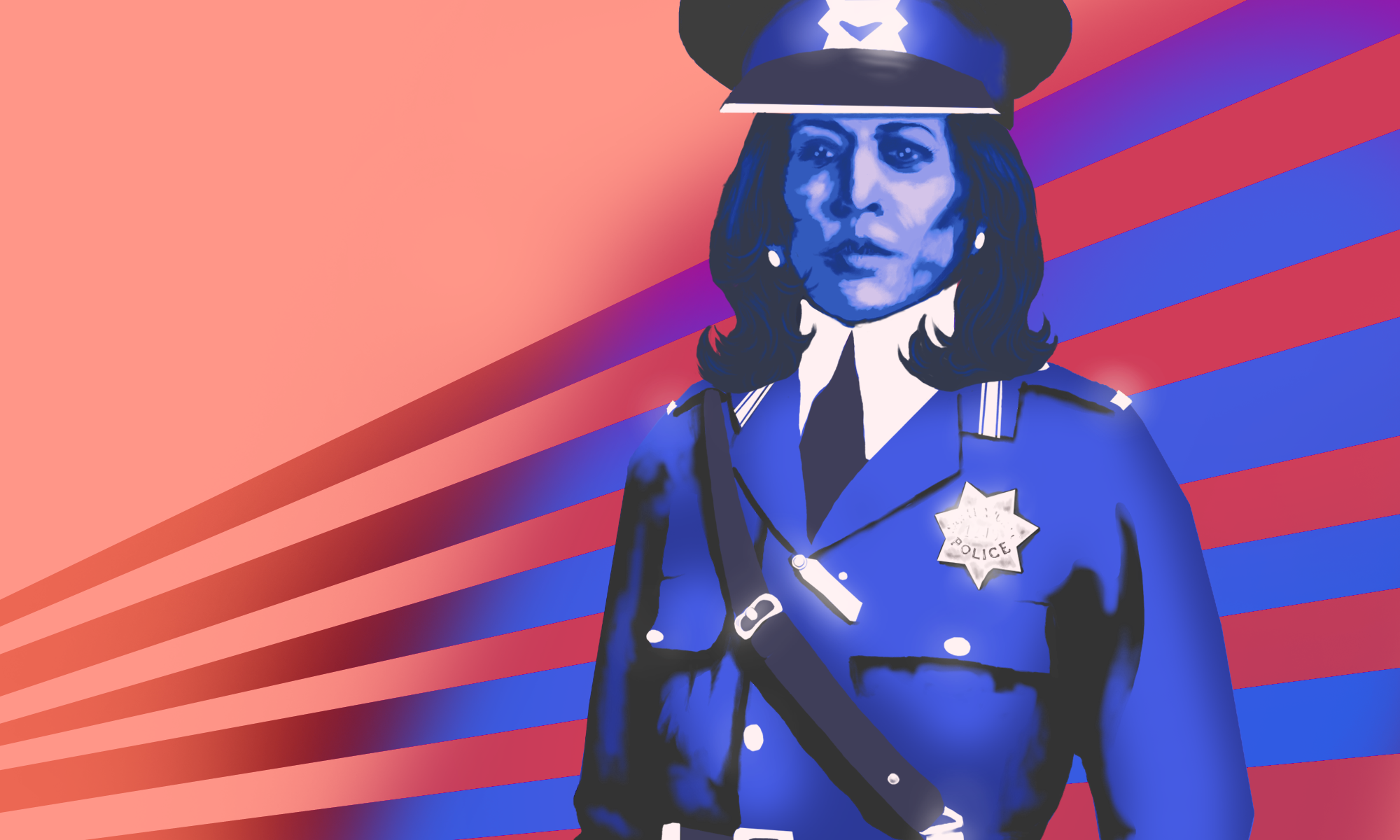
The meming into existence of candidate Harris that took place online this summer featured a fantasy of the vice president as a steely feminine version of Marvel vigilante Captain America, un-fuck-with-able in the iconic spangled blue superhero uniform. In one image, an A.I.-generated Captain Kamala faces off against a certain orange-hued — now orange jumpsuited — prisoner. Her own sleek bodysuit sparkles with sheriff’s stars at the belt buckle and breastplate; her shoulder pads are trimmed with silver and red. Here, unmistakably, is light versus darkness, “Momala” versus the rapist-in-chief, civilizational order versus unbridled lawlessness. This framing of the 2024 U.S. presidential election was mirrored in the mainstream media. The Guardian cast the race as “prosecutor Kamala Harris” against “felon Donald Trump”; a New York magazine headline described it as “The Cop Against the Criminal.” The Manichaean showdown between putative opposites doubles as an old-fashioned battle of the sexes: the Democrat is not just a cop, but a woman cop.

When Kamala ran last time around, her identity as California’s “top cop” — the term she was using to introduce herself as recently as 2016 — was not an asset. After years of Black Lives Matter organizing that drew national attention to the disproportionate police killing of black men and women, anti-cop sentiment was high throughout the 2020 primary. Critics hammered Harris’s history of enforcing laws against truancy and marijuana possession — while inadequately addressing police brutality — during her time as a Bay Area prosecutor and, later, as California’s attorney general. In a January 2019 New York Times op-ed, San Francisco law professor Lara Bazelon called on Harris to “apologize to the wrongfully convicted people she has fought to keep in prison.” At one primary debate, then-Representative Tulsi Gabbard assailed Harris for advocating to “keep a cash bail system in place that impacts poor people in the worst kind of way.” Harris dropped out of the race before the end of 2019, and she likely made the right call, because a revived pandemic-era BLM insurgency hit the streets in May 2020 after a white police officer murdered black Minnesota resident George Floyd.

As Minneapolis’s third precinct burned, liberals grasping for easy solutions to the crisis of American carceralism turned to the figure of the female cop. A slew of pieces in venues from Ms. magazine to the Los Angeles Times called for police departments to hire more women. “Law enforcement agencies do not recruit, retain or promote women at the same rate they do men — even though research suggests that if they did, the nation would see far fewer tragedies like the killings of Floyd, Laquan McDonald, or Eric Garner,” a 2020 CNN piece bemoaned. In 2021, a self-described “coalition of police leaders, researchers, and professional organizations” launched the 30×30 Initiative, which aimed to persuade police departments to ensure women comprised thirty percent of new recruits by the year 2030. Police Chief magazine wrote that law enforcement should cultivate cops with people skills, deftness at “community partnerships,” and care for their neighborhoods. “Recruiting more women into policing is a critical step in achieving these three ideals,” they claimed. 

Pleas for more women cops served as a counterinsurgent alternative to the “defund the police” slogan, which was itself a watered-down version of the call to abolish the police. Now, four years after Harris’s ill-fated primary campaign, what was once a liability has become central to her appeal. “Those ‘Kamala the Cop’ memes certainly hurt Harris the last time she ran,” Elie Honig wrote in New York magazine in October. “But now she wears the label like a badge.” At an August rally in Philadelphia, the day after the party officially offered her the nomination, Harris trotted out familiar boasts about her prosecutorial victories — “I took on perpetrators of all kinds: predators who abused women, fraudsters who scammed consumers, cheaters who broke the rules for their own gain” — before delivering the punchline that has become a sort of calling card: “So, hear me when I say, ‘I know Donald Trump’s type.’” At that, the crowd erupted in applause and chants of “lock him up,” an echo of the line that shocked liberals when Trump fans aimed it at Hillary Clinton.

While the GOP has generally been the more pro-police party, the right is not all that hot on the woman cop. Commentators like Joe Rogan suggest that women are too physically weak to be cops — “it’s not sexist to think that it’s a scary thing to have a 130 pound woman out there on her own, driving around in a cop car with a gun trying to pull over six-foot-four” men, he said in 2017 — and in the aftermath of the assassination attempt on Trump in July, his supporters complained about “female Secret Service agents,” especially those present that morning. Certainly, when a self-described female “top cop” confronts an avowed pussy-grabber on the world stage, the revival of cop feminism — by which I mean the school of representational politics that champions a woman’s touch in policing — comes to seem like a distinctly liberal project. Historically, though, cop feminism has roots tangled with European fascism, and fascism’s traces remain present in the ideology’s modern-day incarnation — even as it’s used to bolster Harris’s campaign to save democracy.”


In the English-speaking world, the ideal of the woman cop originated with a group of felons. The British feminist Mary Sophia Allen was repeatedly jailed as a soldier in the guerrilla “Votes for Women” army led by Emmeline Pankhurst, the militant feminist known for her early twentieth-century Women’s Social and Political Union. Allen had been one of the WSPU’s core terrorism coordinators at a time when the group was pouring acid into mailboxes and planting nitroglycerine bombs in public places. A lesbian, Allen delighted in breaking not only laws, but gender norms as well. She adopted a man’s hairstyle, called herself “Robert” among intimates, and required subordinates to address her as “sir.” By the 1930s, she had become a self-professed fascist who admired Adolf Hitler — and a “Pioneer Policewoman,” per the title of her first autobiography. (I am using she/her pronouns here in conformance with the anxious self-location within womanhood that Allen performed in her memoirs, which bear the pointedly gendered names Woman at the Cross Roads and Lady in Blue.) 

According to her biographer, Nina Boyd, Allen’s early political activity was motivated in part by an “obsession” with “white slavery.” In the Victorian era, newspapers breathlessly reported that young girls were being waylaid and debauched by foreign pimps and traffickers operating in railway stations, or being abducted and locked in padded cells by aristocratic pedophiles. Today, the scholarly consensus is that the phenomenon was more or less bullshit. English prostitutes generally did not recognize themselves as “white slaves,” but the difference between the sex industry and white slavery, in the minds of Allen and others, was nonexistent, or, rather, rightfully located in the eye of the uniformed beholder. Allen adored moral crusades in general and, per Boyd, cared not so much about fighting injustice as about fighting, for its own sake. For her, the suffrage cause was about securing authority for the “right” women: “working women were as far from her own sphere of experience as the elephants at the zoo.”

Allen’s pivot from militant feminist to militant Blackshirt coincided with the outbreak of war. Pankhurst, ailing after a series of hunger strikes — and stirred by the patriotism of the moment — called on the suffragettes to cease their fire against the British government. “The views I have always held I still hold. Nothing is more horrible than wars of aggression,” the formerly socialist WSPU leader said in a November 1914 speech. “But I believe that, whatever faults we have had in the past, now we are engaged in a righteous war.” The sudden stoppage of WSPU’s operations gave many of Pankhurst’s loyal feminist paramilitaries whiplash. Allen felt lost and abandoned. “I won’t pretend we liked it,” she wrote later of Pankhurst’s decision. “We were heart and soul in our fight to gain recognition for women.” Allen was desperate for a substitute vehicle for her fanaticism, and, Boyd writes, she found it with the volunteer police squads “being set up by women who saw an opportunity opening up for them with the deployment of men to the Front.” As a 1915 issue of the suffragist newspaper The Vote put it, “We want women police, women gaolers, women inspectors, and women in more and more departments of police life.” 

Allen soon became second in command of the Women Police Volunteers (WPV), a militia founded in 1914 and later renamed the Women Police Service (WPS). Under the wartime Defence of the Realm Act — a measure imposing martial law on all British subjects — the state commissioned organizations like the WPV to surveil homes, taverns, and munitions factories. The WPV’s raison d’être was to prevent sexual abuse and provide moral assistance to women in need. In Allen’s view, this kind of policing was consistent with the feminist cause, not only because the suffragettes had experienced brutality at the hands of male police, but also because women police could protect women from their own immoral instincts, which otherwise might reflect badly on the gender as a whole. According to Allen, the WPV uniform was so powerful it could combat “subversive forces” with its appearance alone. “It was evident,” she reminisced in 1925, “to all those closely concerned with the maintenance of order, that the uniform was in itself a deterrent, an actual weapon of defense, and that it had also a prompt moral effect.” She donned her cop regalia in 1914 and, by all accounts, was never seen in public without it again — an absurd affectation.

That year, Allen was deployed to Grantham, a town whose population had doubled with the stationing of twenty thousand soldiers. His Majesty’s troops were officially deemed at risk of venereal disease on account of all the loose women swarming around, and the WPV was enlisted to help. Eager to wield her truncheon, Allen exercised her right to enter any house, building, or land within a six mile radius of the Army Post Office, and helped impose the 6 p.m. curfew for single women. In a 1917 service report, the (now renamed) WPS declared that it had “cautioned” 100 “wayward girls”; helped local picturehouses “blacklist” 10 “frivolous” filmgoers; “assisted” 18 “respectable girls”; proceeded against another hundred “prostitutes and disorderly houses”; arrested 16 “drunks, women”; intervened in 24 “illegitimate baby cases”; and reported 10 “dirty houses” to the authorities. The feminist police, by its own admission, spent a lot of time “inspecting lodging-houses” and driving men out of them, separating women “from the company of soldiers,” and reprimanding couples for reclining in “suggestive attitudes” in parks. Allen personally compiled dossiers on women she suspected of performing illegal abortions, and regarded extramarital sexuality — not, of course, her own, but that of the unwashed masses — with abhorrence. 

The British establishment was mostly amenable to Allen’s approach. Members of Parliament were hardly thrilled, of course, by her homosexuality, or the fact that she had such a lurid criminal record. But she had powerful supporters, including the Prince of Wales. She was knighted at the end of the war, and the Cabinet, having been convinced of the moral benefits of “feminine” policing, created an official unit of the Metropolitan Police modeled on Allen’s organization. It was a choice made in an all-too-brief moment of feminist triumphalism: by collaborating with the government, the WSPU had ostensibly won the right to vote in 1918, at least for women over thirty who met property requirements or were married. (It would take another decade for the Equal Franchise Act to pass, removing these restrictions.) Yet even as the police commissioner formed a women’s division, he decided that he didn’t like Allen’s autonomy or suffragette past. She was forced to disband her London units or risk being prosecuted for police impersonation. 

Even though she had no squadrons in London, the name Mary Allen OBE swelled in domestic and international repute. Despite holding “no official standing,” Allen’s militia, now called the Women’s Auxiliary Service, remained active in multiple cities, including British-occupied Dublin. Allen, meanwhile, set out on a world tour, visiting Germany, the U.S., Czechoslovakia, Egypt, Uruguay, Scandinavia, and Palestine. To her delight, she was received almost everywhere as an emissary of the British crown. In 1929, Boyd writes, the Cairo-based magazine L’Égyptienne hailed Allen’s “star-like quality,” calling her “one of the most popular figures of contemporary feminism,” the “Chief of Women Police in England.” And no wonder: the Met’s new women’s division had even adopted the WPV’s uniform design in 1919, and in 1923, the British government hired Allen to consult on methods of policing the occupied Rhineland. If, in the end, the state did not officially absorb her force, it proved willing to partner with and emulate her.

Allen’s most ecstatic hour arrived when the British Trades Union Congress organized a general strike in May 1926 — a Bolshevik display of criminal treason she helped quell. Allen, who dreamed of purging the country of communists, foreigners, and communist foreigners, raised an emergency corps to break the strike. While she herself had, of course, participated in mass anti-government action before the war, she seems to have increasingly regarded that kind of lawbreaking as fundamentally patriotic, pro-British, and even protofascist. She was not the only suffragette who succumbed to the allure of fascism; following Mussolini’s rise, “fascisti” fan clubs popped up throughout the Anglophone world. The historian Martin Pugh writes that some disaffected, adventure-hungry suffragettes recaptured the thrill of “the semi-military style of the WSPU” by joining the British Union of Fascists (BUF), which “couched much of its propaganda in distinctly feminist terms.” When the Equal Franchise Act finally passed in 1928, giving women the vote on the same terms as men, it was seen as too little, too late by many right-radicalized feminists. The WSPU’s former general secretary came to believe, by the ’30s, that “fascism alone will complete the work” started “by the militant women from 1906 to 1914.” 

True to form, Allen took feminism’s flirtation with fascism to its extreme, hobnobbing in the late ’20s and throughout the ’30s with BUF founder Sir Oswald Mosley, Hermann Göring, and Adolf Hitler. She visited Spain, lectured at a pro-Franco meeting in England, and attended the Nazi Olympic Games in Berlin. After the burning of the Reichstag, she recounts in Lady in Blue, “for two and a half hours I sat absolutely entranced beside the Chancellor’s charming sister, listening to the great Dictator.” Hitler’s “hypnotic gestures, his passionate, forceful voice and his visionary eyes held me spellbound.” By turns secretive and open about her affinity for Nazism, she nevertheless often lauded the Führer in print and admitted to a journalist in 1940 that she had joined the BUF. But, she made sure to clarify, her enthusiasm for Nazi Germany was not mutually exclusive with a passion for female policing. “I would work for my country tomorrow — training women for the Services — if I was asked,” she said. 


In 2023, Allen’s picture appeared in a collage that graced the jacket of a new feminist tribute to the NYPD, written by Mari Eder, a U.S. Army veteran. The retired major general’s snappy title? The Girls Who Fought Crime: The Untold True Story of the Country’s First Female Investigator and Her Crime-Fighting Squad. The cover designer doesn’t seem to have cared about Allen’s British nationality, let alone her Nazism: the feminist credentials of a breaker of glass ceilings in the crime-fighting sector, not to mention a first wave suffrage pioneer, were all that was required to qualify for inclusion. A similar logic undergirds the lionization of Kamala Harris by virtue of her veritable litany of “firsts.” She is, as her Wikipedia page recites, the first woman, the first African American, and the first Asian American to be San Francisco district attorney or U.S. vice president, as well as the first South Asian American to be a U.S. senator or California attorney general, and even the “first resident of the Western United States to appear on the Democratic Party’s national ticket.”

Like Allen, Harris had radical beginnings. She portrays her parents as activists who, according to her 2019 memoir The Truths We Hold, “met and fell in love at Berkeley while participating in the civil rights movement.” Harris reports that once, as a fussy toddler, her mother asked her “What do you want?” and she called back, “Fweedom!” with an implied fist in the air. When she told them she planned to become a prosecutor, Shyamala and Donald Harris “at best, found my decision a bit curious.” At times, the frustration sounds like it was mutual. “I like to joke,” tweeted Kamala in 2017, “my sister and I grew up surrounded by adults who spent their full time marching and shouting for this thing called justice.” (It’s not clear what the joke is here, but it’s probably on us.) During a 2012 speech at the Chicago Ideas Week, Harris mocked anticarceral activists, pantomiming holding a placard and chanting “build more schools, less jails!” Though she claimed to agree with the slogan conceptually, the “fundamental problem with that approach,” she said, is that such protesters “have not addressed the reason I have three padlocks on my front door.” For Harris, the solution “is not not having jails, because there are people who do bad things who need to go to jail.” 

In Harris’s case, as in Allen’s, the pivot from radical to cop involved sex crimes. Finding out that her best friend in high school, Wanda, had been sexually abused by her stepfather was, Harris said in a 2020 campaign video, “a big part of the reason I wanted to be a prosecutor,” adding that “the vast majority of my career as a prosecutor was about protecting women and children, including a significant period of time where I specialized in child sexual assault cases.” She told the same story in a speech at this year’s Democratic National Convention, reiterating that she had been motivated by a desire to “protect people like Wanda, because I believe everyone has a right to safety, to dignity, and to justice.” 

As a prosecutor, and subsequently as district attorney of San Francisco, Harris did pay special attention to sex crimes, especially those against children. Even while she sought crackdowns on child sex trafficking in California, she cautioned against the standard approach that entails charging minors with prostitution rather than treating them as victims. This fall, Mackenzie Mays pointed out in the L.A. Times that Harris’s focus on sex trafficking “proved to be a smart political strategy, allowing her record to appear more moderate as she got tough on a crime that her progressive peers calling for less incarceration could not argue with: child abuse.” 

Even as Harris advocated for a more progressive approach to crimes involving minors, she took a hardline stance on sex work. In 2008, according to The Nation, she equated decriminalizing sex work with putting out “a welcome mat out for pimps and prostitutes.” The following year, in Smart on Crime: A Career Prosecutor’s Plan to Make Us Safer, she wrote, “we must arrest the prostitutes as well as the pimps and johns.” At a press conference, she accused sex workers of “terrorizing their neighborhood.” When she was attorney general of California, Harris brought criminal charges against the founders of Backpage.com, the host of a digital marketplace for classified adverts, not unlike Craigslist, that allowed sex workers to more effectively screen clients. (According to Harris, it amounted to “the world’s top online brothel.”) In 2016, her office resisted calls to investigate allegations that dozens of Bay Area cops had sexually exploited a teenage sex worker. As a senator, Harris supported the Stop Enabling Sex Traffickers Act and Fight Online Sex Trafficking Act (SESTA-FOSTA). When asked on a podcast in 2018 for her response to arguments that SESTA-FOSTA and the shutdown of Backpage made sex work “more difficult and more dangerous,” Harris rolled out a masterful non-reply. “Well first of all, I’ve spent a large part of my career — in fact, the majority of my career — working on issues that are crimes against women and children,” she said. “So that’s been part of my life’s work and I’m very, very familiar with the issues.” 

But around that same time, Harris seemed to sense that the political winds were changing. In a 2019 interview with The Root, she answered “I think so, I do” to the question of whether sex work should be decriminalized. Many publications ran with the narrative that she supported decriminalization, but it didn’t stick. This fall, Politico noted that although the Democrats’ 2020 platform included the promise to “work with states and localities to protect the lives of sex workers,” under Harris, the party has made no similar commitment. 

While Harris has flip-flopped on Medicare for All and the border wall, she has held firm in her vision of law enforcement as “a voice for the vulnerable,” especially women and children. This rubric has proven flexible enough to stretch and shrink to fit her sometimes contradictory record. Harris “pushed for programs that helped people find jobs instead of putting them in prison, but also fought to keep people in prison even after they were proved innocent,” German Lopez wrote in Vox in 2019. She declined to seek the death penalty for a man who killed a cop, but also fought a district court ruling that advocates said would have overturned the death penalty altogether. If it sounds inconsistent that Harris sometimes paints sex workers as neighborhood terrorizers deserving of arrest, and sometimes as victims — or that she would crusade against those taking advantage of sex workers while ignoring such a case in her own jurisdiction — that’s because the domain of commodified sex is the field where feminist carceralism’s hypocrisies are laid most bare. 

Harris’s vilification of women in the oldest labor sector is part of a tradition that is threaded through the history of feminism’s right wing. Nineteenth-century and early twentieth-century suffragism was always wracked by internal tensions between some of its activists’ devotion to temperance, purity, and protection, and others’ desire for solidarity and liberation. That same division surfaced at the tail end of the second wave in America, in the form of a new female cultural nationalism propounded by femopessimists like Robin Morgan and Andrea Dworkin, and buttressed by that anti-prostitution, anti-pornography faction’s willingness to envision the armed wing of the state as a feminist weapon. This tendency’s ascendance ushered in a form of Women’s Lib very far afield from the “family abolition” dreams of the movement’s apogee. The new vanguard sought, instead, to use the power of the security state to protect “women and children” against male violence. In a 1975 lecture, for instance, Dworkin called for the creation of “squads of women police formed to handle all rape cases,” and for there to be “women prosecutors on rape cases.” Anti-trans, sex-worker-exclusionary groups of the era, like Women Against Pornography, morally exceptionalized the entire sex industry as a form of “slavery,” demanded mandatory arrests in rape and domestic violence cases, and cheered for female police.

Those demands jumped to the mainstream after 1991, when L.A. police officers almost lynched Rodney King, and for the first time, the proposal to add women and stir was heard around the world. Forget fewer cops, let’s try more and different cops, liberals said — and maybe even lady cops. In 1992, Time published an article called “Are Women Better Cops?”; in 1994, the Los Angeles City Council set a goal of increasing the proportion of women police officers in the LAPD from 14 percent to 43 percent. The possibility that those same lady cops might be especially well-suited to jailing sex workers — compassionately, and for their own good — was a plus. One law professor argued in a 1992 Yale Journal of Law and Feminism article that jail, as a gender segregated space, “is the closest thing many women in prostitution have to a battered women’s shelter.” As late as 2011, the renowned feminist legal theorist Catharine MacKinnon reprised this chorus. While granting that “not being arrested” is “in general a real improvement” for sex workers, she suggested that detention might offer “a respite from the pimps and the street.” It was an idea Harris echoed in Smart on Crime, where she celebrated “making the women agree to follow a court-directed and monitored program of substance-abuse treatment, education, and counseling.”

The theory that women cops can help those they incarcerate thrives thanks to a pop-culture machine that buzzes with kind but firm figures; weary, gun-toting avatars of state-issued gender progress; glamorous shield-maidens of law and order. The first American female cop show was Decoy, which featured the undercover cop Officer Casey Jones and ran from 1957 to 1958. Sixteen years later — not long before Dworkin called for more women police — Police Woman premiered, with its central character, the coiffed blonde Sergeant “Pepper” Anderson, also undercover. Female law enforcement started to more fully come into the light when the NYPD duo Cagney and Lacey took their place on television in 1982. The trope flourished in ’90s entries such as Prime Suspect, in which Helen Mirren plays a glass-ceiling-shattering London detective, and The Silence of the Lambs, in which Jodie Foster plays an FBI agent uniquely suited to understanding the anthropophagous serial killer Dr. Hannibal Lecter, as well as to sniffing out a transfeminine butcher of women. The past three decades have seen Law and Order: SVU, Wonder Woman, Mare of Easttown, Top of the Lake, and Killing Eve, among countless more dramas and procedurals. It’s not hard to understand the appeal of this politics, which envisions a world of law enforcement that is armed yet sensitive.

In real life, women cops aren’t doing the warm fuzzy work that our media imagines. While their own frequent abuse at their male colleagues’ hands is a matter of record, their abuse, in turn, of civilians is equally well-documented. Girl cops, too, strip search and racially profile. Contra the expectation that policewomen are emotionally attuned, sociologists have found that they employ emotionally flat, macho, dehumanizing speech patterns in their dealings with civilians. Perhaps they feel pressure to perform toughness, or embrace violence — a curse that seems to have befallen Harris. In 2016, David Axelrod, Obama’s former senior adviser, speculated that “the image of toughness that comes from being in law enforcement may help candidates repel the biases against electing women to higher office.” In 2024, Harris is clearly leaning on that image. Take her lighthearted confession to Oprah Winfrey that she is a proud gun owner: “If somebody breaks into my house, they’re getting shot.” Or her team’s declarations of “ironclad” support for Israel and her hawkish enmity vis-à-vis Iran. 

Cop feminism dresses up the armed wing of the state in new clothes; it quite literally puts lipstick on the pigs. This feminine filter neutralizes critique, and even when Harris telegraphs herself as tough on crime, tough on immigration, tough on foreign policy — ride-or-die with Israel through its genocide of Palestinians — liberals today are apparently unable to hear anything that comes out of the mouth of a black female Democrat as even a little bit fascist. Meanwhile, from the point of view of those trigger-happy “boys” of ours in whom the public’s trust has been so bitterly eroded since the uprising for George Floyd, the presence of a lady cop-in-chief promises a welcome vibe makeover. Women, so long as they are of good character, show us that policing can be fundamentally moral work: a thin pink line.