

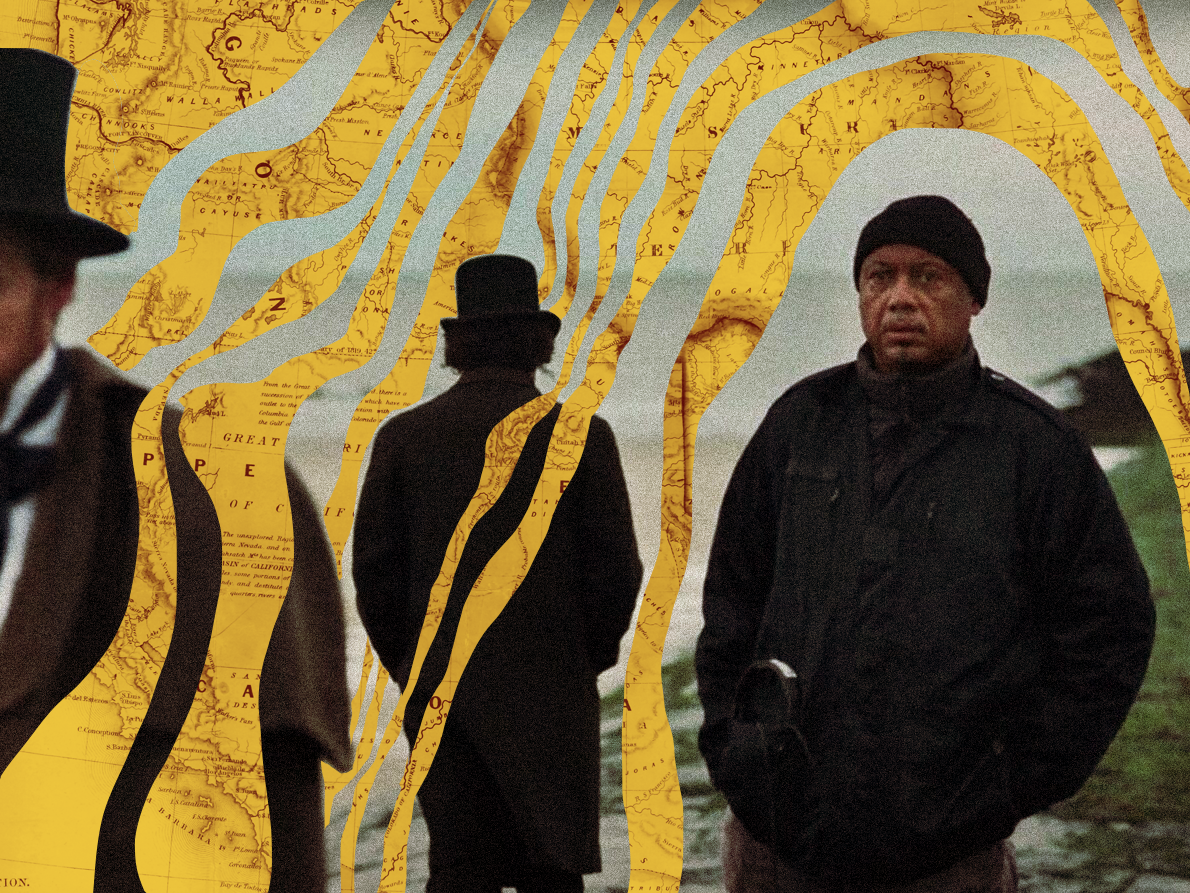
An Indigenous woman steps onto a white beach. Several others follow her carefully, winding their way through nearby palm trees and squinting out over warm Atlantic waters. Coming across the horizon is a single rowboat, white hands pulling the oars. The flag adorning the caravel that looms beyond the smaller boat indicates that they are Spaniards. When they reach the shore, a priest blesses the land, claiming it for the Lord and the Crown. The Indigenous welcoming party approaches, poking and prodding at the trespassers. Pushing leads to punching, punching to choking, choking to stabbing. Soon, the foamy water runs red and pink, and the Spaniards’ bodies are left limp on the sand. Our heroes celebrate the successful defense of their land, and the colonists on the larger ship beat a swift retreat. As the horns of Charles Mingus’s “Haitian Fight Song” blare their final triumphant salvo, the vessel disappears.
Through the four-hour run of Raoul Peck’s HBO documentary series Exterminate All the Brutes, which aired last April, this sequence offers perhaps the sole moment of true, unbothered catharsis. It is equal parts release valve and warning, following the first episode’s hour-long depiction of the unrelenting horrors of European colonization. The brief moment of Indigenous resistance suggests that victorious expressions of violence merit celebration, even if we know what comes next.
Not long after the ship fades from sight, it returns, accompanied by an entire flotilla that spans the full length of the frame. Peck then pulls us from the fateful year of 1492 up to the 1950s, when he was born in Haiti. After five centuries of Native genocides, African enslavement, and Christian missionary movements, Peck begins his own story with his Jesuit school days — a childhood, he notes, on that same island the Spaniards invaded.
Exterminate All the Brutes, which draws heavily from Sven Lindqvist’s book of the same name, is grandiose in scale and unrelenting in detail. Much of the series is set in and around 1492, but Peck also weaves in the era of his upbringing. Marshaling a dazzling array of recreations, archival footage, and family photos, Peck issues a clear, contemporary political message: to understand the America of today we must face the original extermination that made it possible.
“The very existence of this film is a miracle,” Peck says during the narration of the series’s final episode — a statement echoed by nearly every American critic who wrote about Exterminate. “How Peck tells the story of white supremacy,” The New Yorker’s Richard Brody wrote, “matters less than the fact that, at last, it is indeed being comprehensively, insightfully, compendiously told.” Daniel D’Addario likewise paused in his Variety review “to give HBO credit” for airing Exterminate at all — a sentiment shared by Jon Schwarz in The Intercept. “Before this moment in history, it would have been impossible to imagine that one of the world’s largest corporations — AT&T, owner of HBO, with a current market cap of $220 billion — would have funded and broadcast a film like this,” Schwarz wrote. “The fact that it somehow squeezed through the cracks and onto our TVs and laptop screens demonstrates that something profound about the world is changing.”
I’m generally skeptical when I see art lauded for its liberal bona fides (diversity, representation, etc.) — these are grounds for praise that tell us more about the limitations of a white audience than about a work itself. But even for a wary Indigenous viewer like me, it was tempting to come away from Exterminate believing that American society is working, in some way, toward understanding, owning, and teaching its true history. For a brief moment, I was lulled into believing what both Peck and the critics said, that the existence of a radical work on HBO must be a marker of progress — if not for all of the U.S., then at least for its entertainment industry.
But the further away I got from my first encounter with the film, the less I found revelatory about Peck’s thesis and the bloated project around it — and the less I felt comforted by the cooing critics. Exterminate debuted on a streaming service that costs at least $100 per year to access; anyone who clicked knew, to a degree, what they were signing up for — they likely already agreed with Peck’s general arguments, even if they lacked the gory specifics.
While Peck and so many others have been chipping away at the foundational myths of America, conservative reactionaries have only tightened their stranglehold on state legislatures and school curriculum standards around the country, seeking to further entrench the very myths that Peck and others aim to dismantle. By situating his project within these kinds of historical debates, Peck made it a bit too easy for the white HBO viewer — so focused on acknowledging the sins of the past — to forget that the descendents of the tribes they’re watching be decimated are still here, and that their oppression is ongoing. The problem with constantly fighting over historical accounts is that doing so keeps us distracted from the battles that are still being fought — those over political and legal issues, land and water rights, and other matters of sovereignty that determine the lives and futures of our communities. Decolonizing the narrative doesn’t, in itself, decolonize the state.
Peck’s strategy in Exterminate reflects the reality that the physical violence wielded against the victims of colonization, hard as it is to stomach, has always been the easiest and most convenient aspect of colonial history for Americans to understand. Many of the film’s semi-fictionalized scenes feature Josh Hartnett as an unnamed, timeless agent of colonialism, committing excruciating acts of violence. One of Hartnett’s characters puts a bullet in the forehead of a Seminole woman, and his men proceed to burn down her community. Another Hartnett tortures a Congolese man and his son at a rubber plantation, threatening to cut off the son’s hand before shooting the father in the face and having the son saw the hand off his dead father’s body. A Congolese woman carefully bathes another Hartnett as he sits mute, the camera trained on the two of them for several minutes before finally following the woman’s gaze out an open window, revealing the corpses of four men hung by the neck.
Peck understands the impossibility of summarizing the incredible scope of colonial violence: in one animated sequence, a ship’s captain looks on with a dark grin as an enslaved African man plunges over the side of his ship, choosing death over a life in chains. The camera lingers on the man’s body as it descends through the ocean’s depths, coming to rest in a field of human remains gathered on the seafloor, before zooming out until his body is an unidentifiable speck among the bones. Such is the result of trying to capture the story of colonialism in a single shot. To look at one horror and think it any worse than another, this film seems to say, is to miss the entire point of the European, and now American, project. As Peck continually takes pains to reemphasize the extent of the violence, moments like these bring me back to a familiar question: who is this piece of art designed for — the colonizer, or the colonized?
Peck himself provides something of an answer, in the form of a suggested reading and viewing compendium released alongside the series: Exterminate was intended as something of an introductory seminar. It arrived at a time when white liberals appeared especially keen to decode the present by identifying the root of America’s sins. So-called “anti-racist reading lists” proliferated; #Decolonize appeared in Twitter bios; the “1619 Project,” which aimed to recenter the American national myth on the original sin of slavery (while barely engaging with Indigenous sovereignty or genocide), was so swiftly assimilated into school curricula in certain liberal enclaves that it prompted a full-fledged conservative backlash. It’s the kind of work tailor-made for people who advocate for a bigger, kinder welfare state without ever being able to imagine a smaller America.
Making it through to the end of Exterminate All the Brutes is not so easy for viewers who will see themselves and their ancestors among the victims of the crimes Peck so painstakingly recreates. Nor are the less violent, more informative scenes really intended for Indigenous viewers. An animated map, shown toward the end of the opening episode, for instance, visualizes the dispossession of the tribal nations, each one’s name slowly dropping away from its original territory. What new information does this scene provide an Indigenous viewer? The people of my tribe live every day without access to an original speaker of our language, and without a protected, collective land claim to foster together. The historical realities Peck depicts are palpable in our present; does a graphic depiction of this information help us understand our situation any differently? Other tribes have had their cultural and religious ceremonies erased from living memory, their children ripped from their homes and herded into boarding schools. They were forcibly removed. They were massacred. They were starved. Must they sit through four hours of the most traumatizing moments in our histories in order to grasp that our struggles are broadly similar, or that America is a nation founded atop our broken bodies and stolen lands?
Refusing to admit to the atrocities committed against Indigenous peoples is an act of erasure, but when the story of our defeat, subordination, and abuse is the only one told about us, it tends to handcuff Indigenous people to the violence we have endured, pinning us to the past. To accept the reality of how entire communities, languages, religions, and landscapes were destroyed by colonization, you must also accept and center the present-day realities of what has survived.
This is an old paradox familiar to Indian Country: the fact of genocide should not be the center of the American perception of Indigenous peoples, yet without knowledge of it, there is no way to perceive us accurately. The history lessons that works like Exterminate seek to deliver — the ones rarely taught to American children, sometimes even Indigenous children — were passed to me by my relatives in the Sappony Tribe, not my school textbooks. It was in the High Plains community, among my people, that I learned of our treaties with the British, of what remained of our language, and, most importantly, of the subtle ways that our kinship systems had persisted through four centuries of colonized thought. I recognize that there is no way for me to understand myself as Sappony without understanding the violence integral to both our dispossession and America’s formation, but it is also not the sole way I want to shape either my own or anyone else’s understanding of our modern presence. It is but one fractious part of a larger mosaic; it is not the place I would choose to start such a conversation. The problem is, when this is the only piece of the history someone knows, you have nowhere else to begin.
The remarkable thing about Exterminate is not that it exists, nor that it was watched and heard by the select few who watched and heard it. The remarkable thing about Exterminate is that for all the astounding, painful truths it holds, it is essentially a concession. Peck still sands down the edges for broader appeal at the expense of those who know.
Exterminate could have engaged the past, present, and future realities of European invasion radically and with nuance. Instead, determined to service the unaware beneficiaries of colonization, Peck has made a film with a pat message — an exercise in finger-wagging. This is the only way to understand his intense effort to draw a correlation between Indigenous genocide and the Holocaust. Peck recognizes the American impulse to define World War II in moral binaries, and lines it up one-to-one with America’s centuries-long effort to exterminate Native people. “The determining factor of this domination was the willingness to eliminate whole civilizations of people in order to possess their land,” Peck says. Nations do not randomly appear. They are formed by force and by will. The disappearance of any nation or group of nations, likewise, is not a coincidence of history. And yet, the term “genocide” does not appear in American textbooks’ or American history museums’ description of what happened to the continent’s Indigenous nations: genocide, to the American mind, is something that happens in a short time-frame, with a direct intent to exterminate. It comes with a specific set of images: a mustachioed dictator, train tracks, gas chambers. Rather than subvert or circumvent this mechanism, Peck kicks it into high gear.
Fifty minutes through Exterminate’s third episode, Peck lays the words “We do not want to remember,” on the screen. Later, he says in voiceover, “we would rather genocide to have begun and ended with Nazism.” Both Lindqvist and Michel-Rolph Trouillot, a Haitian scholar Peck cites, emphasize that Hitler based the Final Solution on the colonial powers’ attempts to eliminate and control Indigenous peoples in Africa and the Americas; he cited the reservation system as an inspiration. Even beyond Nazi Germany, Peck and Lindqvist both draw a straight line from colonialism to fascism, arguing that genocidal tactics, oriented overseas for five centuries, eventually turned inward. It’s an argument that Peck sprinkles throughout the series, frequently cutting to images of concentration camps to remind viewers that their definition of genocide cannot be selective. By the time he brings us inside a crematorium for a long shot and a conclusive monologue in the final episode, the point has been hammered home several times over.
Peck leans on the Holocaust connection because, I believe, he recognizes the ways that the descendants of the settlers continue to distance themselves from their ancestors’ sins. The film does not explore how German society has reckoned with the Holocaust. Nor does it broach the question of what reparative justice can look like in the U.S. Peck recognizes that Americans don’t just need to remember that they slaughtered the Indians; they need to be convinced that it was a willful act of evil. But in trying to deliver this message, he glides too quickly over what the contemporary version of this evil looks like. It is not just Donald Trump and Bolsanaro red-faced at rallies, or Barack Obama and Hillary Clinton learning that Osama bin Laden had been killed via the code word “Geronimo.” It is not just the insurrection at the Capitol. It is the existence of the Capitol and the everyday actions of those within it. It is all of it, the very fact of a state that exists on the basis of the extraction and occupation of Indigenous land. The evils of colonialism are not over; they are ongoing. The crime is not in the past, accessible only through reenactment. You can witness it today.
Attempting to revise the official story of American origins always demands a delicate balance between past complexities and present context. In his 1969 book Custer Died for Your Sins, Vine Deloria, Jr., shows how the foundational genocidal policies of the Department of the Interior and the Army Corps of Engineers have shaped the way our contemporary federal government interacts with tribal nations and communities. Roxanne Dunbar-Ortiz’s 2014 book An Indigenous Peoples’ History of the United States, which Peck cites extensively, concludes with a call for a radical reconfiguration of the continent both “physically and psychologically,” starting with the return of land and water rights to the tribes. More recent works, like Lakota scholar Nick Estes’s Our History is The Future and Ojibwe scholar David Treuer’s The Heartbeat of Wounded Knee, which Peck does not cite, provide not only clear-eyed visions of our histories, but also straightforward prescriptions for how to reckon with them and exercise our treaty and sovereign rights. Meanwhile, Peck holds us in the past. There is power in remembrance, as he reminds us in the film’s opening monologue. But in keeping the audience’s heads turned backward, Exterminate ultimately does little more than add a coat of polish to an old, familiar story.
Last July, I visited the Smithsonian’s National Museum of the American Indian, located steps from the Capitol Mall in D.C. I’d already been to the one in New York, which abuts Battery Park at the southern tip of Manhattan. It was a depressing affair, rooms sparsely populated with exhibits and visitors, but I had maintained hope that the D.C. branch would offer something more. In quantifiable terms, it did — more exhibits, more art, more representation. But on the fourth floor, things fell into the usual pattern. There, visitors are greeted by a presentation on the political relationship between tribal nations and the U.S., which focuses on the litany of treaties signed and then broken by America. Beside each entry is a two-columned description titled “VIEWPOINT.” It offers one perspective from the “Native Nations,” and then another from the “European Nations,” “Pennsylvania Colony,” or “United States.” Even in the “Bad Acts, Bad Paper,” portion of the exhibit, which reviews U.S. President Andrew Jackson’s forced removal of many Native nations from the Southeast, visitors are shown the American viewpoint, which leads with a paragraph about how some historic allies like Davy Crockett felt the Trail of Tears “violated the law and honor of the United States.” It of course never questions how honorable the United States was, or whether its laws were built on the violation of Indigenous people.
The institutions that shape and disseminate the American story, including the Smithsonian, Hollywood studios, and state curriculum boards, have only begun to recognize the extent of the nation’s malicious past. Many American school systems — public, private, charter, home, the whole lot — still fail to teach the history and modern state of tribal nations. In most curricula, our very existence is consigned to the nineteenth century, and our contemporary situation is left out of the story. Indigenous histories, when they are taught, are framed as features of the past, keeping intact the idea of a national moral arc and obscuring the ongoing legal, environmental, and social struggles of tribes today. “It’s not an exaggeration to say it’s brainwashing,” Cheyenne and Arapaho author Tommy Orange once told me.
In twentieth and twenty-first century mainstream American film and television, Indigenous life has had narrow possibilities. We’ve had stints as backdrops, props, and villains. We are the root of audiences’ deepest horrors in works like Pet Sematary and Poltergeist; we are the decorations that ease children’s comprehension of an ordained nation in Pocahontas and Peter Pan; we are a tool for white protagonists’ redemption in Hostiles, The Searchers, The New World, Dances With Wolves, The Last of the Mohicans, and Wind River. Sometimes, oftentimes, we are nothing more than playthings (see: The Ballad of Buster Scruggs, The Ridiculous Six, Pathfinder, Twilight, Navajo Joe, and more). The supposed factual accuracy of documentaries doesn’t solve much: how many people’s understanding of history has been shaped by Ken Burns’s The West or Lewis and Clark, both of which portray the colonies’ westward expansion as inevitable, an American destiny, and both of which aired nationally on PBS and hauled in millions of viewers on their initial runs?
To pat HBO on the back for the existence of a cultural product like Exterminate is to miss the reality of the narrative most Americans continue to be taught. For every advancement, more powerful backlashes lurk around the corner. In July 2021, The Wall Street Journal’s Editorial Board lambasted the National Education Association for promoting “the lie that America has made little or no racial progress and therefore its legal, economic and political systems must be turned upside down.” In mid-May, at a school board hearing in Forsyth County, Georgia, the county’s Republican Party chairman, Hunter Hill, ranted about the county’s diversity, equity, and inclusion policy enacted in 2017, calling it “a Marxist Trojan Horse disguised with sunshine, rainbows and a bow on top,” which could only end in “white repentance.” North Carolina’s State Superintendent of Public Instruction, Catherine Truitt, was filmed in early June bragging to the Orange County Republican Party chapter about removing from the state’s educational standards glossary the terms “systemic racism,” “gender identity,” and “systemic discrimination.” In the same state, House Bill 324, which would “prohibit teachers from promoting concepts that suggest America is racist or that people are inherently racist or sexist,” was passed by the Republican-held state legislature before being vetoed by its Democratic governor — meanwhile, thirteen different governors happily signed similar bills protecting against challenges to our national mythology.
Altering dominant narratives remains a politically fraught pathway for tribal communities. Take the case of Old Main STREAM Academy, an elementary school planned for children in the Lumbee Tribe in Robeson County, North Carolina, in 2018 — a two-hour drive from my hometown. Unlike federally-recognized nations, state-recognized tribes like the Lumbee — and my own — are denied an official relationship with either the Department of Interior or Congress, meaning the Lumbee Tribe has no real control over its school curriculum (or its healthcare, courts, or law enforcement). The charter route, then, is the most expedient way for Lumbee educators to create an Indigenous-centered education experience. In their application for charter status, the Old Main team cited as inspiration Sandy Grande’s Red Pedagogy: Native American Social and Political Thought, which argues that the participation of Native peoples in American school systems “was a project designed to colonize Indian minds as a means of gaining access to Indian labor, land and resources.” When the time came for the state charter board to review the application, the complaints raised by those holding the keys weren’t surprising. Lindalyn Kakadelis, a white school board member, vocally opposed approval of the school because upon reviewing Grande’s work, Kakadelis “did not find one thing in the book that talked about the greatness of America.” The country “has sins,” she conceded, but “we learned from them and we’re changed and we’re not what we used to be.” She opposed the creation of the school. Even board member Olivia Oxendine, who is a Lumbee citizen as well as a former Republican politician, told the Old Main leadership that their upper-grade material was too much “‘America the oppressor,’” and not enough “‘America the land of opportunity.’” The school’s application was voted down four to three.
We are only allowed the power to remember ourselves as long as American myths remain clearly dominant. Cutting through the same Lumbee community that sought to open Old Main, there is a highway, one that stretches across nearly the entire southern border of North Carolina. For most anyone in the western or Piedmont part of the state, it’s the fastest way to the coast. The official name of this road, the one that flashes by on green road signs every fifty miles or so, is “Andrew Jackson Highway,” save for in one brief stretch, when you hit Robeson’s county line — there, the signs read “American Indian Highway.” There is your history, Indians, the state said. Savor it and do not forget it.
As we continue to move away from the true horrors of outright Indigenous slaughter and into a more nebulous era of coexistence between the colonizers and the colonized, we must be careful not to get too comfortable. Statues and holidays commemorating colonizers are toppling, but the oppressively paternalistic political and economic systems they created still thrive.
In the years following Trump’s election, liberal attitudes toward original American “sins” have confused the landscape. “Rather than mine the past for usable politics,” historian Matthew Karp wrote in a recent Harper’s essay, “thinkers now travel in the opposite direction, from present injustice to historical crime.” The Confederate symbolism displayed at the January sixth Capitol riot is framed by mainstream Democrats as yet another blood-soaked opportunity to come together, while the New York Times’s “1619 Project” wins a Pulitzer Prize. But holding the hand of our oppressor or heaping praise on the Times does not challenge America’s right to exist, nor does it ask white liberals to give up the empire that made them dominant. Just as the descendants of America’s slave trade and Jim Crow policies are entitled to trillions of federally-sourced dollars in reparations, Indigenous nations should be economically, legally, and politically free from the settler state. But neither aim feels neatly compatible with the aims of white progressives, because such initiatives demand an actual shift in political and financial power. Narrative reckonings can be good starts; as Michel-Rolph Trouillot wrote in his 1995 book, Silencing the Past: Power and the Production of History, “The ultimate mark of power may be its invisibility; the ultimate challenge, the exposition of its roots.” But it’s not enough to locate the roots; we must rip them from the earth.
The exchange of power and land is what most frightens the individuals and institutions that are supposedly on our side. Unwilling to go back to a naive belief in the pure and virtuous roots of the United States, but equally unwilling to give up control, they try to compromise. They lend their voice, but not their hand, with the universal language of the Indigenous Ally: the land acknowledgement. Well-meaning museums, universities, art forums, and plenty of others use it — something like “We stand on Lenape lands” is the typical phrasing. This is empty symbolism. Institutions that perform land acknowledgments, essentially pointing to the people whose land their founders stole, without attempting anything that might right the wrong, exist in a nebulous space between apathy and empathy. The statements present as good practice for any organization seeking to perform its guilt or shame for the public, without actually requiring them to fundamentally shift their position or repatriate their lands. The ultimate goal for many activists is not to arrive at a place where everyone knows who used to own the land — it is to set about restoring that land, and undoing that harm.
There are, of course, moments that break through the apathy. The 2016 protests against the Dakota Access Pipeline at Standing Rock sought to reject a project that threatened the health and safety of Standing Rock Sioux Tribe citizens, though during the brief period of media attention, stories still focused more on the optics than the movement’s goals. Since Marlon Brando had Sacheen Littlefeather accept his Academy Award for The Godfather, non-Native celebrities often become the protagonists of news stories about Indigenous attempts to demand basic civil and human rights. The #NoDAPL protests were no exception: Jane Fonda and Mark Ruffalo drew awareness to the cause, reminding us that we can’t always draw it ourselves. Coverage of Standing Rock, other pipeline protests, extractive Native child adoption practices, or congressionally underfunded Indian health and social services have rarely centered the sovereign status of tribal nations. This leaves us and our allies to make a moral case, while the legal case — based on treaties the U.S. continues to ignore — is left on America’s cutting room floor.
Rulings in favor of tribal sovereignty are indeed taking place, even if they draw fewer white eyes. In July 2020, Justice Neil Gorsuch, a Trump appointee and a reliable conservative, penned the Supreme Court’s decision in McGirt v. Oklahoma. In the case, which concerned the jurisdictional ability of the state of Oklahoma to prosecute Mvskoke (Creek) citizens for crimes committed on their treaty lands, Gorsuch found that Congress has never exited or renegotiated the treaty it signed with the Mvskoke Nation in 1866, and that criminal prosecution of Mvskoke citizens in certain instances must be pursued by either tribal law enforcement or the feds. As a result, the ruling noted, much of the eastern half of the state remains legally Native land. For once, there was no celebrity out front being performatively arrested, no drum circle to film, no images of dogs being sicced on Water Protectors. “Oklahoma replies that its situation is different because the affected population here is large and many of its residents will be surprised to find out they have been living in Indian country this whole time,” Gorsuch’s decision read. “But we imagine some members of the 1832 Creek Tribe would be just as surprised to find them there.”
At the same time that McGirt reemphasized the legal precedent for treaty-based land claims, international movements like Land Back, led by Native organizers, began to advocate for the return of land and water stewardship to tribal nations. In the midst of a two-decade drought worsened by human extraction and pollution, tribes and pueblos along the Rio Grande and Colorado rivers are beginning to enact and enforce their own water regulations. Native advocacy groups like NDN Collective are counteracting racist housing policies, policing, and schooling in places like Rapid City, South Dakota while pushing national climate policy grounded in recognizing Indigenous sovereignty and traditional knowledge. With such urgent and challenging movements at hand, it feels a particular waste to spend four hours graphically reiterating the many ways Europeans and Americans found to kill us over the course of centuries.
Many citizens of the U.S. would likely echo a desire for better Native voting and healthcare access and more economic stability for individual tribal nations and communities. But the idea that we could reclaim what was stolen — that they could cede control — is still far afield from the aims of any white liberal, progressive, or leftist, even those who happily deconstruct the myth of America’s founding.
Any lasting progress must be won in court. Still to this day, we must enter the colonizer’s legal system and ask for our treaties to be upheld; we must go before their politicians to ask that our sovereignty be restored and respected; and we must go before their school boards and ask that they merely recognize our continued existence beyond the massacre at Wounded Knee. Some Americans are certainly becoming more cognizant of their country’s genocidal ways and are even becoming increasingly sympathetic toward Indigenous communities. But a great many more are merely calcifying their long-held position — that America is a nation founded by God’s will, and that all subsequent acts of erasure and theft and betrayal were merely the Lord’s way of delivering salvation to a lost people.
The ways America has chosen to remember are insane, and pathetic, and fucked up, and enraging. Rick Santorum’s take on pre-contact Indigenous societies is more representative of the American median than Raoul Peck’s, and our educational system is held hostage by those terrified at the prospect of having to loosen their grip on the reins of history. We have been stuck on the same ride since that landing party rowed ashore in Haiti 529 years ago, an endless cycle of excuses, blind eyes, and bad faith.
The day before I visited the museum in D.C., I found myself standing on the banks of the Anacostia River with a good Diné friend and colleague. We were talking about what it was like to be from an East Coast tribe, particularly one that had been located in the heart of the lands now called Virginia — not the first or most severely struck point of European contact, but the place that would serve as a Ground Zero for American colonization nonetheless. My friend looked out over the waters and said they sometimes thought about what the land and nations looked like in the moments just prior to Europeans’ arrival. I watched as fireworks in the distance flickered on the slow-moving waters, waters whose fish are no longer safe to eat. I said the only thing that came to mind: that I wanted to stop being forced to consider what came before and what came after; that I now think instead of what could have been for us had that landing party in Haiti, so hauntingly depicted by Peck, been the first and final victory.
At the end of my D.C. trip, I boarded a flight to Raleigh. I was on my way to High Plains, the heart of our Sappony community, which lies along the North Carolina-Virginia border. For two weeks, I had been on the road, traveling across Indian Country to report a story on tribal consultation and consent — a tribal nation’s right to have a say over what happens to its sovereign lands and waters. I had been stewing over the inequities my tribe continues to face because it is denied the federal recognition, and subsequently the sovereign rights, that I was reporting on. Pulling into the driveway of my great-grandparents’ home — known to my community as the Big House — that anger began to fade. It was replaced by something else. Not that desire I voiced along the Anacostia, the desire for alternate past and futures, but the thing I wish Peck had sought to capture more of in his work: I was greeted by hugs and handshakes, love and warmth, the heart-breaking sense of togetherness that a year-and-a-half of pandemic life had robbed from us. It’s not that my gripes with our political and legal reality had dissipated — we deserve federal recognition and so much more. But at that moment, surrounded by our people, the ones who had somehow survived all the violence and chaos that eventually followed that flotilla of Spanish ships, I couldn’t help but let slip a faint smile. Standing there, watching my 95-year-old grandfather’s eyes twinkle at the sight of all of us together again, I realized that what I sought from Peck, and what I seek from anyone trying to tell the disturbing tale of the past, is the recognition of a simple truth, one that cannot be denied no matter how hard any American tries: we are here.