In December 2021, employees of the prominent New York-based architecture firm SHoP — most famous for designing landmarks like the Barclays Center, the Brooklyn Tower, and 111 West 57th, the thinnest supertall skyscraper in the world — announced they were seeking to form Architectural Workers United, the first professional architecture union in over seventy years. Organizers told the press that they had been driven to unionize by mismanagement, an inconsistent overtime policy, increasingly unsustainable conditions, and sixty- to seventy-hour work weeks — one former employee was hospitalized for pneumonia after a 110-hour week.
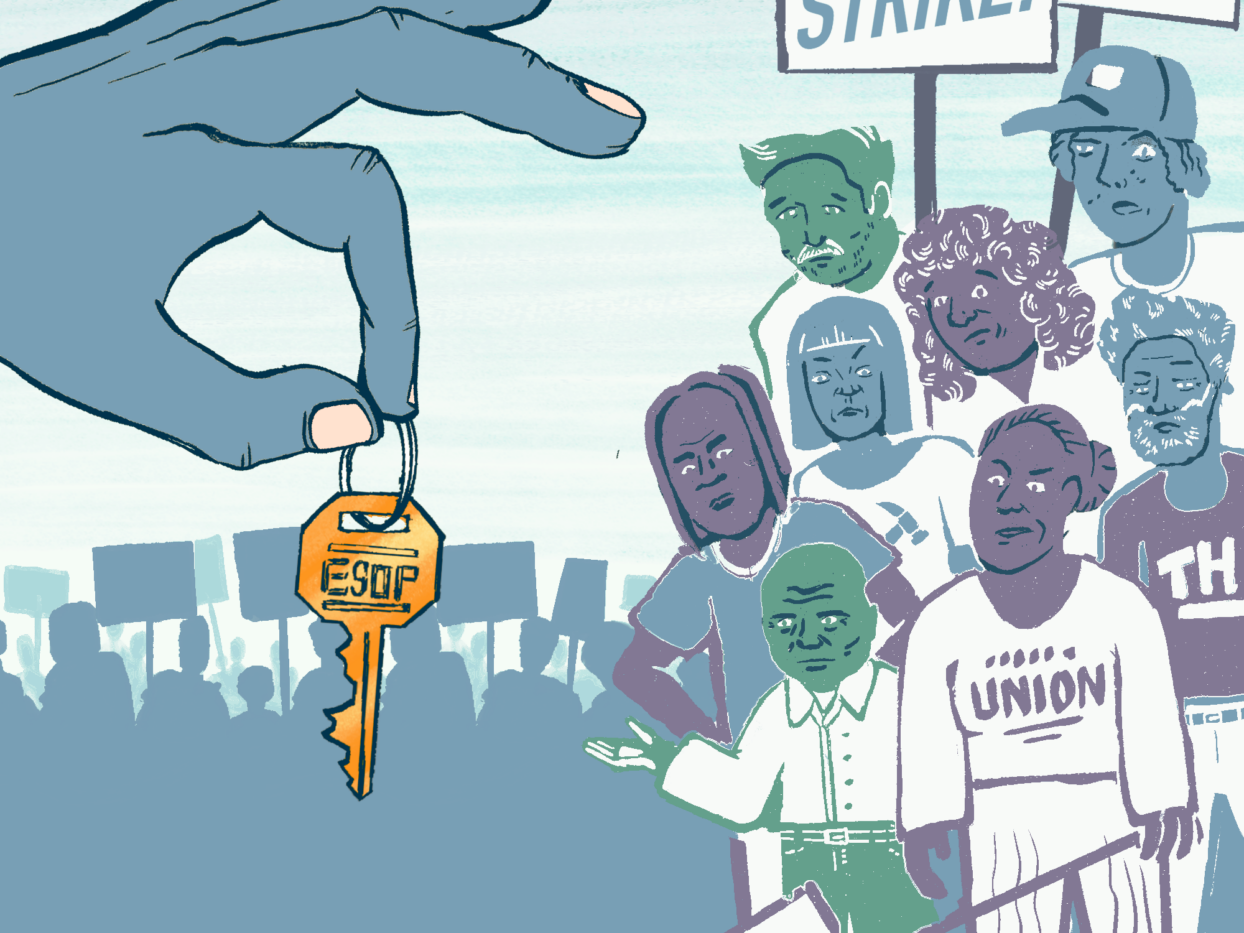
But the effort soon collapsed. According to former employees I spoke with, the firm’s “powerful anti-union campaign” pushed an alternative company advisory committee and an employee stock ownership plan (ESOP), even going as far as to incorrectly tell employees that if they unionized they would lose eligibility for the stock plan. Instead of bargaining rights, SHoP workers would get to collectively “buy” the firm’s stock. In a telling choice of words, management reportedly framed the new model as the “third way” forward, in lieu of either the status quo or unionization — the workplace equivalent of the liberal free market politics of Bill Clinton and Tony Blair.
Per the National Center for Employee Ownership, as of 2023 — the most recent year for which data is available — there were 6,609 ESOPs in the United States, comprising about two trillion dollars’ worth of assets and involving over fifteen million participants. The supermarket chain Publix runs the country’s largest ESOP, but few other companies involved are household names. There are forces trying to change that. Over the past decade, politicians on both sides of the aisle have embraced the idea that workers should own more of the fruits of their labor. The Republican Party’s 2016 platform explicitly endorsed ESOPs, saying they “enable workers to become capitalists” and “expand the realm of private property.” The Democrats didn’t mention ESOPs by name that year, but similarly vowed to “incentivize companies to share profits with their employees on top of wages and pay increases.” Senator Bernie Sanders put forward his own employee ownership model, which would have mandated that large corporations offer their employees stock and have 45 percent of their boards elected by workers. In 2024, the Harris-Walz campaign promised to “make it easier for businesses to let workers share in their company’s success” through mechanisms like “employee stock ownership” and “profit-sharing plans.”
The Trump administration has been especially receptive to the ESOP lobby, which spent six figures rallying support for the nomination of Lori Chavez-DeRemer as Secretary of Labor. During a keynote address to the ESOP Association last May, Chavez-DeRemer said that “the Trump administration recognizes the real transformative power of employee stock ownership plans.” In October, the Senate passed the Employee Ownership Representation Act, which would add two new ESOP representatives to the federal advisory council that oversees pension and benefit plans. The Retire Through Ownership Act, which would clarify valuation standards for ESOPs, was also advanced by unanimous vote.
The press has cast employee ownership as a balm for capitalism’s troubled soul. Articles and op-eds in favor of the practice have been published in magazines from The American Conservative to Jacobin. Profit-sharing “deserves to make a comeback,” declared Robert Reich in The New York Times in 2020. The Financial Times concurred in 2023: “Business leaders have styled themselves recently as stakeholder capitalists,” one editorial read. “What better way to demonstrate that commitment than to turn more of their stakeholders into capitalists?” In April 2024, Fast Company asked, “Can employee ownership improve capitalism?” The article’s three authors, all part of the Aspen Institute, answered with a resounding yes: employee-owned companies, they said, “show we can have an economy that is successful not only in producing great wealth, but also in sharing it with the people whose labor helps create that wealth.”
Yet if history is any guide, experiments with employee ownership typically end up juicing returns for the investor class rather than benefiting workers. Profit-sharing and employee ownership sound like a nice deal for workers as long as there are profits to share. The question is what happens when there aren’t.
The titans of industry who pushed the first experiments with employee ownership in the Gilded Age sought explicitly to overcome “the seeming antagonism between capital and labor,” as the robber baron Leland Stanford put it in an 1887 interview regarding his advocacy for cooperatives. A generation later, John D. Rockefeller Jr. devised his own scheme to improve “relations between Labor and Capital” when he was beset by bad publicity following the murder, by the National Guard and a hired militia, of over a dozen men, women, and children at a strike at one of his Colorado mines. In collaboration with the consultant William Lyon Mackenzie King (who would later become prime minister of Canada), Rockefeller Jr. advocated for corporations to combine company unions with programs to incentivize employees to buy company stock. Members of the labor movement viewed these schemes with skepticism and even outright hostility. When the stock market crashed in 1929, and workers who had put money into their employers’ stocks lost big, critics’ suspicions were validated.
After World War II, during the so-called golden age of American capitalism, profit-sharing and employee stock ownership regained momentum, with some union leaders pushing for plans that provided bonuses tied to companies’ successes. Modern profit-sharing models emerged in the 1970s, after the Employee Retirement Income Security Act of 1974 created a retirement scheme allowing employees to own shares in their companies: the ESOP. Louisiana Senator Russell Long became an important advocate for the bill in Congress after the idea was introduced to him by the lawyer and political economist Louis Kelso. Over dinner, Long reportedly gushed to Kelso that it would “make haves out of the have-nots without taking it away from the haves” and called it “the kind of populism I can buy.” A few years later, the senator told a think tank that ESOPs would “make our form of government and our concept of freedom prevail over those who don’t agree with it.”
The advent of ESOPs decidedly did not accomplish that, but the program did allow owners who sold their companies to reinvest the proceeds in other securities, deferring capital gains taxes. This made ESOPs incredibly attractive to private equity firms, as they could use ESOPs to delay — or perhaps even avoid altogether — significant capital gains tax liabilities. “A private equity firm could theoretically defer taxes almost indefinitely by continuing to roll sale proceeds into new transactions,” explained Pete Stavros, then a business student at Harvard, in a 2002 paper. And ESOPs held an additional advantage for corporations beholden to large, organized staffs. “ESOPs were used to save struggling companies in unionized industries,” Stavros continued. “Using an ESOP, a company near bankruptcy could often convince its labor union to accept certain cost-cutting measures such as lowering wages and/or closing plants.” The idea was that employees, by becoming owners, would be trading present-day concessions for future stock appreciation. This manipulative tactic was soon used to hasten the dismantling of unionized companies entirely.
For instance, in 1985, famed corporate raider Carl Icahn promised employees of TWA that if the company chose him over a despised rival bidder, he would form an ESOP. The airline’s two primary unions, the machinists and the pilots, took roughly $145 million in annual wage concessions in exchange for a share of the profits and twenty percent of the company’s stock through the promised ESOP. When TWA filed for bankruptcy in early 1992, that ESOP became worthless. Despite running the company into the ground, Icahn left with hundreds of millions of dollars in profit.
United Airlines — which became the country’s largest ESOP in 1994 — soon followed the same playbook. Faced with layoffs, staff unions agreed to convert nearly five billion dollars in promised wages and benefits into employee-owned stock that became worthless when the company filed for bankruptcy less than a decade later. ESOPs, as Stavros put it, were “a means of achieving liquidity” when private equity firms and corporate raiders were stuck with companies “for which the public markets have limited interest.”
After the 2001 collapse of Polaroid and Enron, which both had ESOPs, it looked like the programs had finally been unmasked as the scam that they were. Enron had used its ESOP to match employees’ retirement contributions with fraudulently inflated company stock. At that point, the Department of Labor began to clamp down on the abuse of ESOPs, especially the practice of overvaluing companies, which can leave employees with inflated and toxic assets. All this, according to Stavros, made “a resurgence in ESOP activity unlikely.”
About two decades after he graduated from business school, Stavros would become global cohead of private equity at the investment firm KKR. In 2022 he led the effort to raise $19 billion — the group’s largest fund until that point — to acquire companies in which he then installed a “flagship employee stock-ownership program.” (The following year, KKR acquired the publishing house Simon & Schuster, giving its 1,600 staffers the opportunity to become “employee-owners.”) He also founded a nonprofit called Ownership Works, which, according to its website, partners with private equity firms including KKR, Leonard Green & Partners, and Warburg Pincus to implement its proprietary employee ownership model across portfolio companies “not only because it’s the right thing to do, but because it’s also good business.” In 2024, Stavros started an entirely separate company, Expanding ESOPs — which, though still in its early stages, aims to promote ESOPs by advocating for legislative and regulatory change. Per the website, Ernst & Young, Deloitte, and JP Morgan are among its “coalition members.”
Stavros has routinely told a personal story to explain his career-long interest in employee ownership. On a 2022 episode of “Meet the Leader,” a World Economic Forum podcast, Stavros said that his father, a unionized construction worker, often complained that there was “no incentive” and “no alignment” between management and laborers at his job. “My dad always wanted profit sharing in his union,” Stavros concluded. He’s repeated this anecdote in interviews with the media teams of firms like McKinsey & Company and Goldman Sachs, and in news outlets including NPR, Bloomberg, and The New York Times. The Wall Street Journal parroted this origin story almost verbatim, calling Stavros “the son of a road grader for a construction company who sought but never achieved profit sharing.”
Stavros is not alone in framing employee ownership as a boon for the working class. “Workers power our economy,” the website of private equity supergiant Blackstone declares. “Blackstone believes that being attentive to the wellbeing of its portfolio companies’ employees is foundational to building successful businesses.” To that end, Blackstone announced a broad-based employee ownership program for “most” employees of any large U.S. companies it buys out in the future. Blackstone started with Copeland, an HVAC company that employs 18,000 people, making it “the largest-ever shared ownership initiative at a private-equity backed company,” per the fund’s website.
Sometimes, the messaging appears to be the point. At the 2022 Milken Institute Global Conference (nicknamed “Davos West”), a panel called “The Future is Employee Owned” featured a partner at Leonard Green and a private equity advisor (formerly a union president), as well as the executive director of Ownership Works. The moderator was the conference’s namesake, Michael Milken — the “junk bond king” famous for developing markets for high-yield, high-interest debt in the eighties. “The future of the free enterprise system as we know it,” Milken told his audience, depends on “making people feel they are part of the process.”
By this logic, regulators are the ones standing in the way of the future of free enterprise. The Department of Labor, Stavros claimed in 2022, has “scared some folks off” from converting companies into ESOPs. But with the second Trump administration has come a new regulatory regime. Daniel Aronowitz, who was appointed last year as chief of the Employee Benefits Security Administration, promised to “end the war on ESOPs” during his appointment hearing. “Congress wants ESOPs and everybody is for ESOPs except for the DOL for the last twenty years,” he said. “I’m going to put an end to that.”
While regulation is still technically in place, alternate worker-ownership models that can operate with less oversight have sprung up. Teamshares, a startup founded in 2019, was named one of Fast Company’s “Most Innovative Companies of 2024” and, as of this writing, is anticipated to go public this spring via a “SPAC” deal that valued the company at more than half a billion dollars. (A SPAC, or special-purpose acquisition company, is essentially a shell company that merges with a private business to take it public, circumventing the more traditional regulatory scrutiny associated with IPOs.) Teamshares’s goal, per the company’s mission statement, is to put a “dent in wealth inequality.” In order to do this, Teamshares buys up small businesses and converts them into worker-owned entities. But that process can take up to twenty years, according to Teamshares’s website. In the meantime, the companies are run by Teamshares-trained presidents, who are typically recruited from, as CEO Michael Brown puts it, “some really great companies — McKinsey, USAA, Tesla, and Amazon.” Acquired companies also serve as captive customers for Teamshares’s suite of “proprietary software, education, and financial products,” including a “neobank,” which exists completely virtually, without physical locations or ATMs, as well as credit cards, business insurance, and health insurance.
In other words, Teamshares is best understood, in the words of a Glassdoor review by one of its software engineers, as “private equity with a smile.” Even though the “mission is positioned as transformative,” a separate review by a former employee explained, Teamshares “resembles a PE firm with a different narrative.” That review pointed to Teamshares’s habit of bringing on “corporate-trained managers, who rely on spreadsheets and data-driven models rather than deeply understanding the business, its culture, and its people.”
Unhappy employees of Teamshares-owned companies also took to Reddit in 2024 to complain. Their comments describe incompetent presidents (“He spend [sic] all his time on a computer or on the phone with his boss”), poor distribution of shares (“I quit 6 months ago. Just got an email today that they ‘forgot’ to issue my shares”), and all-around mismanagement. “Before they bought the company they told us how everything is going to stay the same and we’re going to get dividends from the company’s profit and will be able to retire with the money from our shares,” one contributor explained. “I never got a single dividend.”
Teamshares claims that its work will help address the “small business succession crisis.” This crisis is in part a demographic one: baby boomers, the wealthiest generation in American history, are retiring en masse and leaving behind the products of their relatively prosperous lives, including once-profitable small businesses. Owners saddled with assets of dubious profitability have been left looking around desperately for someone to take them off their hands. With ESOPs, Teamshares, and similar models, they’ve found their buyer: the American working class.
Private equity, ironically, is also facing the consequences of the succession crisis. According to research from Bain & Company, the industry is sitting on a backlog of 31,000 unsold companies, worth in total $3.7 trillion — a number that may be grossly inflated. As economic forecasts have grown cloudier and interest rates have risen, firms are finding it harder and harder to unload their assets. Unable to find buyers and unwilling to realize their losses, firms have been limited to selling assets to one another and, at times, to themselves, through so-called continuation funds that allow them to move underperforming assets between different funds and buy time for hypothetically better exits. According to the Financial Times, about a fifth of all private equity sales in 2025 involved continuation funds, up from twelve percent the year before. Industry heavyweights have likened secondary markets such as these to “Ponzi schemes.” Per Bain’s annual report on private equity, the industry is in need of a “persistent liquidity” solution. The current employee ownership push could be just that — draped in lofty rhetoric about alignment between Main Street and Wall Street, employee and employer, labor and capital.
In a photo Stavros posted on LinkedIn in August 2023, he’s sitting next to Bill Clinton in a sunny dining room, listening to the former president talk about employee ownership, which the caption describes as “a classic Clinton ‘third way’ initiative.” The post also thanks the host, Lynn Forester de Rothschild, for opening up her home for “a weekend of great conversations.” In 2020, de Rothschild founded the Council for Inclusive Capitalism with the backing of a group that billed itself as the “Guardians of Inclusive Capitalism” and included the then-future prime minister of Canada, Mark Carney, as well as the leaders of Salesforce, DuPont, Bank of America, State Street, Johnson & Johnson, and Ernst & Young. The council won the support of the late Pope Francis, who called it a step toward “an economic system that is fair, trustworthy, and capable of addressing the most profound challenges facing humanity.” De Rothschild is less sanguine. “We’re not going to just turn on a switch and make greed go away,” she said in an interview. “But one thing that’s nice about being connected to the Vatican is a Christian principle of redemption and forgiveness.” (De Rothschild was recently accused by Ghislaine Maxwell of introducing Prince Andrew and Jeffrey Epstein.)
Older models of employee ownership and profit-sharing, whether from the Gilded Age or the postwar golden age, attested to the vitality of working-class politics. Labor was on the march, and capitalists had to come up with tricks to mollify their workers. But today, there is far less of a labor movement to mollify — let alone one that could mount a unified opposition to ESOPs. Instead, parts of the left have been swept up in the enthusiasm. “What ESOPs is about,” Bernie Sanders said on the Senate floor in July, “is empowering workers to say you’re not just a cog in the machine, you’re not going to be thrown out the door. You have a say in how the company runs, you’re a decision-maker. You’re not just a worker. And that’s a big deal.”