

Mentions | Issue 16
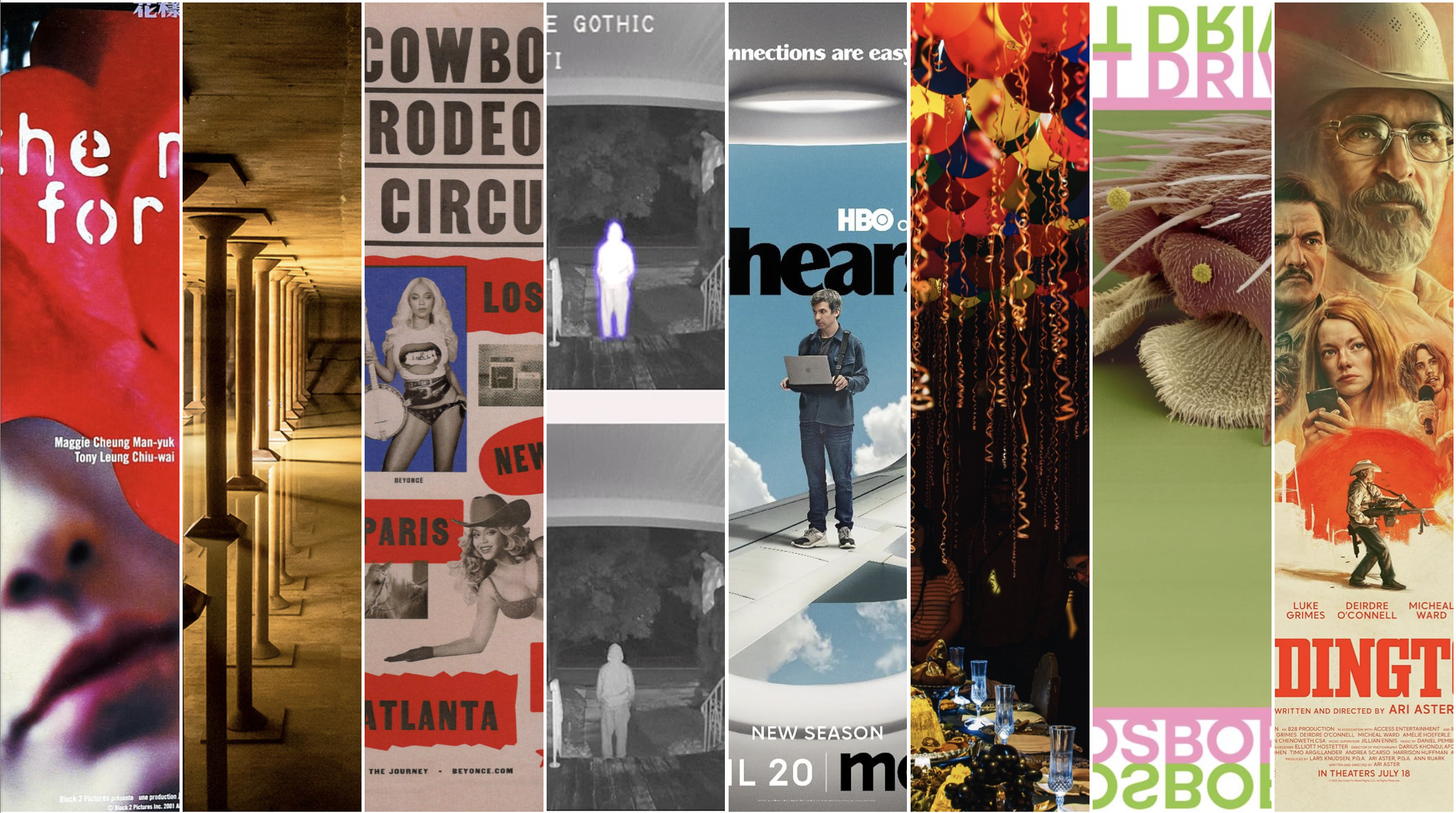
In the Mood for Love 2001 |
FILM
After the rose-toned feast that is Wong Kar-wai’s 2000 opus, his short of the same name released the following year — and recently revived at IFC — goes down like a digestif. Maggie Cheung and Tony Leung return as a miraculously magnetized pair of strangers, but this time they meet in an ice-blue Y2K convenience store instead of in a shabby-chic 1962 apartment building. The film is less a sequel than an alternate universe, one that is frothy and absurd; the star-crossed lovers bond over concurrent nosebleeds and spend much of the nine-minute runtime in a cake-smeared makeout, the frame dominated by her hands in his conspicuously un-gelled hair. At last, Mr. Chow and Mrs. Chan get to fool around, uncoiffed.
I.A.
Mussolini: Son of the Century |
TV
According to director Joe Wright, every camera used to shoot this eight-part series bore a sticker that read “this machine kills fascists,” a nod to the famous inscription on Woody Guthrie’s guitar. But the finished product lacks the moral clarity of, say, Guthrie’s “Tear the Fascists Down.” Rather than mocking or belittling fascists, Wright chose instead to explore the libidinal allure of squadrismo through sequences of gratuitous blackshirt violence set not to folk but to EDM. If there’s a critique buried somewhere in here, it’s been lost amid the social media flood of what can only be described as Sigma Mussolini fan edits.
T.B.
Six books called Audition |
LITERATURE
Two novels with this title came out in the U.S. this year. Katie Kitamura’s is about an actor playing multiple roles in her family. Pip Adam’s is about an audient spaceship fueled by the speech of its imprisoned giants. Four other Auditions precede them: Stasia Ward Kehoe’s young-adult novel in verse, Barbara Walters’s autobiography, Ryū Murakami’s horror novel, and Michael Shurtleff’s how-to guide for actors. Each is good — Kitamura’s is the best — but only Adam’s has a great title.
B.G.
Dourifs imprisoned in hospitals |
FAMILY MATTERS
Take a moment to consider the beguiling, poignant symmetry in the series of events that have befallen members of the Dourif family. In The Exorcist III (1990), the brilliant, reliably batshit Brad Dourif plays the Gemini Killer, a possibly possessed and highly charismatic lunatic, straitjacketed and stashed away in an empty wing of a Washington, D.C. hospital. (He had to put up with the same business in One Flew over the Cuckoo’s Nest, but the Gemini could eat Billy Bibbit for lunch.) Now, on HBO’s The Pitt, Brad’s daughter Fiona plays Cassie McKay, one of the attractive, harried E.R. doctors, who cannot leave her workplace without being arrested thanks to a court-mandated ankle monitor. Both are charming and clever; both flail bitterly against the sinister forces confining them (for Brad, it’s the demon Pazuzu; for Fiona, it’s the Pittsburgh probation court). None of the nurses at Pittsburgh Trauma have been decapitated, as they were in The Exorcist III’s Georgetown University Hospital. But there’s always next season.
P.S.
Foreclosure Gothic |
FICTION
In FENCE editor Harris Lahti’s debut novel, houses aren’t the only things that are torn apart and rebuilt. With tight, lyrical prose, Lahti follows a father and son duo, Vic and Junior Greener, as they flip foreclosed homes around the Hudson Valley. The two meet an assortment of mysterious characters, like the seven-foot tall garbageman who leaves a grease stain when his head hits the Greeners’ ceiling, or the wealthy, incestuous couple who may or may not keep their mother chained up, or the twins with shotguns who confront Vic to try to get their uncle’s smut collection back from the Greeners’ latest flip, only for Vic to pay them to help rip up the carpet. There isn’t much closure in Foreclosure Gothic, only a reminder that, while none of us ever go home again, we never really leave it either.
R.W.
The Rehearsal |
TV
Nathan Fielder’s HBO show made at least one thing clear: between the rotating cast of babies raised as a single baby in season one, and Fielder’s turn as a diapered man-baby being raised as a baby-baby in season two, the man is fascinated with babies.
A.G.
Les Rencontres d’Arles 2025 |
EVENT
Europe’s “Mecca of photography” tried to position itself as radical this year. The theme of the 56th installment of the annual festival was “Disobedient Images,” in celebration of the role of the photograph as “an instrument of resistance.” Yet none of the dozens of exhibitions on view included any mention or image of the genocide in Gaza. (When artist Nan Goldin projected the word “GAZA” behind her on stage as she accepted the Women in Motion award, several attendees walked out.) An even clearer expression of defiance came from the unaffiliated documentary studio Doubledummy, which staged a counter-festival drawing attention to work by Gazan photographers to critique the festival’s omission. It turns out photos can only become instruments of resistance when they’re given the space to be seen.
A.D.
“An Evening with Francis Ford Coppola” |
DISQUISITION
After a showing of his attempted magnum opus Megalopolis this past summer at the Chicago Theater, the director wheeled out a whiteboard that listed ten concepts he believes we must abolish in order to promote human flourishing. The first three were time, money, and work. Perhaps Coppola’s rebellion against the latter explains the many factual errors in his lecture, including his misdating of the Dead Sea Scrolls, which he claimed are ten thousand years old and predate the Epic of Gilgamesh. But the crowd didn’t challenge him. The first audience question was whether Marlon Brando really ate cheeseburgers in a canoe.
B.S.
Second Sacred Concert |
ALBUM
Duke Ellington turned toward God near the end of his long, mostly secular career. The King of Big Band Jazz released two religious albums in the sixties, the second more emphatic and riveting than any in his career. This aptly named 1968 record is like a faith-led IMAX event — all horns and crashing cymbals, with plaintive strings replacing his usually lithesome piano. On one track, the Swedish vocalist Alice Babs, whose range spanned three octaves, sings an operatic scat arrangement that contains no actual words. Duke called it “TGTT,” or “Too Good to Title.”
W.D.
Autoportrait |
BOOK
An early work of autofiction so effective that it renders its successors all but unnecessary, French artist Édouard Levé’s slim 2005 volume consists of nothing but statements about the author: “I sing badly, so I don’t sing. Because I am funny people think I’m happy. I want never to find an ear in a meadow.” The sentences, set down almost, though not entirely, at random, are detached and flat, but produce an almost miraculously coherent effect. As protagonist, Levé both surprises and grows into a familiar type: the artist struggling with despair. Levé took his own life in 2007, ten days after turning in his following book, Suicide, which elaborated on a story in Autoportrait. But here, you can see him puzzling through possible reasons to live. “Some day I will wear black cowboy boots with a purple velvet suit.”
A.L.
Howard Gardiner Cushing: A Harmony of Line and Color |
VISUAL ART
The grandson of opium smuggler John Perkins Cushing, little-known outside of Rhode Island’s toniest quarters, may be best remembered for his association with the artist Gertrude Vanderbilt Whitney, who founded a museum of some repute in New York. Cushing’s retrospective at the Newport Art Museum’s “Cushing Gallery” confirms that his own work was largely unremarkable, save for some delightfully outré Orientalist-inspired paintings. (One study for a mural cast Cushing’s redheaded wife Ethel in a kind of harem scene, flanked by turbaned attendants.) The exhibit was organized by a guest curator, following layoffs in 2024 of the museum’s entire curatorial staff for reasons that remain murky, and co-sponsored by Blackstone CEO Stephen Schwarzman — perhaps in an attempt to ingratiate himself with locals in the wake of controversial (and probably sinkhole-causing) construction on his new mansion.
R.N.
Ghost Driver |
FICTION
It’s difficult for novels about neurotic losers crushed by indifferent bureaucracies to avoid the long shadow of Kafka. But in her debut, English writer Nell Osborne manages to achieve a grimly comic sensibility that feels distinctly her own. The narrator of this tale of misery and doom has a gift for Customer Service Voice and a strong grasp of the passive-aggressive potential of an overly cheery exclamation point.
S.R.
Cowboy Carter and the Rodeo Chitlin’ Circuit Tour |
MUSIC
“America Has a Problem” is on the set list of Beyoncé’s tenth concert series, but after the visual onslaught of stars and stripes one would be forgiven for assuming the production designer forgot. The nearly-three-hour spectacular was rife with Americana, from classic Cadillacs to cardboard cutouts of bald eagles, and featured a video interlude that included a dizzying Attack of the 50 Foot Woman homage in which a gargantuan Bey traipses across past world landmarks, stopping to light her cigar on Lady Liberty’s torch, and get winked at by the Lincoln Memorial. Do the troops feel respected by the product managers in assless chaps removing their bejeweled cowboy hats for Queen B’s rendition of “The Star-Spangled Banner?” I didn’t ask, and they certainly wouldn’t tell.
G.A.
Rio Tinto Kennecott Visitor Experience |
TOURISM
Just south of Salt Lake City, you can ride a six-dollar company shuttle to the edge of the Bingham Canyon Mine, the largest open-pit excavation site in the world. (Signs along the way warn workers to “control the hazards.”) Like “Spiral Jetty,” the region’s more famous earthwork, the copper mine will leave you thinking about scale; from three Empire State Buildings up, ore-toting trucks appear planktonic. But even more mind-bending than the view is the experience of reading about Rio Tinto’s “environmental stewardship” on their website right after staring into an abyss that was once a mountain.
C.L.
75 Hard |
SELF-IMPROVEMENT
This trendy exercise program, created in 2019 by podcaster and supplement entrepreneur Andy Frisella, went viral on TikTok during the pandemic and has remained popular in hustle culture circles. Frisella boasts of “winning the war with yourself” through “transformative mental toughness” over the course of 75 days. Adherents are given, among other tasks, a daily reading goal: ten pages of any self-help book. This endearingly petite morsel of homework is supposed to be roughly as difficult as the other assignments, such as drinking a gallon of water or completing two 45-minute workouts (one outside, regardless of weather). According to the program’s introductory email, “audiobooks DO NOT COUNT.”
O.N.
Viola’s Room |
THEATER
The target audience for The Shed’s latest immersive offering appears to be bats: visitors are instructed to surrender their phones, remove their footwear, and “follow the light,” only to be repeatedly plunged into pitch blackness, groping along corridors like penitents in a haunted house stripped of actors and fun. Based on a wisp of a gothic tale about a princess obsessed with a moonlit maze, the nearly hour-long guided crawl across grassy carpets, sand, and gravely symbolic set pieces feels at once too long and too short. (Daisy Johnson wrote the somnolent script, which is conveyed to us, in Helena Bonham Carter’s feathery ASMR voice, through bulky headsets.) Any feeling of suspense is mostly of the will-I-get-a-fungal-foot-infection variety.
R.F.
Eddington |
FILM
An almost palpably self-satisfied Ari Aster frames his latest overstuffed foray as a Western from the very first shot: a lone man shuffling past tumbleweeds into a town at the edge of civilization. But this Covid period piece is also garishly festooned with “2020” motifs, from surgical masks, iPhones, and water-leaching data centers to hypocritical Black Lives Matter protesters and a socially distanced fundraiser where Pedro Pascal slaps Joaquin Phoenix (twice). Then Antifa flies in on a private plane. The film made me long for the comparatively subtler Beau Is Afraid and its giant penis monster.
J.S.-G.
“Goose Gazette” Subscriber Chat |
NEWSLETTER
Hannah Neeleman, the Mormon tradwife behind the infamous Ballerina Farm, joined Substack in the spring to “share things close to my heart,” including lasagna and focaccia recipes, a tribute to her deceased father, and an announcement about her new Utah farm stand. The real action, though, takes place in the subscriber chat, where fans ask how to store flour and discuss whether pregnant women should eat raw milk ice cream (no response from Neeleman, but Ballerina Farm’s soft serve is pasteurized). Recently, posts soliciting donations for Gaza converged with Neeleman copycats boosting their own channels. Commenters seemed divided on whether the chat should stick to “home life topics,” raising the question: what would Jesus report as spam?
D.H.
The Shrouds |
FILM
David Cronenberg is the only working director who understands what the fuck is going on with technology right now. The Shrouds is post-late style, so stilted that it seems a cross between a filmed theater production and a dream. Silver fox Vincent Cassel, a clear Cronenberg stand-in, delivers his lines with an eerie intensity A.I. could never replicate. The Promethean hope of conquering death — an ambient obsession across Silicon Valley — is revealed to be a mere conduit for the expression of psychosexual hang-ups. The scariest moment of the film comes with the reveal that Cassel’s character drives a Tesla. Beneath the intellectual carapace, Cronenberg has the heart of a comedian.
M.F.
Prins |
BOOK
The narrator of César Aira’s 2018 novella has left behind a lucrative career as a writer of genre fiction to become a full-time consumer of opium. “The human is no more than a format, the content is left up to chance,” he thinks. The same goes for the novella, which recounts dreamlike stories of getting high, having sex, and being the one person uniquely situated to save a world teetering on the edge of oblivion. The world of the book, for all its secretive sages, potent substances, and labyrinthine architecture, is knowable, at least to César Aira. It is Buenos Aires. The novella is, so far, less so for Anglophone readers: it has not yet been translated into English.
B.H.
GovDeals.com |
MARKETPLACE
This municipal auction platform with a bare-bones, Craigslist-style interface offers a welcome, albeit strange, respite from the excesses and pop-up ads that plague most online shopping experiences. The site describes itself as a “liquidity services marketplace,” providing a centralized portal for offloading government surplus, though it is impossible to know the true provenance of whatever item you’re buying, save for the seller and their location. (Whose 1.2-carat marquise diamond ring is this, and are they still looking for it?) Items up for grabs as of this writing include a pallet of years-old MREs (Meals Ready-to-Eat); a half-dozen CPR dummies, clustered together as though languishing in a Boschian hell; and a little white church in rural Illinois with a positively post-apocalyptic interior (starting bid: $19,900).
C.Ch.
Midnight Is Not in Everyone’s Reach |
FICTION
António Lobo Antunes offers Greater Lisbon’s answer to The Sound and the Fury’s Compson family, complete with its own self-drowned firstborn, near-mute youngest child, and middle son of the usual type (estranged, violent, involuntarily celibate). The Caddy stand-in, and only daughter, narrates a final visit to her childhood summer home. Deftly rendered in English by translator Elizabeth Lowe, the novel is a nonlinear, minimally punctuated onslaught of memories, interspersed with refrains of unattributed dialogue that give voice to furniture, plush toys, and blackbirds. When the protagonist bids farewell to a grove of pine trees beside the house, their parting message may well echo the sentiment of most readers at the book’s end: “How mean of you to leave us.”
J.E.
The Buffalo Bayou Park Cistern |
TRAVEL
This 87,500-square-foot decommissioned reservoir, built in 1926, lies underneath Houston’s Buffalo Bayou Park, which offers walking trails alongside a mud-colored river and towering overpass supports. Forgotten for years, it reopened in 2016 as a tourist site and performance space called the “Cistern,” a name intended to evoke the monumental Byzantine ruins beneath Istanbul. But the Houston version involves more concrete and more tales of municipal corruption. You can take a guided tour to learn about the city’s history of dubious water sanitation infrastructure, including a memorable anecdote about a three-foot-long eel carcass clogging a downtown pipe. To demonstrate the facility’s seventeen-second echo, the guide encouraged us to scream into the musty darkness. “Leave it all inside the Cistern!” she yelled, as tourists from Dallas howled beside me.
A.K.
Sontag: Her Life and Work |
NONFICTION
Rarely does the doorstopper moonlight as page-turner, but Benjamin Moser’s dazzling 800-page biography deserves a spot in your beach bag. Come for the riveting account of the highest-brow New York intellectual’s life and times, stay for the epic record of her sexual conquests: Annie Leibovitz, Warren Beatty, Rothschild heiress Nicole Stéphane, Joseph Brodsky, Lucinda Childs, Bobby Kennedy. (Sontag loved lists.)
K.V.
80 Clarkson |
DEVELOPMENT
This two-tower development rising over New York City’s West Side Highway contains an eighty-million-dollar penthouse, a one-million-dollar wine cellar, and an 82-foot swimming pool. But it may be more interesting to consider what the building doesn’t have, like nearly five hundred affordable housing units or an outdoor public recreation center — two features that were promised, on a now-scrubbed government website, when the city rezoned the land in 2016 in order to allow Atlas Capital Group and Westbrook Partners to, as they say in the real estate business, go nuts. Atlas and Westbrook shook hands and then promptly sold part of the land to another developer that built a swanky new office building for Google, leaving room for just a third of the proposed units. Those past pledges seem to have been lost in the fog of 80 Clarkson’s private steam room.
J.I.
Buckley: The Life and the Revolution That Changed America |
NONFICTION
My favorite detail in Sam Tanenhaus’s biography of William F. Buckley Jr. is that when the intellectual father of the neoconservative movement got peckish on sailing trips, he liked to raid lobstermen’s traps for a nosh. Though only a minor skirmish in the class war Buckley waged from above, the anecdote calls to mind a preening interview he gave The Atlantic in 1968, four years after Yale had awarded Martin Luther King Jr. an honorary law degree. Dr. King, Buckley sneered, “more clearly qualifies as a doctor of lawbreaking.” Tanenhaus knew and liked Buckley, but the portrait that emerges in this careful book, sketched over the course of three decades of research, makes it hard to share the author’s affection for his subject. Buckley was a covert correspondent of J. Edgar Hoover’s, the secret funder of a newspaper in South Carolina founded to oppose desegregation, a reflexive hawk, a free-market evangelist, and an anti-communist (he was once pleasingly referred to as “McCarthy’s egghead”). In one respect, at least, Buckley has surpassed his old rival Gore Vidal: Buckley’s authorized biography breaks a thousand pages.
C.Co.
Campari red |
FOOD SCIENCE
In 2006, the Campari Group announced that it would stop using cochineal insects to give the company’s namesake liqueur its trademark reddish hue, citing “uncertainty of supply.” In the U.S., Campari switched to a vegan dye, which may or may not include Red 40 — an additive HHS Secretary RFK Jr. hates almost as much as vaccines. It remains to be seen whether Campari will follow other multinational food and beverage corporations, which have informally agreed to phase out artificial dyes. But the time is ripe for a campaign to reindustrialize American insects, and, as the pro-bug barback meme account @moverandshakerco put it, “make Campari bugs again.”
L.M.
