

Mentions | Issue 17
Club Cumming |
MUSIC
The Scottish actor Alan Cumming took over DJing duties at this year’s Winter Words, a literary fest in Pitlochry, Scotland. In the foyer of the local theater, where Cumming has been artistic director for the past two years, a small audience of all ages was treated to his selection of radio classics (“Dancing Queen,” “Umbrella,” “Good Luck, Babe!”) and Broadway show tunes. Between bouncing and belting the words with remarkable fidelity, the host of the U.S. version of The Traitors reassured the ecstatic crowd that this was not his day job. He consistently proved as much by accidentally hitting the space bar on his laptop, interrupting songs mid-flow, and fiddling with some knob to inject a bit of ear-piercing distortion. Gaye and Terrell’s “Ain’t No Mountain High Enough” was paused twice between chorus one and chorus two, before Cumming gave up and pressed “next” (sadly, no such luck with Katy Perry’s “Roar”).
M.S.
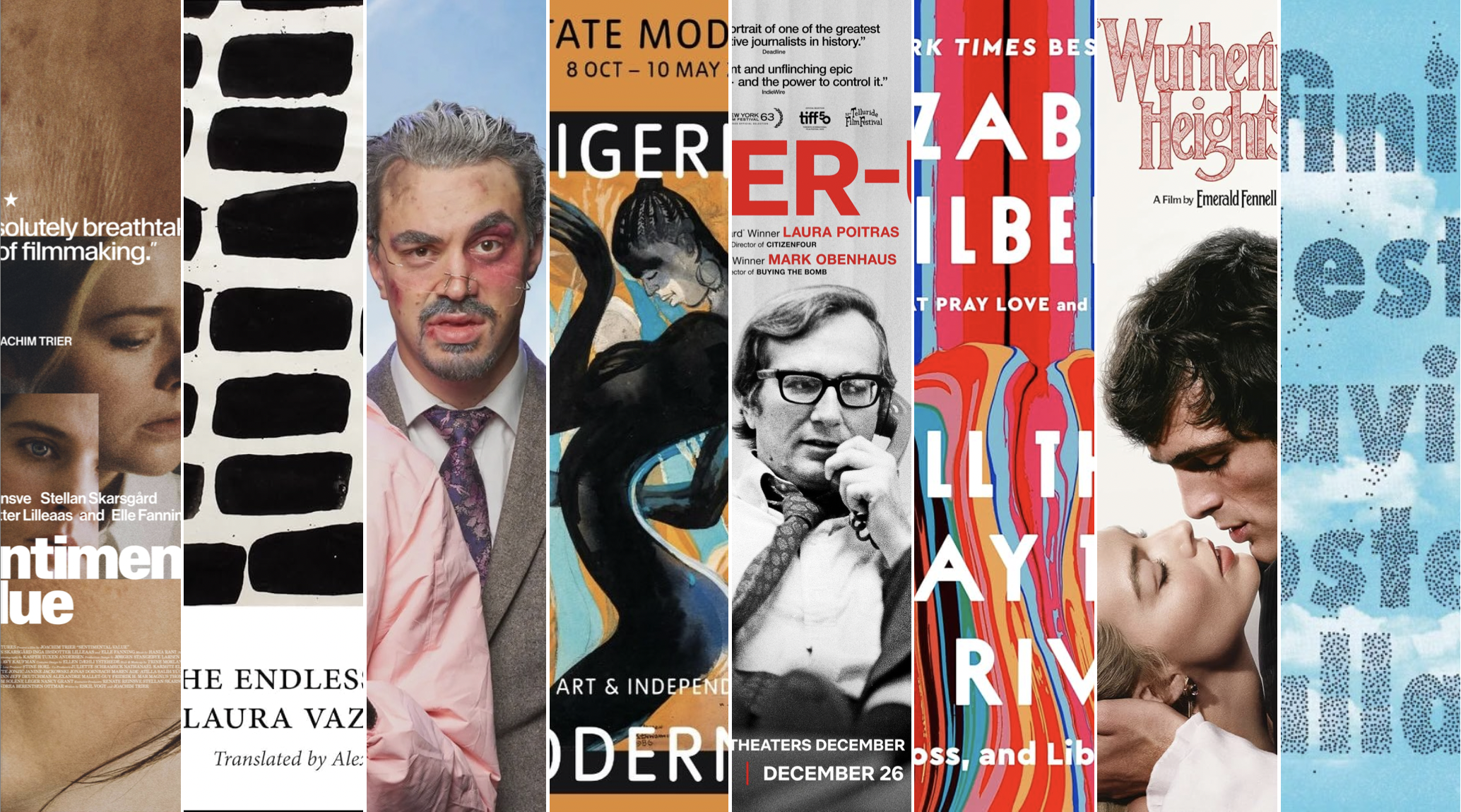
Sentimental Value |
FILM
Some Bergmanesque magic propels this rather intimate and contained domestic drama into a metaphysical meditation (after Persona, which is referenced overtly) on the simultaneously revelatory and obfuscatory power of the cinematic form. The house where it’s set is beautiful and clearly holds significant… well, you know.
M.B.
Gwyneth Goes Skiing |
THEATER
In this unauthorized musical reenactment of the Goop foundress’s high-altitude collision and subsequent lawsuit — which, it bears reminding, she won handily — Linus Karp and Joseph Martin skewer the mogul’s contributions to the wellness-industrial complex while honoring her undeniable panache. The plaintiff’s Mormon lady-lawyer is played by a hand puppet. An enormous cardboard deer croons about being the namesake for Deer Valley. Apple Martin is played by an apple on a string.
M.W.
The Truth About Jussie Smollett? |
DOCUMENTARY
Everyone knows that Jussie Smollett faked a hate crime in a misguided attempt to further his career, but what this documentary presupposes is… maybe he didn’t? The nadir of Netflix’s pseudo-investigative journalism, in which vacillating between an accepted narrative and a far-fetched alternative is the purest benchmark of impartiality, this “RawTV” production may nevertheless justify its existence with a single genuinely funny courtroom clip: just before sentencing Smollett to 150 days in jail, Cook County Judge James Linn tells him that his name has become “an adverb for lying.” If that’s the case, I Smollettedly give this film my ringing endorsement.
J.K.
The Republic |
PERIODICAL
Peter Thiel isn’t the only right-wing ideologue investing in journalism. Palantir CEO Alex Karp acquired a URL from The Republic Journal (which once touted the benefits of hydroxychloroquine as a miracle cure for Covid-19) and, in 2024, quietly began publishing his own not-quite-quarterly version of the magazine. The mission statement promises “contrarian viewpoints,” but contributors range from undergraduates to early-career researchers (including a Koch daughter), a sizable number of whom work at Palantir. The rest hail from outfits like the CIA’s venture-capital arm. You might wonder why Karp bothered with a project like this — until you stumble upon the fifteen different reviews the magazine published of Karp’s own book.
P.O.
The Endless Week |
FICTION
In her unclassifiable 2021 debut novel, recently translated into English, French millennial poet Laura Vazquez recreates the experience of being on the internet, examining how a semi-famous social media personality reckons with family dysfunction. (The answer, at least for teenage protagonist Salim, is to hide in his house for years and to beg his followers to repost his Instapoetry.) While the novel’s prose is restrained, the subject matter is as eclectic and enigmatic as cyberspace itself: mukbangs and video-game walkthroughs produced by eight-year-olds, a childbirth reality competition show, a news segment about a surgeon who carves his initials into patients’ organs.
J.E.
Doors |
VISUAL ART
A good problem is a problem nonetheless. How to follow up a career-defining work so mesmerizing and all-encompassing that whole universes of aesthetic inquiry seem to be born and die in its wake? For Christian Marclay, the answer is simple: just do it again, but looser and lazier. On view recently at the Brooklyn Museum, Marclay’s sequel to The Clock is a supercut of film scenes, each bookended by doors opening or slamming shut. As with The Clock, the viewer’s delight is in chasing one trope into another across film history. Audrey Hepburn evades busybodies in an office corridor. Mia Farrow watches her sinister neighbors through a keyhole. But unlike the work’s longer, more accomplished sibling, scenes begin to repeat almost as soon as they’ve started. Without the grandiose 24-hour superstructure, each new space and face become ripples in an arbitrary current. Here, it seems, when God closes one door, he merely opens another.
R.M.
Mars Yard 3.0 |
APPAREL
Two years after Nike suspended its partnership with the artist Tom Sachs over allegations of cruel, inappropriate, cult-leader-esque behavior toward his staff, the collaboration resumed with the announcement of this sneaker. But only after downloading a dedicated Tom Sachs app, then completing and documenting a series of daily rituals, were the most devout of Sachs followers awarded the ultimate prize: an opportunity to purchase a pair for $275, plus shipping and tax.
T.H.
The Queen of Versailles |
THEATER
In this recent Broadway musical from Stephen Schwartz, Kristin Chenoweth glitters gamely as Jackie Siegel, the former “Mrs. Florida” and wife of billionaire “timeshare king” David Siegel. But the pieces of Jackie’s aggressively materialistic life are fidgeted together into two hours of instantly forgettable musical numbers. The show departs from its source material, Lauren Greenfield’s 2012 documentary, by softening all gestures toward condemning the Siegels’ bottomless appetites — perhaps because the real Jackie has a financial stake in the production. The St. James Theater has become yet another of the Siegels’ pieds-à-terre.
R.F.
Jake Paul vs. Anthony Joshua |
SPORTS
There is a popular GIF taken from Friday the 13th Part VIII: Jason Takes Manhattan in which a boxer tries to fend off Jason Voorhees with his fists. Jason responds with a hellish uppercut, knocking the boxer’s head clean off his body. That’s roughly what the boxing community expected to happen when Jake Paul agreed to fight former heavyweight champion Anthony Joshua in December. Boxing, like poetry, is perpetually dying; every generation likes to think they’re the ones to witness its last great gasp. Joshua did land an uppercut, though it was a straight right hand that ended Paul in the sixth round. The YouTuber’s head remained attached, but watching him spit blood and smile, I recalled that line from Emily Dickinson: “If I feel physically as if the top of my head were taken off, I know that is poetry.”
A.J.R.
Beast Games |
REALITY TV
The world’s least charismatic carnival barker, Jimmy “MrBeast” Donaldson, reemerges on Amazon Prime to coax a new coterie of oafs and cretins through a glossy reinvention of Bumfights.
J.G.
Philip Roth: Stung by Life |
NONFICTION
The latest biography of Philip Roth is slim — fewer than three hundred pages, before endnotes — especially compared with Blake Bailey’s 2021 doorstopper, which was pulped by Norton after the author (Bailey, not Roth) was accused of sexual misconduct. Stanford professor Steven J. Zipperstein engages with his subject’s writing more than Bailey, whose biography is stuffed with trivia about book advances and affairs. Zipperstein finds Michel Foucault haunting the pages of The Ghost Writer and makes a convincing case that one of the novel’s central characters, the writer E.I. Lonoff, was less a portrait of Bernard Malamud than a projection of Roth’s anxieties about his own future. But Zipperstein gets good gossip, too. Like, did you know that Portnoy was originally gay (“A Homosexual Begins His Analysis”)? Or that Roth told Claire Bloom that he would only marry her when Nelson Mandela got out of prison? (Agent Andrew Wylie recalls Roth’s reaction when the civil rights leader was released from prison: “Oh, fuck.”)
A.M.R.
Infinite Jest (Thirtieth Anniversary Edition) |
NOVEL
The jacket for the 2026 American edition of David Foster Wallace’s 1996 tome riffs on the iconic cloud cover of the first, despite the fact that Wallace himself once said that it looked like an American Airlines safety booklet. The U.K. edition, with its Art Deco-esque cover, comes closer to what the late writer had in mind. Wallace first suggested a 1927 photograph of Fritz Lang directing extras on the set of Metropolis. But the original designer, Steve Snider, dismissed that idea as irrelevant to the book. Did Snider actually read it?
B.G.-S.
The Plague |
FILM
Charlie Polinger’s directorial debut follows twelve-year-old Ben at a boys’ water polo camp in 2003, where he finds tentative acceptance among the in-group (they call him “Soppy,” for his speech tic). When Ben befriends rash-ridden outcast Eli, that acceptance turns to hostility, including a harrowing nighttime hazing reminiscent of Full Metal Jacket. Comparisons to Lord of the Flies miss the metaphor in water polo, a sport in which goals and ball handling (adolescent snickers) are ancillary to the real competition — pushing the opponent under without being caught or pushed under oneself. The boys in The Plague are not savage because they anarchically abandon all societal norms, but because they uphold the most crucial maxim of all cutthroat competition: to appear to follow the rules.
E.V.
NFL 2025-2026 sideline hats |
APPAREL
A new hat design has overtaken the league, squeezing the heads of concerned-looking offensive coordinators from Seattle to Foxborough. It’s a monochrome trucker with a miniscule team-logo patch stitched in the center of the crown. These fingernail-sized logos are undoubtedly a marketing ploy to emulate fashion brands’ foray into coy chicness. There are a lot of problems with football — CTE, ligaments torn beyond repair, shameless gambling promotion — but a lack of pageantry has never been one of them. This is a sport where spandex-decked buffalos of men shed single tears while American flags unfurl and F-16s roar overhead. There’s something undignified about a 350-pound lineman sporting a logo the size of his pinky.
O.E.
Cover-Up |
DOCUMENTARY
There are several moments in this film when Seymour Hersh seems paranoid that former Snowden-chronicler Laura Poitras and the documentarian Mark Obenhaus might reveal too much about his life and his sources. (“What the fuck is this doing in your hands?” he asks of some sensitive notes.) But he needn’t have worried. This documentary, now streaming on Netflix, might be framed as a biography of his life and career, but it is recounted as a chronology of the nearly six decades of American war crimes since the My Lai massacre. The story probably could have been told without the contributions of the 88-year-old Substack writer, except there is nothing that could have replaced Hersh’s darting eyes and fidgeting hands — psychosomatic traces of a lonely life with too many secrets. Evidently, there is much about the American war machine to be paranoid about, even more than Hersh will let on. At one point he says, “You know too much about what I’m doing.”
L.B.
A Seventh Man |
NONFICTION
When John Berger won the Booker Prize in 1972, he gave half the prize money to the British Black Panthers and used the other half to bankroll this study of migrant workers, the second of his four published collaborations with Swiss photographer Jean Mohr. The British Panthers collapsed soon after — their demise hastened by the “Black Power Desk” of the clandestine Special Branch of Scotland Yard — but A Seventh Man proved the writer’s most formally ambitious and prescient book, blending photography, reportage, sociology, poetry, and macroeconomic theory. Mohr and Berger traveled across Europe talking to an array of toilers and gleaners, immersing themselves in the new cosmopolitan underclass staffing the engine room of what was only just starting to be called neoliberalism. Verso’s new edition, released in time for Berger’s hundredth birthday, is a good reminder that the critic is at least as deserving of a biopic as Leonard Bernstein, whose distracted effort to raise money for the Panthers gave us the term “radical chic” and no good art.
A.H.
World Jai Alai League |
SPORTS
The so-called fastest game in the world was introduced to the Americas during the 1904 World’s Fair in St. Louis. In the New World, it forsook its roots in the ecclesiastical courtyards of the Basque country to become one of America’s favorite legal carve-outs for sports betting. Increased competition in gambling outlets began eating away at the game’s market share in the 1980s, but in today’s hyper-saturated betting environment, the game’s premier league is making another pitch to stand out on social media. The incessant “Gen-Z intern”-style Instagram posts of the Miami-based World Jai Alai League seek to build a genuine fandom for the sport. A July 2025 post suggests they may have a ways to go: the account’s most frequently asked question is apparently still, “What sport is this?”
L.M.
Shadow Visionaries: French Artists Against the Current, 1840-70 |
VISUAL ART
A recent exhibit at Williamstown’s Clark Art Institute offered an atmospheric tour of mid-nineteenth-century melancholia depicted in the media of the past (printmaking) and the future (photography). The dimly lit compositions of artists like Rodolphe Bresdin, Charles Marville, and Victor Hugo document the ravages of modernization and mourn the loss of medieval France. Yet from the penumbral gloom of forests, catacombs, and spires emerges a wry gothic tenderness, a sense of being winked at. The forests are disappearing; the old Paris is crumbling; in Charles Meryon’s “The Vampire (Le Stryge),” from 1853, a bored gargoyle perches atop Notre-Dame, insolently sticking out his tongue at the circling crows.
V.S.
Heavy Metal |
MUSIC
On Geese front man Cameron Winter’s solo effort from 2024, he evokes the vehement anti-rationality of Gertrude Stein (“names are donuts on the sea”), the freewheeling absurdism of the Beat Generation (“let’s go California on all fours with nothing, babe”), and the earnestness of the New York School poets (“you left me promising your shoes / I need your feet more than you do”). The Gen-Z rocker’s disarming sincerity undercuts his wry nihilism, and vice versa. Toward the end of “$0,” the album’s penultimate song, he repeatedly bellows: “God is real.” Elsewhere, he tells us that “everything is lying.”
E.B.
Bernie for Burlington |
NONFICTION
As much a moving memoir of a particular time and place as a biography of the socialist. Dan Chiasson has penned a lyrical account of power, gentrification, and the history of Vermont. No surprise, then, that right-wing tabloids would try to reduce such a layered work to a few lines about Wilhelm Reich’s orgone machine and Sanders’s early interest in its practical use for revolution.
G.B.
Yentl |
FILM
This 1983 musical about Barbra Streisand cross-dressing so she can study the Talmud really should’ve been a porno. You’ll see what I mean in the scene where the bochurim go skinny-dipping and girlypop catches a tantalizing glimpse of her man’s mezuzah. Sadly, the rest of us have to be content with mere tuchus action.
L.H.
Nigerian Modernism |
EXHIBITION
A dizzying survey of twentieth-century Nigerian objects at the Tate Modern, in which renowned but barely described paintings jostle for attention with other, lesser-known works, all hung too close together. In one room, you can listen to highlife music while perusing record sleeves, issues of a state-run magazine, and old photographs of Lagos. It’s tempting to read this assembly of seemingly random and extraneous things as an inadvertent reproduction of the colonial fair, with its hodgepodge of native curiosities, but in those days they shot and kept actual birds, so, progress.
K.A.
Afternoons of Solitude |
FILM
Albert Serra’s narration-less documentary about Spanish bullfighting delivers cruelty and ceremony in a brutal, repetitive rhythm: bullfights, getting dressed for bullfights, driving to and from bullfights. Matador Andrés Roca Rey grimaces and grunts as he elaborately dodges a series of panting, wounded bulls, before sticking his sword in their spines. Against the noise of the braying crowd, meaning and nothingness meet in a murderous little dance while Roca Rey’s fellow toreros repeatedly tell him how big his balls are.
D.F.
“The History of English” |
PODCAST
This underappreciated series, hosted by attorney and autodidactic linguist Kevin Stroud, begins 6,500 years ago, when the Proto-Indo-European language group started to fracture. From there, he builds a word-by-word etymological epic that turns into a stealth history of the entire world. It’s deadpan, meticulous, and blissfully unproduced; eleven years in, Stroud is nearing two hundred episodes and only in the 1600s, with four hundred years to go. The questions may seem elementary (why does knife have a silent k?), but the answers are invariably thrilling, as with the origin of tartar sauce (a thirteenth-century British slur about Tartars being warriors from hell).
E.W.
Don Giovanni |
OPERA
Ivo van Hove’s baffling rendition of one of the great operas dared to ask: what if Don Giovanni lived in the Barbican? As with so many of our beleaguered opera house’s recent productions, the innovations can be summarily filed under “not adding much.” That said, if we must modernize Mozart, the source material suggests at least one fresh staging: the seducer’s henchman, Leporello, keeps a “little book” of Don Giovanni’s conquests. In the never-ending age of bad men, why not a Don Giovanni set on Little Saint James?
K.V.
The Egg |
DESIGN
Enter any of the modernist megaliths that line Albany’s Empire State Plaza and it becomes nearly impossible to remember where you are, what time it is, and what the outside world looks like. But the Plaza’s many structural horrors pale beside The Egg, a performing arts center less ovoid than its name suggests. With the exterior of a UFO and the interior of a cavernous waiting room, The Egg lives up to its name only in its ability to reduce visitors to a state of fetal dependence.
V.S.
“Wuthering Heights” |
FILM
“Costume designers have been having a hard time recently,” reads the lede of a February Dazed article, which argues that Emerald Fennell’s new adaptation “doesn’t owe you historical accuracy.” The clothes that Margot Robbie wears are indeed ludicrously stylized — often sewn from cheap-looking, ultra-shiny cloths that would shock any Georgian-era aristocrat. On her wedding night, Cathy is wrapped in ruched fabric so plastic and translucent it can only be compared to cellophane. But critics have failed to consider that the script describes Edgar Linton as having made his fortune in textiles — perhaps he was innovating petrochemical-based synthetic blends that the rest of the world had to wait over a hundred years to discover. The moors do hold secrets.
L.W.F.
All the Way to the River |
NONFICTION
When’s the last time someone told you a story you had truly never heard before? That should be the bar for memoir after the first-person revolution. The latest book by Elizabeth Gilbert, about leaving her marriage for her hairdresser-turned-best friend after the latter’s terminal cancer diagnosis, spins into a codependent fantasia (sounds pretty fun for a while), drug relapse (very sad), and supposed murder attempt (reading this too literally would be a mistake) — all recounted in the distinctively flat vocabulary of a midlife, self-diagnosed “love addiction” — tells a completely new story. It’s not really a love story, because Gilbert’s notion of love is impressively unmoored from even its object — why else would Gilbert have never learned that you call your Syrian-American female beloved habibti, not habibi? (Her passion recalls nothing so much as Bertrand Russell’s realization, on a bike ride, that he no longer loved his wife.) Gilbert’s true and only subject is herself, which she plumbs with a Hemingwayesque sense of adventure. She makes it new!
K.V.
The Roses |
FILM
The perfect movie for married couples on the brink of divorce to watch the night before they finally try therapy. The Roses will leave you wondering: why isn’t Olivia Colman in more movies? And why was Benedict Cumberbatch in this one?
J.dR.
The en dash |
PUNCTUATION
Contrary to recent discourse, em dashes are a sign of human intelligence: their alleged overuse by A.I. stems from their demonstrable overuse by H.I., or at least by writers in the throat-clearing stage of drafting. Like human intelligence, the em dash is versatile but exclusionary — it interpolates, interrupts, and, when doubled, censors. The en dash, by contrast, is specialized and inclusive, often used to indicate connection (“U.S.–British relations,” “New York City–based”) and duration (“9–5”). While the em dash is ubiquitous and difficult to truly misuse, the en dash is a rare delight whose niche purposes largely preclude its abuse. Yet the en dash’s specificity renders it susceptible to threat: it has been replaced in most publications (including this one) by the hyphen.
B.G.
