

Mentions | Issue 18
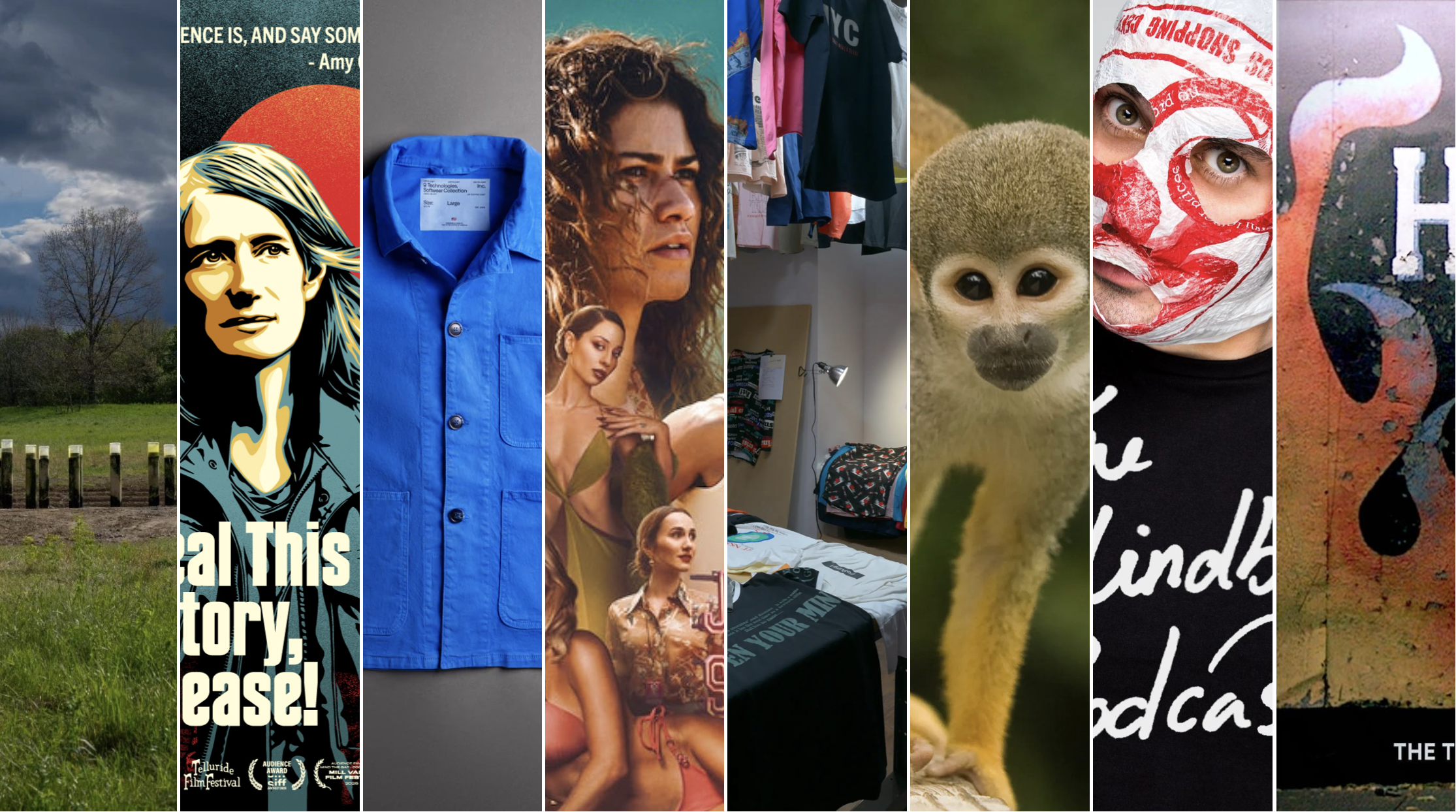
Steal This Story, Please! |
FILM
Scrappy journo-activist Amy Goodman of Democracy Now! spends much of this documentary about her career out of breath. It opens on her chasing a cagey Trump official up the stairs with a microphone. It closes after she reveals why she’s often coughing: the toxic dust she inhaled post-9/11, when she and her team stubbornly continued to broadcast from their Chinatown headquarters. Midway through, Goodman recalls telling The Intercept cofounder Jeremy Scahill that she would work with him only if he stopped smoking cigarettes. I thought of the breathlessness of the news cycle, the many last gasps of independent media. Then I walked out of the theater and lit up.
B.G.
Shannon Cartier Lucy book jackets |
ART
In Anika Jade Levy’s novel Flat Earth, the narrator’s best friend fixates on a painting: “a fully clothed adolescent girl in a bathtub, three sets of adult male hands reaching in to scrub her clean.” The description matches painter Shannon Cartier Lucy’s “Bathtime,” a reference all the more probable given that another of Lucy’s paintings, “Woman with Strings,” is the provocative cover of Earth Angel, a story collection by Levy’s Forever Magazine cofounder Madeline Cash. Indeed, Lucy’s oil paintings of disquieted young women have proliferated across bookstore shelves thanks to the recent spate of female malaise novels. A woman sits vacantly on her bed, heedless of a fire (Jenny Mustard’s What a Time to Be Alive); a man reaches to arrange a woman’s hands (Erin Somers’s The Ten Year Affair); a prone girl balances fruit on her head (Alexandra Tanner’s Worry); a supine girl balances fruit on her head (Lauren Elkin’s Scaffolding); a figure in a nightgown hunches under a sink (Nicola Maye Goldberg’s Other Women); a slumped lady in a raincoat dangles a plastic bag of dead swans (the U.K. cover of Scaffolding). With their subtle abjection and faint residues of brutality, Lucy’s works recall motel rooms. Would that we could illuminate a “No Vacancy” sign above this microgenre.
G.D.
“I Will Survive” (2020) |
SONG
In the music video for ANOHNI’s petrifying cover of Gloria Gaynor’s disco bop, ghosts of the East Village past commingle in spliced archival footage: here’s the late AIDS activist Chloe Dzubilo smoking inside her Sixth Street apartment in 1994; there’s a young ANOHNI onstage at the Pyramid Club, bleeding from a crown of thorns. The beloved British artist-singer’s unmistakable timbre and minor-key meshugaas transform Gaynor’s 1978 classic into a lamentation for all the dead and gone. By the end of the video, Dzubilo’s cigarette is almost out, Christ has fallen from Mother Mary’s arms, and a text overlay informs us, cryptically, that “We will be remembered for what we have done / And for what we are about to do.” The song’s refrain has almost started to sound like a threat.
D.Y.
“Message from the Mud” |
ART
The grass at Storm King Art Center looks lush and well-kept until you arrive at Anicka Yi’s newly installed excavation. In a circle of bare dirt, glowing acrylic columns filled with soil and pondwater emerge from a kidney-shaped pool. The deep black soil blooms with lurid green algae, gesso-like white areas, and ochre stains of bacterial growth. The work could be a Clyfford Still abstraction, or marble from an alien planet; it is unmistakably alive and slowly bubbling. Although Yi’s disruption of the Minimalist surrounding scenery — the landscaped trees, Alexander Liberman’s tubular sculptures nearby, and the impressive ionic columns at the top of the hill — is genuinely jarring, the effect is ultimately serene. Whatever message the mud has for us, the mud will speak it slowly.
C.M.
Palantir’s lightweight chore coat |
FASHION
After some poor soul presumably wished to a mischievous genie to no longer see so many rich people wearing Carhartt, the couturiers at everyone’s favorite Sauron-inspired surveillance-tech giant released their own line of work shirts this spring. “Chaos is Tolerable; Pain is Tolerable / The Only Thing that Matters is to Win,” reads a tag sewn into the inside of the garment, which comes in cobalt blue and Schutzstaffel black. As of this writing, the $239 jackets are sold out in all sizes, so I am unable to assess their quality, but the Palantir store boasts that they are made from “100% American grown cotton,” for fans who are nostalgic for that kind of thing.
M.B.
“Melody Road” |
CONSTRUCTION
From 6 a.m. to midnight, a new five-hundred-meter stretch of Mumbai’s $1.6 billion Coastal Road thrums out a melody if a car drives over it at an appropriately slow speed. Using carefully crafted rumble strips, this marvel of modern engineering is ostensibly designed to promote safer driving through song. The tune in question? A.R. Rahman’s Oscar-winning “Jai Ho” (roughly, “let victory prevail”) from Danny Boyle’s 2008 poverty-porn blockbuster Slumdog Millionaire. Small victory for Mumbai, a city whose infrastructure crisis has grown so dire that highways cut through people’s balconies, flyovers and bridges collapse regularly, and annual pothole-related deaths number in the thousands.
R.M.
Euphoria |
TV
Just as the color palette of the series has shifted (from Petra Collins blue to deep spray tan), so too have its tone and subject matter. In its third season, creator Sam Levinson abandoned high school melodrama in favor of Western noir, and when we meet the Euphoria characters all grown up, several of them are working in the sex industry. Levinson is a passable auteur and a better troll, daring his haters to cry “male gaze.” But why take any of this seriously: we’re in high camp territory now, with a giantess Sydney Sweeney trampling Los Angeles in a leopard-print bodysuit, and more buxom desert strippers than a Russ Meyer film. Pity the poor Gen-Z viewers who can’t appreciate the homage.
S.C.
Ghostbox Cowboy |
FILM
Documentarian-turned-feature-director John Maringouin’s criminally under-watched 2018 movie starts off as if Midnight Cowboy took place in contemporary Shenzhen, but slowly morphs into a kratom-infused Apocalypse Now, set against the global commodity supercycle instead of the Vietnam War. Our protagonist, Jimmy Van Horn, ventures deep into Inner Mongolia in search of the elusive Johnny Mai Thai, an underworld figure who eventually utters the most unbelievable “bruh” ever recorded. It’s the only film I know of that scratches a similar itch as that A.I. video of Biden and Trump performing a duet of “Yi Jian Mei,” and, like all great cinema, it’s streaming for free on Tubi.
O.H.
“7000 Oaks” |
ART
Between 1982 and 1987, Joseph Beuys and a coterie of volunteer arborists planted seven thousand trees and seven thousand corresponding stone plinths throughout the city of Kassel, Germany. After Beuys died, the Dia Art Foundation installed a New York outpost of the artwork on West 22nd Street, between 10th and 11th Avenues. This grove of “7000 Oaks” has only 38 oaks, and they are mostly not oaks: Bradford Callery pear, common hackberry, ginkgo, Japanese pagoda, Japanese zelkova, littleleaf linden, sycamore, and thornless honey locusts all feature. The plinths are the real stars, though, with different personalities owing to their various heights, curves, and facets. True to Beuys’s conception of “social sculpture,” they can be activated as armrests, cigarette holders, coffee tables, or trash cans, and have been accessorized with a banana peel, a pink plastic bear, a shoe, a lit cigarette, a crumpled cigarette box, a T-shirt, a rug, a Solo cup, a coaster, and a mannequin.
C.M.
“The Blindboy Podcast” |
AUDIO
The Irish writer who goes by Blindboy Boatclub curates an extended universe for fellow obsessive iconoclasts; that he wears a plastic bag balaclava is the least interesting thing about this national treasure. He’s published three collections of satirical short stories — most recently Topographia Hibernica — and was named Best Documentary Presenter at the 2025 Grierson Documentary Awards for Blindboy: The Land of Slaves and Scholars, an LSD trip into early Irish Christianity. (The country’s monks invented spaces between words.) But it’s the podcast, which has run weekly for eight years, that best showcases Blindboy’s range. Subjects vary from a vulnerable dissection of his mid-thirties autism diagnosis (“Intrapersonally Speaking”) to audio essays like “The miserable blood drenched history of Jaffa Cakes” (one installment of what The Guardian called “some of the best food writing being published anywhere”) and creative nonfiction like “Why I want to fuck Captain Planet.” He has also interviewed no fewer than two Irish presidents.
E.R.B.
In the King of Prussia |
FILM
Emile de Antonio’s 1983 docudrama reconstructs the trial of the “Plowshares Eight,” arrested three years prior for breaching a General Electric weapons plant in King of Prussia, Pennsylvania, to symbolically hammer on the nose cones of missiles. It stars the selfsame eight (including Jesuit activist Daniel Berrigan) as themselves and Apocalypse Now-era Martin Sheen as their judge. Not so much a dispassionate retelling as a viewer-directed apologia for the Plowshares action, the film comprises stilted courtroom reenactments, fly-on-the-wall documentary footage, and several exemplary Philadelphia accents. The hokey set pieces here aren’t likely to convert any anti-nuclear skeptics, but the footage does testify to long-standing local opposition to warhead manufacturing in the shadow of America’s fourth-largest shopping mall. This past April, a pro-Palestine direct action at the plant, which is now owned by Lockheed Martin, ended in the arrests of 25 activists — including Ben of Ben & Jerry’s.
C.P.
The Frenchmen: Or, My Life in Theory |
NONFICTION
When, in a turn-of-the-millennium interview, Jacques Derrida was asked what he’d want to learn from a documentary about famous philosophers, he offered something unexpected: he wanted to hear about their sex lives. “I’m not saying someone should make a porn film about Hegel or Heidegger,” he qualified. “I want to hear them talking about the part love played in their lives.” In her new book, Emily Eakin obliges, telling a story of the theorists Louis Althusser, Roland Barthes, Gilles Deleuze, Michel Foucault, Félix Guattari, Jacques Lacan, Paul de Man, and, of course, Derrida that is as much about how they lived and fucked — LSD trips, nervous breakdowns, and mommy issues included — as it is about what they wrote and said. The result is at once a scrupulous intellectual history, a memoir of Eakin’s own love affair with theory, and a tonic for anyone who has pined for a boy who seems to use conversations about the finer points of structuralism to avoid actually having sex.
E.Sn.
The Endless Garment |
ART
Since 2015, Ming Lin and Alex Tatarsky have been collecting bootleg T-shirts from the likes of CNAHEL and MAISON MARQIELA, reappraising these circumventions of copyright as sites of linguistic renewal. At a recent group exhibition at Pioneer Works, interspersed among the piles of textiles — through which visitors were encouraged to rummage — were pages of poems, operating in a similarly ruptured vernacular: “It’sNotWhoYou Are… / It’sWhaYouWear… / 1Mean, / WhoReahy Cares.” Such lines lack, by design, the transcendent senselessness of the surrounding clothes; they are counterfeit poems, no match for the real (fake) thing. The sharpest verse came from a MOSCHMO shirt: “after form / admim wob / is a uniq afired.”
I.C.A.
Guidelines for the Ministry of Exorcism |
INSTRUCTIONS
Exorcism, like driving stick or self-defense, is one of those skills you don’t need until you do. Thank goodness, then, that in January the International Association of Exorcists, headquartered in Rome and formally recognized by the Vatican, released a comprehensive guide, complete with tips on how to handle initial communications (email is okay) and arrange the seating (a chair with armrests, above an appropriately plush rug — the subject may fall to the ground). To see the anti-demonic effort sterilized and codified in a series of blanket regulations is oddly comforting, but it also makes the whole ordeal lose some of its magic: in the most unimaginable of situations, bureaucracy prevails.
M.W.
Pepsi, Where's My Jet? |
TV
This 1990s-nostalgia docuseries permits viewers to side with the plaintiff in what might otherwise seem a frivolous lawsuit: business student John Leonard’s bid for a Harrier jet, as promised in a Pepsi commercial. A Pepsi-sympathetic narrative might frame the case as a fight for the right to make jokes. Yet there’s nothing humorless in Leonard’s deadpan insistence that Pepsi’s joke be taken at face value: there are moments when it feels like a natural escalation of the original marketing ploy. One can’t help feeling that only a killjoy would censure Leonard for betting that his joke was good enough to deserve a payout in the millions. After all, Pepsi’s admen made that bet first.
A.G.
Francisco |
NOVEL
In this sliver of autofiction from 1974, retired child actress Alison Mills Newman abandons Hollywood to roam the California coast with her filmmaker lover, the titular Francisco. He agonizes over his latest movie; they revel with a cast of bohemians based on real-life figureheads of the Black Arts Movement. Written mostly in lowercase, as vernacular streams of consciousness, Newman’s scenes barrel from night into day, from one party to the next. Yet her candid prose is acute rather than frantic. With every fleeting thought on race, wealth, and sex, she lays herself bare: “fuck a bank, fuck a movie. fuck me,” she pleads. Amen, sister.
J.W.
Monkey Jungle |
TOURISM
The billboard for this thirty-acre zoological park and ersatz rainforest in southern Miami boasts that here, “Humans Are Caged and Monkeys Run Wild!” This is true: visitors stand inside an enormous cage, on top of which the monkeys, recognizing the creatures who feed them, congregate in alarming numbers (the park claims hundreds of primates). Treat the monkeys by dropping craisins into a metal bowl, and they’ll hoist the snack up with a chain. The park lacks official accreditation as a zoo, but the son of its founders did discover how to get squirrel monkeys to reproduce reliably in captivity: by letting them separate themselves by gender for most of the year — much like, according to the park’s website, “at a young teenage dance party.”
A.M.
I Said What I Said |
THEATER
The ticket taker at influencer Mackenzie Thomas’s four-hour, one-woman show pointed out the bathroom, a kitchen sink for water, and baby tees that read “Mackenzie Thomas” in Cooper Black font. “The shirts are forty dollars, and you can Venmo Mackenzie directly,” he told me. I walked in willing to be convinced that a year of social media posts — Thomas’s collected works — could be alchemized, by a strong personality, into something resembling art. Instead, humor was delivered via retweets (@woahhvickyyy is genuinely funny); emotion, via Rilo Kiley lyrics; stakes, via undisguised egoism. When Thomas turned to watch Photo Booth videos of herself dancing in her bedroom, she was giving herself the companion — and the audience — she most wants. I did not buy a shirt.
A.J.
Creased Comics |
CARTOONS
In these grotesque single-panel comics by writer and animator Brad Neely, God is real. However, in place of the august, omnipotent ruler of heaven and earth, here we see Him in more unassuming postures: Yahweh attends a professional expo; Christ on the cross refuses help from a caped superhero. Meanwhile, Draculas, leprechauns, Sasquatches, rock musicians, and good-humored chappies variously fuck, fight, pursue hobbies, and break into strikingly rhapsodic asides. As one leopard-spotted miracle creature whispers over a man sleeping on the savanna: “The ones who run heaven have made your brain into a song. But, in return, I am your lover’s face on your murderer’s body.” The ones who run New York Review Books’s comics imprint have made Brad’s brain into a book for us — no word yet as to the grisly consequences of this cosmic bargain. Whatever they are, the book’s probably worth it.
D.D.
Metropolitans: New York Baseball, Class Struggle, and the People’s Team |
NONFICTION
This “fan’s history,” by the Marxist writer and podcaster A.M. Gittlitz, unintentionally recreates the experience of a Mets game. In keeping with the team’s decorated legacy of starting pitchers, Gittlitz’s early chapters are strong, with a cutting analysis of the Major League’s pro-business, anti-player evolution. But a book about a team that last year suffered yet another epic midseason collapse… well, it couldn’t stay ahead forever. The core argument seems to be that sporadic moments — when pitcher Tom Seaver voiced opposition to the Vietnam War before the Amazins won their first World Series, when the franchise debuted black jerseys around the time of the anti-NAFTA “black bloc” protests — prove that the Mets win only when they embrace left-wing politics. This echoes the shaky logic of the Cubs fan who attributed the Mets’s eleventh-straight loss this spring to my being “fucking liberal.” Unfortunately for Gittlitz, and fortunately for my Wrigley Field acquaintance, whether I get HUAC’d or go MAGA, the Mets will keep losing.
N.P.
The Raw Milk Kid |
SOCIAL MEDIA
You can get a good grasp of this manosphere influencer’s deal from his Instagram “highlights” collections, which include “Gym,” “Meals,” “God is good,” and “Proof I’m 19.” It’s the last topic that separates purported nineteen-year-old Liberty University student Owen Stubblebine from the hundreds of other influencers promoting a mostly beef diet, calorie-tracking apps, and the pursuit of a godly woman. The dissonance between the Raw Milk Kid’s image — with his pubescent face and voice like Pamela Adlon’s — and his manosphere message is obvious, though perhaps that’s the point. His fans call him “Precum.”
D.G.
Tracey Emin: A Second Life |
EXHIBITION
“She pulls you so close it’s like you know her, it’s Tracey isn’t it?” writes The Guardian’s reviewer, explaining why he’s not using “Emin” to refer to the supposedly confessional artist behind the Tate Modern’s retrospective. “IS THIS A JOKE” is, in one of Emin’s works, embroidered across a large blanket, above an image of a man clambering, incubus-like, across a woman’s naked body; the exhibition opens with a wall of Polaroids of the paintings Emin destroyed in the early nineties, when she woke up after her abortion and realized (a) she’d just learned more about creation than she ever had in art school, and (b) her previous paintings were lies that should not exist. This did not invite me to refer to Emin as “Tracey,” but YMMV.
M.K.
Hank’s Saloon |
FILM
If you’re under a certain age, you might not realize that the lopsided black box of a building at Atlantic and Third holds a hallowed gravesite of that endangered Brooklyn species, the actually cheap dive bar. This documentary pays respects to the titular establishment, tracing its hundred-plus-year evolution from Prohibition survivor to ironworkers’ haunt to pukey country-punk pub to long-vacant real estate void. You won’t get the recipe for Patty’s Panties, but you will get to see some haunting hidden interiors, a guy playing pool with a two-by-four, and a cell phone-free dance floor. Like a neighborhood drunk, the movie rambles at times and lingers too long, but goodbyes are never easy. At a March screening, when a regular told director Leon Chase that he’s “not bitter” about the bar’s closure, the audience screamed back, “You should be!”
A.C.
Zombie Proust |
PSEUDOBIOGRAPHY
Although translator Nancy Kline should have stuck to Jérôme Prieur’s less dystopian title, Proust fantôme (Phantom Proust), the book is nonetheless spellbinding, with shades of Scheherazade. Searching for ghosts of the famous recluse in Paris and beyond, Prieur wears his learning lightly, speculating on Proust’s relationship to technology (airplanes, cinema, the telephone), his depiction by artists (Man Ray took postmortem photos), and how he might have fared had he made it past age 51 (finishing À la recherche, attending Chaplin’s City Lights, living under Vichy). Proustians — I won’t name noms — will disdain this book, as they did Anne Carson’s The Albertine Workout, for encroaching on their turf. Good.
J.G.
Ghost Ships Festival |
ARTIFACTS
Scores of septuagenarians gathered in Manitowoc, Wisconsin on a gusty March day for this annual community event hosted by the Wisconsin Underwater Archeological Association (woo-ah for short). Via slide decks and Ken Burns-esque voice-overs, underwater archaeologists, divers, and maritime historians reported on the latest Great Lakes shipwreck discoveries, including the Lac La Belle, a steamship seated at the bottom of Lake Michigan since 1872. The audience leaned in, grasping for the sublime, as the two divers on screen plodded their way through the freighter’s remarkably well-preserved hull — and groaned when the footage confirmed that no whiskey barrels had survived. By the end of WUAA’s program, a more pressing message had been communicated: quagga mussels are plotting world domination.
L.G.
Blue Film |
FILM
Elliot Tuttle’s debut feature finds discomfiting love in a hopeless place: a Los Angeles Airbnb. Braggadocious cam boy Aaron Eagle (Kieron Moore) heads to meet a john for a $50,000 night only to find Hank (Reed Birney), his former English teacher, who professes to having loved Aaron since he taught him in middle school. Footage of Aaron reading picture books as a child is interspersed with present-day blow jobs and discussions of post-prison Christianity; to avoid reckoning with their respective pasts, Aaron vapes, Hank takes up drinking again, and they play Mad Libs. Hank does, however, reflect one universal truth: every pedophile thinks he would’ve pulled in ancient Rome.
J.O'D.
The Netflix Little House on the Prairie cabin on Sunset Boulevard |
PUBLICITY STUNT
Nobody in Los Angeles wants to see a plume of smoke these days, but there’s a kind of sick delight to be found in the tiny toots emitting from this fake cabin off the 101. Situated next to Netflix’s L.A. HQ, this promo for their Little House on the Prairie reboot has it all: rope for the cattle, a triangle for calling the girls in for supper, flickering candles in the windows. I first saw the homestead while driving to work the day after I got a bloody nose from the Lineage, Inc. warehouse fire. Like Laura Ingalls Wilder, I grew up in a log cabin with a wood stove; this marketing gimmick made me remember how I pretended to be her as a kid, lying out and beholding my little treasures on the fluffy sheepskin my parents bought at Costco. It’s taken a lot for me to make a life in L.A., a city whose leaders could stand to spend more time thinking about real housing. Westward ho.
R.E.J.
Discord |
NOVEL
The term “weak ties,” which refers to relationships that have meaning but don’t involve deep connection or complicated emotions, may seem, in our post-pandemic era, useful only as wellness clickbait. But with his last two novels, Jeremy Cooper has been working on a legitimate literature of such relations, of peers rather than lovers and associates rather than intimates. Discord, published in February, tells the story of a composer and a saxophonist briefly collaborating on a new piece; Brian (2023) chronicles the life of a man as he joins a loose community of moviegoers who routinely attend screenings at the British Film Institute. Too many novels try to take on the largest of human themes — love and hate and sex and death — and in doing so prove unworthy of them. Cooper’s books instead demonstrate the value in bringing acquaintance, auld and new, closer to mind.
M.A.
Angels |
NOVEL
Denis Johnson’s first novel is grittier than the recently adapted Train Dreams and more ambitious than Jesus’ Son, his breakthrough story collection. The tale of ex-con Bill Houston and runaway Jamie Mays begins with a morbid meet-cute on an Oakland bus and ends in the execution chamber of an Arizona state prison. In between, Johnson overflows with empathy for his endless stock of dazed fuckups, who both commit terrible violence and fall victim to it. The violence — never just shocking or numbing — fuels a sense of humor equal parts black and dry. As Bill says after accidentally setting fire to his own hand, “This kind of shit just keeps happening until you’re dead.”
E.Sa.
The Land Trap: A New History of the World’s Oldest Asset |
NONFICTION
Mike Bird, the Wall Street editor of The Economist, makes for an unlikely Georgist. At the height of the progressive reformer and would-be New York City mayor Henry George’s popularity in the late nineteenth century, Bird’s employer sneeringly dismissed George’s proposals to end extractive landlordism as “wild schemes of confiscation,” appealing to only “simple mind[s]” and “Bohemian ‘thinkers.’” Today, as frenzied speculation in urban real estate markets from San Francisco to Shenzhen renders city life increasingly unlivable, liberals can safely admit that landed property owners deserve at least a moderate skewering. But while Bird extols Georgist success stories like Singapore — where Lee Kuan Yew leveraged authoritarian power to buy land at below-market prices in the 1970s, selling affordable housing back to citizens — he has little to offer contemporary cities like New York, where high land values and widespread ownership make a similar public buyout “inordinately expensive” and expropriation “impossible.” What’s left, in his sensible imagination, is tinkering at the margins: Abundance-style deregulation to streamline building, a modest land tax, and an ardent hope that future technological change might somehow solve the problem. Wild schemes of confiscation end up sounding like the better bet.
A.W.
“Nicole Kidman visits Constantin Brancusi’s ‘Danaïde’” |
MARKETING
In a two-minute video released to drive up the bidding for a recent Christie’s auction, Nicole Kidman enters a curtained chamber and, after a little flirting, beckons Constantin Brancusi’s “Danaïde” to dance. It’s not quite Astaire swaying with a hat rack, but considering that the 113-year-old gilded head sculpture has no arms, no legs, no torso, and is firmly affixed to a limestone pedestal, the performance — set to David Bowie’s “Golden Years” — isn’t half bad. In the end, the video generated more cultural ROI (Kidman’s best performance since the AMC ad) than financial: no one at the live auction outbid the anonymous third-party guarantor. But that guarantor’s $107.6 million made the sculpture the second-most expensive ever sold. At the video’s 43-second mark, you can see the Brancusi blush.
C.M.
Dry Leaf |
FILM
This three-hour experimental road movie by Georgian director Alexandre Koberidze was shot, like some of his previous works, on a 2008 Sony Ericsson camera phone. It plays in 144p resolution; on the big screen, it approaches abstraction. We (try to) follow a father, Irakli, as he searches for his photojournalist daughter, who decided, while on assignment shooting soccer pitches in the countryside, never to return home. Little in Dry Leaf is wholly legible, and the film complicates itself further by having Irakli encounter invisible people, whom he can hear but cannot see. Viewers must search for familiar voices and faces among the blocky weft, much like Irakli himself is doing. In the end, there’s something surprisingly pleasing to all this irresolution — who hasn’t, after all, railed against that old bogeyman, “being perceived.”
J.K.
