

Mentions | Summer 2026
“The Blindboy Podcast” |
AUDIO
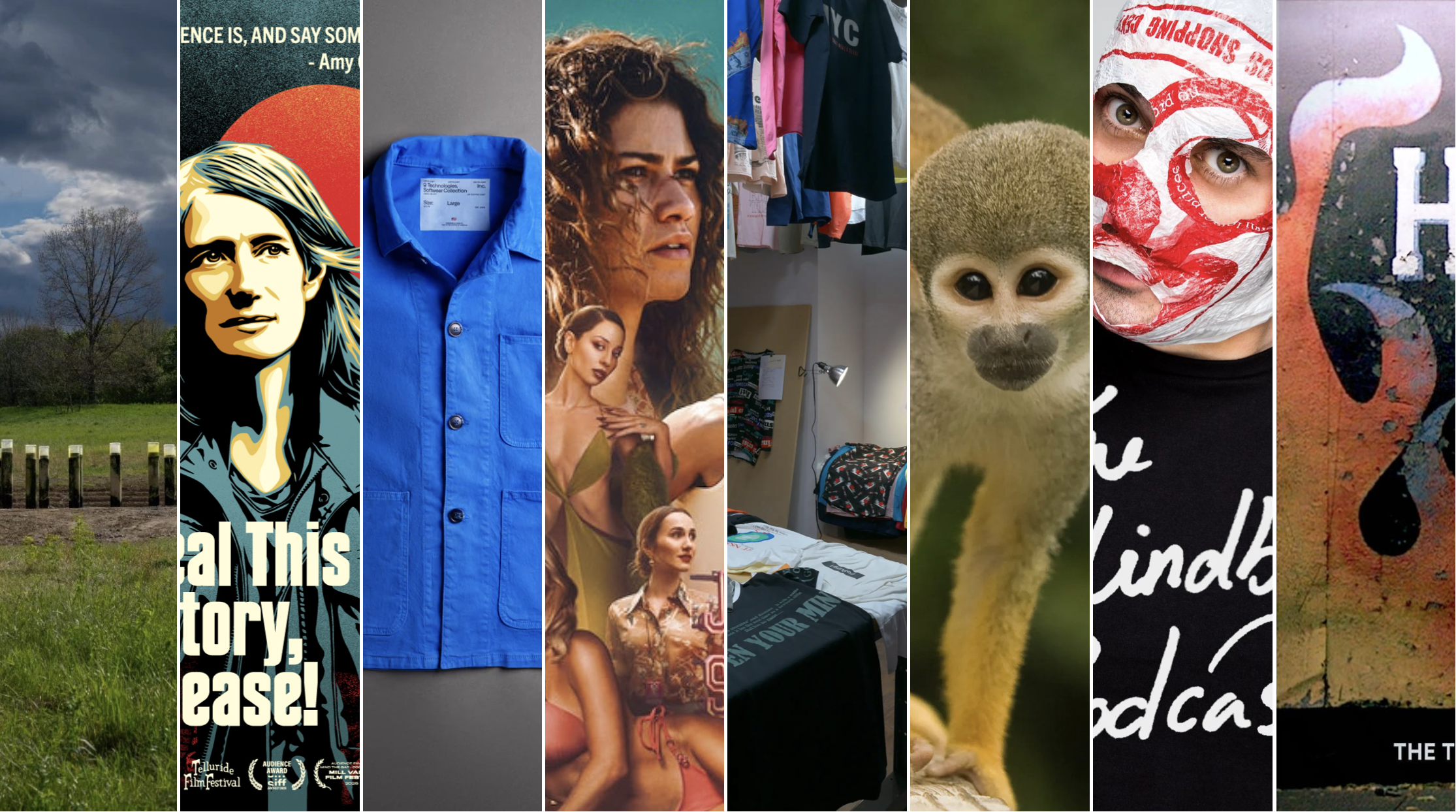
The Irish writer who goes by Blindboy Boatclub curates an extended universe for fellow obsessive iconoclasts; that he wears a plastic bag balaclava is the least interesting thing about this national treasure. He’s published three collections of satirical short stories — most recently Topographia Hibernica — and was named Best Documentary Presenter at the 2025 Grierson Documentary Awards for Blindboy: The Land of Slaves and Scholars, an LSD trip into early Irish Christianity. (The country’s monks invented spaces between words.) But it’s the podcast, which has run weekly for eight years, that best showcases Blindboy’s range. Subjects vary from a vulnerable dissection of his mid-thirties autism diagnosis (“Intrapersonally Speaking”) to audio essays like “The miserable blood drenched history of Jaffa cakes” (one installment of what The Guardian called “some of the best food writing being published anywhere”) and creative nonfiction like “Why I want to fuck Captain Planet.” He has also interviewed no fewer than two Irish presidents.
E.R.B.
Message from the Mud |
ART
The grass at Storm King Art Center looks lush and well-kept until you arrive at Anicka Yi’s newly installed excavation. In a circle of bare dirt, glowing acrylic columns filled with soil and pondwater emerge from a kidney-shaped pool. The deep black soil blooms with lurid green algae, gesso-like white areas, and ochre stains of bacterial growth. The work could be a Clyfford Still abstraction, or marble from an alien planet; it is unmistakably alive and slowly bubbling. Although Yi’s disruption of the Minimalist surrounding scenery — the landscaped trees, Alexander Liberman’s tubular sculptures nearby, and the impressive ionic columns at the top of the hill — is genuinely jarring, the effect is ultimately serene. Whatever message the mud has for us, the mud will speak it slowly.
C.M.
Ghostbox Cowboy |
FILM
Documentarian-turned-feature-director John Maringouin’s criminally under-watched 2018 movie starts off as if Midnight Cowboy took place in contemporary Shenzhen, but slowly morphs into a Kratom-infused Apocalypse Now, set against the global commodity supercycle instead of the Vietnam War. Our protagonist, Jimmy Van Horn, ventures deep into Inner Mongolia in search of the elusive Johnny Mai Thai, an underworld figure who eventually utters the most unbelievable “bruh” ever recorded. It’s the only film I know of that scratches a similar itch as that A.I. video of Biden and Trump performing a duet of “Yi Jian Mei,” and, like all great cinema, it’s streaming for free on Tubi.
O.H.
Ghost Ships Festival |
ARTIFACTS
Scores of septuagenarians gathered in Manitowoc, Wisconsin on a gusty March day for this annual community event hosted by the Wisconsin Underwater Archeology Association (woo-ah for short). Via slide decks and Ken Burns-esque voice-overs, underwater archaeologists, divers, and maritime historians reported on the latest Great Lakes shipwreck discoveries, including the Lac La Belle, a steamship seated at the bottom of Lake Michigan since 1872. The audience leaned in, grasping for the sublime, as the two divers on screen plodded their way through the freighter’s remarkably well-preserved hull — and groaned when the footage confirmed that no whisky barrels had survived. By the end of WUAA’s program, a more pressing message had been communicated: quagga mussels are plotting world domination.
L.G.
The Raw Milk Kid |
SOCIAL MEDIA
You can get a good grasp of this manosphere influencer’s deal from his Instagram “highlights” collections, which include “Gym,” “Meals,” “God is good,” and “Proof I’m 19.” It’s the last topic that separates purported 19-year-old Liberty University student Owen Stubblebine from the hundreds of other influencers promoting a mostly beef diet, calorie-tracking apps, and the pursuit of a Godly woman. The dissonance between the Raw Milk Kid’s image — with his pubescent face and voice like Pamela Adlon’s — and his manosphere message is obvious, though perhaps that’s the point. His fans call him “Precum.”
D.G.
The Endless Garment |
ART
Since 2015, Ming Lin and Alex Tatarsky have been collecting bootleg T-shirts from the likes of CNAHEL and MAISON MARQIELA, reappraising these circumventions of copyright as sites of linguistic renewal. At a recent group exhibition at Pioneer Works, interspersed among the piles of textiles — through which visitors were encouraged to rummage — were pages of poems, operating in a similarly ruptured vernacular: “It’sNotWhoYou Are… / It’sWhaYouWear… / 1Mean, / WhoReahy Cares.” Such lines lack, by design, the transcendent senselessness of the surrounding clothes; they are counterfeit poems, no match for the real (fake) thing. The sharpest verse came from a MOSCHMO shirt: “after form / admim wob / is a uniq afired.”
I.C.A.
Hank’s Saloon |
FILM
If you’re under a certain age, you might not realize that the lopsided black box of a building at Atlantic and Third holds a hallowed gravesite of that endangered Brooklyn species, the actually cheap dive bar. This documentary pays respects to the titular establishment, tracing its hundred-plus-year evolution from Prohibition survivor to ironworker’s haunt to pukey country-punk pub to long-vacant real estate void. You won’t get the recipe for Patty’s Panties, but you will get to see some haunting hidden interiors, a guy playing pool with a two-by-four, and a cell phone-free dance floor. Like a neighborhood drunk, the movie rambles at times and lingers too long, but goodbyes are never easy. At a March screening, when a regular told director Leon Chase that he’s “not bitter” about the bar’s closure, the audience screamed back, “You should be!”
A.C.
Euphoria |
TV
Just as the color palette of the series has shifted (from Petra Collins blue to deep spray tan), so too have its tone and subject matter. In its third season, creator Sam Levinson abandoned high school melodrama in favor of Western noir, and when we meet the Euphoria characters all grown up, several of them are working in the sex industry. Levinson is a passable auteur and a better troll, daring his haters to cry “male gaze.” But why take any of this seriously: we’re in high camp territory now, with a giantess Sydney Sweeney trampling Los Angeles in a leopard-print bodysuit, and more buxom desert strippers than a Russ Meyer film. Pity the poor Gen-Z viewers who can’t appreciate the homage.
S.C.
Steal This Story, Please! |
FILM
Scrappy journo-activist Amy Goodman of Democracy Now! spends much of this documentary about her career out of breath. It opens on her chasing a cagey Trump official up the stairs with a microphone. It closes after she reveals why she’s often coughing: the toxic dust she inhaled post-9/11, when she and her team stubbornly continued to broadcast from their Chinatown headquarters. Midway through, Goodman recalls telling The Intercept cofounder Jeremy Scahill that she would work with him only if he stopped smoking cigarettes. I thought of the breathlessness of the news cycle, the many last gasps of independent media. Then I walked out of the theater and lit up.
B.G.
Palantir’s lightweight chore coat |
FASHION
After some poor soul presumably wished to a mischievous genie to no longer see so many rich people wearing Carhartt, the couturiers at everyone’s favorite Sauron-inspired surveillance-tech giant released their own line of work shirts this spring. “Chaos is Tolerable; Pain is Tolerable / The Only Thing that Matters is to Win,” reads a tag sewn into the inside of the garment, which comes in cobalt blue and Schutzstaffel black. As of this writing, the $239 jackets are sold out in all sizes, so I am unable to assess their quality, but the Palantir store boasts that they are made from “100% American grown cotton,” for fans who are nostalgic for that kind of thing.
M.B.
