Issue 16 |
October 29, 2025
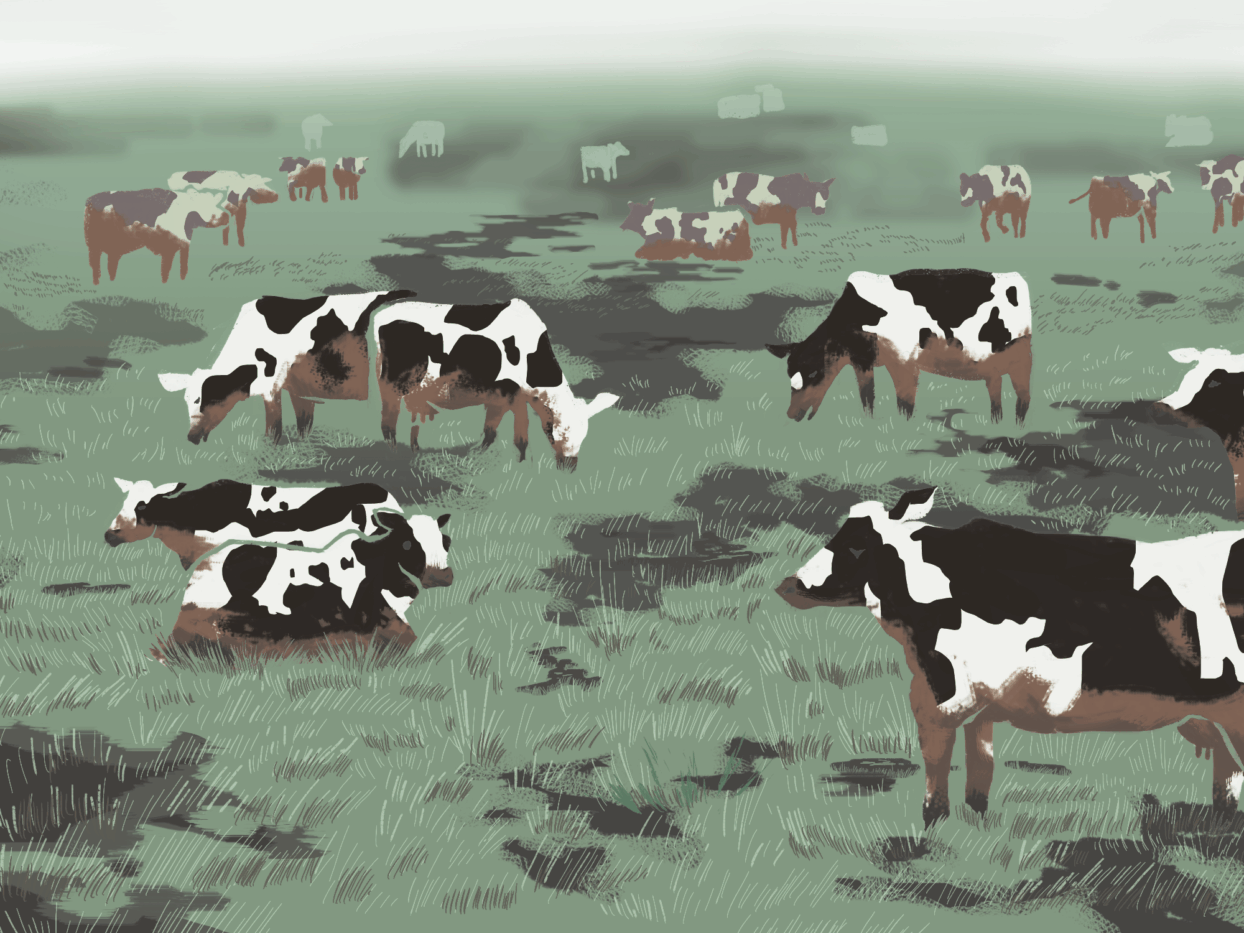
Image by John Kazior

Image by John Kazior
Marissa likes to begin her stories with walks on the beach. The beaches are never idyllic because the travel agencies are always devious. After setting the scene (dusk, iridescent oil slicks on the waves, sand), her characters enjoy a brief stroll before undertaking ferocious sexual intercourse. Marissa encourages the reader to suspect the lovers are siblings, but it turns out they’re just third cousins. In this way, she humanizes the travel companies, which have served the beneficial purpose of bringing a family together. She’s the most talented writer in our class.
Two months ago, I joined a local creative writing course in pornographic fiction after a disagreement with George. The complications that led me to this class had more to do with scheduling than sex. I had been gunning for Detective Fiction or maybe Sci-Fi, but only Intro Pornographic Fiction still had openings in the evenings after work.
During our first class, the instructor walked us through the history of pornographic literature, which turns out to be quite extensive. By sighing frequently, Jack made it clear that he felt the weight of working within such a hallowed tradition. When the instructor asked us to try to come up with a definition of pornographic literature, Norbert, who chortles, channeled Supreme Court Justice Potter Stewart: “Can’t define it. But I know it when I see it.” His head bobbled as if he were in the throes of an ecstatic stroke.
Marcel said, “Intimacy is like a wall that sometimes echoes.”
I liked this. Turning towards him, I nodded — you always need an ally.
Jocelyn said, “Pornographic writing is about capturing being inside another body.”
Norbert said, “That’s very traditional.”
In response to Norbert, the instructor said that we should both embrace and reject tradition.
He then turned to me, “What do you think, Becca?”
I thought about describing post-surgical pleural effusions, which occur when fluids build up between membrane layers outside the lung and make breathing difficult. To drain thicker fluids from the membrane, you insert a chest tube into the patient’s midaxillary line somewhere between the seventh and ninth rib. In the field, I sometimes MacGyvered suction devices with soda bottles, water seals, and flexible tubing.
I said I wasn’t sure.
George and I don’t struggle with sex. We’re instead troubled by divergent estimations of his friends’ intellectual aptitudes. There is also conflict around the interpretation of works of art, which is probably not aided by the fact that George runs a Substack called “George’s Films” — “your home for weekly in-depth reviews of foreign cinema.” A few days before I joined the writing workshop, we watched the South Moravian director Mikuláš Matyáš Marek’s eleven-hour magnum opus, Milk in the Expanse. The film features a critical scene during which two dairy farmers walk across a soggy field for seven hours. After we finished the movie, George joked, “That scene is a metaphor for our relationship.” I wasn’t so sure. For context, the movie begins with these dairy farmers searching for a specific cow in a field for two hours in order to present 85 milliliters of fresh milk to the village’s only barista, who has been training for the World Latte Art Championship. I guess this cow has special properties — it’s not clear. After the farmers get their 85ml, the barista botches the competition’s pre-announced first-round foam design: the latest payment terminal from Square, which is sponsoring the competition. (This inspires the film’s only line of dialogue: “Square Terminal is the card machine for everything from managing items and taking payments to printing receipts and getting paid.”) Anyway, the barista’s blunder means the farmers have to walk across the field again to get another 85ml. This takes seven hours and the film ends before they reach the cow.
George said the important thing was the squelching sound the farmers make while walking in the fields. They squelch for over 411 minutes. He said that if the squelch were to grow more intense over time, or really alter in any way, the scene could be read as hopeful. Instead, the undifferentiated squelch signaled life’s monotony.
While he spoke, I wanted to lick the small of his back but resisted because the moment didn’t seem apt. To finally end the discussion — because it was 3 a.m. and I needed to be at the hospital early the next morning — I nodded in agreement and said I thought the squelch represented life’s innate futility. He said monotony and futility were not the same. The next day, he wrote in “George’s Films” about how some viewers, “including Mrs. George,” may see the film as highlighting life’s futility, when it’s actually about life’s monotony. We’re not married.
On my break at the hospital the following afternoon, I joined the writing workshop. Each week, we review three stories. By the end of the class, everyone will have submitted two.
In our second class, we discussed Jack’s story “Concupiscent Affrays.” Jack prizes an elevated register. In the story, the Baron de Sache Verlängert “darts lascivious gazes” and “tenders his licentious magniloquence” in the direction of a redheaded orphan who is a scullion and also hot. Naturally, she suffers from “priapic longing.” Jocelyn felt that Jack leaned too heavily on traditional tropes. I noted that he used the word kerfuffle somewhat liberally, and as a verb.
Before I came to New York and met George, I spent three years working as a trauma surgeon in conflict zones for Doctors Without Borders. It ended up being mostly reconstructive surgeries and caesarians, but we saw some classic trauma stuff too, like blast and shrapnel wounds and burns from torture. After returning, I realized people don’t know how to approach these sorts of things in conversation. “What was the experience like?” “How did it make you feel?” I told people it was hard. Then I would lie and say it had felt good to do good. I didn’t say that by the end I despised every single patient and felt disgusted at the tedious questions asked by their families. The best patients were arterial bleeders without next of kin. In New York, I tried not to look at people’s problems differently. I drank a lot. And then I stopped drinking because in real life absolutely no one cares for a drunk, dejected woman uninterested in sex. In our class, stories never feature drunk characters, I guess because they’re all just naturally disinhibited.
A year after I returned, I swiped right on George’s face on Bumble. He was goofy and basically interested in the world. He had trained to be a painter, and now traded bonds for Vulcan, a large asset manager. On our second date, he took me to see a French film from the 1950s about a man who tries to escape from prison. His passion for movies and contemporary art — subjects I knew little about — was infectious, and I liked learning about them even if he could be long-winded. We never talked about my experiences in the field. I think he felt that any question would be trivializing, and I think he also felt frightened. If he had asked, I would have told him that I mostly remembered the makeshift surgery floors always being wet from washing.
My first story featured two characters named George and Becca. It culminates with George and Becca going to a nice dinner and sustaining conversation for over three hours. The scene comprises a lot of listening and follow-up questions. Then, George’s friends arrive at the same restaurant and walk over to their table, and they ask Becca what she thinks about the latest A.I. news, a question Becca approaches with modesty, nuance, and incisiveness. Throughout this dialogue, George’s friends don’t speak over Becca at all, and then they make a series of thoughtful counterpoints, which demonstrate that they have internalized Becca’s main arguments. After the friends leave, an errant knife flies from the kitchen and lands between George’s ribs, puncturing his fascia. Becca drags him to the hospital, pausing to do compressions every fifteen feet. After identifying zero vital signs and some pretty significant jugular venous distention, she conducts an emergency room thoracotomy — a surgical incision into the chest wall — to temporize him. The story leaves his survival unclear.
During the workshop, Jocelyn grew flustered. “There’s no penetration,” she said.
I said there were actually different types of penetration.
The instructor told me not to speak. He opened the floor again.
“Is this story even good?” Adam asked suggestively. Everything about Adam is suggestive except his fiction.
I wanted to say, “This story uses genre expectations without feeling the need to assume their full weight, exploring questions of self-actualization, friendship, and relationship maintenance in the process.” But I had to remain silent.
On the whole, the reception was mixed, although my ally Marcel was very positive.
Next, we discussed Jocelyn’s story. It featured a horse, a Mongolian yurt, a man named Edas, and a lot of pomegranate seeds. At the top of the page, she scrawled: “Edas is the spelling of Sade but backwards.” I crossed this out and wrote “Edas is an anadrome,” which had the virtue of parsimony and would force readers to engage actively with the text.
After class, Jocelyn asked me out on a date, which I found surprising given her negative reaction to my story. I told her that I had a partner. She told me that wasn’t important. I told her it felt important. She held up my edits on her story and pointed at the word anadrome. “Most things that feel important are not actually important.”
After Jocelyn left, I lingered in the hallway.
The instructor came up to me and said, “Who is Becca?”
I said, “I am Becca.”
He said, “Who is Becca?”
I realized he meant the story. I said, “Becca is a 38-year-old doctor in the fourth year of a relationship who hopes to be listened to by her partner’s friends.”
He nodded cryptically.
A lot of pornographic fiction in our class deals with transgression and adultery, although I guess adultery doesn’t really feel all that transgressive on the page anymore. It’s probably different in real life. A lot of the stories feature relationships that initially appear perfect, only to be undone by lust and temptation. Lust and temptation are usually personified by perfumed older men and lesbians. Happily, Marcel deviates from these tropes by writing about cannibalistic polycules.
In our next class, I argued that the pain of adultery actually has nothing to do with the sex.
Marissa vigorously disagreed, “It’s definitely the sex.”
Jack said, “The thrust and parry, if you will….”
Jocelyn said, “The pain derives from the premeditated artistry of the adulterer’s seduction, but also the sex.”
George likes to say there is an “art” to private fixed-income securities just as there is an “art” to painting. On weekends, we tend to go to museums together, where we usually find ways to say what the wall text says but differently. A disadvantage of his job is that he can’t help estimating the prices of paintings while standing in front of them. I have come to the conclusion that this general posture also leaves him unable to effectively analyze the movies we watch. An advantage of his job is that we can close on a three-bed, three-bath in downtown Brooklyn and then send his friends the Zillow listing.
After class, I met up with George at a cocktail lounge in Midtown where he had gone with a couple of his work colleagues — who are different from his friends. Throughout the evening, he spoke conspiratorially to Margot, who is French and has good skin. She teases out a sly mischief in him that rarely surfaces at home. She’s also intelligent, which is aggravating. While Margot laughed at George’s quips, I lingered at the bar with Bob from compliance. Bob said, “The UAE recently revised its regulatory and legal frameworks in a way that makes it more investor-friendly.” I thought about IO kits and subcapsular bruising and chemical burns from ordnance and about how washing floors doesn’t do anything about blood splotches on socks.
I said, “You realize they torture dissidents.” I may also have implied that working for a firm that does so much business in the UAE made him a shitty person. He looked at me like one of Marcel’s polycule members being told they were lunch.
At home, George made us both tea and then gamely explained that my issue wasn’t really with a firm like Vulcan, which follows the law, but instead with U.S. government regulations. And anyway, he pointed out, the U.S. supplies weapons that kill innocent people all the time. He added, “Not that that’s good.” I let it go. I guess I don’t really believe everyone who works at Vulcan is a shitty person, since I don’t think George is shitty.
My second story once again featured George and Becca, but in a different setting and with different themes. This time, they’re walking across a field to milk a cow. For a while, they remain silent, and I describe the landscape, which is barren.
Finally, George says, “I’m disgusted that I have to listen to your trite observations about the world every day.”
Becca says, “Your body, but particularly your feet, and even more particularly that one grotesque toenail that you broke and doesn’t grow right, makes me want to punch you in the face.”
I went back and described the field as both barren and moist so they could squelch in silence for a sentence.
Then Becca says, “You’re an intellectual mediocrity. Your friends prove it. Your midwit work crush proves it.”
George says, “She has a PhD in Management from INSEAD. No one cares about anything you have to say.”
Becca pretends not to know the meaning of INSEAD.
George explains that INSEAD is a highly reputed business school an hour south of Paris by train.
Becca thrusts, “Your relationship to art is false. Also, you do work that’s at best ethically neutral and at worst actively harmful to the world.”
George parries, “Your sanctimony is boring. You’re the most boring type of depressive.”
Squelch squelch.
Eventually and admittedly somewhat out of the blue, George asks Becca to pick up his asthma inhaler at the pharmacy. I realized I had to put a pharmacy in the story, so I went back to the beginning and put a pharmacy in the moist and barren field. It dawned on me that this was a pretty neat metaphor. Suddenly, George collapses from a heart attack and Becca has to carry him to the pharmacy — which I now made a hospital — in order to perform a percutaneous coronary intervention, which is much less intrusive than the thoracotomy she performed in the first story, but requires significantly more skill. During surgery, Becca is assisted by an interventional cardiologist.
While I wrote the story in our home office, George was in the living room: doing something, doing nothing. At home from work after another day that would be like tens of thousands of other days and then we would die, probably from something stupid like cellulitis that we ignored for too long until it became osteomyelitis — he would likely succumb first, statistically speaking. This thought made me feel desperate. I closed my computer and joined him on the couch and took off his clothes and checked for swollen skin and then kissed his back. Then he took off my clothes and we reenacted the final scene from Jack’s “The Wicked Maiden of Otranto.”
Afterwards, I showed George both of my stories. I felt like also telling him about the wet floors, but I didn’t. He studiously read the stories and then gave some feedback on the narrative mechanics without offering any interpretation. I made changes based on his comments. After dinner, we watched a really good Chilean film called No.
During the workshop for my second story, Marcel said that except for the end, he felt it was all very Waiting for Godot.
Norbert said, “So after she saves him they’re going to have sex?”
I said, “The patient will have to recover and won’t be in a position to undertake strenuous physical activity.”
The instructor instructed me to be silent.
Norbert chortled and said, “Can’t define it. But I know it when I don’t see it.”
Marcel looked in my direction to indicate our alliance was stronger than ever. “The squelch is the sex, I think,” he said. He grew more confident. “The squelch is a metonym for their sexual intercourse.”
I couldn’t respond so I moved my eyes left and right and back again — a bit like the quadriplegic billionaire in Adam’s last piece.
Jocelyn didn’t get the squelches and said they lacked context. She then said my story wasn’t pornography so much as romance, which often featured different types of abuse. I looked to the instructor to support the fact that I was working within a broad tradition, but he just nodded along. Building on her first comment, Jocelyn noted that both my stories lacked sex and questioned whether I was actually interested in becoming a pornographic writer. She gestured grandly to the whole room to indicate that everyone else had already made this commitment.
Norbert stroked ecstatically in agreement.
That evening, I read George’s review of the Chilean film No in “George’s Films.” It was a bit long and a bit pedantic, but it included the words, “Mrs. George, who writes fiction, observed that in the film light signals revelation, yet the very technique of overexposure eventually obscures what at first it disclosed….”
I liked the post and shared his blog with a couple colleagues.
In our final class, Marcel’s cannibalistic polycules returned, except this time they had pooled their resources to buy an induction stove.
Jocelyn called the writing hot and polyphonic.
Jack lauded the work’s critical examination of protein culture.
Marissa turned to me and asked, “In your medical opinion, would the characters have the physical strength to undertake both the sex and the sawing?”
I thought for a while and then said, “The story is fiction, but also feels true in certain ways.”
Jocelyn grimaced at my reply.
If I could answer again, here’s what I would have said: “Intimacy is ugliness, I think. It is hemostats, electrocautery, forceps, and maybe saws too. It requires submission to a kind of remedial brutality. But sometimes it is other things as well.”
Finally, we discussed Marissa’s second story, which once again featured a beach. The plot goes like this: a duplicitous travel company sells a deserted island vacation package to both Princess Charlene of Monaco and the Ruler of Abu Dhabi, His Highness Sheikh Mohamed bin Zayed. They meet each other on a rocky beach next to a large sewage pipe that runs into the ocean. Except for water shoes, they are both completely naked. Marissa made sure to detail how the sharp, jagged rocks cut into the lovers’ skin, which did a lot to humanize the travel company for me. Her story ended in this way: “And the jagged edges of the rocks on the beach cut into their thighs which bled a bit as they passionately thrust into each other next to the sewage pipe which also thrust into the sea and the pain made the intercourse so much better.”
Nick Foretek is currently writing other stories and a novel. His short fiction has appeared in The Baffler and is forthcoming in the New England Review. He has published narrative nonfiction on Syria and Russia in New Lines Magazine.