Jeffrey Epstein — pedophile, sex trafficker, consigliere to the ultra-rich and the ultra-connected — once belonged to the truly elite. As the full extent of his crimes was exposed, he became the property, at least symbolically, of a different in-group: online conspiracy enthusiasts on both the far right and the far left. In 2019, he died in federal custody, and now — after the Department of Justice’s chaotic file dumps — his emails belong to us all.
How has the story ricocheted between online niches, the mainstream media, and the halls of Congress? What do Epstein’s emails tell us about the workings of power? Given recent revelations, how should we look back on #MeToo, and begin to think through the future of the movement against sexual violence?
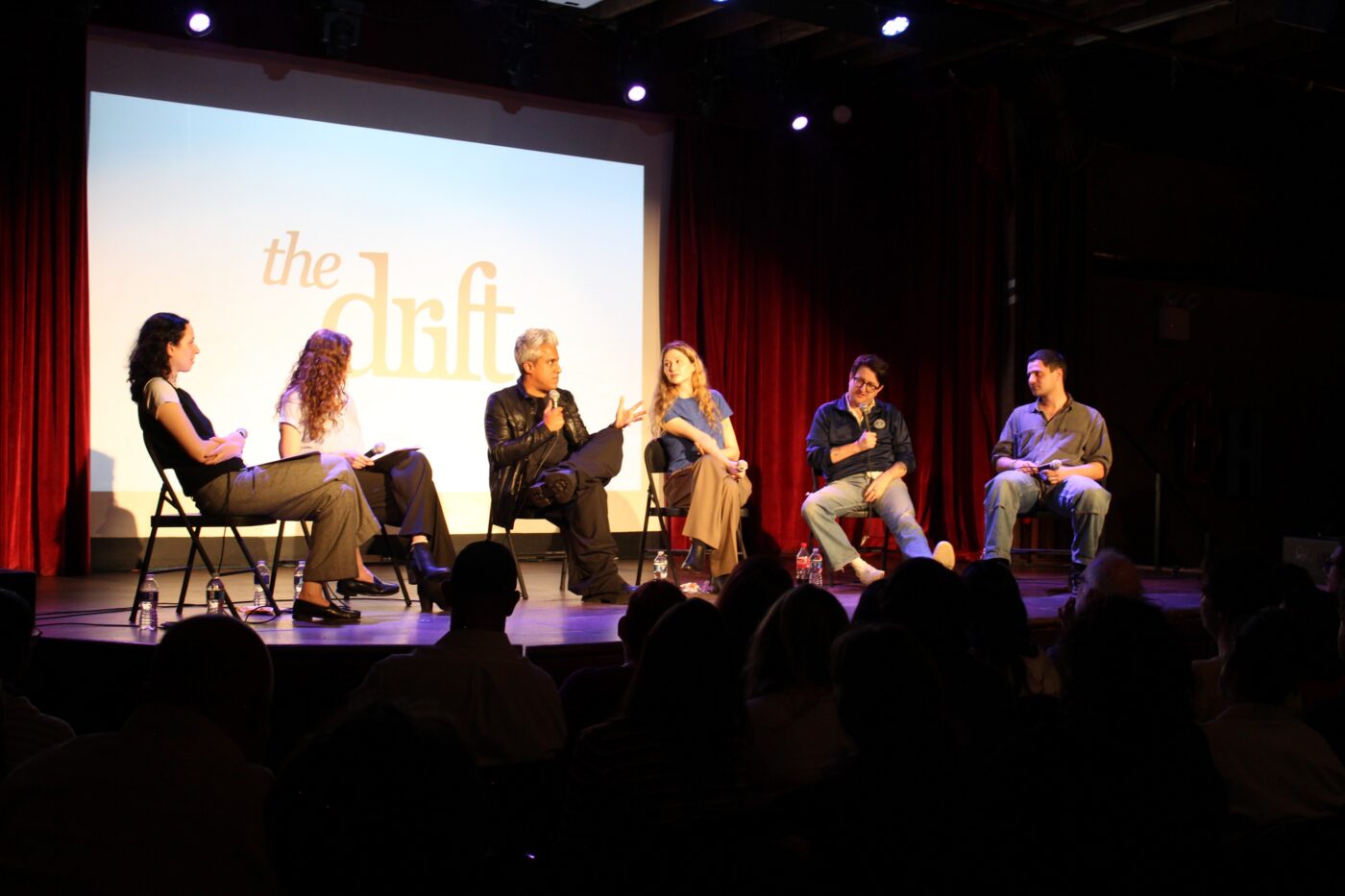
On March 10, we convened a panel at The Bell House in Brooklyn to talk about the Epstein files. We were joined by Brace Belden, the cohost of the “TrueAnon” podcast; Daniel Boguslaw, an investigative reporter covering U.S. politics, national security, and the financial elite; Alexandra Brodsky, a civil rights lawyer and the author of Sexual Justice: Supporting Victims, Ensuring Due Process, and Resisting the Conservative Backlash (2021); and Anand Giridharadas, the author of India Calling (2011), The True American (2014), Winners Take All (2018), The Persuaders (2022), and the forthcoming Man in the Mirror, as well as the newsletter “The Ink.” The transcript of the conversation has been edited and condensed for length and clarity.
The story is tailor-made for conspiracy theorists, in part because there clearly was an actual conspiracy going on here. How do you read the various theories swirling around?
Anand Giridharadas: Conspiratorial thinking rises and falls at different moments in history, depending on what’s going on in a society. When inequality rises — there’s a lot of research supporting this — conspiracy thinking goes up. When life doesn’t feel fair to a lot of people, conspiracy thinking goes up. The public may be wrong about the names, wrong about the players, wrong about the mechanisms. But are they right that the way their health care works is essentially a high-functioning conspiracy? If Washington works the way it does, is that a conspiracy? People are grappling in the dark for explanations about why cause doesn’t equal effect anymore, why effort doesn’t lead to reward anymore, why nothing seems linear, why all the things they’re supposed to do don’t work. And into that space, conspiracies enter.
Brace Belden: I mean, my view is that there really was a fucked up pedophile billionaire that’s friends with almost every rich person in America, and they were all hanging out with him on his island with a weird, fucked up building on it. There are pictures of Bill Clinton in a hot tub. There’s a picture of him getting a massage from a girl.
Giridharadas: The first thing you do with money is make sure no one ever reads your emails. So we don’t get that kind of glimpse into the private communications of the people who run the world very often. We don’t get to see the glide from link-sharing to appointment-setting to child-raping to dinner-party-setting-up. It’s the same people, the same thumbs on the same phone, doing all those things, maybe within a five-minute span.
In many of the emails there was this ritual that first just seemed like filler. And then I realized it was this thing happening, what I’d call the whereabouts ritual. Where are you? Dubai, today, London, tomorrow. Wheels up. Where are you? I’m at this. I’m at that. Where are you? I just got back. I’ll be in Greece tomorrow. At some point I realized: this is a global group of people whose only loyalty is to each other. They have no loyalty to any actual place they come from, including this one. That helped me understand the way in which this power worked. And so many institutions are implicated: Google, Harvard, the Gates Foundation.
Daniel Boguslaw: There are multinational banks — JPMorganChase, Deutsche Bank, Bank of America — that ignored or belatedly filed Suspicious Activity Reports, which we know are in the possession of some U.S. senators. We know that we could explore the way that the CIA helps U.S. companies, whether providing them with foreign intelligence or actually aiding in their foreign operations. We know that this exists. We have an opportunity to explore it more. I think that Epstein probably was bumped by someone. But from my personal reporting, I think he was not an intelligence asset. I was curious about it too, but I think it’s a shame that the speculation has continued when there are very real villains who should be strung up.
Alexandra Brodsky: There is a conspiracy here: the ultimate conspiracy of patriarchy. In those emails, we have Jeffrey Epstein talking with Larry Summers about how women are dumb, and then talking with other people about how to discredit Christine Blasey Ford, and how to make sure that Title IX regulations mean that university professors don’t get into trouble for sexual harassment. We have a group of men protecting each other’s power in ways that even I found to be a little on the nose. It’s really noteworthy to me that we are looking for all kinds of outlandish explanations for how this power works, but I find that patriarchy is remarkably absent from much of the analysis. There are a bunch of explanations for why that’s true. One is that the right wing was interested in the story earlier, owned the story earlier, and so was able to shape that narrative. We can also talk about the death of feminist media, and the complete absence of any kind of feminist public critique now.
How did you first hear about Epstein, and why did it take so long for his crimes to get serious coverage?
Giridharadas: I first read about Epstein in 2018, when Julie K. Brown revived the story with this bombshell in the Miami Herald, for which she needs a Pulitzer Prize still. I’d written a book about philanthropy, and all the shady people universities had no problem taking donations from. And the Epstein story was just a reductio ad absurdum. Not only would they take his money, but they even gave him an office at the program he helped create at Harvard, PED: the Program for Evolutionary Dynamics. These people flaunt it in your face!
As someone who’s written about the elite for a long time, it can be hard to explain some of this stuff. People don’t care about corruption, or they don’t get it. But people get this story; it’s really easy. Everybody has a biological instinct to protect children, I think. And at some level, that brings people in who are not super political. I have insisted, as many others have, on making the connections between the truly criminal behavior and the other behavior: these are not separate things. There are a lot of powerful people who would like this to be a story about nine pedophiles. But this is not a story about nine pedophiles. A lot of people, systems, cultural norms, and incentives made all of this possible: the very worst stuff, and the rest, too.
We don’t feel like we have a choice about anything these days in our society, but I think there’s a collective choice that we have about what this story ends up becoming. It’s still early in some ways. You could very easily see this story functioning as a kind of release valve, where we all feel like we got a few people. Some stories came out; there was outrage. There was even an important piece of legislation in Congress, but fundamentally, nothing changes.
I think we have a huge responsibility to actually make this a political turning point where you can say: that’s the moment that the world saw the neoliberal era at its basest reduction very clearly and started choosing differently.
Boguslaw: Right around when Epstein killed himself — allegedly — I was working as a fact-checker. There was some coalescence on Twitter of people questioning the official narrative around his death, and I remember the contrast between working at The New Republic’s gilded office and looking outside at this literal scrabble of conspiracy theorists and trade publication reporters and both fascist and socialist Catholics who were gathering in Union Square. In 2019, everyone in the office was kind of like, This is a side show. This isn’t real. But the people just hanging out and smoking loosies in Union Square were like, No, this is legit.
Obviously, now, literally anyone can write a story about the files; that’s, in most ways, a good thing. But it wasn’t people threatening legal action, or stories getting killed, that led to the delay in mainstream media coverage. It was a resistance to taking those initial big swings on something that implicated powerful people, and that hadn’t already been deemed socially acceptable and seeded throughout the elite media class.
Belden: I’ve never worked in a newsroom in any capacity, so I’m speaking from the outside here. Epstein was initially mostly fodder for the Daily Mail or Page Six. I love the New York Post — not their politics, but I like reading it sometimes. A lot of the stuff that eventually became part of the Epstein canon comes from that side of media. Maybe it was seen as seedy or gossipy to pursue stories on it. I think that the “Perversion of Justice” series that Julie K. Brown did in the Miami Herald opened the gates to more mainstream coverage. I do recognize that if you work in a large newsroom, there is more of a rigorous process that you have to go through. But I think that you saw the tide turn two years ago, and definitely now that the Epstein story can be used as a cudgel against Trump. A lot of people saw it as something that arose in the fumes of QAnon or Pizzagate and so a kind of right wing-coded, chud-ish thing to write about. So I think that there was this delay in the Epstein story having utility to basically everybody. The ball is definitely in the liberal court right now, but it could very well bounce back.
Boguslaw: The transition into the liberal sphere has kind of sucked. There’s a weird irony in the fact that once something hits the mainstream — once it leaves the purview of actual normal people, of the masses — it becomes a political cudgel and loses some of its utility. Trump’s name is in the files, sure, but so is Kathy Ruemmler’s, the former Obama White House counsel.
Now politicians are asking for more FBI files, but what’s getting pushed aside are the actual Financial Crimes Enforcement Network reports that could fuck up the banks. What else is getting pushed aside? The CIA’s National Resources Division reports, which would have exposed the architecture of how the CIA’s domestic branch interfaces with corporations and people like Jeffrey Epstein, writes off all their crimes, and never reports any known crimes to the DOJ, so that they can further their international objectives.
There’s an incredible anecdote that I love about a Ro Khanna staffer being the one who said, what if we introduced this bill to force the disclosure of the Epstein files? Everyone in the office was silent. And on her way home, she called her boyfriend, and asked him if the idea was “crazy.” That’s what you’re up against. You’re up against this machine of people who aren’t necessarily evil, but are part of a bureaucracy that is uninterested in taking risks. I think the House Oversight Committee would probably like to expand their purview, and maybe some of the staff will be interested in exploring these other government agencies that are implicated. But ultimately, it’s far too easy to just go after Trump and his inner circle.
Donald Trump was elected for the first time at the height of Pizzagate, which was about an elite cabal of pedophiles. How should we look back on that episode now?
Brodsky: I mean, it’s still wrong. One thing that troubles me: QAnon and Pizzagate tell us that people like thinking about group sexual abuse of children. And a word we sometimes use to describe something sexual that people like thinking about is a “fantasy.” I think that part of what brings people to this story is a prurient interest in the details — not everyone, but some people — and that makes how we talk about it very important.
Giridharadas: Trump ran on the promise of liberating us from a cabal of people who are all in cahoots with each other and don’t care about us. And then he became the greatest living incarnation of that phenomenon in office. That is, I think, reflective of a behavior in this larger Epstein class: you will profit from whatever is going on. So when the winds of opinion are going this way, you will be leveraging that and profiting from that. When the winds of opinion are going that way, you will become the solution to that thing. There’s this constant arsonist-to-firefighter pipeline. He’s the icon of it. But they’re all doing it.
Boguslaw: I want to push back on what you just said a little bit. I think Trump voters knew that this guy was a dirty piece of shit in a lot of ways, that he was a scumbag, and that when he said “grab ’em by the pussy,” he meant it. But the alternative was someone who was definitely going to keep the same Democratic insiders on, and I think the difference was, like, This guy’s a wild card. Maybe even though this guy’s outwardly a scumbag, he’s willing to randomly close his eyes and shoot into a crowded room. I think that distinction is actually important, because it signals to the left what a successful candidate would look like. It would look like someone who is fully willing to alienate themselves, to chop out huge parts of the coalition, to not be confined by any system. It’s important to recognize why Trump was attractive.
In some ways, #MeToo gave us frameworks and momentum for thinking about Epstein’s crimes. But in other ways, the media’s coverage of #MeToo had muddied the waters by the time the Epstein story rolled around. We were reckoning with everything from misbehavior to really serious, horrific crimes all at once. How do you think about the relationship between #MeToo and Epstein?
Brodsky: Americans broadly, and the left specifically, have been very critical of #MeToo, both because criticism is good and because people love to be mad at women. One thing I actually found pretty gratifying in the emails was the evidence of just how concerted and organized the backlash to #MeToo was. People were not just organically asking questions in good faith. Jeffrey Epstein was talking about “Title IX cunts,” which I’m going to get tattooed on my forehead one of these days. They were coaching each other to defend against harassment allegations and plotting to sue Moira Donegan for publishing the Shitty Media Men list. They were afraid of us, and they pushed back in an organized fashion. That’s where the backlash came from. They are the reason we’ve seen such regression on sexual harassment policy and politics, not because some 22-year-olds who got raped didn’t talk about it in the right way.
I also think this is a warning to be wary of those who defend sexual harms not on the merits but by insisting that those who think the conduct is bad are stupid or have bad politics — a line of defense I think the left is particularly guilty of. You’ll have people who argue that thinking it’s bad for professors to sleep with their students is unsophisticated or unduly carceral. Of course there are plenty of valid critiques of sexual regulation. But we should be skeptical of the tendency to frame excusing sexual violence as a mark of intelligence or nuance, which is very convenient for abusers. I get the pull. I wrote a book that tried to take seriously concerns about due process in the context of #MeToo. And I’ll be honest: in reading the files, there were times where I was like, Fuck, I was doing exactly what these guys wanted me to do. And I made a promise to myself to not try to be a cool girl, to just say bad things are bad.
I do think that the way we are talking about Epstein now is evidence that #MeToo is dead. I’ve been invited to many events since 2018 that were billed as being post-#MeToo. And at first I was like, I don’t know if we’re really post-#MeToo yet. But now we are. I see that in the complete absence of any kind of gender analysis in the reporting on Epstein or the discourse. I think there’s a lot of attention, rightfully, on how it was that there were all of these people who knew what he was doing but were still willing to come to his parties — basically, that weren’t willing to take on the inconvenience of distancing themselves from him, at the very least, because that would mean a lack of access to networks and resources and fun. Obviously, Epstein was a unique dude with uniquely powerful friends. But also, what I’ve just described — I would bet that almost every woman has seen some version of that in their own social or professional lives. By not drawing that together, we’re both losing out on the opportunity to learn something about Epstein and losing out on the opportunity to reflect on how similar dynamics play out in our own lives.
Belden: Epstein was very aware of #MeToo, and followed it closely. I don’t know if this made it into the DOJ release of the Bannon-Epstein videotape, but in the hastily cut trailer that Bannon made for a seemingly fake documentary a few years ago about Epstein, he has a clip of Epstein saying, “I’m a firm believer and supporter of Time’s Up.” When accusations are made against one of his friends, he sends that guy’s name and an article to all of his other friends and is like, for example, Look what they did to Larry. And it’s interesting, because you can tell that Epstein is thinking about how to couch his story in this stuff — he’s constantly thinking about how to reinvent the way that he’s viewed by other people. So much of this is media training. They sort of float, Maybe this was just a #MeToo situation, rather than a pedophile situation. I don’t think that they get very far with that, but they do talk about it quite a bit. So he’s super aware of it.
Giridharadas: For the series we’re doing at “The Ink,” I went through all the photos in the newly released files. Obviously there are women and girls everywhere. But there are almost no photos of women and girls when meals are being served. So the women and girls disappear whenever there’s a table, food, and intense conversation. I think it gets at a basic point: this is an extremely patriarchal world where they don’t think of women as full people. You swim with women, but you don’t eat with them. You get in a hot tub with women, but not a lecture room. But I also think their view of women is related to their other views. Part of it is an allergy to any friction. They see women, in general, as friction and as a hindrance. It’s connected to their views on antitrust. I talked to Lina Khan the other day, who was an antitrust regulator, and also a woman who incurred a huge amount of wrath from these guys. She said, “There has been a really interesting Venn diagram and kind of an overlap of the people who it seems were part of this really horrendous pedophilia ring and people who have been opposing working class policies in the last Democratic administration.” Being held accountable, she said, is “a very foreign and offensive experience” for these men. There’s a rape version of that, there’s a mergers and acquisitions version of that, there’s a lobbying version of that. One email may be about, Who the fuck is that woman blocking our merger, and the other may be, Sure, I’ll go to a party with a cute girl.
In the emails, pedophilia is framed almost as a rarefied taste, as if these rich men are rendered true elites by having sex with underage girls. Survivors of this abuse have spoken out, and now we’ve gotten some fairly straightforward testimony from the perpetrators, too. What do you make of the way Epstein and his friends were discussing their crimes?
Boguslaw: Pedophilia creates a kind of social cohesion. I was curious, back in 2019, about the idea, which was circulating then, that there were cameras in all of these places and participants were being blackmailed, but I think it was actually something even worse than that. There was no blackmail against these people, and yet they were still celebrating abuse because it made them feel part of some sort of elite community. I think it’s too bad that some of the extreme interpretations or the extreme conspiracy theories are still proliferating when the files actually reveal something darker about the psychology of the elite and the way that it made them feel included in an imagined reality, a network that Epstein was at the center of.
Giridharadas: These guys expect and can only actually function at very high levels of power distance. That’s true in their work, and it was true on Rape Island. Virginia Giuffre wrote about this very insightfully in the incredible Nobody’s Girl. She was so young, and observed that a lot of these men were socially obtuse — not good at talking to women, as far as she could see, and not able to persuade or entice women in the normal way that one might. So Epstein was providing this very valuable service to people who, as she put it, had big brains but an inability to relate to peer-level women, women who would require them to negotiate and come to consensual agreements of any kind.
Epstein was highly interested in international affairs. He was emailing with and about heads of state and members of royal families and took part in international political gatherings. What have we learned from these emails about the way deals get done and decisions made?
Belden: He is the archetypical Davos man, in many ways. What I was fascinated by is how integrated he was with the U.N. and with certain people there. He built out his European network through people who had pretty prominent positions at the U.N. He would host these people at parties in New York and Paris, and he would bring in young girls from Eastern Europe. The schedules appear to line up; we don’t really know if they were all at his house at the same time, but we can imagine what might have been going on. And he used his diplomatic connections to both ingratiate himself with the Davos set and with European banking royalty. Take his relationship with Edmond de Rothschild and his conversations with Ariane de Rothschild giving advice about getting her husband kicked off as chair of the company and settling with the DOJ.
This element was almost completely absent from the Epstein story prior to the release of the emails. We had indications that he was friends with a lot of rich people. But we hadn’t previously seen how invested he was in them, and they in him. Norwegian diplomat Terje Rød-Larsen was one of Epstein’s best friends. And we really hadn’t seen, except for in random glimpses, how many connections Epstein had with the Gulf states as well. They’re all over the emails. What is Davos but a collection of our GOATs from all around the world meeting up? DropSite did a really long piece, for another example on how Epstein and former Israeli Prime Minister Ehud Barak got involved with Mongolia’s defense industry.
Giridharadas: You can’t understand the way he hijacked the U.N. without understanding that U.N. Week — which takes place in New York every September — is an enormous, enormous scandal waiting to happen. It is no longer really a meeting of all the countries — although that technically happens, and the U.S. president gives a speech — it has become a major public-private partnership dealmaking confab. And he recognized that. Some of the best emails are like, Kathy Ruemmler, you’re coming to town, it’s U.N. Week. I’ve got former Norwegian Prime Minister Jagland. I’ve got ten guys from Dubai. Who do you want? Like a menu. That can only happen because a lot of people — like the Clintons, like Bloomberg — use U.N. Week that way already. The international organization of the U.N. has been completely removed from U.N. Week.
Belden: I think it should be noted that the only criminal cases that have been opened are in England, Norway and France, not in the U.S. And I think it’s probably going to stay that way. In France, they’re investigating three different people. I think the highest ranking people they’re investigating are in Norway and Britain, where it’s a member of the royal family, and the ambassador to the U.S. until last October. I do think it’s probably going to be a ceremonial bloodletting, in which some people are let go and some people resign. I don’t have a lot of faith that there will be any real change among the elite.
Giridharadas: These are flash-mob resignations rather than justice and accountability. During #MeToo, if you had a really bad story, and you had enough online frenzy, someone could lose a job, and we felt like we got one. But in the end, there was not enough getting relative to the problem. It’s the same thing happening now: just enough catharsis. The British are doing just enough catharsis with Andrew to ignore the question of whether the Queen paid the settlement and whether they should have a royal family anymore.
Boguslaw: I’m also very pessimistic about this moment being able to change a lot of things. This was forced onto Congress. Neither party wanted to have to deal with it. I think it’s amazing that there was a populist outcry, and people continued to scream about this until it was taken up. Unfortunately, the people we have in Congress right now to respond to it on both sides are fucking useless. But I think the positive spin on it is that it’s incredible that people were able to leverage this into a national issue that’s running the news cycle.