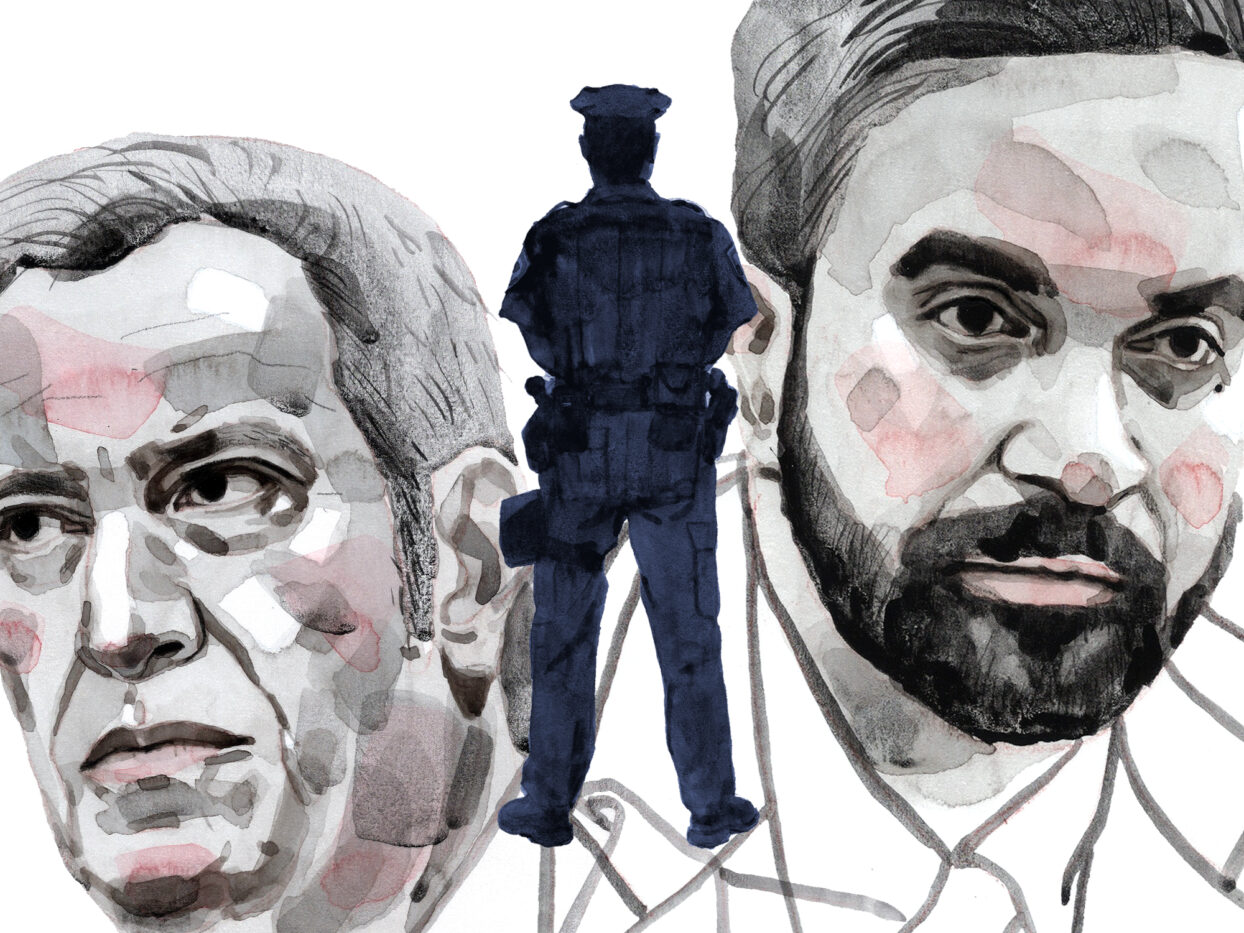
When Bill de Blasio was running for mayor in 2013, he vowed to “end the misuse of police tactics that have made New York into something out of Dickens,” invoking A Tale of Two Cities to describe the effects of stop-and-frisk under Mayor Michael Bloomberg. The practice — which further criminalized life in majority black and Latino communities — was increasingly controversial, and de Blasio vowed to “repair police-community relations,” building on work he’d begun as the city’s public advocate. His campaign published proposals to create a new Inspector General position that would oversee the NYPD, sign anti-racial profiling legislation, and halt arrests for low-level marijuana possession offenses. In an op-ed in The Guardian, de Blasio called for “reforms that protect residents and police officers alike” in order to restore “trust, and the flow of information that comes with it,” conjuring a utopian New York in which concerned citizens could work with their local beat cop to target “real criminals.”
De Blasio’s promises were bolstered by what the candidate framed as a personal stake in ending racialized policing: he was the white father of two black children. In a 2013 TV spot, fifteen-year-old Dante de Blasio approvingly ticked off highlights from his father’s platform. “Bill de Blasio will be a mayor for every New Yorker, no matter where they live or what they look like, and I’d say that even if he weren’t my dad,” Dante averred. In the press, campaign advisors boasted (and rivals complained) that Dante’s ad had clinched the primary. The political strategist behind it concluded: “I made the ad, but Dante made the ad.” An aide for one opponent said it “killed” their candidate’s shot at a primary win.
By the end of de Blasio’s second term, he was reviled by both proponents of police reform and the police themselves — blamed, paradoxically, for doing too little and for doing too much. “We can’t afford for someone to put a video of their Black son on a campaign ad and then talk about how they are going to stop police brutality and reform criminal justice and then just turn around and betray the Black community and betray New Yorkers,” a former senior policy advisor in the mayor’s office told New York magazine in 2020, at the height of the protests that followed George Floyd’s murder. Yet it was de Blasio whom Democratic mayoral candidate Zohran Mamdani named, in an interview before his primary night victory, as the best New York City mayor of his lifetime. Of course, at 33, Mamdani had only five choices, and he could hardly have selected Bloomberg or incumbent Eric Adams, who oversaw an increase in the use of stop-and-frisk tactics while ushering in an era of blatant cronyism, misconduct, and outright corruption. But the pick was nevertheless revealing.
Mamdani has much to learn from a close study of Mayor de Blasio, who endorsed him in September. When it came to the NYPD, the largest and best-funded municipal police force in the country, de Blasio was feckless and indecisive. The NYPD is a powerful, staunchly conservative political entity with enormous influence on traditional media. And its officers have rarely been eager accomplices in the enactment of any mayoral agenda, let alone an unambiguously progressive one. Faced with a blue wall of opposition to his reformist agenda, de Blasio faltered, and never regained his footing. If Mamdani is elected, the most reactionary voices in the department will have their knives out. Already, there are signs that his campaign may be bowing to the pressure. But Mamdani cannot flinch.
Admittedly, Mamdani made a bad first impression with the police: during the summer of 2020, he tweeted that the NYPD was “racist, anti-queer & a major threat to public safety.” When pressed by The New York Times in September, Mamdani agreed to apologize for the comment, and he did so during a Fox News interview in October. The Times separately reported that he has held multiple talks with current and former NYPD officers since his primary win. Rodney Harrison, the NYPD’s first black chief of detectives, told the paper that Mamdani will have an “uphill battle” with the department, but has nonetheless met with the candidate, backed his public safety proposals, and stopped just short of endorsing him.
Accusations that Mamdani is anti-police have dogged his campaign, but not derailed it. One reason may be that he has avoided the issue as much as possible. His public safety platform mentions the NYPD only three times, including one citation of the department’s data on hate crimes and a footnote about “non-NYPD crisis responses” to emergency and non-emergency calls for help. In fact, Mamdani has made just two concrete promises when it comes to the NYPD: to disband the Strategic Response Group (SRG), and to discontinue the department’s gang database.
The SRG, which was formed by erstwhile police commissioner Bill Bratton in 2015 for the express purpose of protest suppression and counterterrorism activities, has rapidly become the force’s most controversial unit, and, thanks to significant legal costs, a very expensive one. Since 2020, the city has doled out tens of millions in settlements to victims of the SRG’s tactics — including $6 million for the hundreds of protesters kettled at a June 2020 Black Lives Matter action in the Bronx’s Mott Haven neighborhood, and another $13.7 million settlement for thousands of other protesters brutalized while marching for George Floyd. The SRG’s bills may continue to mount: an August lawsuit accused the department of using excessive force against, and violating the First Amendment rights of, pro-Palestine protestors last fall. In Mamdani’s December 2024 call to disband the SRG, he emphasized that the unit “has cost taxpayers millions.” It was a tidy illustration of the kind of messaging his campaign has mastered: couching reform in practical, financial terms for people who’d prefer their tax dollars go toward something other than NYPD settlements.
The NYPD’s gang database, meanwhile, has received little oversight since its inception in 2013. In April, plaintiffs in a civil rights case filed evidence indicating that the database overwhelmingly includes young black and Latino New Yorkers who have tripped invisible alarms on social media: interacting with someone already in the database, wearing the wrong color, or using the word “gang” in a post. In September, Mamdani argued that the database is a “vast dragnet” that renders many “facts of life of being a young New Yorker” as “mark[s] of suspicion.”
Unlike de Blasio’s sweeping promises of reform, Mamdani’s police-related proposals are narrow, targeted, and theoretically achievable. They might seem uncharacteristically incrementalist were it not for the key plank of his public safety platform. Mamdani has promised to create a new Department of Community Safety that would “invest in citywide mental health programs and crisis response,” per his campaign website, as well as “expand evidence-based gun violence prevention programs, and increase funding to hate violence prevention programs by 800 percent.” Mamdani has cited the CAHOOTS 911 response teams in Eugene, Oregon and the STAR medical teams in Denver as successful (if limited) examples of non-police emergency intervention models for the new department. “Evidence and outcomes — they have to be the North Star of our administration,” Mamdani told NY1 journalist Errol Louis in an extensive September interview. “What’s frustrating is that we have evidence of approaches that work, but they’re not operating at the scale that they could be.”
So far, Mamdani seems to understand what de Blasio did not: that the NYPD is at once highly sensitive to perceived attacks and influential enough to crush perceived attackers. De Blasio sought to emphasize “community policing” — better integrating cops into the neighborhoods they patrol — and encouraging diversity within the force. The conceit of community policing is that public safety improves when cops become entrenched in the daily lives of ordinary people. The conceit of Mamdani’s Department of Community Safety is the opposite: that unarmed specialists, rather than police, should take on crisis response, freeing up officers to focus on violent crime. “Unlike de Blasio, he has not put forward this rhetoric around making the police kinder and gentler and creating Officer Friendly,” Alex Vitale, a professor of sociology at Brooklyn College and author of The End of Policing, said of Mamdani in an interview. Vitale commended Mamdani for not staking his public safety platform on reforms like body-worn cameras, which were issued to officers under de Blasio in 2019, or changes in training and recruitment for the department — policies the professor considers ineffective. “Zohran is not wasting his time and political capital on reforms that don’t work, that are not going to make any difference, and that the police department won’t implement anyway,” Vitale said. “That institution is powerful, entrenched, and one hundred percent opposed to changes in the way they do business. So, we just have to work around them.”
If attempting to work around the NYPD still sounds like a recipe for conflict, a Mamdani mayoralty would have one advantage de Blasio lacked. Mamdani would take office in the wake of Mayor Eric Adams, a former cop whose misconduct-marred tenure may serve as a convenient foil. Though Adams’s alleged corruption was by no means limited to the NYPD, his stewardship of the department has yielded innumerable scandals. An abbreviated list of those involved might include: the former NYPD commissioner who was investigated after his sinister twin brother was accused of impersonating him in order to run a mafia-style nightclub racket; the retired NYPD inspector, one of Adams’s longtime friends, who was sued by half a dozen people for a variety of offenses, from sexual harassment to attacking hired security guards at a migrant shelter; another NYPD official, also Adams’s former roommate, who, police sources told the New York Post, complained about seeing ghosts in her office; the NYPD aviation unit commander who allegedly took a helicopter for a joyride; and the former “top cop,” or highest-ranking uniformed NYPD officer, who was ousted after allegedly extorting a subordinate for sexual favors in exchange for overtime pay.
These episodes have hardly helped attract new hires — nor kept the rank and file happy. Indeed, the yearslong decline in NYPD recruitment, which began during the pandemic and continued under Adams, slowed only after the department loosened age and college credit requirements for prospective members of the force. John D. Macari Jr., a retired NYPD lieutenant and the cohost of the podcast “New York’s Finest: Retired & Unfiltered,” told me that the current state of policing in New York City is unsustainable. The work is PTSD-triggering, marriage-destroying, and burnout-inducing, owing to what Macari described as continuous exposure to traumatic incidents. “There’s no way for you to stay healthy in that type of environment,” he said. To “restore morale in the NYPD,” he believes that a mayor could “alleviate the staffing crisis,” restore work-life balance, put better leadership in place, and “give rank and file officers a pathway to success.” Within the NYPD, the city’s mayor is always unpopular, he explained. “Cops didn’t even really like Rudy Giuliani; they didn’t like Bloomberg,” according to Macari. “They don’t traditionally love the mayor, but they felt supported under Giuliani, they felt supported under Bloomberg. Under de Blasio, they didn’t, and under Eric Adams, rank and file officers — if they’re not in with the in-crowd — do not feel supported.”
Mamdani has been careful to couch his calls for reform in the language of support. When speaking to NYPD officers in August, he said that he intends to take mental health calls off of their plates. He’s said the same of “forced overtime,” and also repeatedly committed to maintaining the NYPD’s current headcount — focusing less on adding new recruits than on slowing their departures. “When I started running this race for mayor, on average about 200 officers were leaving the department each month,” he said in the NY1 interview. “That number has now climbed above 300.”
One of the factors that will determine whether Mamdani can effectively boost morale while pursuing his own agenda is his choice of police commissioner. De Blasio tried to temper his progressive image by choosing cops’ cops, department veterans who commanded respect within the force. This bid to ingratiate himself with the rank and file did not work. De Blasio’s first commissioner, Bill Bratton, had held the role twenty years earlier, under Rudy Giuliani, and it quickly became clear that he had not returned to carry water for de Blasio. The mayor had pledged to turn the NYPD away from so-called preventative policing, the practice of proactively deploying department resources into otherwise underserved neighborhoods, which had become a shortcut to racial profiling. Less than two weeks after Bratton took the job in January 2014, he offered a consulting gig to George Kelling, the criminologist behind the “broken windows” theory, which proposed that visible disorder can lead to more serious crime. Bratton was already familiar with Kelling’s ideas: he’d put them into practice during the Giuliani administration. Two decades later, he seemed intent on pursuing the same agenda under a very different executive.
Bratton’s style of policing led to a rocky dynamic between him and de Blasio — and between de Blasio and the NYPD as a whole. In July 2016, the mayor and commissioner clashed after the police killings of Philando Castile and Alton Sterling ignited protests in the city and across the country. De Blasio publicly defended Black Lives Matter, and Bratton bristled. “You can’t say people are bad because they are blue,” Bratton said at a joint press conference with the mayor, a day after asserting that the movement had accomplished “nothing.” When Bratton resigned from the department the following month, polling showed that the commissioner’s approval rating was higher than that of the mayor. The two praised and thanked each other at another press conference. But in Bratton’s farewell address to the NYPD, he thanked only God and the department’s thousands of officers. “Cops count; police matter,” he intoned. “We matter, and I hope the public can come to understand that and respect that.” He didn’t mention de Blasio by name.
De Blasio’s next two commissioners would hardly fare better. When, in 2019, Bratton’s successor James O’Neill finally fired Daniel Pantaleo, the officer who had killed Eric Garner five years earlier, the Patrolmen’s Benevolent Association (now known as the Police Benevolent Association, or PBA) responded with an immediate vote of no confidence. O’Neill resigned before the end of the year. De Blasio’s final commissioner, Dermot Shea, was a 28-year veteran of the NYPD who had served as the chief of detectives and the deputy commissioner for operations. Shea undermined the public’s confidence in de Blasio, warning in a 2020 New York Times op-ed that “violent criminals are being returned to the community and will know the names of their accusers and where to find them.”
If de Blasio appointed three commissioners over the course of his two terms, Adams bested that record, with four in just one term. It’s only with Jessica Tisch, who appears to be respected both within the department and beyond it, that he’s found some measure of success. A billionaire heiress, Tisch is known as a competent leader who gets her hands dirty; she previously served as Adams’s head of sanitation. The city’s overall crime rate has been on the decline since January 2024, and that trend has continued under Tisch, who was appointed to the commissioner post that November. Likewise, the rate of citywide shooting incidents have fallen to an all-time low, according to the department’s data (though watchdog groups have questioned the accuracy of the NYPD’s crime stats). At the same time, Tisch has taken a more aggressive approach to police oversight than some of her predecessors did, recently bringing misconduct charges against the officers who shot and killed Win Rozario, a New Yorker who was experiencing a mental health crisis and had called 911 himself.
Mamdani is already facing political pressure to retain Tisch from Democratic establishment figures who have endorsed him, like Governor Kathy Hochul, State Attorney General Letitia James, and Brooklyn Democratic Party Chair and fellow Assemblymember Rodneyse Bichotte Hermelyn. Political analyst Michael Lange pointed out in his newsletter that Tisch could be a “bulwark” against attempts to tar Mamdani as an extremist: a palatable, experienced bureaucrat, she could calm the business class’s fears about Mamdani’s political agenda and give NYPD officers a sense of continuity after four years of chaos. Speaking to Astead W. Herndon in The New York Times magazine, Mamdani “stressed that his praise for Tisch was ‘sincere’ and that he was considering keeping her on as commissioner.” He believes “there is — and has to be — room for disagreement among those at the core of your City Hall,” and does not want yes-men in his administration, he told Herndon, who reported that Mamdani likes the idea of a “team of rivals.”
But the choice to keep Tisch would not come without complications. Given her strident opposition to bail reform and commitment to so-called “quality of life” policing (which is similar to the “broken windows” approach), the current commissioner is squarely to the right of Mamdani. Keeping her around, The New York Times noted in July, “would echo a move made by Bill de Blasio, when he named William J. Bratton as his police commissioner.” (Bratton himself — Tisch’s former boss — heartily endorsed her for the role in Mamdani’s administration. “They would be like the ‘Odd Couple,’” he told the Times. Mamdani “should be so lucky for her to stay.”) Tisch is also reportedly weighing her own chances as a future mayoral candidate, and it might not be wise for Mamdani to have a potential competitor in his administration. Meanwhile, police oversight advocates have questioned Tisch’s dedication to holding officers accountable. In July, Tisch decided not to discipline a cop who had killed a man in October 2019 during a routine traffic stop. Both the Civilian Complaint Review Board (CCRB) and an NYPD judge recommended firing the officer, and a former member of the CCRB wrote in a City & State op-ed that Tisch’s move had “thrown significant roadblocks in the way of any union” between her and Mamdani.” The following month, Tisch officially ruled that the officer would not face consequences. In October, Mamdani proposed giving the CCRB the final say on officer discipline — a change that, if approved by voters via a ballot measure, would siphon power away from the commissioner.
Of course, Mamdani’s luck with the police will be shaped by events outside of his control just as much as by his choice of commissioner. The course of de Blasio’s relationship with the NYPD was altered by two incidents that occurred during his first year in office. One was Garner’s killing. In December of 2014, after a grand jury declined to charge Officer Pantaleo, de Blasio gave a speech promising investigations into Garner’s death and again reminding constituents of his personal stake in police reform. De Blasio and his wife had needed “to literally train” their son, he recalled, “as families have all over this city for decades, in how to take special care in any encounter he has with the police officers who are there to protect him.” PBA president Patrick Lynch described the mayor’s speech as a betrayal. “What police officers felt yesterday after that press conference,” he told reporters, “is that they were thrown under the bus.”
Less than three weeks later, two NYPD patrolmen — Rafael Ramos and Wenjian Liu — were shot at close range through the window of their car in Bedford-Stuyvesant by a man who’d posted on social media about “putting wings on pigs” as revenge for the deaths of Garner and Missouri teenager Michael Brown. The perpetrator also shot his ex-girlfriend and later took his own life. But to some members of the NYPD, Ramos and Liu’s deaths weren’t just the work of a disturbed individual — they were the direct byproduct of de Blasio’s vilification of New York’s police force. “There’s blood on many hands tonight,” Lynch said in a speech the day of the shooting. “That blood on the hands starts at City Hall in the office of the mayor.”
What followed was a display of anger and disdain that would color de Blasio’s legacy. That night, the mayor paid a visit to Woodhull Medical Center in Brooklyn, where the two officers had been pronounced dead hours earlier. Dozens of uniformed officers turned their backs on the mayor, who, in their estimation, had turned his back on them. Bratton urged (though, crucially, did not order) NYPD officers not to repeat the action. But they disobeyed, moving silently and in unison as the mayor assumed the podium a week later at Ramos’s funeral. At Liu’s funeral, cops again turned their backs on the mayor while news cameras rolled. The press seized on the symbolism, portraying de Blasio as unable to control his police department.
The episode undoubtedly inflected de Blasio’s response when, in May 2020, George Floyd’s murder prompted a national outpouring of grief and outrage. The police subjected protesters to pepper spray and batons, illegal kettling maneuvers, interminable stretches in buses or vans, and overnights at One Police Plaza, enforcing a mayor-approved curfew that promptly triggered more of the protests it was intended to quell. At a press conference on May 30, de Blasio maintained that the NYPD had “acted appropriately,” even after footage of bleeding protesters and squad cars accelerating into crowds had begun circulating on social media. “I’m not going to blame officers who were trying to deal with an absolutely impossible situation,” de Blasio said.
New Yorkers — including the hundreds of current and former city employees who demonstrated outside City Hall — were livid about de Blasio’s pivot. At a Cadman Plaza action, the mayor was greeted by boos and jeers as he struggled through a speech less than five minutes long. In what must have been a painfully familiar moment, the George Floyd protesters turned their backs to de Blasio. “You claimed you believed in a ‘Tale of Two Cities,’” former staffer Ifeoma Ike called into a bullhorn. “But that is not a story about rich and poor; it is a story about the police and the rest of us!” Russell Berman wrote in The Atlantic that de Blasio’s deference to the NYPD “seemed to sever Bill de Blasio from the city that twice elected him mayor.” The Nation retracted its 2013 endorsement. A headline in The Intercept declared, “Bill de Blasio Promised to Change the NYPD. His Courage Failed Him, and Us.” At a moment of acute, citywide mania, when the air was thick with pain, fear, and hope, New Yorkers looked to de Blasio to lead them, and de Blasio looked from side to side for the path of least resistance.
Ironically, the mayor’s refusal to condemn the NYPD didn’t play well among officers, either. On the night of May 31, after de Blasio had publicly defended the NYPD, the Sergeants Benevolent Association (SBA)’s official Twitter account posted a photo of his 25-year-old daughter Chiara’s arrest report; she’d been detained at a protest the night before. The unredacted document included her weight, height, address, driver’s license information, and date of birth. (It feels like no coincidence that nude photos of the mayor’s daughter began circulating around the scummier sides of Twitter at the same time the SBA put a target on her back.) Even five years later, Macari, the retired lieutenant-turned-podcast host, recalled that in this period de Blasio stuck to his pattern of “demonizing” the department.
In September 2020, a Human Rights Watch report found that the NYPD’s brutal response to a protest that June in the Bronx — the same one that prompted the massive SRG settlement — had been “intentional, planned, and unjustified.” Presented with these obvious abuses on his weekly public radio appearance, de Blasio dithered. The mayor called the NYPD’s actions “wrong” while simultaneously disputing the report’s accuracy and denying that he had read it. He characterized the department’s overall response as “actually facilitating the peaceful protest by walking along with it.” It was his administration’s approach to policing in a nutshell: try to appease both parties, please neither.
New Yorkers are, on the whole, less militant than they were five years ago. Still, over the course of this year’s mayoral campaign, cops have clashed with protesters at labor actions — like the Amazon warehouse walkout that inspired Mamdani to announce his plan to disband the SRG — at massive pro-Palestine demonstrations, and at smaller anti-ICE actions. Mamdani has been vocal about supporting labor activists and the Free Palestine movement, and shouted down President Trump’s “border czar” Tom Homan when he appeared at the state capitol in March. If elected, Mamdani’s handling of civil disobedience will be a test of his convictions. If he allows the NYPD to tacitly aid federal immigration enforcement and crack down on protesters, he risks alienating not only the most progressive parts of his base, but also the broader swath of New Yorkers who want to see him protect the city from Trump’s incursions.
The NYPD has become notably more diverse since de Blasio was in office. Thanks to those changing demographics, Mamdani’s background — if elected, he will be the city’s first South Asian mayor and its first Muslim mayor — has already bought him some goodwill with at least one segment of today’s force: the rapidly growing Asian American contingent, which, perhaps unsurprisingly, seems to identify more with a Muslim immigrant than with a beret-wearing vigilante, a nepo baby who was living in Westchester until very recently, or an indicted politician whose closest allies can’t stop catching corruption charges (and who is still on the ballot despite having suspended his campaign). Shamsul Haque, cofounder of the Bangladeshi American Police Association told City & State in July that he endorsed Mamdani and believed sixty to seventy percent of Bangladeshi and Muslim NYPD officers will support him for mayor.
Mamdani’s rapport with Muslim and Asian officers came to the fore after the Midtown shooting in July that left three people dead, including Bangladeshi NYPD officer Didarul Islam, who was working an off-duty security job. One could be forgiven for forgetting that Mamdani wasn’t already mayor from the way the Democratic nominee sat beside Islam’s grieving family at the officer’s funeral. Mamdani had received an invitation to the ceremony the day before from the deceased cop’s brother-in-law, a fellow NYPD officer, who said he’d seen the politician once at an Eid prayer but hadn’t gotten a chance to greet him. When Haque was asked by City & State the night before Islam’s funeral whether officers would turn their back on Mamdani, Haque responded: “I think those of Bangladeshi descent would not do it. They hear Zohran. They listen to how he speaks. It is very, very respectful. He explains what he’s trying to do, and I think the majority of the officers do understand what he’s talking about.” (Indeed, no back-turning occurred.)
If Mamdani is unlucky, his connection to some of the city’s police officers could prove as fleeting and ephemeral as the one de Blasio had with fellow parents of black and brown children. Issues of policing are unlikely to be the top priority of a candidate buoyed to the top by strong messaging on affordability. But circumstances may force his hand — particularly in the face of Trump’s threat to call in the National Guard, which puts Mamdani under competing pressures to appear both tough on crime and defiant against the administration in Washington. How, practically, will he “stand up to Donald Trump,” as he promised to do on the debate stage, without the buy-in of the police department? What happens if another officer is murdered while Mamdani is the mayor, and he fails to show what police unions deem sufficient support?
In the September interview on NY1, Louis asked Mamdani what he’d do if faced with a back-turning moment. The mayoral hopeful seemed sincere, if slightly evasive. “You take every opportunity you can to build a relationship,” he explained, insisting that disagreement must be accompanied by “a respect for the work that is being done.” Mamdani meticulously avoided the appearance of side-taking: “behind every headline, behind every caricature, I’ve found, is a New Yorker just trying to do their best.” Mamdani surely is, too. But to avoid repeating de Blasio’s biggest mistakes, he will need to define his position and stick with it, even — especially — when New Yorkers and the NYPD inevitably find themselves once again on opposite sides of the barricades.