


Our Friend Angela

Several years ago, I found myself sitting at a desk in the main reading room of Stanford University’s Hoover Library. The box in front of me contained thousands of unopened letters, their thin red, white, and blue envelopes stacked indiscriminately. All were postmarked in the winter of 1972, and written in languages of the former Soviet Union: Russian, Latvian, Lithuanian, Estonian, Ukrainian, Kazakh. Most notably, all were addressed to Angela Davis. 

The box was just one of 506 that had been languishing in storage since the full set was purchased by the library in 1974. The letters remained untouched and uncatalogued until I arrived and opened them, one by one, carefully but eagerly. After so many years, it felt only right for someone to read them.

Today, we know Davis as a political activist, a retired professor, a writer, and, at 76, a social justice elder. In March, she was named one of Time’s “100 Women of the Year.” Writing on the occasion of the award, Ibram X. Kendi referred to her as “a legend, as revered by my generation of millennials as she is her own.” Since the election of Donald Trump, a new cohort of activists have been introduced to Davis. She spoke at the 2017 Women’s March in Washington, D.C., declaring that “the next 1,459 days of the Trump administration will be 1,459 days of resistance.” And in the wake of mass protests against police brutality, many have rediscovered her book Are Prisons Obsolete?, a classic abolitionist text published in 2003, long before the idea of prison abolition had made its way to cable news and Instagram feeds. 

But in the winter of 1972, Angela Davis was not yet the “legend” that she is today. Aside from her doctoral dissertation on violence in German Idealist thought, produced under the supervision of the Frankfurt School’s Herbert Marcuse, Davis had not written much. She was also unemployed. In 1969, she had been dismissed from her first academic job, a two-year post in the Department of Philosophy at UCLA. Ronald Reagan, then governor of California, had ordered the state’s Board of Regents to fire Davis, citing public comments in which she had referred to police as “pigs.” Davis and her defenders framed the decision as a combination of racism and poorly disguised red-baiting, pointing to a 1949 policy banning the University of California from employing members of the Communist Party. 

The scandal morphed into a fierce debate over the merits and limits of academic freedom: can a public institution of higher learning discriminate against employees on the basis of their politics? The New York Times, The Detroit Free Press, and other national outlets reported on the controversy, but no major newspaper came to Davis’s defense. Those journalists who did explicitly criticize Reagan and the Regents did so not to support Davis, but to lament the radicalizing effect her dismissal might have. A Los Angeles Times op-ed warned that any media attention could become “a rallying cry for extremists who would continue to destroy higher education.”

But the media and the public wouldn’t remain ambivalent about Davis for long. In the summer of 1970, the State of California charged her with kidnapping and murder after a gun used in an armed courtroom shootout was found to have been purchased and registered under her name. Davis fled the state shortly thereafter, launching a nationwide manhunt that would last for two months and earn her a spot on the FBI’s “Ten Most Wanted Fugitives” list. In October, she was apprehended at a Howard Johnson’s Motor Lodge in New York City and sent to the New York Women’s Detention Center to await trial.  

Almost instantly, Davis became an internationally recognized cause célèbre. Protests bloomed in Paris, New York, Mogadishu, and Hamburg, each accompanied by posters and chants demanding that the American authorities “Free Angela Davis!” Her portrait became a fixture on buttons, t-shirts, and other memorabilia worn by the members of the post-Woodstock counterculture. 

John Lennon and Yoko Ono released the song “Angela” to join the chorus of Davis supporters : “They gave you sunshine/ They gave you sea/ They gave you everything but the jailhouse key/ They gave you coffee/ They gave you tea/ They gave you everything but equality.” But the duo was quickly outmatched by the Rolling Stones’s own take on the genre. In “Sweet Black Angel,” an Afro-Caribbean inspired song released in April of 1972, the British rock band dispensed with teatime niceties: “She’s a sweet black angel/ Not a gun toting teacher/ Not a Red lovin’ school mom,” they sang. “Ain’t someone gonna free her/ Free de sweet black slave.”

“Free Angela Davis” defense funds emerged around the world, from Tanzania to Guyana, India to Egypt. They collected letters of support, financial donations, and legal advice. One such fund, the Palo Alto-based “Committee to Free Angela Davis and All Political Prisoners” received hundreds of thousands of letters between 1970 and 1974. Some came from the United States, but the vast majority were from the Soviet bloc. The committee’s offices quickly began to overflow, leaving its founder, civil rights activist Bettina Aptheker, eager to pass the letters on to Stanford, where I first encountered them. 


No country was more vocally supportive of Davis than was the Soviet Union. Her name became so deeply embedded in official Soviet discourse that it even bled into diplomacy. In 1974, American Secretary of State Henry Kissinger expressed admiration for Soviet leader Leonid Brezhnev’s willingness to tolerate a slew of sanctions that had been placed on the Soviet Union as punishment for its refusal to allow Jewish citizens to emigrate. “I would not put up with it if [Soviet Ambassador to the United States] Anatoly Dobrynin came in here and made demands about Angela Davis,” he said.

Davis’s appearance in the USSR coincided with a time of perceived ideological, spiritual, and economic decay. In 1972, Brezhnev was older than the Soviet Union itself, having just turned sixty-six. After decades defined by rapid economic growth, military victories, territorial expansion, and prestige projects like nuclear programs and space travel, Soviet society was settling into a period of stagnancy, a dangerous state for a country founded on the idea that “socialism is acceleration.”

Angela Davis was not the first martyr to emerge in the Soviet Union during a moment of crisis. Throughout its history, the Soviet state manufactured countless fictionalized socialist icons — from courageous war heroes to tireless industrial workers to assassinated party members to children who chose the Communist Party over their own families — to both inspire and distract its citizens. Angela Davis was only the latest to join the ranks of fallen heroes like Vasily Chapaev, Pavlik Morozov, and Aleksei Stakhanov, names and faces with whom all Soviet citizens were intimately familiar. The only difference was that she was alive.

Davis’s arrest and imprisonment provided the Soviet government with an irresistible propaganda opportunity. A persecuted communist? Check. Racial discrimination? Check. The silencing of an educated, seemingly liberated woman? Check. As the world’s first socialist state, one that claimed to have achieved economic, gender, racial, and ethnic equality, the Soviet Union was more than prepared to claim Davis as its own. And for a few months in the winter of 1972, it did just that. 

In late 1971, Soviet bureaucrats organized a letter-writing campaign. Part classroom activity, part ideological indoctrination tool, the project encouraged schoolchildren to write letters to Davis on the occasion of her twenty-eighth birthday (January 26) and the International Day of the Woman (March 8). If the children could be mobilized to try to save a fellow communist living on the other side of the world, then perhaps their enthusiasm for the Soviet state could be rekindled. The goal of the “Free Angela Davis” campaign was never to free Angela Davis, but to save Soviet socialism.

Children from Riga and Kiev to Vladivostok took up pencils, pens, markers and crayons to write letters, postcards, petitions, and birthday cards to Davis. Whether in a school classroom, as a homework assignment, or as part of an activity at pioneer camp (the communist version of the Boy and Girl Scouts), they ultimately produced tens of thousands of letters, most of which ended up in Palo Alto, and, more than four decades later, in my lap.

Unintended time capsules, the letters were born in a time before a solid notion of Angela Davis had congealed in the public imagination. While the United States media was framing Davis as a revolutionary — someone who, according to scholar Lakesia Johnson, embodied the trinity of “Anger, Afro, Avenger” — the Soviet state forged an Angela Davis iconography of its own. It was an alchemy premised on the idea that people could (and maybe should) adopt the beliefs, aesthetics, and actions of extraordinary others as stand-ins for the beliefs, aesthetics, and actions of their ordinary selves. And for Soviet schoolchildren in the early 1970s, no one was more extraordinary than Angela Davis.
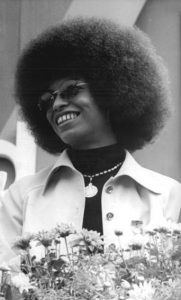
Davis in 1973, courtesy of the German Federal Archive


The Soviet Union had forged a strong pen-pal tradition as part of its educational and cultural programming. Writing to “friends” abroad, especially to fellow communists — within the Eastern Bloc and across the decolonized world, but also to interested interlocutors in the United States and Western Europe — had been in the Soviet Union’s soft diplomacy arsenal since the early years of the Cold War. What distinguished Davis from foreign pen pals before her was that she was not a willing participant; it was, in other words, a one-way dialogue, though the schoolchildren didn’t seem to notice. 

Many addressed their letters to “our friend Angela” or “our dear friend,” asking Davis to write them back and including their home addresses. “Hello, kind friend! I wish you a happy birthday! Your friend, Virtiniya,” writes a student from Soviet Lithuania. From the Russian far north, another asks Davis to “write me at home, I would like to be friends with you!” A small Russian rhyme appears on one envelope: “fly with a ‘hi,’ return with a reply.” In a co-written letter, two secondary school students announce that they are “very good friends and want to become friends with you, too.” 

Hand-drawn images of Soviet scientific accomplishments, socialist iconography, and national emblems accompanied many of the letters. A young boy from Khabarovsk decorated his envelope with stars, hammers and sickles, airplanes, a Soviet naval flag, a generic red flag, and his own version of the Star of David, all rendered in variations of blue, green, and red ink. In addition to paintings, cartoons, and doodles, some envelopes included actual gifts: I found homespun political paraphernalia, red pioneer flags, and even a box of chocolates. 

Other children took the letter-writing campaign as an opportunity to talk about themselves, their friends, and where they lived — a mode of introspection that was also part of a longer Soviet tradition of life writing. Under Stalin, the state explicitly encouraged its citizens to keep diaries and author memoirs and autobiographies to document their transformations into what the historian Stephen Kotkin termed “new Soviet men and women.”

The letters to Davis seem to have served a similar function. “Here is our beautiful Baikal!” reads a note on the reverse side of a postcard with an image of the lake on a warm summer day. The greeting comes from a group of preschool students in the city of Sliudianka on Lake Baikal’s southern shore. Another postcard, from a young boy writing from an industrial town in Soviet Lithuania, paints a much colder and more industrial scene. Its writer confesses to having read in a recent issue of Lithuanian Pioneer that Davis was lonely. He seems to sympathize: “It is winter here and it snows a lot. The weather is cold and we go to school.” His postcard depicts a factory and an adjacent parking lot, which he captions “our city.”

A birthday card for Davis, courtesy of Yana Skorobogatov, with permission from Stanford University’s Green Library (National United Committee to Free Angela Davis collection)


Since its founding in 1917, the Soviet Union had touted a commitment to ending all forms of oppression, including racism, which was portrayed in schools as an ugly byproduct of capitalist exploitation. Remove capitalism, the theory went, and racism would disappear, because all social conflict stemmed from economic inequality. Only a socialist economy could integrate all people  through guaranteed employment and welfare. 

The Soviet state had, since the 1920s, invited people of African descent as visitors to see firsthand what life under socialism was like. Langston Hughes, Paul Robeson, and Claude McKay were some of the most illustrious of the many Black cultural figures to visit the country in the 1920s and 1930s and return home with broad praise for a welcoming, open-minded society. Less-famous visitors reported more awkward, even violent experiences: long stares, invasive questions, and, occasionally, physical and verbal abuse. But Black people continued to visit and even immigrate, especially during the age of decolonization, when the government courted men and women from newly-independent socialist African countries with offers of jobs and education.

The schoolchildren’s letters offer insight into the way that Soviet ideas about race in America were received by its youngest generation. Across the board, the children evinced the belief that Davis was a political prisoner, jailed for her participation in the Black freedom struggle. A group of primary school students writes, “We want for you to again fight for the rights of black people, so that people in your country could live the same way we do, like all of the Soviet people live.” 

One letter signed by a class of young pioneers from the eastern city of Khabarovsk pledges to follow “your selfless struggle for the civil rights of your people,” and promises that their group will continue to remain with her in spirit. Yet another pioneer brigade, this one from a town in Soviet Kyrgyzstan, tells Davis, “we Soviet students are proud of your struggle for civil rights, of your resilience, and are certain that victory will come for your people.” Tamara Samorai, a third-grader from Soviet Kazakhstan, wishes Davis “good health and certainty in your struggle for the good cause, a cause for all the oppressed people.” Cheering her on from afar, the children offered the Soviet Union as a model for the kind of society that could one day exist in the United States.

In 1972, after more than two decades as diplomatic rivals, the Soviet Union and the United States agreed to pursue a period of détente. Nuclear non-proliferation, cultural and economic exchange, and the sharing of scientific and technical expertise were just some of the policies initiated in this period. Calls for world peace — especially in Southeast Asia, where the Vietnam War raged on — and a world free of nuclear weapons became common tropes in Soviet propaganda. Brezhnev, himself a veteran of World War II, which claimed upwards of 26 million Soviet lives, ruminated excessively on peace in his own private diary.

It is not a surprise, then, that words like “peace,” “equality,” “happiness,” and “freedom” appear regularly in the children’s letters; they are words that the children would have seen emblazoned on all kinds of state-produced posters, public art and iconography. “We support you in your fight for freedom, happiness, and peace on the planet!” writes a third grader from Soviet Ukraine. A letter from students in the Moscow provinces recognizes Davis’s “struggle” as one dedicated to “strengthening peace all over the world.” A drawing made by a group of primary school students from Moscow speaks directly to the “peace” motif. It depicts two hands, one light skinned, the other dark, clasped together against the background of a planet, with “peace to the world” printed in block letters below — a strange mirror of a now-ubiquitous stock image, in 2020. 
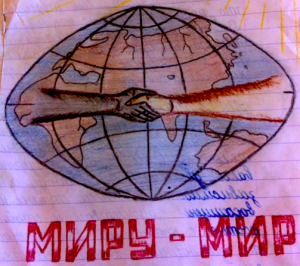
An illustration sent to Davis, Courtesy of Yana Skorobogatov, with permission from Stanford University’s Green Library (National United Committee to Free Angela Davis collection)


In March 1972, the journalist Hendrik Smith noticed a peculiar trend while traveling in Siberia, not far from the Mongolian border, on assignment for The New York Times: everyone was talking about Angela Davis. Dazzled by the sight of an American traveling in this remote region behind the Iron Curtain, one “young professional woman” took the opportunity to ask why “Miss Davis was being so persecuted.” Many in her town, she recounted, had been “so stirred by the Angela Davis case,” they had begun naming their children after her. 

Fast-forward nearly half a century, and Davis has been claimed by people and institutions even more surprising than mothers in far-eastern Siberia. Part of her wide appeal has to do with the smorgasbord of political issues to which she has lent her name. Long before “intersectionality” became a buzzword, Davis used her public platform, her teaching, and books like Women, Race and Class to speak about the ties that knit together issues of race, class, gender, and war. 

Perhaps most unexpected are the ways in which Davis’s brand is invoked selectively by those who prefer to ignore or whitewash her more radical positions. In the past four years alone, she’s been covered in Vogue, Elle, O!, Town and Country, and The Wall Street Journal, publications whose target audiences would likely be unsettled by her erstwhile popularity in the Soviet Union. Just this week, T Magazine, a fashion, beauty, holiday, travel, and design vertical published by the New York Times, selected Angela Davis as one of the faces of its annual “Greats” series, crediting Davis for the “current moment in grass-roots activism [as] one she both precipitated and inspired.”

Davis, who identifies as a Democratic Socialist, lent her support to Bernie Sanders in the 2020 Democratic Primary before offering a tepid endorsement of Joe Biden and Kamala Harris. The party’s moderate wing — much of which dismissed movements for prison and police abolition — leapt at the opportunity to use Davis as another cudgel against those on the left who were less enthusiastic about Biden’s candidacy.  

Revisiting the children’s letters, and parsing the inherited ideologies they reflect, is instructive in a moment when everything from PR emails to Instagram captions are laden with anti-racist rhetoric, and civil rights icons like Davis have come back into the spotlight. Forced into the public imagination for decades, the idea of Angela Davis at times seems almost completely detached from the actual person. Today, her brand is marshaled in ways that find a surprising echo in the phrases dutifully copied by 1970s schoolchildren in the Soviet Union, emptied of real actions or commitments past and present. Maybe the children’s view of Angela turned out to be right. She looms large; offering an expansive range of positions to seize upon. We look to her for moral guidance when we are lost, for consoling words in moments of crisis. To so many, she has begun to seem like a friend.
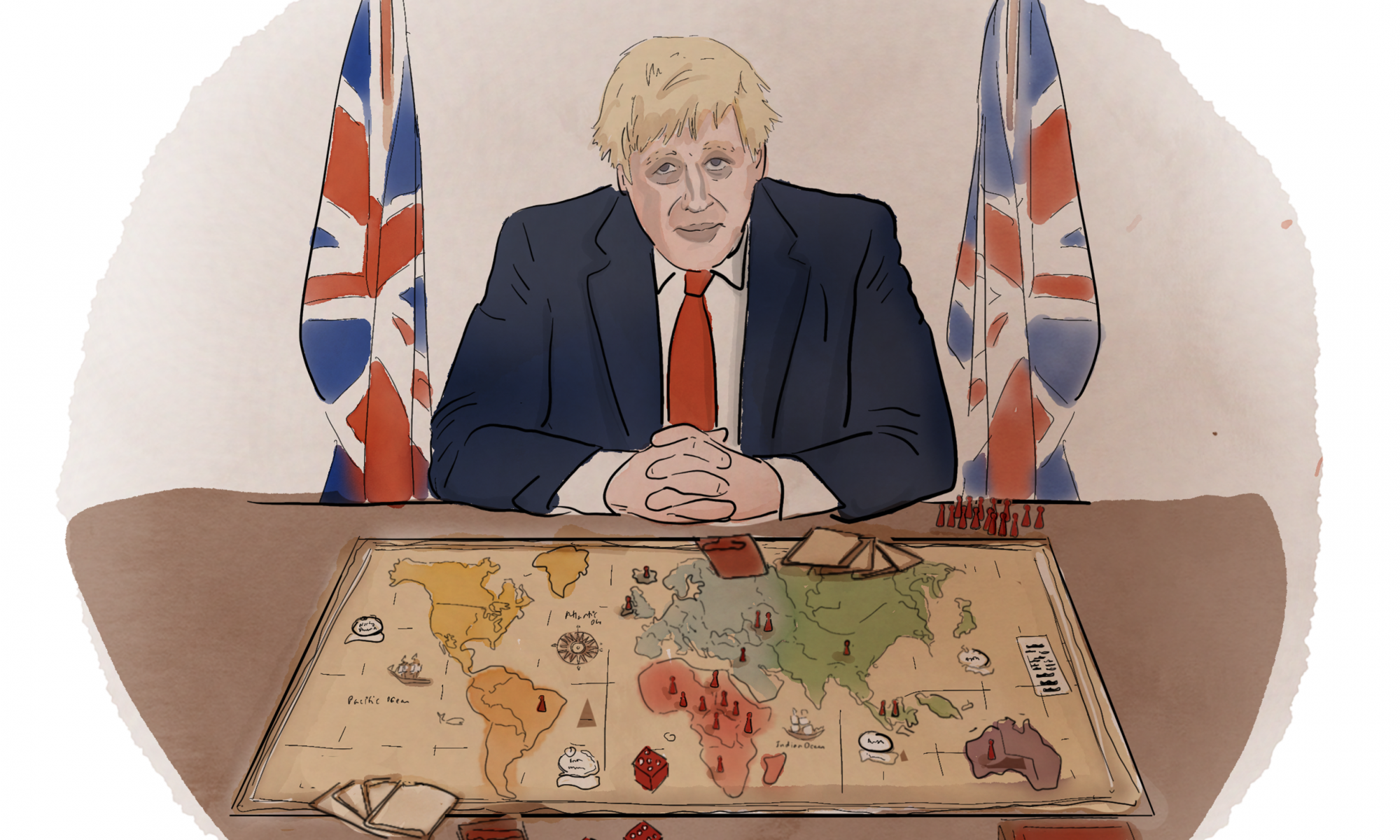

First World Problems

By June this year, the UK had surpassed 40,000 deaths from Covid-19. That same month also marked the end of a quarter in which the nation’s GDP shrunk by 20.4 percent, leaving the country firmly in the grip of a recession. At the same time, social movements percolated across the globe: Black Lives Matter protests had reached London, Birmingham, Manchester, and more UK cities following the death of George Floyd. In Bristol, a statue of a slave trader was pulled from its pedestal and thrown in the harbor.

If among these events you barely registered the merger of two acronymed departments in the British government, who could blame you? On June 16, Prime Minister Boris Johnson announced plans to merge the Foreign and Commonwealth Office (FCO, Britain’s State Department) and the Department for International Development (DfID, its foreign aid office) to create a new “super-department,” the Foreign, Commonwealth and Development Office (FCDO). The move was the most substantial reworking of British foreign aid policy in decades. Since 1997, DfID had been firewalled as a distinct department, maintaining its own budget, cabinet minister, and clear legal mandate: poverty reduction. Now, it would be demoted to a subset of Britain’s foreign policy bureaucracy. 

Edward Colton’s empty pedestal in Bristol (Caitlin Hobbs, CC BY 3.0)

Johnson pitched his decision as an overdue administrative action, calling it “an opportunity for us to get value from the huge investments that we make in overseas spending.” He cited examples of supposedly inefficient aid allocation that undervalued what he saw as Britain’s more important foreign relationships: equal amounts of aid currently go to Zambia and Ukraine, for example, “though the latter is vital to European security.” For too long, Johnson proclaimed, DfID had been treated by the rest of the world as “a cashpoint in the sky.”

Rolled out before opposition could be mobilized, the move appears to have been calculated to coincide with the distraction of the Covid-19 pandemic. Despite assurances from Johnson that a “massive consultation” had taken place, Devex reported that many in the development sector were unaware of any such process. The trade union representing senior civil servants learned of the merger from the media, and were only called to a staff meeting nearly two hours after the Prime Minister’s announcement in the House of Commons. What’s more, it was revealed that the UK aid budget would be cut by £2.9 billion the day before Parliament broke for summer, leaving MPs with no opportunity to interrogate the decision. The timing was especially cold given that the pandemic was disproportionately impacting individuals along lines of race, income, and class, both in the UK and abroad. In early August, the Guardian reported that nearly half of the UK’s small charities working with the world’s poorest expect to close within the next twelve months due to lack of financial support. In September, the UN predicted that between 90 and 120 million people will be pushed into extreme poverty in the developing world as a result of the pandemic. Quietly executed at the start of September, the move ties up Britain’s foreign aid and policy staff with a messy reorganization at a time when international focus on the unequal burden of Covid-19 is essential.

The development sector, along with three of Johnson’s four predecessors, swiftly condemned the merger. But by leaning on an ideal of the compassionate global citizen in arguing for DfID’s essential existence as a standalone department, the detractors revealed a tension in British foreign affairs. No government — neither Labour nor Conservative — has yet reckoned with Britain’s colonial legacy or the unique responsibility it might have as a result. On its creation, DfID was part and parcel of the Blairite outlook — one in which global inequalities were seen as a moral failing for all. 

That ideal of global responsibility has soured across Britain, as it has in the US, in the austerity-ridden decades since Bush and Blair. Politicians now face a choice: explain directly how Britain benefits from its global development work, or drop support for DfID entirely. The former requires confronting thorny questions. What right does Britain have to decide where development funding goes in independent nations? Why is this neocolonial posture still so prevalent? Does Britain owe more than other nations in the fight against the global inequities it shaped? Should British aid be thought of not as benevolence, but reparations?

The merger of the FCO and DfID represents a continued deferral of those conversations, epitomizing a nascent post-Brexit era of British foreign policy that leans into, rather than away from, the country’s colonial past. Subsuming DfID into the FCO institutionalizes the idea that where Britain’s purely nationalistic priorities collide with development needs — namely, those of foreign countries and, frequently, ex-colonies — the UK’s aid will be mobilized for her own self-interest. The danger is that those goals are being formulated from an embryonic foreign policy animated not by Little England, nor the City of London, but the ghosts of empire.


Britain’s development policy was born an imperialist endeavor. The 1929 Colonial Development Act enshrined aid funding as a tool “for the purpose of aiding and developing agriculture and industry in the colony or territory, and thereby promoting commerce with or industry in the United Kingdom.

Left- and right-led British governments tussled over foreign aid’s relationship to diplomatic policy throughout the post-war era. In 1964, Harold Wilson’s Labour government created a ministry that united aid functions from across Whitehall under one roof, apart from the Foreign and Commonwealth Office bureaucracy. When Conservatives took power in the 1970s, this ministry was then folded back into the FCO. Returning to power in 1974, Labour again wrestled it away from the FCO’s mandate, though it remained without its own cabinet official. At the end of the decade, Thatcher took office, and “structural adjustment” (making foreign aid conditional on neoliberal market reforms) became global orthodoxy via the World Bank and International Monetary Fund. The ministry was swallowed by the FCO again and remained in this position throughout Thatcher’s tenure and into Major’s.

In the early 1990s, the FCO’s troubled alloy of foreign policy and development work ruptured with the Pergau Dam scandal, a watershed moment in which it came to light that the British government had promised aid money for an ill-conceived hydroelectric dam in Malaysia, contingent on an arms deal with the Malaysian government. The cost of the undertaking ballooned nearly fourfold in the decade after the deal was first struck in 1980, ultimately totaling an estimated £238 million. Though Malaysia could produce electricity far more cheaply by other means, British companies stood to profit mightily from the arms deal — so it went ahead. With Britain’s commercial and development objectives diametrically opposed due to the dam’s astronomical cost, Tim Lankester, the Permanent Secretary overseeing aid, demanded a written directive from Foreign Secretary Douglas Hurd, who decided “it would have been very damaging to our commercial interests, as well as our political interests, if we started to weasel around.” Citing an informant from Balfour Beatty, a British construction firm participating in the dam project, one Labour MP claimed that British taxpayer dollars had been used to pay off local Malaysian politicians. 

The story broke in 1993, near the height of the neoliberal consensus and shortly after the end of history. Investigations followed, two select committees filed reports, and the World Development Movement (an NGO campaigning for economic justice in the Global South) brought a court case against the British government. The plaintiffs argued that because the development of the dam was uneconomical, supporting it with development funds was contrary to the law. The High Court agreed, and the government lost the case.

After his election in 1997, Tony Blair created DfID as a new standalone department with a Cabinet-level, ministerial role. In 2002, he passed the International Development Act, effectively outlawing tied aid and making “poverty reduction’’ the sole legal basis for international aid spending. Within the FCO there was substantial opposition: some ministers and diplomats ignored the split and continued to sweeten deals and lubricate foreign relations with promised aid. Clare Short, DfID’s first Secretary of State, deducted any such sums from the FCO’s limited aid budget, and they soon ceased.

Since then, governments on both sides of the political spectrum have largely left DfID alone, in part because it is hard to make a case for combining aid and foreign policy under the same roof without falling back on nationalist and imperialist arguments. And DfID, for all its faults, carved out a global reputation for engaged, evidence-based policymaking. Its employees, nearly a third of whom are technical specialists, controlled around 75 percent of the UK’s overseas development assistance budget until last month. (The FCO controlled just five percent.) While in 2018, DFID spent 62.5 percent of its country-specific aid in the least developed countries, for non-DFID aid, the proportion was 25.7 percent. Considering the merger, the International Development Select Committee reported that UK aid not administered by DfID “has a very different geographical profile, with around three quarters going to middle-income countries, including China, India and South Africa.” Stated priorities were “reducing carbon emissions, tackling insecurity, building research partnerships and promoting trade and investment ties with the UK.”

Without the institutional ring-fence constructed around DfID from its inception, there is now little to prevent the FCO from repurposing aid funding for less-than-humanitarian goals. “Poverty reduction” can be broadly defined. After all, despite its enlightened mandate DfID’s existence has always been tinged with British self-interest: the department’s anti-poverty work acted as a sort of moral cover while the Home and Foreign Offices enacted steadily more callous policies. In 2015, David Cameron announced on an official visit to Jamaica that Britain would spend £25 million of “aid money” building a prison on the island to house foreign criminals currently serving sentences in the UK. Cameron said it was “absolutely right” that foreign criminals be properly punished, but not at the expense of the “hard-working British taxpayer.” The announcement of this sensational project overshadowed a promising campaign for reparations from Britain for its role in the slave trade, led by the Caricom reparations committee and directed at Cameron by the then-Prime Minister of Jamaica herself. (When pressed, Number 10 said it understood reparations were “an issue for some people” but refused to address the question other than to dismiss the idea as “not the right approach.”) In another instance, Theresa May’s “hostile environment” policy aimed at deterring illegal immigration during her tenure at the Home Office resulted in the Windrush Scandal of 2018, in which British citizens, predominantly 1940s émigrés from the Caribbean, were denied housing or medical treatment and, in some cases, deported.

Even as DfID’s achievements were rigorously tabulated, its qualitative role in aiding and abetting Britain’s global power remained amorphous, fueling the department’s reputation as a scientific force for good. Britain has been exacting in demonstrating the return on its aid in terms of poverty reduction, but it has stayed far more circumspect in auditing the returns to the national self-interest.

Tony Blair denounces the merger in a brief video


At the time of the merger’s announcement in June, the International Development Select Committee had been leading an ongoing, government-commissioned, non-partisan review of the effectiveness of UK aid, including the consequences of a potential merger, for three months. (Johnson announced the dissolution of the Committee alongside DfID.) An interim report, published just over a month before the announcement, concluded that DfID should be retained as a standalone entity, so as not to damage Britain’s international standing.

In an attempt to reframe DfID’s worth amid the nationalist pressures of a post-Brexit political climate, Tony Blair, in a three-minute video released after the merger was announced, called the department “a major and important arm of British soft power.” Before his government created DfID as a distinct department in 1997, Britain’s aid arm was “not recognized as a key global player;” it became one of the most respected post-colonial development programs in the world. In his statement, Blair edged closer to directly describing the premise of DfID than he ever did while in power. The merger is political, Blair stressed, and “has nothing to do with the true national interest.”

Saying that Britain should fund a self-contained development department for the “true national interest” is politically challenging. It requires arguing that Britain does and, more controversially, should benefit directly from the development it funds — a position inarticulable without obvious colonial overtones. The countries receiving funds from the “fantasy cash machine,” as Johnson characterized it, have predominantly Black and brown populations and are without deep reserves of wealth, often directly because of Britain’s colonial plunder. The idea that such funds should be tied to a return for Britain is an inconvenient reminder of the very-much-alive legacy of British imperialism and foundations of British power.

Blair’s New Labour avoided this debate by leaning on the idea that poverty reduction is not a British responsibility, but a global one. In 2001, Blair famously stated, “Africa is a scar on the conscience of the world.” The challenges on the continent had global solutions, and “if the world as a community focused on it, we could heal it.” It was a thesis that held significant appeal at the time. The public was ready to swallow the myth that Africa’s challenges had arisen independent of any history for which Britain might inconveniently be responsible. DfID benefitted from such a view, sitting within an international development sector that holds vestiges of power, money, and decision-making systems built along lines of race, class, and nationality. (This sector, at least in the UK, is still painfully tokenistic.) The development community adopted the idea that history was a distraction, and that fighting poverty, meant only looking forward. Aid, in turn, was designed to “make poverty history.”

This framework was one well-documented casualty of the 2008 financial crisis and its global fallout. With poverty reduction as global obligation no longer political gospel (the UN’s much-vaunted Millennium Development Goals went quietly into the night in 2015), justification for Britain’s aid spending became a lacuna. Today, disaffection with globalization is redundant to document, given the scale of its impact. We’re a long way from the optimism of 1997, a year when New Labour won a colossal electoral mandate predicated on using the energy of the present to blueprint the future. (Blair’s book-cum-manifesto, published the same year, was titled New Britain: My Vision for a Young Country.) After 2008, when the present looked too bleak to build on, Britain looked backward. The country’s best days were the ones when it had stood alone — ruling an empire, or in its “finest hour” during World War II. British exceptionalism resurged.

The Conservatives — and Johnson especially — stood primed to lead the revanchist charge. The European Union provided a convenient scapegoat for the pain of Cameron-era austerity — a liberal, outward-looking constraint on Britain’s imperial potential. Cameron bowed out the morning after the Brexit referendum, as soon as the inexorable became obvious. Four months later, at her first Conservative Party Conference as leader and Prime Minister, Theresa May stated, “if you believe you’re a citizen of the world, you’re a citizen of nowhere. You don’t understand what the very word ‘citizenship’ means.” (She is the only one of Johnson’s four predecessors who has not condemned the merger.)

In explaining away the hasty merger, Johnson took as a premise that Britain should gain in obvious terms from any aid it spends. He rushed to promise that the new super-department will secure “maximum value” for the British taxpayer. Every employee will receive “ideas and sense of mission” from DfID, “but also the understanding of the need to protect UK values, UK policies and UK interests overseas.” Defining which “values” and “interests” Johnson meant is not difficult. The emphasis on “British interests” betrays an implicit skepticism of the worth of any independent aid at all. Though Johnson has called the move a merger, he has made it crystal clear that the foreign secretary will lead the department, effectively leaving DfID with no executive advocate. 

Britain is not the first country to merge its development and foreign offices. While some have been effective — or at least not detrimental to development policy — others have not. The reasons seem to lie in the purity of the motivations (not Johnson’s strong suit). Evidence shows cabinet-level leadership on development leads to consistently better outcomes. In Denmark, for example, a cabinet position overseeing development was retained, and aid priorities seem to have remained intact. Until this year, the UK was also cited as a prime example. 

Perhaps in anticipation of calls to keep a ministerial position for development, Johnson crippled the role by appointing Anne-Marie Trevelyan — a hard-line Brexiteer with no evident interest in global development — as DfID’s minister in a February cabinet reshuffle. Johnson promised DfID’s aid budget would be preserved, but scrapped the committee that audits aid spending and assesses its efficiency. The FCO also reserves most roles for UK nationals: serving the Office’s interests apparently requires “special allegiance to the Crown.” Since the announcement, it has been reported that DfID staff moving to the FCO can continue their positions “up to any pre-agreed end dates.” After that point, unless the FCO changes its nationality requirements, many non-UK nationals working for DfID will no longer be eligible for their current roles.


It is not obvious that British career diplomats will have the experience or skills to manage multi-million dollar development programs. Good development requires expert staff living in the locales they are serving, either permanently or for long periods of time. Above all, it requires people who view development as the means and the end, and are willing to work to make their jobs irrelevant. Good diplomacy, the saying goes, is the ability to tell someone to go to hell in such a way that she looks forward to the trip. Aid cushions the seat. 

And it is telling that DfID will be annexed entirely under the FCO, and not one of the many other departments with which it shares goals, such as health or climate change. The FCO is the weaker partner in terms of transparent, effective, evidence-based development, tending to pursue expressly nationalistic interests, which have led it to mismanage its aid budget in the past. In 2018, the Aid Transparency Index — an independent assessment of the accessibility of information on aid spending and evaluation run by Publish What You Fund — ranked DfID third out of 45 major development agencies. The FCO ranked 40th and was classified “poor.” (This year it rose to 38th and “fair,” falling short of the British government’s goal to have all aid-spending departments rated “good” or “very good” by 2020.)

The merger is instead an attempt to shore up the power of the FCO, an office whose influence — especially among developing nations — faces a self-imposed decline. Since the 1990s, its operations, particularly in developing nations, have substantially decreased. In 1995, for example, there were 25 UK-based diplomatic staff members in Zambia. There are now two. Without a strong physical presence, cooperation will be difficult. Such actions communicate a low priority to the country in question, and Britain can no longer rely on its economic weight to force through extractive foreign policies. Grive Chelwa, writing in Africa is a Country, notes that exports from Africa to the UK represent about five percent of Africa’s total exports: “Africa is more worried about a slowdown in China, its biggest trading partner by far.”

Under the new plans, a single British “strategy” will be implemented by the relevant ambassador in each country. The foreign secretary will be “empowered to decide which countries receive or cease to receive British aid.” The new “super-department” was the culmination, at the highest level of government, of the idea that optimal foreign policy was an “Empire 2.0,” as Conservative Party politicians described it to The Times in 2017. It makes sense that since Johnson took office last year, the pace of policy change has quickened. In 2002, Johnson, misquoting Blair, wrote that Africa was a “blot, but it is not a blot upon our conscience. The problem is not that we were once in charge, but that we are not in charge any more.”


If anyone in the British government cares about historical accountability, it is not the Prime Minister and his privileged compatriots in Westminster — a type at once ubiquitous inside British politics and completely bizarre outside of it. Alexander Boris de Pfeffel Johnson is one of them, as is Jacob Rees-Mogg — the so-called “honourable member for the 18th century.” Johnson’s 2019 cabinet was the most privately educated for over 20 years: seven percent of Britons attend private high school, but 64 percent of Johnson’s ministers did. Cameron appointed Old Etonians as his chief of staff, his chief of policy, and the head of his policy unit.

This cohort arrived in political office to find their task was to manage a decline of something they had been taught to worship. The juxtaposition between their own lives — comfortably ensconced in a generational wealth that was equated with moral superiority — and the decline in British global dominance metastasized into a full-blown identity crisis. Faced with existential questions, many have responded by attempting to revive — top down, from the government — a period when superiority by accident of birth was celebrated, not challenged. 

Successive Conservative governments have managed to marry a popular snobbery towards anything foreign with a rose-tinted nostalgia for a benevolent Empire and a commensurately imperial FCO. To entertain these two competing positions, Johnson and others often reflexively refer back to Britain’s status as a global superpower while insisting on the country’s modernity. But government decisions like the merger also throw Britain’s historical record into sharper relief, revealing how little most modern Britons are prepared to account for their empire’s crimes. Some are particularly sensitive about the figures and events Britain most wants to reincarnate in the scramble for relevance. Winston Churchill, for instance: as his biographer, Johnson defended him to the point of assigning the removal of Churchill’s bust from the Oval Office to Obama’s “ancestral dislike of the British Empire.” (The bust was in fact a loan made by Tony Blair to George W. Bush, and was returned to the British government in 2009, as planned.) In The Victorians: Twelve Titans Who Forged Britain, Rees-Mogg explained that imperial figures justifiably thought it “reasonable to export” British civilization “to other countries to remove such hardships as exist there.” After rumors this summer that “Rule, Britannia!” might be performed without lyrics on the last night of the Proms (an eight-week classical music festival and centerpiece of the London summer that usually ends with a showcase of British anthems), Johnson told reporters, “I think it’s time we stopped our cringing embarrassment about our history, about our traditions, and about our culture, and we stopped this general bout of self-recrimination and wetness.”

One reason New Labour did not look back to justify modern development work through a reparative lens was that much of the electorate would have disagreed. The entire curriculum of the state education system says virtually nothing about the horrors of British imperialism; history lessons often skip from the Tudors to the First World War with little mention of anything in between. By three to one, Britons think the Empire is something to be proud of. This sentiment, however, is driven by Conservative voters: over a third would like the empire to exist today, and more than half think countries are better off for having been colonized.

That trope — that Britain’s extracted wealth was a small remuneration for its superior civilization — is near-identical to the motivation behind the DfID-FCO merger today. The narrative was recycled into one of Britain’s unjust loss, over Britain’s unjust gain. At its center was the ubiquitous taxpayer — no longer exploited by Britain’s internal class system, the story went, but instead by the unearned social mobility of foreign powers Britain had historically suppressed.


In a way, the Conservatives have benefited from the asymptotic nature of Brexit’s implementation, which has appeared imminent and then receded at various points since 2016. For over four years and under three different Prime Ministers, the party has been able to define its foreign policy in opposition to European counterparts only, using the EU and internationalism of any color to deflect from punishing years of Tory austerity. From 2021 on, this will be trickier, and how the government attempts to shape Britain’s identity internationally remains to be seen. Immediately after the Brexit referendum, the government summed up its position with a purposefully vague, slightly arrogant slogan: “Global Britain.” To call this a strategy would be generous. The phrase is at once a rejection of Europe, a Singapore-on-the-Thames embrace of globalization, and a statement of British exceptionalism — in practical terms, meaningless. 

This incoherence is the inevitable byproduct of the doomed attempt to revive British imperialism as modern foreign policy. The slide of Britain from a first-tier world empire to a second-tier nuclear military power has formed the basis of a potent, reactionary political current at odds with the world in which it now operates. The cultivation of “soft power,” as Tony Blair described the work of DfID, is incompatible with the aims of a nostalgist right. Accepting neither the strategic advantages nor moral imperatives of foreign aid, Johnson and the Conservatives are redefining it in explicitly transactional terms: play ball with us diplomatically, or else.

For all DfID’s errors — and those of the history it is built on — stripping Britain’s development work back to its foundations in colonialism risks reproducing an unwanted legacy in a modern incarnation. In its best instances, DfID operated on the assumption that Britain’s national interest was served if the recipients of aid benefit by the maximum degree possible. Instead of directing British funds and support to long-term and resolutely local operations, democratically demanded by the citizens of the recipient country, there is now a real danger that DfID’s mandate will be lost and its technocratic reputation used to give a sheen of objectivity to whatever aid program most helps Britain’s foreign policy crisis of the day. 

The events of this summer have shown that Johnson’s government and policies are not, however, an unstoppable juggernaut. The murder of George Floyd spurred enormous protests, which in Britain amplified calls for curriculum reform, truth and reconciliation commissions, and the fall of colonial figureheads. (A statue of Robert Clive, the first British Governor of Bengal, stands directly outside the FCO in Whitehall. Clive’s ancestral home, Powis Castle in Wales, holds more Mughal artifacts than the National Museum in New Delhi.) This opposition has been sustained by broader public engagement with grassroots movements simmering under the conditions of institutionalized racism and classism that span Britain’s political spectrum. Politically, Keir Starmer’s Labour has proved more willing to broach these subjects. The “eradication of structural racism,” Starmer has said, “will be a defining cause for the next Labour government.” 

But Starmer’s first party conference speech as leader of Labour was temporally Blairite. No reference was made to his predecessor, Jeremy Corbyn, whose opposition was decimated by Johnson in the 2019 election. Instead, Starmer lauded Clement Attlee, Harold Wilson, and Blair. The message from these leaders, he said, was “don’t look back, look to the future.” How Labour plans to account for Britain’s imperial history from this standpoint is as unclear as it was in 1997. And how palatable that message will be on a post-Covid electoral stage — where a growing demand to reckon with the empire’s legacy sits alongside a refusal to acknowledge it as morally wrong — is as opaque. The national identity crisis in Britain today is the result of a learned imperial nostalgia that is pathetic at best, racist at worst. Britain has been loathe to examine the periods of its history whose discriminatory -isms have a particularly long half-life. With the merger of DfID and the FCO, its attitude has progressed from reluctance to full-on denial.