

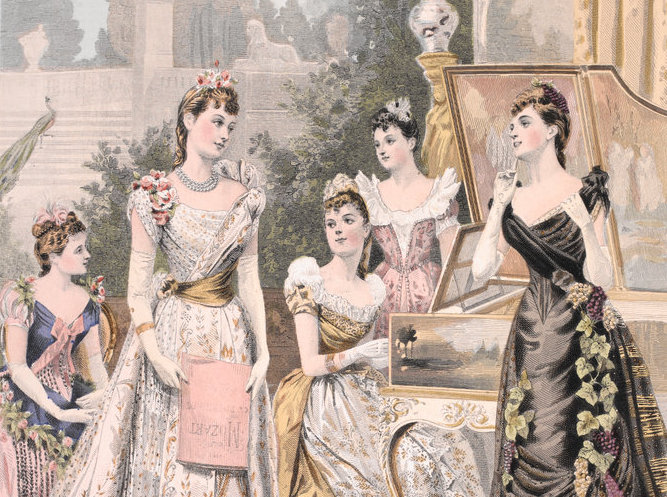
No friendships worthy of Flaubert’s exacting pen emerge from the Ursuline convent of Emma Bovary’s schooldays. Blame it on the local black market. Out of sight of the nuns, a matronly seamstress stashes books “full of love and lovers” in her apron smocks and slips copies to the older girls — hypnotizing tales of moonlit crossings, fainting damsels, horses ridden to death by perpetually late beaux. Only lovers (noblemen in cloaks) count here, while other attachments get short shrift.
Transported to our era, today’s Emma — in leggings, not smocks — might favor a different sort of book, one that gives pride of place not to male lovers but to female friends. If the romance novel was once the genre of fashionable sincerity, then a more affable successor has come to supplant it. Swooning and sobbing are out; an upbeat sisterhood is in. This genre occupies a different register of preciousness, one set amidst an egalitarian milieu that, the reader is made to understand, only the company of other women can offer. More even than lust or the winning marriage, latter-day Emmas seek the depths of sorority, the complex confidences, rivalries, and private languages shared among women. Perhaps the novel of love did not just peter out. Rather, it shape-shifted into the novel of “female friendship.”
An idle observer of the cultural marketplace might have noticed something of an inflection point in the mid-2010s, when the trope of female companionship began to heavily pervade fiction and film: novels by Elena Ferrante (and “Ferrante fever” ephemera), Sheila Heti, Zadie Smith, Sally Rooney, and series and films directed by Lena Dunham and Greta Gerwig, in which best friends, not boyfriends, star. Cheerleaders behind the New York Times culture desk chanted headlines like: “Sisterhood (and Friendship) Is Powerful,” “A Debut Calls a Ferrante-Style Female Friendship to the Fore,” and (a real gem, this) “A Call to Action for Girl Squads Everywhere.” Men, meanwhile, seemed to be suffering something of a friendship drought. Corresponding headlines carped: “The Challenges of Male Friendships,” “Can’t Guys Just Learn to Fight for a Friendship?” and even in the science section, “Why Male Baboons Benefit from Female Friends.”
It is easy enough to sketch a composite image of the female friend, tin-stamped with sheepish heroism. Invariably an artist or writer, or trying hard to be one, she has yet to produce her great masterpiece and is afflicted by feelings of fraudulence. Often her status as an artist may seem more a clamorous speech act than an earnest sign of resolve. Yet she is quick (too quick) to call her own bluff. Her companion — the one with the wilder hair, rawer talent, but sometimes consigned a dimmer fate — she is the true artist. So the protagonist laments. If the visible world of friendship is formed in love and protective urges, the more obscure backdrop is often enough formed in envy and rivalry.
Does the luster of the female friend emerge in compensatory fashion at a time when it is especially financially daunting (or ideologically unappealing) for many women to form a family? Has this niche proven a winning formula for a book industry catering to a readership skewing more than a smidge female (80 percent)? Putting such cynical speculations to the side, a girl-power generation has spoken with the confessional flair of Flaubert himself: “Madame Bovary, c’est moi”!
And publishers have taken note. Following the friendship boom, a more recent spate of group biographies of female writers and artists works a similar terrain, surveying the social worlds women have forged on their own defiant terms. Fortunes here are shaped by Parnassian pals, and lives oriented against patriarchal slights. But if Emma Bovary erred in viewing trite art as a model for life, the trade-press historian risks viewing it as an efficient formula for the writing of the past. One gathers that the (female?) reader is meant to experience a frisson of uplift and admiring recognition throughout. More often, you can feel you are getting a peppy archetype in the place of any difficult reckoning with the making of art or social relations. The female friend certainly sells books. But does she offer a way of capturing the lives of artists?
Some of these recent group biographies do outfox the powerful industry trend, steering clear of facile tropes and uninspired feminisms. Mary Gabriel’s Ninth Street Women (2018) forthrightly admits that the female Abstract Expressionists hurling down paint and kicking around canvases would have flinched at the very term “female artist.” This is not a book about sisterhood that would dare silo off Lee Krasner, Elaine de Kooning, Grace Hartigan, Joan Mitchell, and Helen Frankenthaler from their male counterparts carousing and confabulating at Cedar Tavern. And yet, to some, the women’s capsule-sized bios seemed readymade for another medium altogether: Amazon Studios has bought the rights to make the book a television series, to be directed by the same team behind such avant-garde triumphs as “Gilmore Girls” and “The Marvelous Mrs. Maisel.” (Frankenthaler’s boyfriend, the Partisan Review critic Clement Greenberg, popularized just the term for art that crosses the velvet rope cordoning off the refined from the rabble: kitsch.)
Though unlikely to be optioned anytime soon, Deborah Nelson’s Tough Enough (2017) and Michelle Dean’s Sharp (2018) also scrupulously avoid any hint of sentimentalism. The women in Nelson’s brilliant study — Arbus, Arendt, Didion, McCarthy, Sontag, and Weil — eschewed emotional expression in the face of worldly pain, while never entirely succumbing to an affectless hard-edged skepticism. Among Nelson’s subjects, only Mary McCarthy and Hannah Arendt became pals, on a subway platform after an editorial meeting for Dwight Macdonald’s short-lived magazine, politics. But their friendship is unrecognizable in the terms of the fictional female friend. They saw in one another, as Nelson puts it, a “preference for solitude over solidarity.” Acid tongues, not eager sociability, unite the women in Sharp too. “Irony, sarcasm, ridicule: these can be the tools of outsiders, a by-product of the natural skepticism towards conventional wisdom that comes when you haven’t been able to participate in its formulation,” observes Dean. Both books successfully name 20th-century sensibilities — the loosey-goosey nature of a sensibility being “one of the hardest things to talk about,” Sontag herself observed in “Notes on Camp.”
But other submissions to the genre take a decidedly different tack. Instead of sidelining sentimentality, they create a historical backdrop for it. The resulting group biographies are mawkish histories of women who opposed mawkishness. Virginia Woolf once herself encountered the challenge of pinning down the elusive iridescence of a life in biographic writing, we learn in Francesca Wade’s Square Haunting (2020). “How does one euphemise 20 different mistresses?” Woolf asked, midway through the bio she was writing. When the subject was an apparent philanderer, and his mourning family was providing the archive — boxes of “tailor’s bills, love letters, and old picture postcards” — the question was a live one. As Woolf chased after the riddle, we learn, she lived on Mecklenburgh Square, where she shared real estate with other writers between the World Wars. Historian Eileen Power, classicist Jane Ellen Harrison, detective novelist Dorothy L. Sayers, and poet H.D. (the nom de plume of Hilda Doolittle) all variously took up residence on the square in Bloomsbury (D.H. Lawrence called it the “dark, bristling heart of London”).
If one assumes Leopold Bloom’s timeless definition of a nation in Ulysses — “the same people living in the same place” — then Wade has discovered a very small, very erudite nation indeed. That the conceit is more poetical than rigorously historical is hardly a defect. The book might have come closer to offering a quiet meditation in the vein of Fleur Jaeggy’s These Possible Lives (with lush biographies of Thomas De Quincey, John Keats, and Marcel Schwob) if it did not insist on its PBS-style signposting, blaring orchestra and all. Must we hear one more time that “it was the help of women, and the support of a female institution,” (in this instance Cambridge’s Newnham College) that changed these women’s fortunes? Or that “their lives in the square demonstrate the challenges, personal and professional, that met — and continue to meet — women who want to make their voices heard”?
One can be heart and soul for women’s voices being heard, but also eager to hear them say something beyond that they want their voices to be heard. Unfortunate in Square Hauntings and some of these other recent “women who changed the world” books — i.e. titles I wish I were making up: Outsiders: Five Women Writers Who Changed the World; Visionary Women: How Rachel Carson, Jane Jacobs, Jane Goodall and Alice Waters Changed Our World; The Life and Times of Butch Dykes: Portraits of Artists, Leaders, and Dreamers Who Changed the World; and (breaking the mold, those rebels) The Book of Gutsy Women by Chelsea and Hillary Rodham Clinton — is the lack of animating ideas other than a pat mission statement: to wit, that women (for the most part, white and well-educated) remain grotesquely underrepresented and that we can better represent them and their historical achievements.
Gutsy women turn gusty. Wade intones, “They refused to let their gender hold them back, but were determined to find a different way of living, one in which their creative world would take precedence.” Beholden to this simplistic framework, Square Haunting tends to boil down to a recovery project of previous recovery projects — a feminist archival infinite regress. We read of Harrison researching matrilineal descent and “matriarchal, husbandless goddesses” among the Greeks, of Power’s penning her tome on medieval nunneries, of Woolf’s plan to write the lives of our mothers and grandmothers, of H.D.’s musings on the collective voices of female Greek choruses.
This spiralizing retrospective can leave one wondering: when we are at the point at which historians are recovering the recover-ers, might it be time to shift the set of questions slightly — to ask, perhaps, why this infuriating exclusion exists in the tradition of modernism to begin with? Apparently not: Wade has signed on a double-book contract for two new group biographies, one involving Gertrude Stein and Alice Toklas and another, set in 1970s New York, that tells “the story of the decade through the interconnected lives and experiences of a group of female poets and activists….”
The latest spinoff comes in the form of Maggie Doherty’s The Equivalents: A Story of Art, Female Friendship, and Liberation in the 1960s (2020), which was recently chosen as a finalist for the National Book Critics Circle’s annual award for best biography. The book showcases a group of five writers and artists at the Radcliffe Institute, where women with PhDs or their artistic ‘equivalent,’ hence the title, were granted a $3,000 stipend (around $25,000 today), along with an office in the yellow house at 78 Mount Auburn Street in Cambridge, Massachusetts. We learn in the preface that this is, thank god, “a story of how [these women] changed the world” — and what “remains to be done.” And why five women, yet again? Quintets work well enough, whether for the Spice Girls or Rona Jaffe’s The Best of Everything (The Wing’s Audrey Gelman wrote on Twitter that this was “the book that inspired everything 4 me”). Or perhaps, two episodes per woman equals… one Amazon season? Whatever the reason, the historical Herland once more over-schematizes and over-determines the past.
The collective template adopted in this rendition also means that the artist is hardly ever alone — socially as well as politically. The women’s well-funded gabbing and swanning is presumed to have momentous political implications. The account then can seem to participate in a signature vice of our times — the tendency of those in rarified milieus to too readily identify broader political struggles with their own positioning in specialized economies of esteem. The possibility that the gilded goings-on at the Radcliffe Institute might be something other than an egalitarian experiment fits only intermittently into the story of liberation that Doherty aspires to tell. Rather, The Equivalents presents the hallowed “female community” at Radcliffe as worthy of “adapt[ing] their ideas and approaches to our own time,” no matter that the friend group solidified into a clique for petty horse-trading. With the Institute’s patronage and friendships, Doherty claims, the glamorous self-alienation of housewives, some encased in Cape Cod colonials, was transformed into professional seriousness and artistic transcendence.
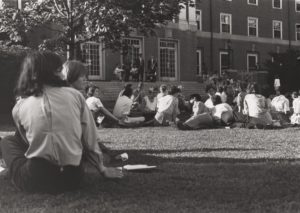
Across nearly two decades, Equivalents follows a circle of artists in New England, writing, painting, and sculpting their way out of the grey-flannelled fifties: poets Anne Sexton and Maxine Kumin, writer Tillie Olsen, and artists Barbara Swan and Marianna Pineda. Sexton — who is the most shrewdly social and the most central to the narrative — befriends Kumin in an adult-education poetry workshop in Boston in 1957. “Kumin could seem at first to be Sexton’s twin,” Doherty writes of the Newton neighbors. Like the classic female friend narrator, Sexton suffers great insecurities, particularly regarding her abbreviated education. “My qualifications are unique — uniquely wrong,” she typed for a throwaway draft of the Radcliffe application. At parties she feels more at ease: “She helped herself to whatever alcohol was on offer and then pranced around the room, shouting with delight at her friends’ brilliant lines.” And like the trope, too, she is poised between opposing feelings of love and jealousy towards other women. “I read Tillie Olsen’s story and I cried and I was ashamed to have my story appear… She is a genius.” Yet without a “creative community,” Doherty reports, “Sexton found writing nearly impossible.”
So strong is the emphasis placed on female mutual aid and stylized feminist liberation that this history can largely function as a work of omission. Nuances of artistic imagination, less suited to the theme, are glided over like the subterranean depths of a frozen sea. (On thin ice, speed is safety, Emerson said.) The raw-nerved confessional poems and paintings, stories and sculptures of Equivalents are glossed with breathless but cursory praise, as if they were indifferently hyped items in a seller’s catalogue. The Brookline painter Barbara Swan is introduced as making “portraits… that exposed the sitter’s soul.” Kumin, we are told a few times, possessed great “powers of observation.” Sexton’s pivotal suite of poems (“Unknown Girl in a Maternity Ward”; “The Double Image”; “You, Doctor Martin”) is summarized as Sexton’s beginning “to discover her knack for image making.” Tillie Olsen planned to write a proletarian novel that, Doherty writes, “would underscore the importance of all human lives.” The women, their work, and their friendships are called “remarkable” at least nine times. Concluding with a line in which Kumin cheers “hooray” for Adrienne Rich’s Of Woman Born, this rah-rah cultural history is itself administered in a prose style that is not always hard-won: “The women compared suicide attempts and munched on potato chips,” Doherty writes of Anne Sexton and Sylvia Plath at the Boston Ritz-Carlton. Or else: “Women like Sexton and Kumin didn’t want to amputate their passions.”
And men? What men? As if hell-bent on passing the Bechdel test on every last page, Doherty produces a world in which the presence of men is oddly minimized. She slips Sexton’s love affairs, one in Rome and one in Boston with poet and Houghton Mifflin editor George Starbuck, away in censorious parentheses — even as the latter connection helped Sexton land her first book deal. Similarly tucked away, somewhat brutally, in a parenthetical is the fate of Adrienne Rich’s husband: he shot himself after their divorce. In Doherty’s recounting, men only get star turns when they can be portrayed as big bad wolves, no matter how petty the scale. For his efforts to meddle in the friendship of Kumin and Sexton, the obscure poet John Holmes (who found his former student Sexton “utterly selfish, blood-sucking, destructive”) wins five admonishing pages.
Doherty’s scene-setting of New England’s “competitive, treacherous literary climate” leads to the purported fix, where the friends first convene: a Harvard institution founded in 1961, in the solemnly purposive Cold War rhetoric of the day, “to generate educated womanpower.” “One could only imagine the conversations that it would start,” Doherty writes in her canned rhapsodizing. The truth was that in 1960 microbiologist and new president of Radcliffe College Mary Ingraham Bunting discerned dead weight in her midst. “Every one of these neat little brick houses has at least one woman who doesn’t seem to have enough to do,” she observed. Bunting — who backed out of co-authoring The Feminine Mystique, repelled by Betty Friedan’s “polemical” style — stopped well short of the daughters in revolt. She billed the new Institute for “intellectually displaced” women as familial and, if not “feminist” per se, then a kind of course correction for mothers who had gotten “off track.” Deftly, Sexton let slip in her Institute interview that she had “recently canceled a meeting with a very important publisher because she’d promised her daughters that they would go visit the pussy willows.”
In one whiplash-inducing scene, Doherty runs down the profiles of desperate applicants who did not land Institute interviews — many with no formal education, with no money — then cuts to Sexton hollering “I got it!” down her street in prim Newton. For the poet, contribution to her household’s finances was revolutionary. “Since I started to make money and get status, I don’t feel so guilty because I’m contributing,” Doherty quotes Sexton, who came from a New England wool fortune.
Not so for Sexton’s contemporaries, who had not, with Olympic synchronization, “put down their books and wrenches and picked up spatulas” after the war, as Doherty writes. In chapters on writers Tillie Olsen and Alice Walker (an Institute fellow from 1971 to 1973), Doherty later concedes that the age’s home-making idyll excluded working-class and Black women. But her exuberant tone tends to jettison such scruples in addressing the “talented” women of the era: “[Y]ou have the perfect life: you have the high-earning husband, the rosy-cheeked children, and the Buick in the driveway.” If only. In stray sentences she qualifies, but the fact is that many women after World War II were forced to adjust to lower-salary work, not freed into bland abundance. By 1960, almost a third of married women worked, earning on average 60 percent of men’s wages.
For women of Sexton’s social class, the Institute stipend offered a frivolous new allowance (an upward redistribution of wealth), funding domestic help, Cambridge parking tickets, home offices, and even a private swimming pool. Doherty defends that last expenditure: to Sexton, she writes, “the pool was an invaluable, therapeutic addition to her daily routine. It became a daily ritual. She swam her laps languidly, her long body slicing through the water. With her eyes closed, listening to birdsong, she could reimagine the stultifying suburbs as a kind of pastoral idyll.” A pool of one’s own? Unlike Herman Melville, who borrowed in advance against his later books (with interest), landing him in debt to Harper’s almost his whole life, dollars did not damn her.
Doherty’s book can never quite decide if the Institute offers a model for an aristocracy of the spirit — those remarkable women — or else for a humbler reconciliation of art to daily life, one with genuine democratic purchase. She suggests this contradiction in addressing at least one critique redolent not of midcentury luxury but of 1930s barricades. The fierier spirit of the WPA turned one fellow, writer Tillie Olsen, somewhat against the polite ethos of Radcliffe: “Olsen imagined a time when everyone would have access to art and culture and everyone would have a chance at producing the same,” Doherty sings. The Institute, as Olsen found it, was part of the “strange breadline system” of artist grants and fellowships that was all too likely to miss “some mute inglorious Jane Austen.” She delivered these observations at an Institute talk entitled “Death of the Creative Process” in 1963. Sexton apparently enjoyed the riffing and asked to copy her friend’s notes. “In times of struggle, perhaps Sexton turned to the transcript, read a few lines, and gathered her strength to write again,” imagines Doherty — Marxist lecture as incongruous tonic.
Unlike either Olsen or Walker, who composed “In Search of Our Mothers’ Gardens” (sometimes read as a retort to second-wave matrophobia) during her fellowship, Doherty does not understand her avowed feminist and egalitarian ideals to be in appreciable conflict with the elite venue. (Radcliffe boasted an admission rate under ten percent.) Eliding such tensions, she reaches for a unifying lowest common denominator: that material support of some kind — state or private, no matter — is good for female artists and “female community.” In practice, the political argument on offer amounts to presenting ideals of the Radcliffe Institute, adding splashes of more progressive elements embodied by Olsen and Walker, throwing in a ritual appeal to state-sponsored childcare on the last page, and shaking. With so little attention paid to the dynamics of actual politics, the concoction can leave the reader woozy. One could be forgiven for picturing The Wing, but outfitted with a democratic-socialist credo and AOC on the walls.
Why not, in fact, think of the Institute and its network as merely an elegant piece of social engineering — an island for elites within a larger island for elites, even with the resident Marxist soliloquizing for a couple of hours — rather than a proto-feminist flashpoint? Bunting, indeed, was not so much a seer of democratic vistas as a planner of society on a minor scale, who wished to transform the habits and practices of American women — positing that “studying, in appropriate doses, mixes wonderfully well with homemaking.”
Beyond Radcliffe’s walls, it was a time of ferment in the realm of family life — an era marked by LBJ’s Head Start program, one of the Great Society initiatives for childcare centers, and by the rise of non-institutional daycare groups formed among feminist mothers and fathers. The Gay Liberation Front’s child-rearing proposals lay just around the corner in the 1970s. Weighed against such energies, the work that the Institute did for its cohorts of mothers can seem tame.
Walks by the Charles River, poetry workshops conducted over the phone, typewriters by the poolside — these scenes Doherty renders more attentively than the politics of the era. Sexton and Olsen could finally admit, for instance, that they admired poets Sara Teasdale and Edna St. Vincent Millay, deemed “minor” by male critics. Doherty also ably captures a mood of domestic ambivalence, not stylizing these women as anti-conformist firebrands. For the most part, they weren’t. “I could try out lines in my head while doing the dishes or hanging the laundry… or conveying a child to a music lesson or the dentist,” remembered Kumin. At the time, this was not a statement to be met with reflexive scorn, and Doherty is generally sensitive to that neutral could, to avoid reading it as an enraged had to, as it would have been formulated in later feminist manifestos, ones with charming chapter titles like Firestone’s “Down with Childhood.”
Other readings, however, are more strained. The Equivalent friend-group’s tradition of picnicking and sharing meals — or as Doherty puts it, taking “responsibility for feeding the others and their children” — did, to be sure, ease “the domestic burden” of guests. But this is also typically called hosting and can be a very pleasant and fun thing to do. When Robert Lowell — then married to the brilliant Elizabeth Hardwick, and admiring of Elizabeth Bishop above any other — calls a young poet, Carolyn Kizer, a “beautiful girl,” perhaps, it should not be summarily written off as “misogyny.” Patronizing, sure! But unmentioned in Equivalents, Sexton reported back to Kizer that Lowell liked her poem and seconds Lowell’s assessment: “now there are several more people who know C.K. is a lovely creature.” Doherty writes about the daisy-chain of poems and lithographs passing between Sexton and Swan as the fruit of a radically “collaborative relationship,” “based more on sound than sense,” “an exogamous love.” One hesitates to point out that there is nothing inherently feminist about ekphrasis.
Feminist or not, these collaborations were short-lived. Doherty notes that the Equivalents represented a “fleeting window of women’s camaraderie and autonomy,” chalking up their disbanding to inevitable geographic dispersal: “schedules failed to line up, visits were missed, there were more weeks between letters.” But more than just home addresses changed. When Kumin had to act as Sexton’s “friend and nurse, her critic and her caretaker,” Doherty does not mince words: “Someone who assumes completely the mantle of caretaker cannot also be a true friend.” Kumin was slighted too by Olsen, who refused to blurb Kumin’s book and offered no response to the proofs. Meanwhile, Sexton commissioned Barbara Swan to draw a cover for her collection Live or Die (1966), which won the Pulitzer Prize in 1967. And as a 1973 Pulitzer judge herself, Sexton convinced the committee to give Kumin the award. (Kumin would go on to name her New Hampshire farm “PoBiz [poetry business] Farm.”) How did this “female community” come to operate so much like the exclusive networks that not long before shut out “lady poets”?
It may be one trouble with such sentimental bonds formed in sisterly solidarity against oppressive domestic restraint — they are only as strong as the oppression that elicits them. Absent its effects, we may find only the ordinary vices. Critics of the time, fighting for other forms of social justice, were attentive to this unlucky dialectic. In 1962, Hannah Arendt wrote a letter to James Baldwin about a strain of unbidden sentimentalism she detected in his New Yorker essay “Letter from a Region in My Mind,” which she otherwise admired. “In politics, love is a stranger,” she wrote, “and when it intrudes upon it nothing is being achieved except hypocrisy.” With Arendt’s admonition in mind, Baldwin would later admit to sentimentalizing politics in his description of his old Harlem neighbors:
“Hannah Arendt told me the virtues I described in the New Yorker piece — the sensuality I was talking about, and the warmth, and the fish fries, and all that — are typical of all oppressed people. And they don’t, unluckily, she said — and I think she’s entirely right — survive even five minutes the end of their oppression.”
It is unlucky. Friendship is not always, or not merely, a staging-ground for a coherent feminist politics. Still women sometimes hoped for a way of life that was strange to the exclusionary networks around them. As Sexton wrote in the same unquoted letter to Carolyn Kizer: “There is such a slight, small band of lady poets with guts that it is impossible not to want to draw closer and form a band of understanding although we all play different notes on our own horns.” We might hear in that expectation powerful criticism and affirmation, and not merely the sound of an age’s hapless captives.
But by the 1970s, the Equivalents were no longer a “slight, small band.” They were the Poetry Biz. Even back in the early ’60s Sexton recognized the Institute for what it was: in her words, a “status symbol.” Why the wide-eyed admiration for a status symbol today? Is this really the story of our aspirational future — of institutional largesse and time and art and big inspirations and petty resentments, somehow for all?
Has it not yet been five minutes?
Historians had once thought so. In the 1960s and 1970s, scholars like Carroll Smith-Rosenberg, Ann Douglas, Nancy Cott, and even Christopher Lasch performed high-wire acts, deftly balancing between the double void of archival oblivion and sentimental admiration. Erotically-charged epistolary exchanges, Boston marriages, and all sorts of sentimental affection among middle-class white women came within their nimble handling, which never resorted to genteel moralizing. That is to say, there is nothing new about stories of female friendships among the well-off and well-educated in history. But before the rise of the female friend™, never had the topic been lacquered over with a lusterless coat of chartreuse.
In Harper’s, a reviewer recently ventured that the gussied-up subgenre suggests “that the classic cradle-to-grave treatment applied to men is not always appropriate for women’s narratives: not because they aren’t interesting enough to deserve it, but because it can’t adequately represent the profound and inextricable networks in which women work and live.” This is impressively foolish. The truth is that cultural or intellectual history often takes the form of a group biography, from histories of Viennese aesthetes and antimodern elites, to New York bohemians, anti-philosophical philosophers, the new breed of radical intellectuals, and doomed Victorian couples. But these particular books justify themselves beyond their particular schema of categorization by staking out what is utterly lacking in the new industry output: ideas. As such, maybe it is understandable that a critic could conclude that there is just something more social about the “social sex” — that, alas, the female artist is the female friend.
This is all the more dismal a takeaway when the female friend challenges so little today. Particularly in the cultural realm, she fits too well into a system of exclusive social alliances that allocate professional perks to the lucky, well-connected handful. Networks — female or otherwise — are the alpha and omega of the writing industry, and of the endlessly whirring reputational mills on social media. Friendship networks earn you prizes; they protect your book from being negatively reviewed; they knock off professional competition. One publisher’s winter 2021 fiction catalog best summarizes the phenomenon, plugging a new book so: “Author is extremely well-connected…. [W]e expect plenty of coverage considering [the author’s] profile and media connections.” Forget whether or not this writer happens to be talented.
Missing from the female friend trope is any coherent account of power outside the friendship — that is, other than the power of female friendship to uplift and the countervailing power of boorish men to tyrannize. But contending with the displacement of women from the modernist tradition is not so simple. Answering that trickier question would require more than what a history written under the sign of the female friend can deliver — at least in these glib incarnations. Among other preliminaries, it might require asking why Emma Bovary spends her days reading such sappy books.