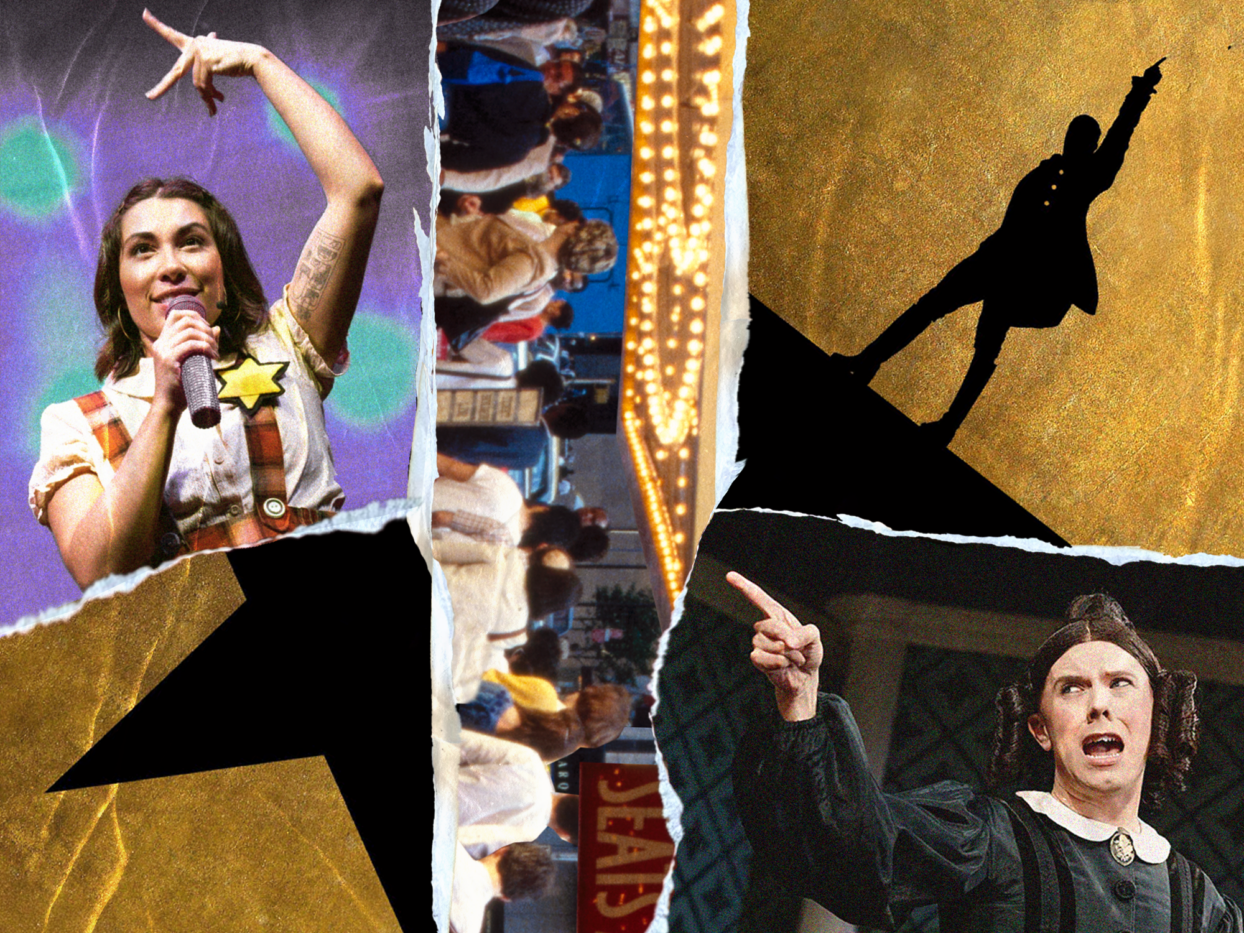
For those who struggled through The Diary of Anne Frank as adolescents, wishing it were more entertaining, 2025 brought a special treat: Andrew Fox and Joel Sinensky’s musical Slam Frank. A send-up of both identity politics and the musical theater that has attempted to cash in on identity politics, Slam Frank imagines what would happen if a woke community theater decided to give the story of Anne Frank the Hamilton treatment. Slam Frank’s logo flagrantly mimics the 2015 musical’s, with the title character standing triumphant atop a Star of David, just as Lin-Manuel Miranda’s Hamilton stands astride a star plucked from the American flag.
Slam Frank begins with the white, male Artistic Director (sometimes played by Fox) stepping forward to perform a land acknowledgment. He cannot remember the names of the peoples he is supposed to acknowledge, but he brazens it out: “Okay, well, whoever they are, they were here first, and we are here now, and shame on us.” What follows is the Artistic Director’s version of herstory, reclaimed from its Eurocentric roots, in which Anne — renamed Anita Franco — is queer, Latinx, and, like Miranda’s Hamilton, a talented rapper. “When this hiding’s over I’ll be in demand with my prose tighter,” she raps. “And if survival’s not the plan I’ll be a ghost writer.” The cadence recalls that of the first lines of Hamilton, which ask how a “bastard, orphan, son of a whore and a Scotsman” managed to become an American hero. Narratively, the whole number parallels “My Shot” from Hamilton: Anita resolves to turn her circumstances to her advantage, just as Hamilton pledges, “I am not throwing away my shot!” In another blatant imitation, the cast introduces a scene by darkly intoning, “Amsterdam. New Years. 1944,” mirroring “1776. New York City,” the start of an early scene in Hamilton.
The new musical started in June 2025 with a staged reading, which led to a developmental run at Asylum NYC in September. Before and during Slam Frank’s run, its creators effectively drummed up publicity with posts on Instagram and TikTok that flaunted the show’s progressive bona fides, without letting on — as Slam Frank itself never does — that the whole thing is satire. In a pinned post from January 2025, Fox opines, “Our world has been getting more and more diverse, but our Holocaust narratives have not been able to keep up.”
The musical is outrageously offensive to basically every group. But somehow, Slam Frank became a hit. In early October, the former New York Times critic Ben Brantley proclaimed, via X, that “the already notorious little musical Slam Frank may be the most important new show around.” In late October, a Times review by Laura Collins-Hughes called it “gleefully provocative.” By mid-December, Fox had been profiled in The New Yorker, framed as an impish visionary, and Slam Frank’s run, originally scheduled for just three weeks, had been extended twice. The showrunners intend to restage the musical later this year; in the meantime, the team is recording a cast album. A Kickstarter, launched to finance that project, hit its original goal of thirty thousand dollars after just one day.
In the decade since Miranda reenvisioned the story of America’s founding as an immigrant narrative with a hip-hop score and a diverse cast, a flurry of musicals has sought to recreate Hamilton’s success by using its template, inflecting history with a modern, progressive sensibility. Many of these shows have enjoyed at least moderate commercial success; several — including Toby Marlow and Lucy Moss’s SIX (2017), about Henry VIII’s wives, and Shaina Taub’s Suffs (2022), about the American women’s suffrage movement — are still on Broadway or on tour.
These same imitators, however, have exposed Hamilton’s blueprint as acutely flawed. In a much more cheerful moment for American liberalism, Hamilton held out the hope that Americans could recuperate their fraught history by remaking it to conform with contemporary values. But the Hamilton ripoffs that rushed in to capitalize on this hope — and now Slam Frank, in satirizing progressive retelling — have instead revealed, in varying ways, that this aspiration is futile.
Theater has always been a medium for retelling. The Greek tragedians and classical Indian dramatists presented versions of well-known tales. Shakespeare drew almost all of his plots from existing sources. Victorian hack playwrights churned out unauthorized adaptations of novels at astounding rates. In the late nineteenth century there was an intense flowering of original drama — largely because theatermakers were trying to match the aesthetic seriousness, and capacity for social critique, of the nineteenth-century novel. This development, which yielded the era of so-called modern drama, with its masterworks by playwrights like Henrik Ibsen and Anton Chekhov, has weakened the association between theater and reinterpretation. But retelling remains the theatrical norm.
Certainly it has been the norm for the modern musical. Over the last century, musicals have depicted real historical events (1776, from 1969; Ragtime, from 1996, which adapted E.L. Doctorow’s historical novel), modernized classic works (West Side Story, from 1957, which updated Romeo and Juliet; RENT, from 1996, which rewrote Puccini’s La Bohème), and leavened old stories with rock music (Jesus Christ Superstar, from 1971; Spring Awakening, from 2006, based on a radical German play from 1906). In 2003, Wicked injected feminism and anti-fascism into L. Frank Baum’s The Wonderful Wizard of Oz, painting the Witch of the West as a revolutionary fighting Emerald City’s authoritarian regime (aspects of Wicked’s politics come from its most immediate source text: Gregory Maguire’s 1995 novel of the same name). Through its extraordinary commercial success, Wicked proved, as the theater scholar Stacy Wolf has written, “that popular forms in mainstream venues can bring progressive values to wide audiences.” Wicked also gave producers cause to believe that musicals that conveyed progressive values could bring money to their pockets. Five years later, Alex Timbers and Michael Friedman’s Bloody Bloody Andrew Jackson depicted the eponymous president as a rock god and his supporters as rabid fans. The resulting commentary on populism and its ties to white nationalism (the show culminates in Jackson’s decreeing the Indian Removal Act) was perhaps a little too ahead of the curve. The Broadway production closed after just a few months.
Hamilton, however, arrived right on time. The vision it offered — “a story,” as Miranda put it, “about America then, told by America now” — was catnip for liberal audiences high on the sanguinity of the Obama years. (The president himself was a huge fan. In 2009, Miranda debuted a draft of one of Hamilton’s songs at the White House; in 2016, he returned with the cast for a performance.) As the musical’s immigrant protagonist rap-battled his way to the peak of American politics, and denizens of colonial New York, portrayed by people of color, sang about how “lucky” they were “to be alive” on the eve of America’s birth, Hamilton incarnated the hope that the nation’s ideals could accommodate those who were originally disenfranchised. The musical also offered theatergoers assurance about their own historical position. In the show, George Washington repeatedly warns Hamilton that he can’t control “who lives, who dies, who tells” his story, hailing spectators as the ones who now got to decide what kind of history they wanted to tell. Many interpreted the show’s climactic moment, in which the lights go down and Hamilton’s widow gasps, as an indication that she is getting a glimpse of America today and being awed by what she sees. In 2015, Hamilton gave liberals more than just a musical in line with their politics; it gave them access to patriotism.
Of course, the show was not without its detractors. Ishmael Reed, whose novels Mumbo Jumbo (1972) and Flight to Canada (1976) skewered America’s suppression of black culture and exploitation of black labor, accused Hamilton of scouring the founding father’s reputation “with a kind of historical Ajax until it sparkles,” depicting him as “an abolitionist” even though he “married into the Schuylers, a slaveholding family, and participated in the bartering of slaves.” For Reed, the portrayal of Hamilton and of enslavers like Washington by people of color was a travesty: “Can you imagine Jewish actors in Berlin’s theaters taking roles of Goering? Goebbels? Eichmann? Hitler?” Reed proceeded to further pillory Hamilton with a play of his own. The Haunting of Lin-Manuel Miranda (2019) depicts Miranda literally being haunted by the Native Americans, enslaved people, and other marginalized Americans that his musical omits. Critics concurred that Reed’s play was ruinously on-the-nose — but it got its point across.
Meanwhile, professional historians began to fact-check Hamilton. In the journal The Public Historian, Lyra D. Monteiro criticized Hamilton for diversifying at the level of casting without redressing the whiteness of the underlying narrative. “The idea that this musical ‘looks like America looks now’ in contrast to ‘then,’” she wrote, “actively erases the presence and role of black and brown people in Revolutionary America.” Monteiro also accused Hamilton of inflating the founding fathers’ antislavery sentiments while gliding over their less flattering deeds and beliefs. By April 2016, enough historians had offered critiques for the Times to publish an article summarizing them. Annette Gordon-Reed — the historian famous for repopularizing the theory that Sally Hemings and Thomas Jefferson had a sexual relationship — told the reporter that the musical’s portrayal of Hamilton as a committed abolitionist was “an idea of who we would like Hamilton to be.” The historian Sean Wilentz stated that Hamilton “was more a man for the 1 percent than the 99 percent.”
But the critical blow to Hamilton’s reputation came not from historians but from continuing history. As the 2010s became the 2020s, and national events made clear that America had not triumphed over its racist foundations, Hamilton transformed, in progressive circles, from common object of fandom to emblem of Democratic naivete. Vulture’s Nate Jones argued on a 2025 episode of “Today, Explained” that the musical was “the single cultural object that most stands in for the Obama era as a whole,” epitomizing that “optimistic, triumphant” period when liberals felt “that the culture was on our side and that things would keep getting better.”
For several years now, the cosmopolitan left has agreed: Hamilton is cringe. But that has not stopped theatergoers from flocking to the show, paying hundreds for nosebleed tickets. And it has not stopped producers from trying to capitalize on the fervor for historical reclamation that Hamilton ignited. The past decade has seen an array of shows that were at once Hamilton imitators and Hamilton correctives, repeating the musical’s formula while trying to remedy its sins.
This two-step was perhaps most obviously attempted by Suffs, Shaina Taub’s musical about the fight for women’s suffrage. Like Hamilton, Suffs premiered at the Public Theater, opening in 2022 before transferring to Broadway in 2024. The Public production even featured a Hamilton star, Phillipa Soo, who originated the role of Eliza. But Suffs also did precisely what Hamilton was criticized for failing to do: by focusing on black activists Ida B. Wells and Mary Church Terrell alongside white activists Alice Paul and Carrie Chapman Catt, Suffs actually told a diverse story as opposed to giving a story centered on white men a diverse facade. Suffs also avoided a rose-tinted view of its characters, highlighting the racist measures that Paul and her allies took to appease white Southern suffragists — for one, suggesting that black women march “at the back of the line” at the Woman Suffrage Procession of 1913.
Nobody could deny that Suffs was presenting history more responsibly than Hamilton had. But as the reviews came in, it became apparent that the aspects of Suffs that made for more conscientious retelling were also making for worse theater. “The whole production feels so attuned to the gender politics and protests of today, so aware of possible critiques, that it takes on its subject with an overabundance of caution,” wrote Maya Phillips in the Times. As Sara Holdren pointed out in Vulture, Suffs’s good intentions also created a depressing contrast: unlike the men of Hamilton, who are “having a great time,” the women of Suffs don’t get to enjoy their story much, held “accountable to a different decade’s set of standards,” and forced to act as mouthpieces for the show’s banal precepts. One typical Suffs verse goes, “We demand to be heard / We demand to be seen / We demand equality and nothing in between.” In the show’s care to only endorse aspects of its source material that remained laudable in 2022, it fails to muster anything like one of the stirring thesis-refrains for which Hamilton is famous. Instead we get an anemic admonition to (as the suffs proclaim in a fatally earnest climactic number) “Keep Marching” in the face of hardship.
Similar problems plagued 2022’s all-female, transgender, and non-binary revival of 1776. The show recounts the lead-up to the signing of the Declaration of Independence, with John Adams, Benjamin Franklin, and Thomas Jefferson as its trio of protagonists. Its flattery of the founders at times goes over the top, as in an entire song dedicated to Jefferson’s sexual prowess, told via his skill as a violin player. (Sings Martha Jefferson, “it’s heigh, heigh, heigh diddle diddle / Twixt my heart, Tom and his fiddle / My strings are unstrung.”) Like Hamilton, the revival depicted America being established by people debarred from participation in the actual founding — people who aren’t cis men, most pointedly, but also people of color, who comprised a large portion of the cast. The irony was intensified by 1776’s plot. The musical follows its heroes as they broker the terms of the Declaration in real time and compromise their ideals in the process. Much is made of the removal of a clause condemning slavery. However, 1776’s portrayal is, on the whole, admiring. Even the removal of the anti-slavery clause is framed as a fair sacrifice for the sake of independence. Franklin makes the key exculpatory speech: “What will posterity think we were, demigods? We’re men, no more, no less, trying to get a nation started.” Stuck with this script, the revival of 1776 was hamstrung. As The Guardian’s Alexis Soloski summarized, “the material doesn’t allow the revival” to develop its feminist premise “in any real way.” All it could do was continually accentuate the tension between its script and its casting — but “underlining one’s progressiveness a thousand times,” as Jesse Green wrote in his Times review, “will not actually convey it better.”
British theatermakers tried a different way out of the Hamilton bind with SIX, which opened in the West End two years after the premiere of Hamilton. The musical reimagines the six wives of Henry VIII as pop divas vying to be the lead singer of their group. Each of the queens is ready to prove why she had it the worst from Henry, speaking her truth “live in consort,” as wife number six Catherine Parr puts it. SIX’s superficial feminism (as the wives eventually realize, too late to fix the problem, the very act of grouping them defines them by their relationships with Henry) makes no serious comment on the history it engages with. Rather, the show treats history as little more than an aesthetic. The musical’s queens are decked out in ensembles that blend Renaissance fashion with modern jumpsuits and leotards. Its songs teem with jokey anachronisms. “Everybody chill, it’s totes God’s will,” Anne Boleyn sings about her accession to the throne at the cost of England’s split from the Catholic Church. The past furnishes SIX with verbal and visual codes that create a vibe of clever, sexy irreverence, but little else.
Operation Mincemeat, which opened in the West End in 2019, handles history with a similarly light touch. The musical recounts a real MI5 operation in which the British tricked the Nazis into thinking they were invading Sardinia rather than Sicily by planting false documents on a corpse made to look like a drowned British soldier. Mincemeat is subtler than SIX, and uses gender-bent casting (a woman plays one of the male MI5 operatives; a man plays their female secretary) to nod at our era’s enlightened views. Like SIX, though, it doesn’t interrogate so much as tease history. Its opening number mocks the posh men of MI5 for their assuredness that their “centuries of breeding” make them “born to lead.” But Mincemeat also depicts these elites as easy to chasten: toward the end, the women of the operation turn the tables on one of its men, who had belittled their contribution. The metafictional moral of the show — “When you write the book / You’re off the hook” — acknowledges that the account the show presents came from its male subjects. But, delivered jauntily and off-handedly, this message seems like something to shrug at rather than resist.
If our only concern were commercial viability for Hamilton-style retellings, then its British exponents have found a way forward. SIX and Operation Mincemeat transferred to Broadway in 2021 and 2025, respectively, and are still playing there and in the West End. But considered as solutions to the problems of Hamilton, these shows are as dissatisfying as Suffs is: they don’t reckon with history so much as eliminate the reckoning. Since 2015, progressive retelling has gone down a forking path, leaving us with a choice between didacticism and ideological toothlessness.
One way to escape that dilemma is to make a mockery of history. This is the route taken by Cole Escola’s Oh, Mary! (2024), which follows a few weeks in the life of Mary Todd Lincoln and her husband. In the play, Mary — originally played by Escola — is a whining, sadistic would-be cabaret star and Abe is even gayer than the most radical queer historian would dare to posit. The plot culminates in an extravagantly spurious account of what happened that fateful night at Ford’s Theatre. Often, the play actively dramatizes its indifference to the record. While the Civil War rages, Mary keeps forgetting that the country is at war, or even what country she is in. Twice, nonplussed by a reference to “the South,” she has to ask, “Of what?” She hatches a plan to flee to Canada, “a real country just north of America, whatever that is,” and continually addresses a portrait of George Washington that hangs in her husband’s office as “Mother.” When Abe tells her that the war is over, she steamrolls his announcement with one of her own: her companion, Louise, likes to arouse herself by dropping ice cream in her own lap.
Oh, Mary! repudiates the expectation that we grapple with history through a thrilling, theatrical refusal to engage with it at all. Escola has bragged that they did zero research to write the play, because they “wanted to have the same third grade knowledge of the Lincolns that the audience probably has.” In place of mundane historical accuracy, the play substitutes queer performance forms that go back to the nineteenth century, drawing heavily on drag and its precursors in vaudeville. Theatergoers have been more than receptive: Oh, Mary!’s original off-Broadway run was extended twice and won Escola an Obie Award for their performance. After Oh, Mary! transferred to Broadway in June 2024, Escola became the first non-binary performer to win the Tony for Best Performance by a Leading Actor in a Play. This run, too, has just kept extending, as — ever since Escola left the cast — celebrity after celebrity has signed on for a stint as Mary.
Slam Frank rejects the Hamilton formula not by gleefully jettisoning it, as Oh, Mary! does, but by attacking it head-on. The indictment begins with some easy shots at Hamilton’s devices and style. Slam Frank mocks Hamilton’s gambit of casting people of color as white historical figures by escalating it, making several of the Franks literally people of color in the world of the show. Anita’s mom Edith is, as Fox has said in an interview, a “white theater writer’s idea of a strong black woman.” Her dad Otto, for his part, is gay and (as he repeatedly reminds others) neurodivergent. It is still the 1940s, and the Francos are still in hiding from the Nazis. But they view their persecution by the Third Reich mainly as a metaphor for their oppression by patriarchy, heteronormativity, and racism. “Every woman is a Jew hiding in her own attic,” declares Edith. “Yeah, the Nazis are mean, and they kill you for realz / But I never feel seen, so I get in my feels,” sings Peter van Daan, the non-binary child of the other family hiding in the annex.
Slam Frank’s characters are living caricatures of wokeness, continually missing the life-threatening forest for the micro-aggressive trees: “Outside they’re fighting a war / But in here, I’m fighting expectations!” Peter belts in a song about the agon of gender normativity. Some characters use their identities to evade basic responsibilities, as when Otto insists that his OCD would make him “ineffective at doing household chores,” while his APD (auditory processing disorder) is to blame for his being a bad listener. Others conflate being oppressed with being infallible. As Anita assures Peter, “sometimes when you can’t easily explain your identity, it actually means it’s even better than all the others.” In an anthem to womankind, the ladies of the cast sing: “They are brave, they are strong, women are never wrong.” Eventually they take this progressive pablum to its logical extreme: “Oh the world would be so much better if we cast all men aside,” the women continue. “If we had Eva Braun instead of Hitler / There would be no genocide.”
At a turning point in the show, Anita declares, “I can no longer tell my story using the language of colonizers. Instead, I will tell it in Spanish!” The irony of Anita’s line captures a fatal flaw of the Hamilton formula: slamming together historical periods leads to bad history. Universalizing the connotations of English and Spanish in present-day America — by equating English with oppression and Spanish with its resistance — Anita forgets that Spain was pretty good at colonizing, too. The present does not map neatly onto the past — but if you are determined to make the two correspond, you will end up with broken analogies.
Slam Frank also crystallizes progressive retelling’s tendency to trivialize contemporary concerns. A premise underpinning many of the jokes in Slam Frank is that it is absurd to be bothered by things like fettered self-expression, or men taking up too much space, in the context of a World War and the Holocaust. This same dynamic is unintentionally operative in many of the shows it lampoons. Listening to Alice Paul describe being force-fed by prison staff, or Anne Boleyn sing of her decapitation, it is hard to pity oneself as a twenty-first century American woman. Faced with the monolithic control that the men of 1776 were able to exert over their newborn country, the lot of women and people of color in today’s America might not seem so bad. In theory, progressive retelling galvanizes resistance to contemporary injustices by dramatizing how those injustices have persisted through time. But the effect of this gesture, in practice, is to undermine the need for continued resistance. Progressive retellings urge us to view today’s problems in the light of history. But next to the problems of history, those facing modern theatergoers can look small.
The success of Slam Frank and Oh, Mary! indicates that, after a decade of revisions to the Hamilton model, audiences are ready for something new: theater that stops trying to crack the code of progressive retelling and instead gives vent to the sense that it is impossible to get right. In 2015, the time was ripe for work that reflected our optimism back to us. Today, perhaps, we crave work that captures how undeserving anything feels of our unqualified veneration. If take-no-prisoners satire is one type of art suited to a climate of disillusionment, another may be fare like Oh, Mary! that gratifies the urge to ram our heads in the sand.
Compared with the ambitions of Hamilton and its ilk to reconcile the past with the present, the payoffs of these forms might seem regressive. But Slam Frank suggests that progressive retellings were deluded to think they could do so much. In the last number of the show, the characters sing triumphally about how great the world will be once there is “just us” — i.e., no more people who disagree with their politics. As they do, they remove their costumes to reveal shirts bearing progressive slogans. One is “Art Saves Lives” — a claim Slam Frank has just borne out, absurdly, by causing Hitler, who it turns out was in the audience all along, to realize she is trans and “cancel” the Holocaust. The message the audience is meant to infer is obviously the opposite: art doesn’t save lives, and artists who fancy themselves on the frontlines of activism are kidding themselves.
It is true that “Art Saves Lives” may always be an exaggeration — in part because the sharpest political art almost never reaches the audience that would allow for such an impact. In the era that Slam Frank depicts, the paradigmatic political playwright Bertolt Brecht indicted the sociopolitical status quo through works that were, as Brecht once wrote, “knotted together in such a way that the knots are easily noticed.” His hope was to get audiences to recognize that the social structures shaping their lives were analogously artificial, and therefore alterable. But Brecht’s plays were sophisticated enough to be utterly misread: the Weimar bourgeoisie who flocked to The Threepenny Opera (1928) — Brecht’s biggest commercial hit — failed to register its politics. And the relatively tiny number of people who viewed Brecht’s less commercially successful plays during his lifetime, particularly those he wrote in the United States while in exile from the Third Reich, were almost all already sympathetic to his views.
It is hard for art to start a revolution. But if any form of theater has a claim to popular attention, it’s the musical. The schlocky AIDS musical (and La Bohème redux) RENT meaningfully improved public perception of the disease and its victims — probably more so than Angels in America, despite the latter play being infinitely more incisive. The political potential of the Broadway musical relative to other art forms may be even greater today, as it is becoming almost unique in its ability to congregate Americans with divergent politics. A Broadway theater is perhaps one of the only places in America where progressives and conservatives, New York intellectuals and MAGA-hat-wearing tourists, still sit together and consume the same work of art.
Despite its surprising success, Slam Frank is unlikely to make it to Broadway. And while it amusingly parodies contemporary politics, its most trenchant critique aims at theater itself. But we can hope that Slam Frank will prod its truly commercial brethren toward more fruitful, less opportunistic political engagement than we have seen in the last decade. We don’t need another musical that imposes our era on the past. Give us one that makes us really look in the mirror.