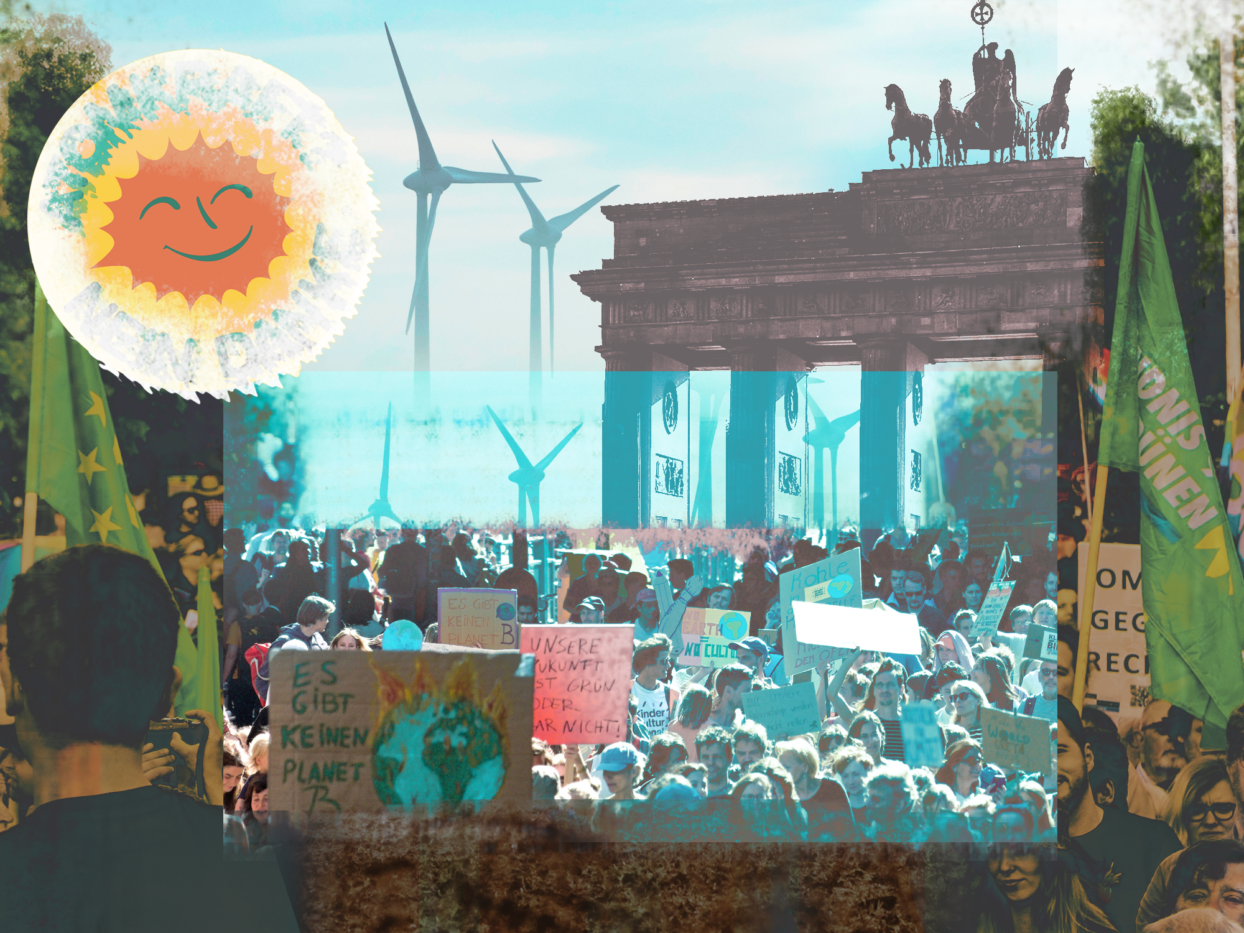
In May 2015, after a weeklong visit to Berlin, The New York Times columnist Thomas Friedman called Germany a “Green Superpower” that “deserves a Nobel Peace Prize.” The Germans, he argued, had made a “great contribution to the stability of our planet and its climate” by “converting almost 30 percent of their electric grid to renewable energy.” Friedman was not alone in singing the praises of Germany’s Energiewende, or its transition from nuclear power and fossil fuels to wind and solar energy. In her 2014 bestseller This Changes Everything, Naomi Klein lauded the program as profoundly democratic, “a departure from neoliberal orthodoxy.”
At the time, German government officials were also eagerly touting their nation’s environmental leadership. About a month before Friedman’s arrival in the capital, Foreign Minister Frank-Walter Steinmeier hosted the Berlin Energy Transition Dialogue. “Do you know what ‘Energiewende’ is in Spanish? Or in Arabic? Or in Indonesian?” Steinmeier asked a room full of delegates. “The answer will surprise you because it’s quite simple: ‘Energiewende!’” The term, Steinmeier continued, was unique among German loanwords. “Just think about the other German words that have entered other languages around the world — ‘Schadenfreude,’ ‘Kitsch,’ or — cropping up most frequently — ‘German Angst,’” he explained. “‘Energiewende,’ by contrast, stands for a positive Germany and a forward-looking and ambitious project.”
Emphasizing green leadership did more than just make Germany — a country whose international reputation had long been defined by Nazism and the Holocaust — look good. It also shaped the way that environmentalists in other industrial democracies, including the United States, imagined what an ambitious climate politics would look like. In combining Germany’s powerful industrial economy with the green growth epitomized by the Energiewende, politicians created an intoxicating cocktail. Under its influence, environmental advocates around the world became convinced that turbocharging industrial capitalism could create new jobs, foster economic growth, and mitigate environmental threats all at once.
But from the start, there were signs that the Energiewende might not be a perfect model. Despite the rapid growth of German wind and solar capacity, in 2019 the country was still the world’s leading producer of lignite coal — one of the dirtiest, most carbon-intensive fossil fuels. And Germany’s renowned automotive industry, which as of 2019 accounted for five percent of the country’s GDP and directly and indirectly employed some 3.2 million people, has struggled to produce competitive electric vehicles (E.V.s). In the 2010s, amid the country’s successes in renewable-energy production, hardcore environmentalists who warned of potential shortcomings were dismissed as pessimists focused only on doom and gloom. But the chickens have come home to roost in the 2020s, now that the Russian invasion of Ukraine and Donald Trump’s aggressive America First agenda — not to mention China’s emergence as the new global leader in green energy — have created a vastly different geopolitical landscape.
Today, the era of cheap Russian hydrocarbons, the post-Cold War peace dividend, and worldwide interest in environmental problem-solving — the era that gave rise to Green Germany — is over. The German economy has been in a recession for most of the past three years. Despite the ubiquity of wind farms and solar panels, high energy costs frustrate consumers and plague Germany’s chemical and steel industries. The country’s automakers are laying off workers as E.V.s roll off Chinese assembly lines. And the German government has thrown in the towel on maintaining its green reputation. In November, Chancellor Friedrich Merz seemed to be counting the minutes until he could leave the United Nations Climate Change Conference. “Which of you would like to stay here?” he asked the press pool sardonically as he prepared to board his flight home.
On its face, the story of Green Germany’s slow ascent from the 1980s to its precipitous decline in the 2020s is about how one country sought to craft a new role for itself in world affairs. But at the same time — and as far as the fate of the earth is concerned, much more significantly — the rise and fall of Green Germany is a story about the tantalizing idea that a few tweaks and technological fixes could turn industrial capitalism green without diminishing the comforts of consumer society.
When West Germany’s Green Party entered parliament for the first time, in 1983, international observers couldn’t believe that a ragtag coalition of activists from the anti-nuclear, peace, and women’s movements had cobbled together the five percent of the vote required to be seated. The Greens’ platform was anathema to West Germany’s image at the time: an orderly and politically staid economic powerhouse. Instead of lionizing growth, as the current Christian Democrat government did, the Greens called for a “complete, structural break with the short-term focused economic system” and the “re-organization of life on the basis of ecology.” In the eyes of Chancellor Helmut Kohl, the Greens were a dangerous and disruptive minority bent on tearing down West Germany’s hard-won parliamentary democracy and creating a “different republic.”
Nevertheless, Kohl set out on an environmental offensive of his own. Opposition to “forest dieback” was environmentalists’ cause du jour, and Kohl targeted the acid rain that was damaging Germany’s beloved forests. His government sought to solve the problem with technological fixes and economic incentives, like requiring sulfur scrubbers at coal-fired power plants and offering tax breaks to consumers who bought new cars with catalytic converters, a device which decreases the emissions that cause acid rain.
Kohl also shrewdly engaged in environmental diplomacy, making his case for Germany’s new policies on the international stage and cutting his domestic critics out of the conversation about acid rain. At a conference in March 1984, West Germany not only agreed, with Canada and eight other European countries, to “reduce 1980 levels of cross-frontier sulfur compound discharges into the air by thirty percent by 1993,” but also went so far as to boast that it would go beyond the target of this “thirty percent club” and reduce its emissions by fifty percent. Three months later, in June 1984, West Germany hosted the Munich Multilateral Conference on the Environment and successfully convinced several more countries to limit their sulfur emissions. By 1993, German sulfur emissions had decreased by an astounding sixty percent.
At that point, Germany had reunified. East German ecologists, who played a key role in the protests that toppled their country’s repressive dictatorship, had been working toward a more humane, environmentally-minded form of socialism. But with access to consumer goods and the Deutsche Mark on the table, that dream soon died out: in post-Cold War Germany, as elsewhere, free markets and capitalism won the day.
But environmentalism was on the rise, too. In 1988, Time magazine named the “Endangered Earth” its “planet of the year.” The same year, the Intergovernmental Panel on Climate Change held its first meeting, and George H.W. Bush declared that, if elected president, he would leverage “the White House effect” to defeat the greenhouse effect. At major international meetings in Toronto, Hamburg, and Noordwijk, the international community discussed what could be done to stop global warming. Meanwhile, European leaders competed to outdo one another’s statements about the gravity of the problem and their will to take it on.
In June 1990, Kohl announced that his country, which at the time had the world’s fifth highest annual CO2 output, would reduce emissions by 25 percent in the next fifteen years. At the G7 meeting that summer, Kohl’s minister of finance informed the press that this commitment would lead to the growth of new green industries and make Germany economically competitive well into the twenty-first century. Without a similar pledge from any of the other leading emitters — the United States, the Soviet Union, the United Kingdom, and Japan — the international press bought into the notion that when it came to tackling climate change, Germany was setting the standard. In a laudatory dispatch from the Second World Climate Conference, which took place in the fall of 1990 in Geneva, Marlise Simons reported in The New York Times that “Germany has the most drastic objectives,” including plans that she claimed were “already approved in part by the German Parliament,” such as “new laws requiring greater insulation of buildings, improvements in public transportation, and making power plants more efficient,” and even “taxes on most carbon dioxide emissions.” In fact, Simons was quoting the Ministry for the Environment’s wish list — the policies mentioned were still under consideration. Nonetheless, two years later, at the Rio Earth Summit, where the U.N. Framework Convention on Climate Change was opened for signature, the Times once again contrasted U.S. inaction with German leadership. German Minister for the Environment Klaus Töpfer spent the conference holed up in an unadorned office, where he held meetings with environmental ministers from all around the world, working behind the scenes to answer questions and resolve disagreements. Times reporter James Brooke concluded that “leadership of the West has fallen to Klaus Töpfer.”
Within Germany, however, environmentalists were not convinced that their government was as green as it appeared from abroad. In a November 1990 column, the environmental journalist Christian Schütze predicted that politicians would continue to waste time bickering over environmental policy proposals. “Above all, don’t act too quickly seems to be Bonn’s motto,” he grumbled about the government. The Social Democratic politician Michael Müller was similarly pessimistic. In the absence of transformative policies from above, he argued, Germans had to “start with ourselves and our behavior.” He pledged to drive less, use less water, eat less meat, and boycott tropical lumber, urging his countrymen to do the same.
These critics were correct that a real gap remained between German leaders’ promises and the country’s actual environmental achievements, especially when it came to the carbon reduction goal. Between 1990 and 2005, German carbon emissions decreased by about 187 million tons, or around 18 percent: significant, but still shy of the 25 percent goal. In fact, the country only came that close because of the collapse of East Germany’s carbon-intensive industrial economy. Unable to compete on the free market, many of East Germany’s formerly state-run enterprises folded in the early 1990s. With less demand for electricity, many of the East’s highly-polluting lignite coal-fired power plants were switched off. As a result of the economic collapse, carbon emissions from energy in the East decreased by 115 million tons between 1990 and 1993; in the West, by contrast, emissions actually increased by about 19 million tons over the same period.
German policymakers’ efforts to reduce emissions at this time mostly consisted of small policy tweaks that had little impact on carbon emissions. But there was one innovation in these years that held the potential to generate larger carbon-emissions reductions: the feed-in tariff, which required electrical grid operators to buy, at a set minimum price, renewable energy that was “fed in” to the grid. On its face, the feed-in tariff was just another minor adjustment. When it was approved by parliament in 1990, Germany had only about four hundred wind turbines with a combined sixty megawatts (MW) of capacity. Since virtually all of these turbines were small models that supplied energy to a single farm or dwelling, no one expected the new law to dramatically change the energy system. As one MP put it, when it came to climate change mitigation, the feed-in tariff “amounted to the wiggling of a toe and no more.” In a sense the skepticism was justified: rather than mandating the construction of new wind farms or forcing coal-fired power plants to go offline, the law allowed individual Germans to take matters into their own hands by generating their own electricity and feeding it into the grid.
But there was a crucial difference between the feed-in tariff and Müller’s call for voluntary self-restraint. By requiring grid operators to pay attractive rates for the electricity individuals generated, the policy virtually guaranteed ordinary Germans a steady return if they invested in wind turbines. Instead of making sacrifices, Germans could get paid to save the climate. The results were spectacular: thousands of Germans became energy producers. Glossy flyers inviting investments in cooperatively owned turbines with slogans like “The ecological capital investment. Join in!” turned up in mailboxes across the country. By the mid-1990s, hundreds of turbines were going online each year. The swelling demand caused manufacturers to speed up the production of new turbines and to develop larger, more powerful models. Powered by individuals’ investments, a new wind energy sector took shape; by 1995, as many as ten thousand Germans were employed in the growing industry. At the end of the decade, more than nine thousand wind turbines had been erected across the country, and Germany’s installed wind power capacity had reached around six thousand MW — more than twice as much wind capacity as any other country in the world had.
The wind boom in the 1990s was followed by a solar boom in the 2000s, as the feed-in tariff program was expanded to include guarantees of profitable rates on energy produced with photovoltaic panels. By the middle of the 2010s, Germany was producing more than a quarter of its electricity from renewable sources; by 2019, that share topped forty percent. As of 2024, although it is roughly the size of Montana and has only about eighty million inhabitants, Germany was third in the world in wind power capacity and production, behind just China and the United States. In 2011, the British intellectual Anthony Giddens called Germany’s feed-in tariff “a model which can and should be copied elsewhere.” Since then, it has been. According to the German Wind Energy Association, by 2022 more than fifty countries had “followed the German example and implemented similar feed-in tariffs.” The feed-in tariff was the primary evidence that Green Germany represented more than an empty boast.
But there was a catch: although the feed-in tariff enabled Germany to produce impressive amounts of renewable energy, it did not end the country’s reliance on fossil fuels. Virtually all the cars on German roads still run on gas, and fossil fuels still account for about 75 percent of Germany’s total energy supply. And although the country has lowered its greenhouse-gas emissions by 48 percent over the past 35 years, it has also emitted more CO2 than any other E.U. member state every year since 1990; as of 2023, it was in ninth place worldwide.
The problem is not that the feed-in tariff isn’t working, but rather that its success has generated a sort of wishful thinking that suggests that if we can just push the rate of green growth high enough, the economy will resolve the climate crisis on its own. This has limited the space for the transformative ideas that will be required to end our use of fossil fuels. The evolution of the German Green Party’s economic vision is a case in point. In 1980, the Greens stated that they were “principally opposed to every form of quantitative growth” and called instead for a circular economy centered on the needs of future generations and the sparing use of natural resources. When Chancellor Kohl announced Germany’s first CO2 emissions reduction goal in 1990, the Greens remained steadfast, issuing a “Climate Catastrophe Call to Action” in which they pronounced themselves “a radical party” focused on “winning societal majorities for the transformation of industrial society.”
But after the Greens lost all of their parliamentary seats in that year’s election, the party began to reinvent itself. Tentatively at first, the Greens embraced the idea that “environmental protection is a global growth market” and took up the message that Minister of Finance Theo Waigel had shared at the 1990 G7 meeting: green industries could power the German economy. In the wake of the 2008 financial crisis, the party extended the argument to its logical conclusion, claiming that only the “green market economy” could pull Germany out of recession. In their 2009 election program, the Greens called for “incentives for modernization, the renewal of industrial production with more energy and resource efficiency, and future-oriented technologies.” In 2013, the German historian Joachim Jachnow accused the Greens of purveying a “kind of pseudo-environmentalism which itself promises to become a lucrative commodity in the face of global disaster, preparing fresh fields for capital accumulation.” Soon, calls for ecological reorganization had disappeared from the Greens’ election programs altogether. As the Green former deputy mayor of Munich recently put it, the party advocates not only “a good climate for the economy, but also an economy that is good for the climate.”
The Greens’ embrace of free market environmentalism aligned them with Angela Merkel — a former mentee of Kohl’s — who led the German government for sixteen years, from 2005 to 2021. A physicist who had previously served as minister of the environment and embraced the nickname “Climate Chancellor” given to her by the press, Merkel presided over the heyday of the Green Germany myth in the 2010s. She spoke frequently of her dedication to environmental protection, but she did not dare go against the interests of the automakers and was reluctant to push too hard against the interests of Germany’s powerful chemical and steel industries, which relied on cheap energy. In 2010, she planned to reverse the nuclear phaseout that the Greens and Social Democrats had arranged in 2000, only changing course after the Fukushima disaster in March 2011. That year, she celebrated the opening of the Nord Stream pipeline, which delivered Russian gas directly to the German grid.
Merkel’s biggest contributions to Germany’s green image, much like Kohl’s before her, came through her performances on the international stage. Early in her chancellorship, she pressured the E.U. to adopt binding emissions reduction goals, and even got the G8 leaders to pledge that their countries would help reduce global emissions by fifty percent by 2050. In 2015, during the run-up to COP 21, she used Germany’s G7 presidency as a bully pulpit to call for an ambitious agreement. Her advocacy helped build support for the Paris Accords, which contained an agreement to keep global warming well below two degrees Celsius. But it was the election of Donald Trump in 2016 that truly enabled Merkel to shine as an outspoken leader on environmental issues. When the United States announced (for the first time) that it was withdrawing from the Paris Accords the following year, Merkel scolded Trump for his “extremely regrettable” decision and affirmed that “Germany, Europe, and the rest of the world will” be “more determined than ever” to fight climate change together. Against this backdrop of loud pronouncements and slowly decreasing carbon emissions, Merkel’s Germany seemed poised to pull the world into a more climate-friendly future. In 2016, the Oxford historian Timothy Garton Ash referred to Merkel as the “leader of the free world.”
Then the free world faced a new threat. In 2021, Russia had supplied 52 percent of German natural gas imports. After Russia invaded Ukraine in February 2022, concerns about the end of cheap gas scrambled the German economy. Firms complained about unpredictable energy prices, supply chain disruptions, lack of access to natural resources, and even lost markets. Starting in March 2022, as newspapers published daily statistics on gas prices and the depletion of reserves, Minister of Economics Robert Habeck raced to conclude a purchase agreement with the Emir of Qatar, got in line to buy shale gas from the United States, and pushed through permits for terminals that would feed all the new overseas gas into the German grid. In June, Russia began decreasing the quantities of gas sent through the Nord Stream pipeline; in September, saboteurs ruptured the pipeline with explosives, ending the flow of Russian gas to Germany altogether. Suddenly, German cities lacked the energy to illuminate landmarks at night. The president of the Federal Network Agency, which oversees the national electricity and gas grids, urged Germans to save energy by taking cold showers. “Every kilowatt hour counts,” added the mayor of Hanover after he restricted the use of hot water in public buildings. Though Minister of Finance Christian Lindner took the opportunity to refer to wind and solar as “freedom energies,” the sudden scarcity of fossil fuels cast doubt on the idea that renewables could power the green good life on their own. As old coal- and oil-fired power plants were returned to service, politicians and commentators called for the lifespans of the country’s three remaining nuclear reactors to be extended.
Even once Germany had successfully replaced its Russian gas with overseas natural gas shipments, the economy was still reeling — which became an excuse to push back emissions reduction targets. Katherina Reiche, the former energy lobbyist who became minister of economics in 2025, has led the charge, arguing that “if sustainability crashes your economy, you have to adjust.” Reiche’s positions have already begun to make an impact: in December 2025, out of deference to Germany’s opposition, the E.U. scrapped the internal combustion engine ban that had been set to go into effect in 2035. The E.U.’s 2050 net-zero goal may be next. As the government’s commitment to green policies collapsed, the German press subjected Merkel’s environmental achievements to new scrutiny. Some critics wondered whether she could have done more to lower carbon emissions by improving the country’s decrepit railways and its electric grid. Others asked why she hadn’t moved to wean German industry off of Russian fossil fuels instead of celebrating the inauguration of Nord Stream 1 and supporting the Nord Stream 2 Pipeline, which would have provided Russia with even more infrastructure to deliver gas to Western Europe without passing through Ukraine. And it wasn’t just German naysayers who were questioning Germany’s green bona fides. Young American environmentalists were dismayed by Germany’s dependence on coal and foreign gas.
Perhaps as much as the Russia-Ukraine war, China’s emergence as an environmental powerhouse has unraveled the myth of Green Germany. In 2024, manufacturers in China built 12.4 million of the 17.3 million electric vehicles produced worldwide, while Germany produced a mere 1.5 million. And because more than half of the new cars on China’s roads every month are hybrids and E.V.s, Germany’s carmakers — which mostly remain committed to internal combustion engines — are losing an important export market. With sales of low priced Chinese E.V.s beginning to grow in Europe too, the German car industry faces unprecedented competition on its home continent.
Germany’s politicians no longer even pay lip service to the idea that the country ought to share its Energiewende with the world. Newly elected Chancellor Friedrich Merz has called wind power a “bridge technology” on the way to atomic fusion and predicted that all of the “ugly” turbines marring the German landscape will soon be removed. Meanwhile, China has taken Germany’s place as the leader in renewable energy: in 2024, China installed more wind turbines and solar panels than the rest of the world combined. The success of renewables within China’s centralized economy has poured cold water on the notion that wind turbines and solar panels are inherently democratic technologies that foster decentralization and involve ordinary citizens in the energy economy. And as is the case in Germany, the proliferation of wind and solar hasn’t caused China to abandon fossil fuels: in 2025 alone, China commissioned more than fifty new coal-fired power plants. Today, it’s increasingly hard to argue that building up green industries is a surefire means of ending fossil fuel use and tackling climate change. Instead, it seems that green technologies and carbon-intensive industries can easily live side by side. Going green has become business as usual.
For decades, it was tempting to believe that Germans had found a way to enjoy the fruits of economic growth while simultaneously practicing, as one American professor of German Studies put it, “careful conservation, deep concern for the public welfare, and intentional stewardship of limited resources.” It seemed possible that we could have our cake and eat it, too. With the right incentives in place, consumer choices would help the green economy to take off, and a gentler form of industrial capitalism would stop global warming in its tracks.
Though left-leaning advocates of the Green New Deal are loath to admit it, the fever dream of reconciling capitalism and environmentalism underpins their signature project, which seeks to overcome the climate crisis without too much sacrifice or constraint, by creating green jobs and building up new, sustainable industries. The Biden administration’s 2022 Inflation Reduction Act (IRA), which mandated massive investments in wind and solar power, operated on this same logic — until much of the legislation was rolled back under Trump. Like the collapse of the IRA, the demise of Green Germany forces us to consider whether this aspirational sort of green capitalism has been overtaken by the course of history and must now be forcefully reasserted, or whether the concept was unsuited to the challenge in the first place.