Issue 17 |
April 21, 2026
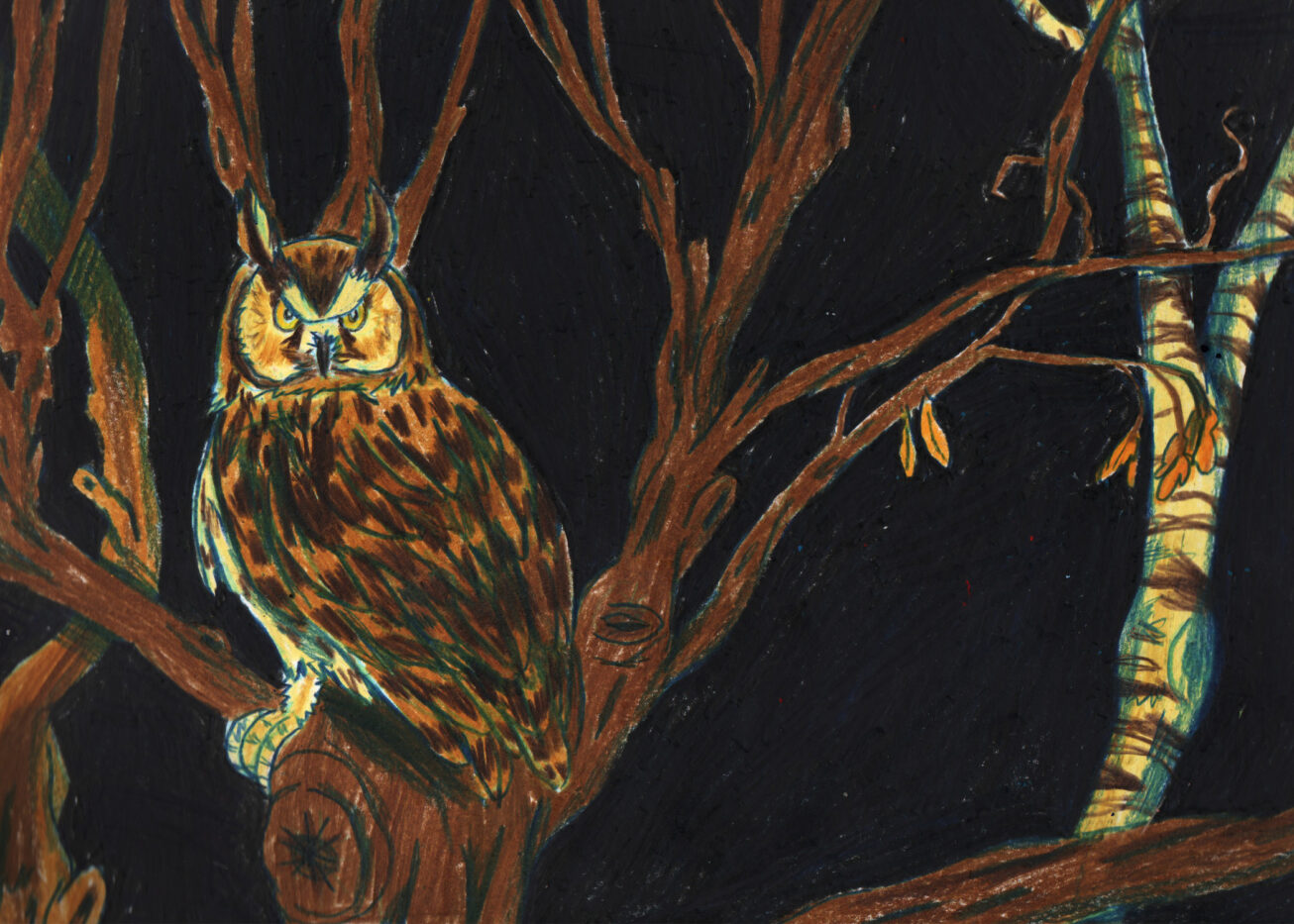
Image by Hannah Lock

Image by Hannah Lock
My last trip to the retirement home before Margaret and I broke up was a pleasant one. Margaret’s grandmother couldn’t stop laughing because her boyfriend Hal kept getting beaten at pool by a man who had gone legally blind. We sat in the dining room, where workers in dark gray scrubs offered us coffee with whiskey in it, topped with a dollop of whipped cream. For the holidays, they explained.
You can get catfish, Margaret’s grandmother said at lunch. But it’s steamed, not fried. Everyone’s very health-conscious here. All your friends dying will do that to a person.
It’s not very good, said Hal. The catfish.
Or you can get a hot dog, Margaret’s grandmother offered. They have good hot dogs. Because there are so many Jews at this place.
It’s better than the catfish, Hal added.
Margaret shot me a warning look, as if I might raise my eyebrows in the condescending way of a younger person who pretends the older person right in front of them is not there — not in a real sense at least. But I knew that Margaret’s grandmother was just remarking on the fact that there were many different types of people in the world, and that some of the people, including myself, were Jews, and that Jews had a culinary history with the hot dog, and that this was net positive for the retirement community because it meant an improved all-beef hot dog for everyone. The true promise of multiculturalism: an upscale mall-grade food hall. Maybe a rising tide really did lift all boats. It was always perfectly clear to me that Margaret’s grandmother had no ill will toward the Jews. She just didn’t know that many of them. Nobody in Margaret’s family did. I realized this one night when Margaret’s Uncle Frank, a little drunk, told me he’d always liked the Jews because they didn’t believe in heaven or hell, and that felt more emotionally honest and less manipulative to him.
I ordered the hot dog. Margaret’s grandmother was right: it was delicious.
It’s very sweet of you to visit, she said.
It’s really nice to be around somebody else’s grandmother, I said.
Which was true. I liked her undisguised honesty. Somebody told me once that it was basically science: the older we got, the less patience we had for padding. I considered that hypothesis, but ultimately it felt reductive to me. It seemed to me that directness was just part of Margaret’s grandmother’s personality. There was a large birdcage in the sitting room off the dining area in the retirement home, near the entrance to the neighboring memory care unit. That unit was separate so that the non-memory care residents could be shielded from having to see age’s more brutal bludgeoning. In the birdcage were four brightly colored lorikeets, who jumped from little wooden peg to little wooden peg across an elaborate painted backdrop similar to the dioramas in the Natural History Museum. They make me sad, Margaret’s grandmother had said on another visit.
They’re pretty, I offered.
Margaret’s grandmother looked at me blankly then, as if to pardon my stupidity.
My grandma is like me, Margaret often said. And when I would ask her why, she’d only say: you’ll see.
That was what was so interesting about watching Margaret and her grandmother interact. It was like the two of them were sharing a secret. Each pretended that the other was ageless. To her grandmother, Margaret was not a young woman staring down the barrel of her own decision-making, surrounded and overwhelmed by consequential choices that would potentially bring her judgment and pain. To Margaret, her grandmother was more than a person stuck in a facility surrounded by people who were cognitively inferior to her. They saw each other as they truly were: people who cared about freedom. Me, I never cared about freedom. I found the words “personal liberty” to have a noxious scent. It was like what my friend Kat said about libertarianism: why would I want to pave my own roads? That’s how I felt about my life. When I thought about self-sufficiency, I thought about having to do everything myself. Being alone.
Yes, I was in love with Margaret, but I did not fully understand Margaret, and I did not relate to Margaret. As if those three things were not intimately related. Never underestimate the delusional force of a man living on borrowed time. The reason she was opaque to me was because she intended to be. She regarded my interest in her as laparoscopic: as welcome as a winding tube up some godforsaken human pipe.
I first met Margaret at my friend Tom’s party. Tom had warned me ahead of time that this gathering would be populated by some of his “childhood friends,” which I understood to mean that he could not in good conscience vouch for them. When I walked through the door, I saw Margaret standing next to two men I didn’t recognize. Her face was frozen in some sort of willful dissociation. Tom quickly introduced us. Margaret’s roommate was his girlfriend’s cousin. As if that explained why she was there, next to a man who later told me that his party trick at the small liberal arts school he’d attended was vomiting on command.
Margaret’s an academic, Tom said proudly.
Margaret shook her head. Don’t ask me what I study, she said. I won’t tell you. It takes too long to explain, and I’m tired of doing it.
What makes you think I want to know? I asked.
Instead we talked about what we were reading “for fun,” a term I could tell she objected to but endured to be polite. Maybe I wasn’t as bad a conversation partner as the guy who vomited on command. And by coincidence we were both reading diaries of famous authors, born some fifty years apart.
I like that it feels like gossip, I said.
It feels private, she gently corrected.
How private can it be, I asked, when they secretly hoped all along that people like us might read their diaries? Isn’t that why we’re reading them in the first place?
Maybe the people in their lives — their estates — were greedy, she said.
I snorted. If the authors didn’t want us to read their diaries, they should’ve burned them. Everyone knows that’s what you’re supposed to do
Book burning is a bad vibe, she said. Even for those who don’t want their privacy violated.
Violated, wow, I said. Well, you’re still reading it, aren’t you?
It doesn’t matter what we do to them, they’re dead, said Margaret — like I had never heard of someone being dead before and didn’t know what it entailed.
Look who’s cynical now, I said. Tipping back on my heels and then tipping forward, just a millimeter closer to her, so it was clear that we were flirting.
It took eleven months for us to see each other again. I thought coincidence was the contrived province of romantic comedies, but one day, there she was, standing in the lobby of a movie theater holding the torn piece of paper that was her ticket. She was adorned in the slouchy, unassuming clothing covertly wealthy women wore. What did I know about her? Her shoes were practical; her long hair was not. Her shirt was white and stain-free. That impressed me.
Hi, I said. It’s nice to see you again.
I’m sorry, she said. Can you remind me who you are?
I’m the friend of the guy whose girlfriend is your roommate’s cousin, I said.
I couldn’t help but laugh at her bewildered expression. As if I were her teacher, asking a question in class about a reading she didn’t know had been assigned. Even then, I understood how thrilling it would be to catch a rare glimpse of Margaret unguarded.
That party, I prompted. Full of those terrible men. I was one of them.
Another pause, and then: I don’t remember you being that bad.
There — recognition.
Well, I said. Enjoy the film.
I didn’t look for her on my way out, though I knew we were in the same theater. I’d wait some more. It was the first and only time in my life I felt the urge to play my cards right, the first and only time I really knew how. Margaret was a woman who needed a little convincing, which meant that she was entirely repulsed by the coercive feeling of being convinced. She would have to come to it on her own. It was Tom who texted me some weeks later to let me know his girlfriend’s cousin’s roommate had reached out to him asking if he had my number.
Sorry if this is weird! Tom’s text started.
All I wrote back was: Not weird at all.
After that, Margaret and I were together. I knew not to rush things, or crowd her with my romantic ideations. It was like keeping your house very neat for an incoming guest you want to impress. It felt good to live that way: aspirational, organized. And also, it was exhausting.
After lunch with Margaret’s grandmother, we ran into one of her neighbors, Ned, in the hallway, and he talked to us for a long time. About the drawings of mountains he did up in his bedroom. About his son, who lived far away and played the guitar. I could tell Margaret’s grandmother was feeling impatient, and that she had probably heard these facts many times before. Ned wanted to show us his paintings and was so insistent about it that we humored him. When we stepped into his apartment, I noticed a partially emptied plastic container of gingersnaps by his recliner and was flooded with affection for him and his watercolor mountains, which were all purple and blue.
He’s moving to the building next door, Margaret’s grandmother said after we left. To memory care.
Oh, I said.
He has a girlfriend here, Margaret’s grandmother said. She keeps trying to break up with him but he doesn’t remember it, really. So.
That sounds like a uniquely terrible breakup, I said. Or a good one. I genuinely can’t tell.
Margaret had told me getting her grandmother to move to this facility was no small feat. Margaret’s grandmother had lived alone for over twenty years and insisted that it was her strong preference. She was fine, she’d said. But the house had stairs, her son, Margaret’s father, had pointed out. Split concrete in the backyard. Her old neighbors had moved away, and she didn’t know the new ones. What if she needed help? What if she fell? Wasn’t it too much house for one person? Be realistic, her friends said. That last one probably got her. Margaret’s grandmother was a staunch proponent of reality. Though she would tell you that what finally convinced her was the dining plan.
I’m done making dinner, she’d said, according to Margaret. I’ve spent my whole life making dinner. Sometimes I have dreams where my sons are still young, but teenagers, you know, and they are yelling for dinner, and I’m making more and more of it, and they can’t stop eating it. Which is basically how it was. I couldn’t make enough food for them. They were ravenous.
Sometimes I wondered if my own grandmother had felt this way about her children. My grandparents were long gone. I never knew them well. When I was young, my grandparents seemed very formal, unknowable. What I remembered of them was mostly their apartment. Charlie Rose on the television. Clip-on amber earrings in a little dish atop a credenza. A stand magnifier for cataractic eyes. A sticky walking pad that looked like a flattened tire. What were my grandparents doing in their apartment when we were not there? How did they spend their days? I had no clue.
After we left Ned’s place, Margaret’s grandmother and I sat on the small balcony outside her apartment, watching the blue jays nip at the bird feeder Hal had hung when he moved in. He was taking a nap, and Margaret was on a walk. It was a sign of trust, I thought, that she left me alone with her grandmother. Margaret knew that her grandmother and I got along well enough at this point that the two of us could manage on our own, have our own distinct relationship. That moved me. Plus, Margaret always liked to walk after she ate. Because she probably had an eating disorder, is what I thought. Or the vestiges of one. It lingered in the air like radioactive fallout. A stark stubbornness which appeared in front of her, taking her briefly from me. Margaret never talked about it. She kept herself to herself. As everyone has the right to, I suppose.
The sky was gray, but the wind had a little hidden heat to it, a wet scent. Margaret’s grandmother and I were laughing about how strongheaded Margaret was.
She’s been that way since she was a child, Margaret’s grandmother said. I practically raised her.
This, I knew, was an inside joke with herself, both because it was not true, and because it drove her daughter-in-law nuts.
She’s very special to me, I offered lamely.
How so? asked Margaret’s grandmother.
I don’t know, I said. I’ve never questioned my love for her. It’s immense.
Margaret’s grandmother set her mouth into a neutral line and said in her own careful way: I can understand that feeling, of course. And it’s been lovely spending time with you.
I was suddenly very sleepy. Like I might lay down right next to Hal on his quilted bed and nap beside him. We could lie very still, arms stiff. We could pretend the other person wasn’t there if we needed to. There was something admirable about two peaceful, silent men.
When Margaret came back from her walk, she told her grandmother we would see her at dinner. We were headed back to Margaret’s parents’ house to help them cook. Margaret would drive back and pick her and Hal up at five. Would that be okay?
Yes, Margaret’s grandmother said, that was okay.
On the drive home I rolled down the window to smell the changing air before the storm. It was a familiar drive: we frequently flew down to visit Margaret’s parents, in part because Margaret’s grandmother now found it difficult to travel. I had made an internal map of the places Margaret had offhandedly told me about. The local chain of Tex-Mex restaurants where her swim team ate various types of melted cheese after meets, the church whose pastor was caught embezzling money to fund his own home renovation, the dispirited patch of grass behind the nearby jungle gym where Margaret first smoked weed. And here: her orthodontist. And there: the home of a family whose second son died in some unspeakable way (no one ever knew, because no one would ever speak about it). The neighbor’s porch where her mother and her friends gathered for margaritas. Realtors, most of them. You could make fun of them if you wanted, but one thing was undeniable: they were actually enjoying their lives.
Margaret’s mother was not a realtor but realtor-adjacent and realtor-tolerant. Tolerant of everyone, really. She was the nicest woman I knew. That was part of the reason why she and Margaret regarded each other with a diplomatic distance. Margaret might have respected her mother’s amiable approach to life, but she did not want it for herself. I felt differently. When I said I love you to Margaret’s mother, I meant it. She was not my mother, nor a substitute for a mother, but a woman whose ample hospitality felt like a gift. I loved staying at their house. I did not know many people our age who owned their homes, and if they did, they lived differently, in the kinds of places where you might be able to buy a house. Margaret and I were in agreement that we did not want to live in those places. But when I was in her family home, I was reminded that there was an unexpected freedom to stairs that were not communal, stairs that were strictly private. You could really bound up and down them with wild abandon. This love of private staircases went against my politics. But it scratched something deep inside of me. A desire to feel imperious — my thundering footsteps like the arrogant toots of a trumpet announcing my impending arrival. It was reason enough to make the trip.
And of course, I liked hanging out with Margaret’s grandmother and Hal. They took us to the movies one of the first times I visited, an R-rated arthouse film set in the 1970s. It was long and featured a kind of squeamish May-December romance, as well as exuberant little monologues about growing up. A movie about another time made for our time.
What did you think? I asked Hal afterwards.
I was still trying to figure him out. He spoke infrequently. I knew that he and Margaret’s grandmother had gotten together when they both landed in the same retirement community. His wife had died six years earlier. Margaret’s grandmother had been divorced for twenty-some years. She actually knew Hal’s wife; the two had been in a book club together.
I knew how he treated her, Margaret’s grandmother once told Margaret. They were good friends, she explained. He took care of her when it counted.
In fact, it was Hal’s first wife who had first floated the idea of his eventual union with Margaret’s grandmother, back when her Parkinson’s had progressed.
You know, you should go out with her, she had said to Hal. Her being Margaret’s grandmother.
And Hal told her she was crazy. So Hal’s first wife had called up Margaret’s grandmother to laugh about it.
I actually do think you two would be great together! she’d said on the phone.
Why on earth do you want to set me up with your husband? asked Margaret’s grandmother.
I don’t want him to be alone, said Hal’s first wife.
And what’s so bad about being alone? Margaret’s grandmother had asked. According to Margaret, that is.
By the time we saw the movie with them, they’d been together for two years. Their romance was largely hidden from me, though it was clear they had gotten very used to one another. Hal let Margaret’s grandmother do her thing. He and I trailed behind our respective partners as they walked arm in arm to the car.
What did I think about the movie? Hal repeated back to me.
The movie, I said. That we just watched.
Hal swallowed. He squinted.
Well, he said slowly. They certainly swore a lot.
While Margaret was retrieving her grandmother, I futzed around. Margaret had no old diaries to snoop through, no bad teenage artwork. Margaret wasn’t sentimental like that. She had thrown away all her old stuff. By the time I met her, Margaret had thoroughly eschewed her former self: the one that was forged in the narrow fire of a private, twisting staircase. But this was not her house anymore, and so she had to capitulate just a little, relinquish some of her power and her control, which I knew was very difficult for her. Here, she had to acknowledge the uncomfortable truth that she came from somewhere, not nowhere. A somewhere in which she was once undecided, in which she had yet to discover the indisputable rush that came from disavowal. To her great displeasure, her mother had hung a photo of her in the upstairs hallway, next to the powder room. It was taken at Margaret’s high school winter formal. In the photograph, Margaret’s bangs were a sharp triangle of heat-treated hair, and her dress was knee-length and had a green tulle skirt with little strips of black ribbon running down the sides. The same color scheme as a Halloween witch. An early attempt at rebellion, I supposed. Oddly embarrassing for Margaret, whom I liked to imagine as frostily herself since the moment she was born.
When Margaret returned with her grandmother and Hal, it was raining. I poured Margaret’s grandmother half a can of beer, drinking the other half. Margaret’s mother had made a ham, and her father cut it in slender oval slices that had candied rinds and thin white seams. I was happily awash in the taste of salt, the eager way it lay alongside the cold beer. Everything was softening now and feeling very cozy. It was raining steadily, the sound of it growing. Margaret’s mother turned toward the window and said thank God Hal doesn’t have to drive in this. That probably made Margaret’s grandmother unhappy, because she never liked to feel that her son and his wife were fussing over them or thinking them incapable of doing anything they were perfectly capable of doing. But what Margaret’s mother had said was true: the roads were now dangerous for anyone.
When is your flight back? asked Margaret’s grandmother.
Tomorrow, said Margaret.
The blackout happened very fast. The wind sped up and slammed into the house, accompanied by the violent scratch of branches. Oak trees, I think they were. The lights went out. I couldn’t have seen my hand if I had held it right in front of me. The Bluetooth speaker continued playing an algorithmically generated dinner party mix into the thick darkness. I couldn’t help it — I was gripped by a terror I had not felt since I was very little. I called out Hello! Hello! I reached out my hand for Margaret. Where was she? To my right I heard Margaret’s grandmother laugh. Or was that Margaret’s? Their laughs sounded eerily similar. I had called out to Margaret like she was my mother. And either she or her grandmother had laughed at this, or maybe they both had, as if to say: I am not your mother.
Our eyes got accustomed to the inky blur. Searching for batteries, we shuffled around the big house like we were very old ourselves. We took extra care on the stairs, feeling for the edges of each individual step with the worn heels of our socked feet. We finished our dinner by candlelight. Bob, Margaret’s father, told his mother that she and Hal should stay in the guest room, but Margaret’s grandmother declined. Which I understood. I was raised to believe there was no better feeling — no greater privilege — than sleeping in your own bed.
When the storm died down Margaret offered to drive them back. She insisted that her grandmother grab onto her tightly as they maneuvered their way down to the car. The rain had made everything a little slippery, and the entire neighborhood was dark. I held the umbrella over Margaret and her grandmother huddled together while they walked down the driveway as if they were running a three-legged race, Hal trailing behind.
Keep up with me, Grandma, she said sternly. I don’t want you to trip.
I think Margaret would have liked to carry her grandmother then, like a hero in an action movie. And the crazy thing was that Margaret’s grandmother would probably have let her. Margaret was the only person she would have allowed to do something like that. They made allowances for one another. They softened in each other’s grasp.
When Margaret crawled into bed that evening, I was already half asleep. She was wearing a big Greenpeace T-shirt that had once belonged to her Uncle Frank. The neckline was huge and droopy; the shirt hung around her like an off-shoulder gown. A lock of her thick hair was caught in the gold chain she wore around her neck. The hair was strong enough that it pulled the chain slightly away from her body and toward the bottom corner of her ear. I placed one finger on the spot of exposed clavicle where the necklace usually lay. Margaret’s skin was soup warm, slightly adhesive. She always felt alive to me, even when she wasn’t paying attention. Even when she was busy quietly deleting her own thoughts.
Did they get back okay? I asked.
They had power over there, Margaret said. The whole place was ablaze.
Margaret threaded her fingers in mine and promptly began to snore. I was always moved by this. She liked to hold hands while we slept.
I now know Margaret’s grandmother’s words to me on the balcony were a warning. About the many ways life can go, and the many ways in which love can evade you. There were maps bigger than the one I pictured for Margaret. How could a map of our future compete with that first map: the orthodontist, the pastor, the dead second son? That, I believed bitterly, was the map Margaret was using to make all the major decisions in her life. She had studied it for the explicit purpose of avoiding its more predictable routes and familiar pathways. As if that ever worked! Besides, I could think of worse things than a nice life. A nice life in a nice home, a nice life with my lovely little wife.
It was just an ordinary evening when we broke up. It was an ordinary fight, a version of the same fight we had been having since the night that we met: she wanted to be free. Okay. But as it turns out, that lack of need contained its own kind of neediness. Did she know that?
We were having a conversation about dinner. What would we eat that night? We had to think about that question every single day. For the rest of our lives. It exhausted Margaret. Her kingdom for a cafeteria-grade, all-beef hot dog, and not my wanting mouth. No more choices, please. There were always too many choices.
Margaret looked at me and told me she couldn’t do it.
What? I asked. I was already putting on my shoes, getting ready to head to the grocery store.
I can’t, she said.
Margaret, what are you talking about, I said. I was angling for a fight. But this time I wanted a reaction. It was an ugly thing to admit, but I often felt I was owed full-throated participation, and that she rarely had the courage to grant it to me.
You can’t think about what it is we want to eat for dinner? I asked. I can choose for you, if that’s easier.
I’m tired of this, she said.
Tired of what, I asked.
I don’t want it, she said.
Please, Margaret, I said. Can you be a little more specific?
I don’t want this life anymore, she said. It’s not mine any more. I need to be on my own.
You need it.
I do, she said. I’m sorry. I’m so sorry, but that’s really just the truth.
But it’s our life, I said. We can make it look any way we want it to. It doesn’t have to feel like a compromise. We can do whatever we want.
That was the thing with Margaret. In her head, I knew, she bleated back the phrase: my life. And was that such a crime? Maybe she was right. Maybe staying was a kind of submission I was asking of her, as I waited for her to yield. And really, while I was pretending to be attentive and understanding, it was all about me and my desires, which were not even remotely shared.
But I’m making it all a lot more complicated than it needs to be. I think I just loved her more than she loved me. Which is embarrassing, but understandable. It happens sometimes.
You’re going to miss me, I hissed.
Probably, said Margaret. She did look very sad.
Everyone is going to miss me, I said impulsively. I had reached the moment of the breakup that was pure jazz. Whatever turgid, awful thought bubbled up to the surface made its way into my mouth. Your mother, your father, I continued, your grandmother.
My grandmother, said Margaret. You think my grandmother is going to miss you?
I know she is! I said. For your sake. She understands what you’re throwing away.
Please, said Margaret. You actually have no idea what you’re talking about. Please.
Like she was trying to save whatever shred of respect she still had for me. So that when the time came, as it was coming now, I could be a friendly ghost she didn’t have to be embarrassed by. I had shown her how much I had loved her. What of my dignity? She picked it up off the floor, dusted it off, and offered it back to me. Here, she seemed to be saying. You might need this one day.
I got a handwritten note from Ruth, Margaret’s grandmother, for my birthday. By then, Margaret and I had been broken up for more than a year. We no longer spoke to one another. Which in its own way felt fairly friendly, if not also wrong. She had a new boyfriend, I had learned unwittingly. That was the tired joke at the end of it: for all her talk — no, for all that true belief — not even Margaret wanted to be alone.
I was touched to see Ruth’s address, written in a tilting scrawl, distinguishing the letter from the rest of the junk in my mailbox: fliers for driver’s services, inquiries from real estate agents interested in purchasing the building where I lived, which of course I did not own. I often buried these deep in the trash, along with the children’s magazines still arriving for a long-gone tenant who’d left when the rents were raised. The sight of the letter made me wistful. There would be no reason for me to go back to that place, without Margaret in my life.
I’m wishing you a happy birthday, the note read. Hal and I are thinking of you today and missing your company. I so enjoyed our visits, and considered you family, but alas, sadness intervened!
I was touched by the note. I read it once, twice. I kept laughing at the phrase alas, sadness intervened! It was as succinct as it was evasive, and undoubtedly true. Things could happen in life without you necessarily understanding why. You could be talking to someone you loved when all of a sudden the lights went out.
I pictured how Margaret used to turn her head away from the smell of cut grass as if it insulted her. The quiet reminders of her adequate childhood were an eternal recrimination.
One time we’d gone for a walk after dinner while Margaret’s mother and father did the dishes. There were no sidewalks in their neighborhood. We just walked in the middle of the street like two bowling balls crawling down a bumpered lane. Somewhere along the way, Margaret raised her hand and pointed to a tree. An owl sat on one of the top branches, its head twisted backwards. This place depresses me, she said.
But the owl was very beautiful. It looked right at us.
Hannah Kingsley-Ma is a writer and audio producer living in Brooklyn.