Issue 17 |
April 8, 2026
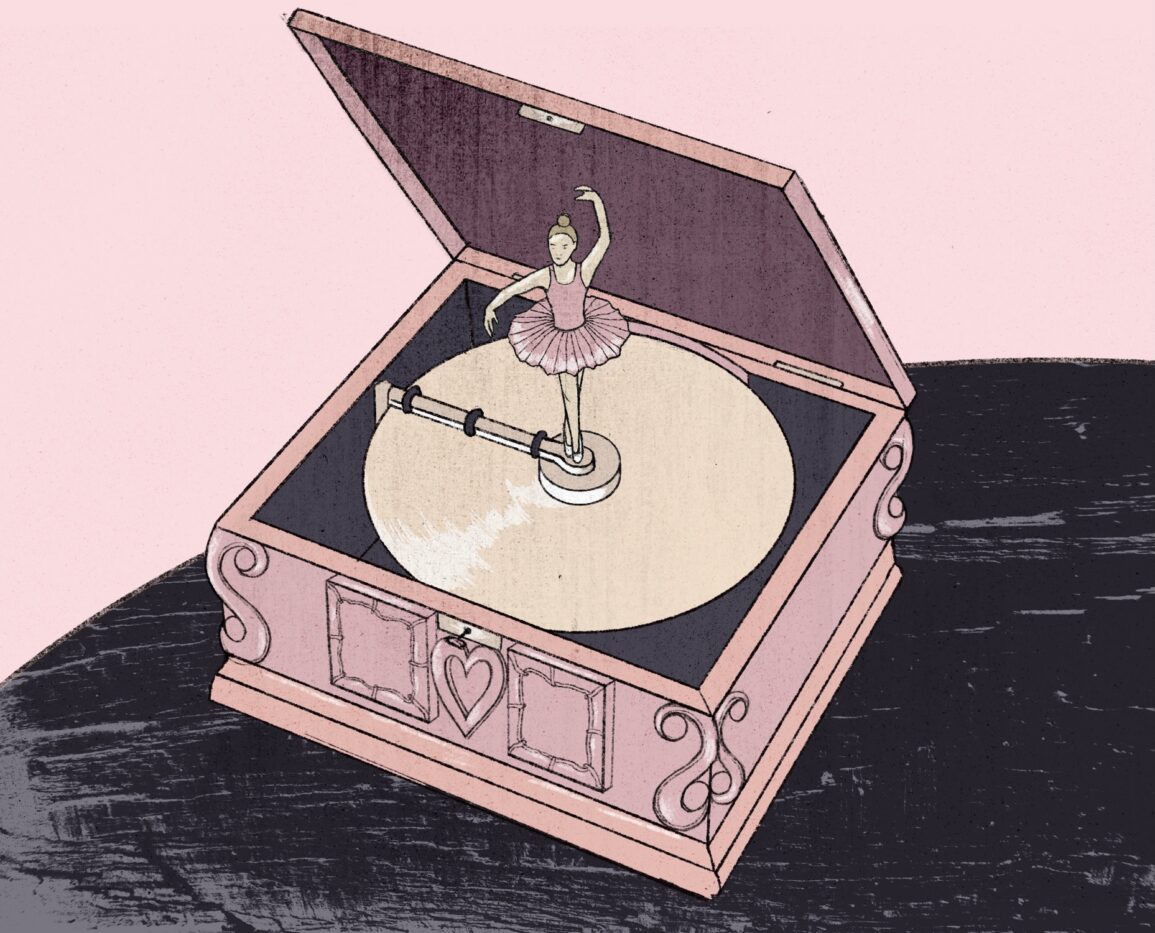
Image by Anna Sorokina

Image by Anna Sorokina
La Rubia lives here now. Even if we don’t talk about the events that led her to this place, she is here. Her back is straight and her chin points slightly forward. She is running her small finger over Tali’s old bookshelf. War: she reads one Céline title aloud. Next to it: War and War. La Rubia’s body is so unnervingly small that I can imagine it slipping between the cracks of the hardwood floor. She tilts back and forth, exaggerating her own delicacy.
“Have you read any of these?” she asks softly, pointing at the books.
“On the shelf of horrors?” I respond.
“What do you mean?”
“You know,” I say. “They’re all about conflict and death. They’re just pornographies of sadness.”
She doesn’t respond, and I fill in the silence.
“It’s pseudo-modernist garbage for people dazzled by complicated syntax.” Tali liked that, though, I think to myself. She felt it exonerated her.
About six months ago, La Rubia moved here from one of those states that Tali and I had only heard about in movies. She had met Tali online and inserted herself into our lives with the ease of a tick. La Rubia was an only child, had no friends in the city, and possessed a seemingly unending amount of money that she never cared to explain. Her real name, Rue, sounded impossibly American, and was hard for me to pronounce. I started calling her La Rubia, the blonde, because she was so uncannily different from us, with her straight, golden hair. In turn, perhaps as revenge, she pronounced my name in the Anglo fashion: Julian, like Casablancas or Assange, instead of Julián.
Tali was like the oldest sister in our sinister triangle, a dynamic that was incestuous yet unsexed. She had left Tel Aviv for New York seven years ago, a refusenik with no money and scant charm. She managed to find work, avoiding the need for a green card thanks to a series of academic loopholes she’d identified by poring over immigration law like it was the Talmud. Before she had even written her first novel, she fell in love with a playwright named Luke. She was impressed, I think, by his preternatural capacity to put pen to paper, and to publish. They had found a rent-controlled apartment on Hester Street which, in her telling, had made her happy for the first five years of their relationship. Back then, Tali claimed to be in love, but her fiction doled out hints of a tortured private life slowly, as though by medicine dropper — cheating boyfriends, girlfriends driven mad. It always seemed to me like she and Luke took turns hurting each other as if it were an Olympic sport. I often wondered if they were doing it deliberately, for material, in order to write.
Tali and I first met at a party for a magazine that had rejected two of my short stories. I told her this, half-drunk, and she laughed.
“You should find a way to be reborn as a well-connected American,” she said. “Maybe then they’ll pay attention.”
We were both foreigners in a hostile city, working in everyone else’s mother tongue. Tali wrote in Hebrew and then self-translated. I spoke Spanish with a chilango accent but found myself at home in the English language. We both romanticized the Jewish-American literary tradition — all those assimilated men who tried to write themselves into the nation. We saw ourselves in them, except I was trying to flee my family’s wealth — the chauffeurs and servants in Mexico City’s glittering suburbs — and Tali was trying to pretend she’d been born anywhere but there.
Our bond solidified when she became single again. Women do this all the time: they break up, realize they have no real friends left, and instead of dating again, they adopt men who are already infatuated with them. I belonged to the friendzoned army that helped Tali paper over her loneliness. When she and Luke called it quits, she told me her place was too big for one person and asked if I wanted to move in. We split the railroad apartment in two unequal parts. In those first few months of cohabitation, our relationship became symbiotic: I edited her pieces, correcting adverbs and commas and softening the needlessly scandalous politics of her characters. She introduced me to her friends, kept me company when dates ghosted me, and let me use her big, stately desk when she was out. We never slept together, although I think Tali knew I wanted to.
Tali often fancied her apartment an urban kibbutz, where everyone was welcome to stay over if they earned their keep with charm, drugs, or humor. She imagined herself as some cross between Edie Sedgwick and Gertrude Stein. But our visitors never lingered, returning to their home countries or moving to cheaper cities. When La Rubia came to town, late in the spring, Tali rejoiced in playing host every time she dropped by. They had found each other on a podcast’s subreddit, where they traded one-liners and ironic stances on the state of the world. Tali enjoyed that corner of the web’s disdain for American Democrats, while I suspect that La Rubia was attracted to its acceptance of body fascism and its authoritarian sense of cool. Online, La Rubia had said she wanted to move to New York to be closer to the internet, and Tali had encouraged her to come. I think she saw in La Rubia a younger version of herself.
Tali was almost thirty, and La Rubia twenty-one. They both had a past with anorexia, a disease that they felt connected them permanently. Tali, though ostensibly recovered, still obsessed over her body during hours spent at a gym on Orchard Street. La Rubia had never really overcome her admiration for fasting; hunger and clonazepam created a thin, glittery layer over her eyes, and she always looked as if she were about to cry.
I often wondered if Tali envied this emptiness in her. If she craved La Rubia’s hunger the way La Rubia craved Tali, or the softer ways in which I craved La Rubia, too — although I knew her to be off-limits, precluded by Tali’s tacit competition with anyone who was even remotely younger, or more attractive, than her.
After she arrived, La Rubia found a sublet in Gowanus, but she seemed unhappy to be so far from Manhattan. Every day, she would take the F train and advance into our apartment, planting her flags like it was a contested territory. La Rubia idolized Tali, and often ogled her clothes and books, studied the way she chewed her food and the gestures she made while she talked. La Rubia longed to be a writer too, and often harassed us with ideas for essays about the deep web and the New York Experimental Ballet. Her opening paragraphs were always brilliant, but the pieces never materialized. La Rubia lacked diligence.
During La Rubia’s visits early that year, she and Tali replaced their Reddit exchanges with long discussions about Tali’s readings, her bookshelf providing a series of topics about the titles La Rubia hadn’t read. The two became very close in a way I never understood, and often closed the door to Tali’s room and left me outside, like an idiot, imagining what they were doing.
At some point, Tali gave La Rubia a key without asking me, and she started coming and going with no warning. The first time La Rubia dropped by unannounced it was almost summer. I had dozed off reading while Tali cooked.
“I saw this and thought of you,” she said to Tali, and I woke with a start.
She walked in over the threshold and stood next to the kitchen table. La Rubia produced a small music box, wound the gears, and set it on the table. She was wearing a white tennis skirt and a pink shirt, and her hips began faintly swaying to the tune. It sounded like a Gagaku melody, naive and playful. When it was over, La Rubia started it again. I don’t know how long we listened.
“Beautiful,” Tali said when La Rubia seemed to have finished. “Where did you find it?”
“In one of those little stores,” La Rubia said, “the bric-a-brac shops on Mott Street.”
“Tchotchkes,” I translated.
“Yes,” La Rubia said without laughing. Her soft, raspy voice always sounded recently smoked.
“Thank you,” Tali said, rising from her seat. She took La Rubia in her arms, her large breasts brushing against La Rubia’s neck. I found myself imagining them naked. Next to each other, La Rubia and Tali looked like porn categories. Tali: Jewish, breasts, athletic, cheap, generic, curly hair, anal. La Rubia: angel, teen, skinny, casting couch, pillow princess.
Then Tali resumed her work, chopping carrots and squash as La Rubia watched.
“How did you get the life of your dreams?” La Rubia said after a while.
“What was that?” Tali asked.
La Rubia tried again.
This time Tali stopped, turned around. “Is this the life of my dreams?” she responded. “Maybe it’s somebody else’s. More like a nightmare. Are you for real, Rue?”
“Of course.”
Tali clenched her jaw and shoved the pan of vegetables into an oven she had forgotten to preheat.
“I don’t know.” She laughed. “This isn’t a dream for me. Maybe if my mother would see me. Maybe if I could go back to Tel Aviv.”
“Tel Aviv?” La Rubia smiled.
Tali shrugged. She knew that talking about her birthplace was anathema for the city’s bien-pensants.
La Rubia became more persistent. How much did she write, she asked, and how did she find the time and discipline? What were her ideas? When had she become so curious, so well-read? What was her method, her process when developing a story, how much of herself was in her characters? Was she this sure of herself, this successful, when she had just arrived in America, or had she also dragged her body across the asphalt like a starving lizard?
I listened as Tali responded curtly to these questions. She didn’t have real talent, she said, just extreme intention. She wrote every day, but that was more discipline than a gift — hers was a triumph of the will. She told La Rubia about the biography she wanted to write of an Israeli painter who had lived on the Lower East Side and died of AIDS in the 1980s; I had barely heard about this idea. I had never seen them interact this way, and wondered if this were normal, if La Rubia’s inquisitions also happened behind closed doors.
“Could you teach me Hebrew?” La Rubia asked. “Then maybe I could translate your old work.”
Without a second thought, Tali accepted.
“How do you say beautiful in Hebrew, Tali?” La Rubia asked. “How do you say blood?”
Tali answered in Yiddish. La Rubia didn’t notice.
“When did you fall in love for the first time?”
“With Luke,” she said. “The week after I landed here.”
“How was he in bed?” La Rubia asked. “How was your mother growing up?”
“Both were tyrants.”
“What was his personality like? What was his writing process?”
Tali answered frankly. She spoke admiringly of her ex, with a twinge of sadness. I was puzzled by her sincerity, and a little alarmed. I rarely heard her speak this way; she was revealing too much, I thought. Few people knew her to be so lonely.
Late in August, I went to a bookstore not far from Hester Street, in a basement where Zebulon, the son of a once-famous mystic, was selling off his father’s estate along with other used books and some ephemera from the 1970s. Tali had introduced me to him, and I would often go pay him a visit, less to shop than to locate a sense of Judaism that my parents had never instilled in me. My Jewishness, I explained to Zebulon, was one of bankers and lawyers who out-glamorized each other with the lavish bar mitzvahs they threw for their children. Judaism’s rich intellectual tradition, its politics and its esotericism, had been entirely absent from my upbringing. But here, in Zebulon’s store, I could make up a new genealogy among the last Kabbalists of East Broadway.
I was browsing the collection when Luke came in. He was fatter than I remembered. Always cosplaying Woody Allen, he looked about Tali’s age but was maybe ten years older. Since they broke up, he had become a local micro-celebrity, an interesting figure to those who were bored by the inoculated art of our times. He was more or less conservative, incredibly learned, and his plays — leavened with references to Plato, St. Augustine, and Wagner — felt free and experimental, but without zest. His characters mimicked our desolate lives, the rotting effect that being on the internet had produced in our relationships to one another, but didn’t pose much commentary beyond a complaint. Some of his reactionary gestures — cocaine on stage, a fetish for abuse — made me uncomfortable, but like everyone, I remained intrigued by his provocation.
I crouched down in the medieval section, next to a collection of rare Haggadahs, and watched him. He was alone but seemed to be expecting someone. He didn’t look evil, although out of loyalty I had vowed to detest him like one of my blood’s own foes. In our few interactions, he’d been slightly condescending toward me (older men usually are). I’d heard about the harem of actresses and dancers he’d dated after Tali, about how he’d supposedly induced at least two hospitalizations in those rehab clinics upstate. He had maligned Tali in some of his plays, but she tried to avoid the topic. From my hiding place, I watched him page through volumes of Elias Canetti and Irving Howe. His choices filled me with rage — what did this man know about Irving Howe? Why did he care? And what was he doing at Zebulon’s, this fortress of Judaica in Lower Manhattan, a neighborhood where union buildings had become luxury condos, Yiddish newspapers were now banks, and synagogues had been turned into designer stores? I thought about how I’d later report his literary choices to Tali. Then he seemed to get a text, bid Zebulon adieu, and promptly walked out. Before I could text Tali, I saw a scant silhouette walking toward him, the back of her white tennis skirt bobbing in my direction. Her blonde hair swayed as she encased him in a hug.
That year we spent Yom Kippur together, Tali and I. Ahead of the holidays, she’d been writing less and started talking about Luke every day, possessed by La Rubia’s lingering questions. She’d become erratic, picking up books and leaving them on the floor after five or so pages. Her reading choices were strange. Biographies of fake messiahs. First-person accounts of war. Catholic apocrypha, Simone Weil, Leon Uris’s sad little epics.
During our fast we alternated between the couch, the kitchen table, and the floor. I drank coffee and sent apologetic emails to my ex-girlfriends. Tali was abstaining even from water. She looked at me with miserable eyes.
Outside, the world continued. To me, Jewish holidays feel like when Mexico’s national soccer team is playing: the gringo universe seems to go on with business as usual, while for me ordinary time stops. On those occasions, I could feel the presence of a sudden messianism that belonged to a different universe. My life was made in that discrepancy between this inner world and the outside, a private and public life. I was used to it, but that didn’t make it any less painful.
Tali’s turn inwards felt even more performative than mine — as if, for a sacred instant, she had a religious reason to return to her early, anorexic youth. Does redemption count if you enjoy hunger? Could the rabbis who drafted the precepts of Jewish law have known that the meaning of their prohibitions would change with the advent of eating disorders? Was Tali less holy if she took pleasure in self-abnegation? Was her mysticism real, or was she just applying her country’s military discipline to this extreme form of self-sacrifice?
We spent most of the day in silence. Toward sundown, Tali crawled toward me, onto the couch.
“My friends are having a party at a gallery two or three blocks from here,” she said. “Everyone will be there.”
When we got to the gallery, Tali was holding my hand. The lights were purple and, although we were not ready to start drinking, the wine was free. We had showered hurriedly, and I inhaled leftover dumplings while she chose a white dress. Now we blessed our plastic glasses like Kiddush cups and gulped them down. La Rubia came late, and handed us each a blue pill.
“Happy Yom Kippur,” she said.
“Thank you,” Tali responded, raising her eyebrows cynically. She downed her pill, but I kept mine in my pocket.
It was one of those parties where everything feels as though it happens on a stage. The characters that belonged to our shared life all seemed to be present: our mutual friends and my former lovers, my literary enemies, Tali’s American mentors, the acquaintances we made online but never dared to talk to in real life. When Luke waltzed in, Tali pretended not to notice. La Rubia grabbed her by the waist — like a book, or a small dumbbell — and pulled her to an improvised dance floor that the gallerists had set up. They started to sway. La Rubia took Tali by the hips, the shoulders. I watched Tali’s face, which looked both joyful and panicked. She didn’t seem in control of herself. It was beautiful, lame, and tragic.
Luke was at the bar, staring at them both while pretending to read the label of a wine bottle. Were they rubbing each other for his attention? For mine? They lingered there for a long time, the effects of the drug prolonging Tali’s patience with La Rubia. Her limp body was turned into a puppet, and her limbs lifted and dropped to her dance partner’s caprice. Around them, people were talking, whispering. Then I saw La Rubia go in for a kiss, forcefully, which made Tali lose her balance. She fell to the floor violently, and her head bounced on the ground. A small thread of blood appeared on Tali’s neck, where the back of an earring had caught. Her legs pointed upwards, letting her underwear show, and a broken heel landed in the corner of the room.
La Rubia didn’t say a thing, but Tali lost control. Still on the floor, she shouted in Hebrew, slurs and outdated expressions overlapping. No one there could follow, and she was becoming the anecdote nobody wanted to be. La Rubia looked like a porcelain doll, God’s chosen gift beside Lilith the demon. For the first time since I met her, I was embarrassed by Tali. I ran toward her, and lifted her in my arms.
“It’s going to be a bumpy night,” La Rubia said under her breath, and then Tali started screaming insults again, this time in English.
La Rubia didn’t follow us. Tali refused to go home, and made me wander around until dawn. Barefoot, she told me anecdotes that emerged for her at every corner, repetitive and poorly narrated. When we reached our stoop, she threw up. Her life in the city lay jumbled before me. After a while, Tali looked at the sour puddle of wine that she had mistaken for dinner, and she started to cry. I hugged her, felt the bones in her back, and understood that she was truly afraid.
When we entered the apartment on Hester Street, La Rubia was sitting at the table. Behind her, a half-naked Luke was caressing her neck. I suppose that he had never imagined that he would come back to that apartment, less so to live there permanently, and least of all with someone other than Tali.
Tali smiled with shame, looked at herself in the mirror, and went straight to her room. She grabbed her music box. She let her eyes linger delicately on the books that crowded each other clumsily, the cheap furniture, every spice and every ceramic piece she had bought. The material sum of seven years in a city. She gazed at the unpublished manuscripts, the letters that she had never mailed Luke, the correspondence with friends in the Middle East. She took only a couple of those, removed her bloody earrings and makeup, and left a pair of keys on the table. Then she nodded her head to La Rubia and Luke. Nobody said a word.
And then she disappeared. She left me, La Rubia, and Luke in the apartment. I don’t know if she returned to Tel Aviv, if she was sent to an Israeli prison, if she moved upstate. Tali vanished from all of our lives and now we only have La Rubia, who continues to inhabit Tali’s world. I sometimes wonder if another woman will come to take La Rubia’s place, eventually, and if Luke will stay here the way men in New York always do. All I know for now is that Tali is finally free and that I still think of her, like a sister or a forgiven prophet who might someday return.
Julia Kornberg is the author of Berlin Atomized and The Parties.