Issue 17 |
April 21, 2026
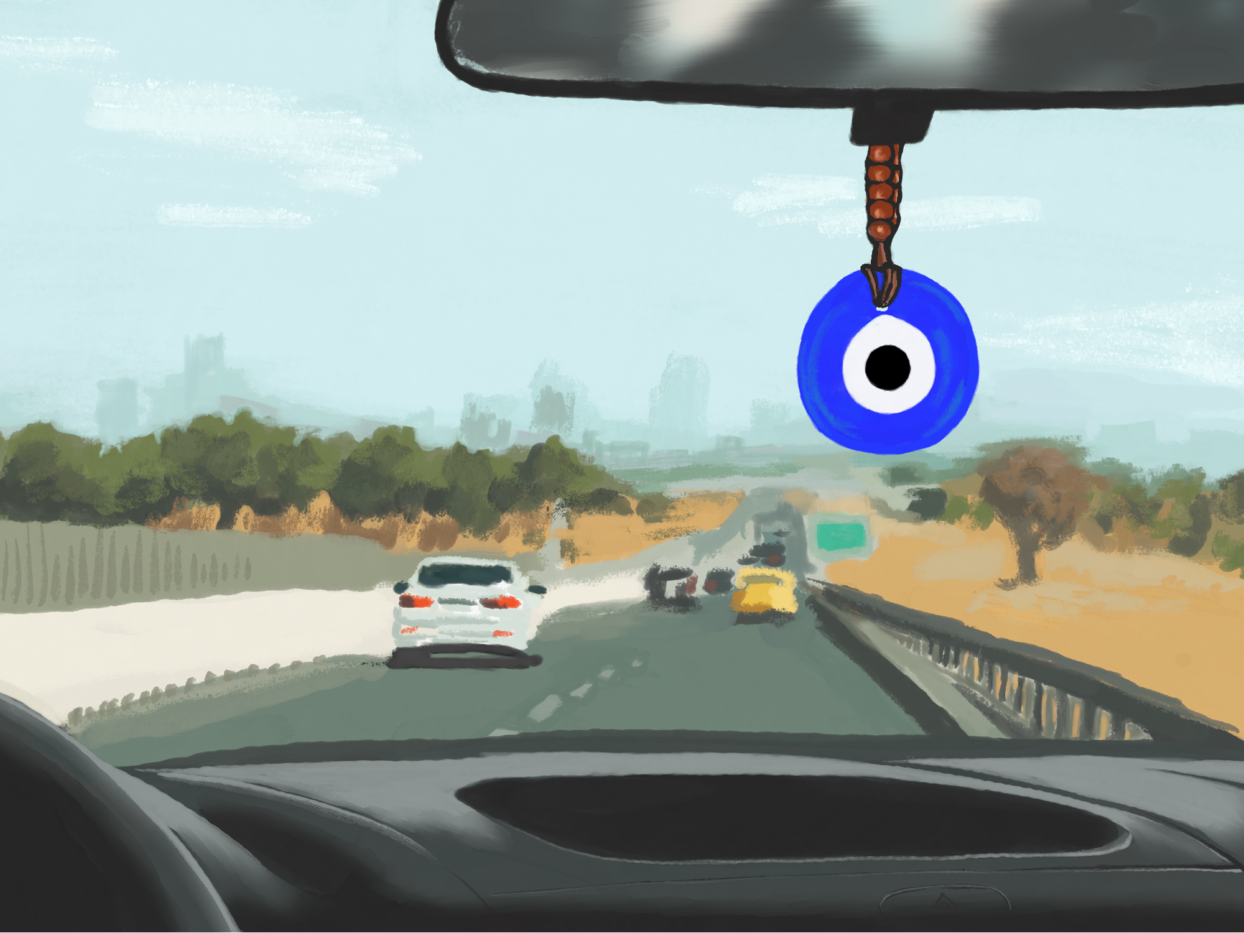
Image by John Kazior

Image by John Kazior
At the airport, I hustled out of my Subaru and waved down my family. They looked awful, but who doesn’t at Arrivals.
“Why is it so hot?” my mother asked.
“Austin, Texas,” my dad said, switching from Korean to English. “Great!”
My mother handed me her suitcase and scrutinized the FREE PALESTINE sticker on the car’s bumper. My friend Joana had put it on — she sold me the car after she graduated last year. Personally, I didn’t love the idea of any sticker on anything.
“If you studied law instead of writing, you wouldn’t be driving a wreck like this,” my mother said. “My friend’s son — ”
“Hi Grace,” I said to my youngest sister, who was wearing flared jean shorts. Her earphones would probably remain in all weekend. My other sister, Hannah, had not come because she and our mother were not on speaking terms.
My mother took the passenger seat, Grace and Dad slunk into the back. Joana’s evil eye charm dangled under the rearview mirror. The 28-year-old station wagon rattled up to sixty miles per hour, its tenable max. I sometimes joked about my “Car Emasculation” — being forced to drive in the rightmost lane, watching every motherfucker on the road zip ahead.
“What would your Jewish girlfriend think about that sticker?” my mother asked, fiddling with the A.C. vent. She never called Clara by her name; it was always your Jewish girlfriend. My mother loved God and the Chosen People, though her love did not extend to the person her son was attached to.
“You used to be such a good Christian,” she said.
“So many trees,” my dad said.
My mother harrumphed. Pre-Covid, she’d toured the Holy City in a charter bus full of pious Korean women. To her, Israel needed to be preserved at all costs, and the destruction of the Middle East was not much of a cost.
“We’re picking up Yebin now,” I said. Yebin, a close friend, had flown in the previous night. She called Austin my “personal Italy.” Perhaps it was because of the city’s perpetual summer, how we had spent her last visit lounging at its premier swimming holes, Deep Eddy and Barton Springs, which I could admit possessed villa-like airs. Earlier that morning I’d dropped her off at Barton, having believed I’d be fine on my own for a few hours.
“Who is Yebin?” my mother asked.
“Wesley,” I said. Yebin and I had met at a summer internship nearly a decade ago, but my mother still called her “Wesley,” as she had been attending Wellesley College at the time.
“Why are we meeting Wesley but not your Jewish girlfriend?” my mother asked.
“Clara’s showing her parents around town,” I said, checking my mirrors because I was being tailgated by a truck. Why were its brights on at ten in the morning?
When we arrived at the pool, Yebin was waiting out front, her hand shielding her face from the sun. Her hair was still wet. She bowed deeply and then squeezed in beside Grace and Dad. I drove us to one of those outdoor cafe-cum-breweries that were ubiquitous in Austin. This place had a delicious house salad that included a smidgen of granola, and you could add on a chicken cutlet for six bucks.
“So many white people,” my mother said.
“It’s not like San Diego,” my dad said.
“Lot of fatties,” my mother added.
“I bet they’re MAGA like you,” Grace said in English. “Same species alert.”
As a reward for fighting the good fight, I bought Grace a matcha. I asked what classes she was taking in the fall, and she answered with a seven word list.
“What are you listening to?” Yebin asked Grace.
“She should be studying for the SAT,” my mother said to Yebin, using the formal suffix -yo — it was disarming to hear her speak in honorifics to someone my age. “Her own brother tutors dozens of high school students but she won’t dare receive his help.”
“The only thing you care about is college,” Grace said.
“If only you cared half as much as me,” my mother said.
“Happiness is most important,” my dad said. He was sitting across from me, slouched painfully forward. Despite my mom’s militant efforts, she had failed in her war against his tech neck.
“When are you ever happy?” my mother asked him. “You pout around after every interview with Apple, Google, Amazing. Unemployed at sixty and still interviewing, isn’t he ridiculous?”
“Don’t talk like that in front of our guest,” my dad said.
“My dad lost his job a few months ago, too,” Yebin said.
“The situation is no good,” my dad said, which was the same thing he told me after divulging the news of his layoff. Yebin and I had often mused over whether we over- or under-projected onto our fathers’ interior lives. Yebin spoke of her dad as embodying a classically male impenetrability, but when I’d interviewed him for a project back in undergrad, he’d spoken with abandon about throwing Molotovs at the Chun Doo-hwan regime. My own dad, who’d participated in this same pro-democracy movement, had shrugged off all my inquiries. “Everyone was doing it,” he once told me. I took him at his word until I visited my grandmother in Korea, who spoke, with surprising vitriol, about how he was a key leader in the student protests, even dropping out of Seoul National to help organize textile workers. I had always believed he flunked out — my mother’s claim, which she aired every time he got laid off from another middling tech company.
“Tell Wesley about Jong-su,” my mother urged him now. “Go ahead.”
“Not now,” my dad said.
“Jong-su?” Yebin asked.
“He was the CEO of Playon, you know Playon?” my mother asked, launching into her spiel: Suh Jong-su, an old college friend of my dad’s, had visited our family in San Diego a few years earlier. My dad showed him the sea lions at La Jolla Cove. Six months later, Jong-su killed himself.
“Eighth richest person in Korea,” my mother said.
“He was not doing very well,” my dad said.
Meanwhile, Clara was texting me about her own slate of familial theatrics: her parents, also in town for graduation, were squabbling over the colorways of their rental car. She seemed legitimately annoyed, but having met her parents a few times already, I found it amusing, their bickering obviously toothless.
Do you know if Taylor’s family is coming? I messaged Clara. Along with Joana, of the Subaru, Taylor and I had once formed a close-knit trio. When Joana was arrested in our school’s pro-Palestine encampment, Taylor and I spent the night in front of Travis County Jail, keeping her distant company. Truthfully, I had a great time. We chanted for our friends inside, and in the spirit of community I chowed down on pizza and tacos and even smoked an American Spirit menthol, which gave me a hiccuping fit. Only later did I learn that Joana had been going crazy inside, staring down a piece of Wonder Bread and reciting phone numbers of emergency contacts.
After Joana graduated, however, Taylor began eliminating every straight man from their life. Ironically, I had counseled them through several problematic relationships they had had with other straight men. Was it because I misgendered them a few times? First they came for the socialists….
Don’t worry, Clara replied, you probably won’t even interact.
“When are we going to meet her?” my mother asked me.
“Who?”
“That girlfriend you are texting — you never smile like that with your own family.”
“We should call Hannah and ask how she’s doing,” my dad said.
“If only her brother was a brother to her,” my mother said, as if the person Hannah was avoiding were me.
“I will send a picture of my salad,” my dad said.
Hannah lived in Seattle. She had severed ties with our mother after our cousin, the sole relative we had in America, had been deported. Local media — Korean media, too — picked up the case because of its spectacle: our cousin was arrested in front of her children’s school, her daughters in the backseat. Reporters cited the immigration court hearing she’d missed in 2022, as well as her domestic violence restraining order, not bothering to unearth the fact that her husband had left her for a coworker and filed the restraining order during divorce proceedings.
Hannah could not stomach having a mother who refused to recant her choice of president — the man responsible for the deportation, or at least the cruel theater surrounding it. My mother pointed out that she’d voted for Trump in 2016 too, and where was my sister’s righteousness then? Hannah, my mother continued, never cared a lick for our cousin, while she herself had helped her secure loans, procure housing, and find a suitable Korean church.
Once Hannah stopped picking up our mother’s calls, our mother started calling me instead, every day. I had only heard her cry once before, during the worst of her menopause, but now she wept constantly, excoriating our cousin’s ex-husband and repeating ad nauseum that such tragedy could not possibly have fallen on the fair-skinned.
For weeks I listened and withheld judgment. It wasn’t too difficult. I respected the indomitability of her internal contradictions. I offered little in response, and even began to anticipate her calls — I had never felt so close to her.
I showed my family and Yebin around my neighborhood, which had more Black Lives Matter signs than black people. My mother fanned herself with a magazine.
“I know you,” she told me. “You’re just fooling around with that girl.”
I did not respond — I was proud of the fact that I had not taken her bait since 2020, the year of her YouTube radicalization. Nagging, after all, is a tool of the powerless.
She shrugged. “I’m taking her just as seriously as you are,” she added.
My dad pointed up at the crape myrtle trees, then down at their fallen pink flowers.
“You’re too young to understand nature,” my mother told me, or Grace, or Yebin.
Did some people find graduation celebratory? We drove to the reception, which was held in the foyer of our department building. We arrived far too early: the only others present were faculty members and Taylor, who stood with their parents. Averting my gaze, I led my family straight past theirs and toward my advisor.
“Your son is brilliant,” my advisor said.
“Thank you,” my dad said.
I rocked from foot to foot.
My mother smiled, though she seemed distracted.
“I loved working with him,” my advisor said.
“Thank you,” my mother said.
“I suppose I should top up my drink,” my advisor said, bowing apologetically and scurrying over to the makeshift bar.
Taylor clasped my forearm from behind, which made me shiver. “I’m Taylor,” they said to my parents, “and you must be Yebin — I’ve heard wonderful things.”
“Why is he dressed like a girl?” my mother asked in Korean.
“So judgmental,” Grace muttered.
I shook hands with Taylor’s father, who had Taylor’s high, protruding forehead. I knew he oversaw a landscaping company in North Carolina, and looked just as out of place here as my own parents did.
“He’s the hardest worker I know,” Taylor told my parents. Their smile appeared gentle but I knew what they were doing: with Joana, we had frequently discussed our difficulties with our mothers.
“Say something,” my mother urged me in Korean. “Why are you behaving like an orphan?”
“Have you met Clara?” Taylor asked my parents.
“She is here?” My mother looked around.
“Not yet,” I said.
By then the reception had filled substantially. Yebin told Taylor’s family about her job at a foundation that sponsored artists from East Asia, and Taylor explained their novel, a Southern Gothic gender transition narrative. My parents nodded diligently but could not muster anything verbal.
“What’s he like as a brother?” Taylor asked Grace.
“He’s… independent,” Grace said, earphones still in.
Grace was being charitable. In reality I knew very little about her, primarily getting updates from Hannah. Grace had been in first grade when I started undergrad, and my mother often said Grace was more afraid of me than of her.
My mother caught sight of Clara and her parents as they entered the building. I wondered how she knew what they looked like — had she scoured my social media? In any case, Taylor caught the gist and stepped aside.
To occupy my hands, I grabbed a seltzer from a cooler full of melting ice. “Okay, let’s go say hi,” I said, ushering my family toward Clara and her parents.
Our two groups formed an oval in a busy corner of the foyer, shaking hands in front of a shelf of hardbacks written by alumni of the program. Clara looked beautiful in her black pants and frilly navy blouse. I hadn’t seen her since my family arrived, and our embrace was chillier than I would’ve wanted. Perhaps she was nervous, too; though I had kept my mother’s disapproval from her, Clara knew about her temperament.
My parents introduced themselves in English, which made them seem alien: my mother more elegant, my dad more grave.
“You must be Grace,” said Rachel, Clara’s mother. “What grade are you in?”
“Eleventh,” my mother answered.
Rachel clasped my shoulder and said she had a gift for me. Clara often characterized her as severe and stressed, but to me Rachel always seemed doting. I felt surprised, nonetheless, whenever I received her affection.
My mother rubbed Grace’s head: “Surprise baby.”
We laughed; my mother was exceeding expectations.
“Well, we love surprises, don’t we?” Rachel said.
“At least you picked the prettiest one,” my mother said in Korean.
The dads remained in standby — they knew to defer to their wives. Later, when Clara and I drifted to the snack table, attempting to catch our breaths, we could see them conversing on their own. About what, we couldn’t hear amid the din, but they were smiling with their eyes, and then laughing. Laughing!
Dinner was my family, plus Yebin, at a Cantonese lazy Susan hall. Our waitress brought out egg drop soup and, after a few minutes, a torrent of meat and vegetable dishes. Yebin asked my dad about his time in college, about protesting against the junta, and he laughed sheepishly and said, “Oh, that was so long ago.”
“My dad was at Yonsei,” Yebin said. “’83-’87.”
“We must be around the same age,” my dad said.
“You have similar immigration paths,” I said.
“My husband was friends with high-ups at Kakao,” my mother said. “The CEO of Naver attended our wedding. They all wanted him to work for their startups, but back then their companies were worthless, and he needed to provide for his parents, you see. His own father could not work….”
“Do you wish you had stayed in Korea?” Yebin asked my dad.
“Of course not,” my mother said. “Look at my children, their lives so easy, my son twiddling a pencil all day.”
I chomped on peppercorn chicken, then spun the lazy Susan to reach the mapo tofu. Grace, next to me, was flicking at her phone.
My mom sipped lukewarm water, then turned to me. “Can I ask you something?”
“Sure,” I said. She was not normally one to ask for permission, but her tone was almost sweet.
She took her time shaping her words. “That girl — why does she like you?”
“What?” I asked, though the word emerged limply, more of a “waaa.”
“What could you possibly offer her?” she asked.
Yebin set down her fork, and even Grace looked up from her phone, tapping to pause whatever was playing. My dad’s neck could not have sunk any lower.
“When you leave this city I want you to end your relationship,” she said, using a Korean word that translated as clean up. “Her family will never accept a sliced-eye Asian like you.”
I considered the phrase sliced eyes. Maybe that wasn’t completely precise — ripped eyes was a more literal translation. Perhaps I was fixating on these words to delay the realization that my mother was calling me a chink. I had never been called a chink before, having grown up in Southern California in the twenty-first century.
“Her parents like me,” I said. “I’ve spent holidays with them.”
“You’ll forget about her once you leave,” she said.
My mother looked at Yebin as if she would concur.
Yebin blushed. “They love each other.”
I stared at the mostly eaten Chinese broccoli, the soy sauce dripping off the plate. I tried to push my tears down. This is my family, I wanted to tell Yebin. I would apologize to her when I had the chance.
“Yebin goes to church and speaks better Korean than you,” my mother said. “Why don’t you date her?”
Yebin blushed harder. My mother had no actual knowledge of Yebin’s beliefs: just last month she was in Berlin, at KitKatClub, getting her toes sucked by some fiending Italian Casanova.
“We’ve been friends for ten years,” I said.
My mother ignored me. “When are you coming home?”
“I don’t know,” I said, shaking my head. “Not for a while.”
“He never visits,” my mother said to Yebin. “Even when he was a child, he hated being home. He’d spend all day at the neighbor’s and come back squawking in English, ‘I’m not baby! I’m no baby anymore!’”
I went to the bathroom and pulled out my trusty vape, blowing smoke into the mirror. I reminded myself that my mother was, fundamentally, a woman deeply afraid. My mother, who woke up at dawn every morning and prayed for me in tongues, aiweiweiwei. My morning alarm, aiweiweiwei. I was free of her, and she could not stomach that.
When I reemerged, I found my dad signing the bill.
“The food was actually not that bad,” my mother said. “No MSG unlike every Chinese place in San Diego.”
“Is there anything you need?” my dad asked me. “I saw there is a Target nearby.”
“She’ll warm up to Clara,” Yebin said the next morning, as I drove her to the airport.
“It doesn’t matter,” I said, not wanting to make excuses for my mother. Some people didn’t deserve the generosity of context. Was I the last one in my family to understand this?
Yebin said that during the reception, my dad asked her if I possessed a “creative mind,” if I had the requisite talent to find success as a writer or a professor.
“He was really trying to figure it out,” she said.
I had never before heard my dad express any expectations for me. It was foolish of me, I realized, to assume this meant he didn’t have any.
After dropping Yebin off, I picked up my family and took them to South Congress Avenue. We twisted through the busy foot traffic, passing Lululemon, Nike, Adidas, Hermès.
“Let me buy you a graduation gift,” my mother said.
“I don’t need anything.”
She sighed. “You never engage with your family.”
“I don’t engage with you.”
“Don’t pretend it’s any different with your father and sisters.”
My mother and sister stepped inside a women’s clothing store. My dad and I sat on a bench, clutching their sweaty drinks.
“Shall we call Hannah?” he asked.
“I don’t think that’s a good idea.”
The previous summer, when my dad and I had flown to Seoul, we called Hannah almost every morning. It was my first trip with my dad, and I had hoped that strolling through the neighborhoods of his youth would prompt unfiltered revelations, but all he remarked on were architectural changes.
In between visits to relatives, my dad accompanied me to see nonsense arthouse films whose titles I could no longer recall. What I remembered vividly, however, was a traveling retrospective on the sculptor Constantin Brâncuşi. My dad spent an ungodly amount of time there, examining a glass case housing six busts. I toured the entire floor and returned to find him still entranced, so I stood beside him and followed the path of his eyes. I wanted to see what he saw.
The leftmost bust featured a baby with downturned eyes, sculpted in clay and finished in bronze. The second, marble, showed the baby cradling its head in its arms. The third, fourth, fifth, and sixth sculptures were just heads resting on cheeks, each more effaced than the last: the fourth had no hair, the fifth no eyes, and the sixth — could it even be called a face? It was a polished ovoid with a parabolic seam cutting across.
I wanted to believe he was pondering Brâncuşi’s path to becoming what the placard called “the Father of Modern Sculpture.” Realistically, my dad probably saw the busts as nothing more than an assemblage of rocks and minerals. But who stared this long at rocks and minerals?
Rising from the storefront bench, my dad took the cup from my hand and threw out my mother’s and sister’s drinks. He sat back down. “I thought he’d be impressed by the sea lions.”
“What?” I asked. He had reassumed his slouch; his mottled bald spot had grown to colonize the entirety of his dome.
“The pelicans, actually, impressed him most. He said they flew like airplanes.”
“Your old friend?” I asked, though I couldn’t bear talking about another tech founder, or Hannah, or any of my dad’s usual deflections — I had little sympathy left to summon. The pelicans in La Jolla were disgusting anyway, streaking the tan cliffs white with acrid shit. Maybe my mother was right: she once told me I had inherited a cruel combination of her coldness and my dad’s soft-spokenness.
“He could only stay for a few hours,” my dad said. “He had to catch a flight to San Francisco to meet the Nvidia board — you know Nvidia?
“Who doesn’t? They’re always in the news.”
“Jong-su took my hands at the airport and said, ‘You look happy. You look healthy.’ Even in college he took a year off because of his depression, but still, when I heard — ”
Through the storefront window, I saw my mother and Grace waiting to check out.
“I’m sorry,” I said.
“Happiness is most important,” my dad said. “I am so happy to be visiting my son in Texas.”
Kion You lives in Pennsylvania, where he works at a residential school for students with developmental disabilities. His writing has been published or is forthcoming in The Iowa Review, The Missouri Review, the Santa Monica Review, and the Los Angeles Review of Books. He holds degrees from Brown University and the Michener Center. He is currently at work on a novel.