Issue 16 |
December 2, 2025
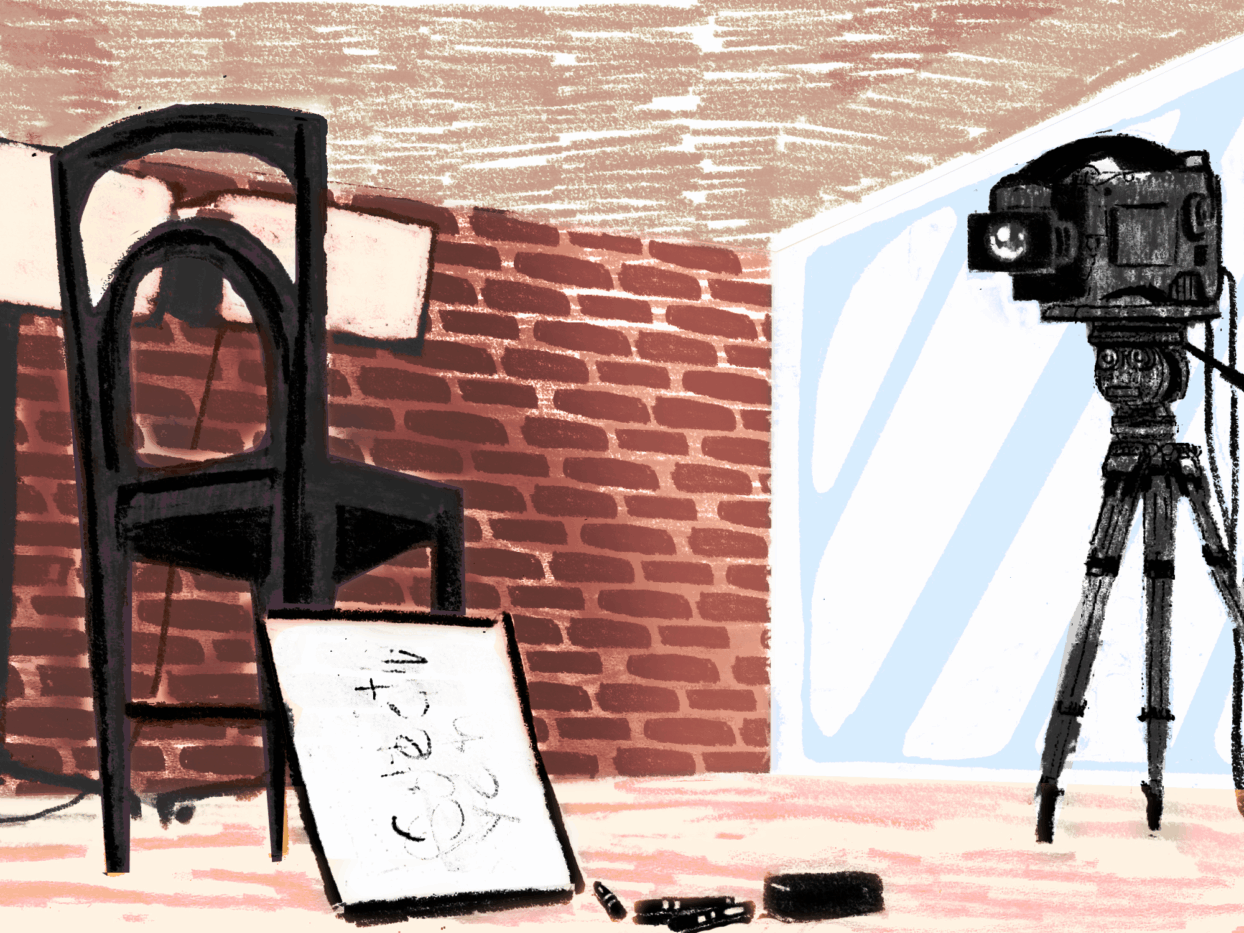
Image by John Kazior

Image by John Kazior
The most money I ever made from acting was for a crisps commercial. The brand wanted to show how its product brought people together by — my agent reading me the brief over the phone — “saying the unsayable.” To do this they made a series of ads in which people wordlessly apologized for things with open bags of crisps.
I played an impulsive young woman who tries on her older sister’s wedding dress while home alone. Waltzing through the kitchen, I see a bag of crisps sitting out and can’t resist them. In the next shot I spill salsa down the front of the dress. When we filmed the part where my sister walks in, because I thought too deeply about the emotion and money involved in weddings, and because the other actor conveyed horror and dismay so well, and maybe also because I’m an only child, I nearly cried. The director asked to see more cheekiness. He told me to shrug but without moving my shoulders.
I was living in Shadwell then, sharing a studio flat with Mia, my closest friend from drama school. I liked our little home, near Wapping’s cobbled streets, the canal you could follow to avoid busy roads. But Mia found it dull compared to other parts of East London. When I try to imagine how she saw things, I remember our small windows and brittle carpets, the damp external brickwork matching the color of the Thames.
Mia is older than I am but started late at Guildhall. Her mother died when she was seventeen, and Mia deferred enrollment to spend several years traveling Europe on a small inheritance. Mia told me the story almost as soon as we became friends — how days after the funeral she boarded a train to Amsterdam without any plan. When the money ran out, she took a job as an au pair for a theater director in Berlin. It was this director who told Mia she would be an actress. He said he could tell because her eyes were “engrossingly silent.”
This last part sounded made-up to me. The first time we were drunk together, at a repurposed working men’s club in Bethnal Green, I nearly told her so. But when I saw the admiring faces of the other students at the bar, I knew I’d look jealous. I suspected I was jealous. Later that same evening, we met an old Scottish cabaret singer who mistook Mia and me for sisters.
“Thank you!” I said as Mia laughed at him. She couldn’t have known what I took from it: that my eyes were engrossingly silent, too.
But even if I looked like Mia, I could not match her quiet allure. At parties or while waiting for classes to begin, people strode toward us with brightening expressions in ways they didn’t when I was alone.
The crisps ad came two years after drama school. That day I finished late and left tired and hungry, planning to insist on taking Mia to our favorite restaurant. I thought it might cheer her up. She’d spent much of the past few weeks in bed with a pair of old Sennheiser headphones that had belonged to her mother. I’d been asking if anything was wrong but getting only vague answers. A relationship with a man named Callum had just ended, but she’d never brought him around, so the breakup didn’t seem important enough to explain why she’d begun drifting through days like a person who had just missed her train.
Mia wasn’t in when I got home, though. A tower of books stood on her bedside table, another feature of her low mood. Most of them were actor biographies. They had piled up so rapidly that I imagined she was only reading the early life sections, frantically searching for parallels or ideas to copy. On top of the books was a bowl with soup dregs. I cleared it and put the books back on our shelf before going to bed.
Mia woke me stumbling in. She had been out for drinks with some friends, she said.
“Guildhall friends?” I asked.
“Yes, it was a last-minute thing. Ivan is back over. Just for tonight, though.”
Ivan had taught us for a year before joining a theater company in Paris. He was a soft-spoken tutor who hated overwrought sets and traced almost all acting problems back to breathing.
“Oh,” I said. “I’m sorry I missed him.”
“Where are my books?” said Mia.
But then, as if a fever had broken, Mia was more like her old self in the morning. Over the next two weeks we spent my ad money roaming London freely. We went to parties, restaurants, and shows, buying new outfits for each night. It was an intensely happy time, though perhaps I only remember it that way because it ended so abruptly. One morning toward the end of winter, Mia told me she had agreed to join a theater company called Émigré. It was based in Paris.
“But you don’t speak French,” I said.
I thought I saw her flinch. “It’s an English-speaking troupe,” she said.
Later when I looked up Émigré I saw it described as “provocative” and “life-affirming.” Its website also listed Ivan as the director. The arrangements would have begun at their drinks and continued behind my back.
A wealthier friend organized Mia’s leaving party. Afterward, people came back to ours. It wasn’t until they left that I spent any time alone with Mia. The whole thing had bled into dawn and just before we completely crashed, she told me from her bed, “This is what I need to get away from.”
I knew I wasn’t excluded from this.
“Well, I had a nice time,” I said.
“I mean the drinking, and everything it leads to.”
We lay there with our eyes wide and dry from substances that made us forget to blink. I was braced for the encroaching panic, hearing a ticking clock even though we didn’t have one, hoping I’d fall asleep before all my new problems became real again.
Mia said, “I worry it’s the only interesting thing I do anymore. That’s all I mean.”
“We do interesting things.”
“Did I say we?”
In the days after she left, I would turn to tell Mia something — three, four times in a single morning — only to find myself perfectly alone.
My day job was at a pub called The Blue Lamp. Had it been called anything else I don’t think I would have been hired. With no experience to mention in my interview, I asked the manager, “Have you heard of a police drama from the fifties called The Blue Lamp? My grandmother was in it. Dirk Bogarde, too.”
He enjoyed this, and the serendipity helped me believe I was on the right path. But after Mia left, I saw how the job might become a dead end. I had to ask for more shifts to cover the whole rent.
“I thought you were going to be on TV,” the owner said.
“The crisps ad? No, not TV. More likely YouTube.”
“That’s still something.” After thinking for a moment he added, “Or I suppose anyone can be on YouTube.”
This kind of comment, without Mia around, would sometimes make me think of scaffolding falling away. To withstand the image I’d tell myself, “You’re a working actor who lives in London.”
I was twirling this mantra around in my head at home when the TV producer rang. Her name was Georgina, and upon hearing what production company she worked for, I sat up straight, hoping it would show in my voice.
“I wanted to see if you’re still interested in being on Love Language,” Georgina said.
I slumped back into my chair. Love Language was a dating show. The concept was that you couldn’t talk to the person you were supposed to fall in love with. Mia had helped me record my audition tape one night after a private art showing in Shoreditch, the sort of fashionable scene I no longer had access to because it was always Mia taking me along. That evening, we’d arrived too late for the canapés but not for the wine, and in my tape I was very drunk. Laughing from behind the camera, Mia directed, feeding me dumb lines whenever I couldn’t think of anything to say.
I told Georgina I was absolutely interested. The exposure it would offer was dubious at best, but I had a different reason for saying yes. Off the call, I started a voice note for Mia: “You’ll never guess what….”
Georgina arranged an in-person interview later that week. I briefly decided I wouldn’t attend, then ended up arriving early. We spoke in the lobby of her office building as people walked by. I thought Georgina might be trying to test if I was too self-conscious for TV. Being an actor, I found this humbling, along with the fact it actually did make me self-conscious. Soon I was even trying to impress her. I told her my grandmother was an actor, too.
“Oh, wow,” said Georgina in a flat voice, and I felt cheap for trying to hide behind a glamorous summary of what was in truth a sad, difficult life. My grandmother spoke of her sole appearance on screen vaguely, in a self-mocking tone. “The Bogarde film,” she’d say, as if uncomfortable making any claim on it. Naming it, even. Our small Yorkshire town, where she had settled to teach drama, had no tolerance for flamboyance or big-headedness. By the time I was a little girl, she was down to one lingering token of defiance: the beauty spot she’d make me draw on her cheek to replace the one she said had faded with age. We only did this for school plays and funerals.
Georgina asked when my grandmother had died. I said it would be three years in the autumn. She paused and chewed her pen like someone filling out a crossword, then made a note.
“Did this grandmother raise you?” she asked, seeming so confused as to why I’d brought her up that I almost said yes.
Instead, I told the truth: two parents, alive and ordinary. Watching her take me in, I smiled weakly, desperate for her approval, if only so I could later salvage some confidence by turning her down.
I’d saved Mia’s reply to my voice note for the journey home, wanting to keep alive the possibility she’d admitted her mistake in leaving.
“I know Parisians are supposed to be rude,” Mia said. “But the way people smile when I try to speak French!”
From the wind noises and the several points at which Mia became breathless, I could tell she’d recorded it on her way somewhere. I hated that. She made fun of Love Language, and I hated that, too, even though I would’ve found it funny had I listened before meeting with Georgina. In fact I may not even have gone.
Weeks passed without word from Georgina or any new auditions. I picked up more shifts at the pub, mostly lates. Nights off weren’t much more fun. I’d lie in bed, listening to sounds in the street below — heels clacking on pavement, the laughter of women, the screeches of taxis that took them away.
Mia tried to help me get work from afar, one time forwarding me an invitation to Claudia Simm’s birthday. Claudia was an actor Mia once understudied for in a stage production of The Comedy of Errors. I wouldn’t know many people at the event, but Mia said I should go.
“Her brother is a casting assistant at Juliet Bradley,” Mia said.
The party was in Hammersmith. A garden flat that took up two floors of a terraced house. It was a sunny day, and in the backyard I floated between conversations that made me bored or bitter because they were about mortgages and complicated workplace dynamics and travel plans and exciting projects. There were three separate occasions on which I used the sentence, “No, but I always wanted to.”
Having elbowed my way through the kitchen, I saw two girls I thought I knew in the hallway. I waved and headed toward them.
“Oh no,” the shorter one said. “Hide!”
She ducked behind her friend, whose face was bright pink and scrunched up with laughter. I sensed they were drunk and this was only a silly inside joke, but it seemed like the kind of thing that wouldn’t have happened to me had Mia been there.
I walked past the girls and followed the sound of voices up the stairs, then through a spacious master bedroom and out onto a small terrace. A woman’s voice sang out, “Hey, Mia!”
It was dark by then, but I recognized her as Claudia. She was sitting on a weathered rattan chair beside a man I couldn’t see well.
“That’s not Mia,” he said.
I could tell Claudia was embarrassed. I told her not to worry, and for the first time since I’d arrived I felt I had the upper hand in a conversation. Claudia had champagne and an ice bucket and was controlling the music. I sat down on a free chair.
“You probably saw Mia with me a lot,” I said. “We lived together.”
“You’re Lisa?” asked the man.
He shifted sideways, and his profile fell into the light. The handsome, sullen face of a man who rarely sat forward in his chair. It was Callum, Mia’s ex.
I nodded and smiled. “That’s me, yes.”
“You know I think we’ve actually met,” Claudia said. “Now I feel even worse!”
“It’s fine,” I said. “I like your flat, by the way.”
“It’s actually my brother Harry’s. He’s in Berlin.” So the brother Mia had told me to bump into wasn’t there at all. “We thought we’d use his balcony to catch our breath.”
“You just became less interesting to her,” Callum said to Claudia. “She’s an actor too.”
He stood up, grinning. He poured me some champagne and Claudia said, “You’re an arsehole, Callum.”
I couldn’t say if I owed it to Mia to be hostile toward him or if that would be awkward and childish.
To deflect I said, “I love Berlin.”
Claudia clearly felt obliged to show interest, so she began asking me all about Berlin, somewhere I’d never actually been. I drew from what I remembered of Mia’s time there. Where did I stay? In Schöneberg, I said, where I had somehow found a spare room in a Bauhaus villa near where Fritz Lang once lived. Did I go alone? Yes, but I made friends with a playwright I met at a cafe in a cemetery. The nightclubs she took me to all seemed to have been named after mythological figures.
Callum smiled, and it suddenly occurred to me that he might recognize the story as Mia’s.
“You’re like a Sofia Coppola character,” said Claudia. “Hey, I should tell my brother to get in touch with you. He’ll probably have something.”
“I should be an agent,” said Callum.
He asked about my work, and I told them about my dating show audition.
“Does anyone really go on those shows to meet someone or is it all just for attention?” Claudia asked, less worried about offending me now. “Are you an attention-seeker?”
“Not necessarily,” I said.
“But you’re an actor,” said Callum. That smile again.
“I don’t mind attention-seekers,” Claudia said. “I just don’t like the way these shows exploit them.”
Then Claudia sighed and said we ought to go mingle. Downstairs, she vanished instantly. I latched onto Callum, who enthusiastically introduced me to people as a reality TV star. For a while I was even enjoying myself, and I drank more than I usually might have.
I lost track of time, then realized the underground was about to close. There was no money for a taxi. All that kept me there, the noise swelling and fading around me, was the knowledge that my flat would seem lonelier afterward, if I did somehow manage to make it back. That, and Callum, I suppose.
I started to blame Mia. She was the reason I was there, at this party where people wanted me to be her. She was also the reason I was spending so much on rent that I didn’t have cab fare.
As Callum was leaving, I mentioned that I lived across the city. “You could stay at mine,” he offered, his tone calling for a quick answer. He lived in Clapham, and his Uber was on the way. The invitation seemed to cast a new and reassuring light on how I’d been perceived all evening.
His room was crowded with items. There was a sense of barely maintained order. Vintage movie posters covered the walls. It struck me that Mia must have, at some point, seen them for the first time, too. The change of setting made me more aware of how much I’d had to drink. For a delirious moment, I imagined I was playing Mia in a film about her life. When Callum put a hand on my hip and then slid it under my jumper and up to my waist, I tilted my head quizzically, the way I often saw Mia do when I asked after clothes she’d borrowed.
Afterward Callum said, “Did you know about us?”
“Yeah,” I said. “But I don’t think she’d mind.”
Neither of us would say her name. I should have paid closer attention to that.
In the morning, I was no longer so sure Mia wouldn’t have minded. When she messaged to ask how the party had gone, I didn’t reply. I didn’t hear anything at all from Callum, which made it easier to forget what I’d done. Claudia did keep in touch, though. Two months later, she sent a review for a Paris production of Chekhov’s Three Sisters with a joke about being proud of me, the joke being that it was in fact Mia in the show. She was cast as all three sisters, and the review described her face in the final act as “an unshakeable image of naked despair.”
Before I read this, Mia and I were only in different countries. Afterward, we were in different worlds — hers so distantly glamorous that I couldn’t even be jealous. I liked a mutual friend’s Instagram post celebrating her success, a small performance of dignity. It felt like joining a standing ovation to avoid being left seated alone.
I told myself I was happy for Mia and drank several vodka sodas with lime behind the bar at The Blue Lamp. On my break, I fell asleep in an empty back room and woke with the owner leaning over me, his hand gently gripping my elbow. He cleared away the tumbler of melted ice I’d spilled across the table. He didn’t fire me, but he gradually reduced my shifts over several weeks until I no longer worked there at all.
After that I had to move back in with my parents up north. I wanted to reach out to Mia but had nothing worth sharing until, after a couple of months, Georgina finally called. She asked if I was still available for Love Language.
When I told her I no longer lived in London, she said, “That’s fine. We’ll put you up near the studio. You’ll even get a little holiday out of it, assuming your date with Paul goes well.”
I had little interest in meeting Paul. But even so, there was a dim promise of material that might amuse Mia.
The Love Language set made me think of a dance studio. Exposed bricks, mirrors, wooden flooring. In the middle of the room was a wall of pristine soundproof glass, a chair on either side. Georgina left me seated in one of these. I watched the crew mill about with lazy proficiency, setting up lights and cameras. After a while, two men walked through the door on the other side of the glass laughing. The taller one — so good-looking I got imposter syndrome — went over to the chair. He smiled at me but didn’t sit down. Instead he approached the glass and touched it.
“Hello,” he shouted, from what I could lip-read. He kept testing the soundproofing until one of the producers told him to stop.
I’d wondered how they planned to make watchable TV with two people who couldn’t hear each other. Their first solution was to bring in two whiteboards. Paul and I each had to describe our impressions of one another in one word without using physical description. A good start, seeing as I planned to make fun of the experience later to Mia. Paul went first and, after visibly struggling to think, he wrote: creative.
Rather than consider him in any way, I decided to show — for the audience, for Mia — that I couldn’t take the task seriously. I wrote back: creative.
Seeing the stony faces among the production staff, I instantly lost faith in my joke. The awkwardness simmered until Paul glanced up from my board. He seemed to clock my embarrassment, and he smoothed over the moment with a laugh.
During the first break I asked Georgina how she thought it was going. Smiling, her eyes wide, she said, “Yeah.”
I asked if she’d met Paul.
“I interviewed him,” said Georgina.
“What’s he like?”
“I don’t remember exactly. I vaguely recall a debate over whether he’s technically a celebrity.”
“He’s famous? I don’t recognize him.”
“We decided he wasn’t. He just dated someone famous.”
She only shared this because I’d have found out anyway during the next round, in which we played noughts and crosses on the glass. For each game we won, we learned a secret about our date. It turned out Paul had cheated on the celebrity ex, who remained unnamed, though the producers did say she only became famous after they broke up.
“Oh,” I said, Paul watching me from the other side.
They cut, and Georgina asked me to be more expressive.
“Use your training if you need to!” she said.
But express what? Disappointment, maybe — though I wasn’t thinking about Paul romantically yet. I was thinking of myself, worrying about being associated with a man who, for all I knew, might become a villain when this aired.
Paul seemed hard to hate, though. He was winning everyone over. During breaks in filming, he kept messing up his hair so that someone had to come over to fix it and tell him off, and he’d always defuse their growing frustration by making them laugh. Watching these soundless exchanges through the glass, I felt excluded. I wished someone would come and tell me what was so funny. Paul won the next game, and moments later I saw him grin. I was burning to know what he’d just heard about me.
When we came back from the next break, the glass wall was gone. They made Paul and me hug for several minutes. He smelled like sea salt spray, and I realized I hadn’t touched another person in a meaningful way in months. We wore noise-cancelling headphones so the producers could direct us. After we broke apart, they wanted a shot of us gazing into each other’s eyes. We held hands, though I don’t remember if we were told to. Georgina’s voice crackled in my ears, asking for more emotion. I thought of things that made me sad — how Mia and I had lost touch, times my grandmother’s beauty spot smudged and she didn’t know — and I let them play subtly across my face.
“Well done,” said Georgina, sounding relieved. “Keep going.”
After I arrived the next day, I was led to a dark room draped with heavy navy-blue velvet curtains. Three big lights pointed at a chair with a small table beside it. Paul and I would have our first real conversation soon, but first they needed to film a pre-date confessional. As the cameras started rolling, I noticed a box of tissues on the table.
“Could you talk us through a recent heartbreak?” asked a producer I hadn’t met before.
“Well, my best friend moved away earlier this year,” I said.
I was already laughing, pretending I wasn’t serious, but the producer asked, “A childhood friend?”
“No,” I said. “We met at drama school.”
“Let’s move on,” said the producer, who continued with her questions until my head was both empty and crowded. “Can you see yourself falling in love with Paul?” “Do you believe in soulmates?” I was still disoriented when they seated me opposite Paul and told us we could speak whenever we were ready.
“Hello,” said Paul, his voice bright and self-assured.
He told me he’d grown up in Hampstead, and I thought of bathing ponds, pubs dressed with flowers, Mia teasing me for wanting to live there. He had a junior role in the music industry, so I guessed the ex was a singer. His dad had played guitar in a well-known band.
“But he was no movie star,” said Paul. “Not like your grandmother.”
“They told you that?”
“They did. What did you hear about me?” said Paul, nervous now, and this was how we got into the story of his ex.
He took a deep breath and began, weighing every word. He must have fretted over this moment for some time. I would have. From where I sat, it was going well. He sounded sincere and took his time, though the circumstances forced him to be vague. I still didn’t learn her name, for example. Paul finished by saying, “But it’s not something I’ve ever done since, or had done before.”
“That’s good,” I said.
“Actually I was worried she might cheat on me. She was going to be successful, there was no doubt. It seemed like the choice was to either act first, or… well.”
“Right.”
“It was stupid.”
“Yes.”
“I was stupid.”
I’d have casually disapproved of Paul if it cost me nothing, if he were only someone I was reading about or watching. But I wasn’t willing to lose his warm attention.
“You were also unlucky,” I said. “The one time you cheat, and she goes on to become famous.”
“True,” said Paul, smiling again. “I’ll know better for next time. You’re an actress, right?”
I laughed and said, “You don’t need to worry about me becoming famous.”
I still wondered why he’d put himself through any of this, so I asked what brought him on a dating show.
“To meet someone else brave enough to do it,” he said. “Working in music tends to dominate your social life. I need to be with someone who has the confidence to fit into that world.”
I was too intimidated by this answer to question it. But also flattered because Paul’s openness implied that he thought I shouldn’t be intimidated, that he could picture himself introducing me to people at glamorous events.
“So what about you?” he asked.
Georgina saved me here by interrupting.
“This could not be going better,” she said as she took me aside, guiding me over some cables so that I wouldn’t trip. “But we need to redo that last bit.”
She reminded me that we weren’t meant to refer to production or anything that might break audience immersion. “Show” was a word we weren’t supposed to use, in fact. “Experiment” was better. Half-listening, I tried to catch Paul’s eye as he spoke to another producer back at the table
Georgina then asked if I’d ever been to Cassis, where they were filming the next stage of the show. I said I hadn’t.
“You’ll love it,” she said. “I try not to get invested, but if the pair of you don’t end up going, I’ll quit!”
In the end both Paul and I did go to Cassis. I asked to travel by train, so that I could visit Mia in Paris on the way.
I wanted to see where she lived, to compare it with the Shadwell flat. But Mia told me to meet her at a bar in the Marais. I lingered outside and watched her through the window, sitting at a small, marble-top table in a corner. In her crisp white shirt and grey wool jumper, she looked like a school teacher. She seemed fragile and uncomfortable being alone, but also like she was more accustomed to it than she had been before.
“So you’re a reality TV star now,” said Mia after we ordered drinks.
I couldn’t tell whether she was flattering me or teasing me, if we would pick up where we left off or if too much had changed. Since the shoot, we’d been messaging again. Now, to ease ourselves in, we more or less recited our voice notes. I asked if she felt settled in Paris. Mia asked when Love Language would air. It wasn’t until I brought up Émigré that she surprised me.
“I left the show,” she said. “Before that review came out.”
When I asked what happened, Mia sat back in her chair and folded her arms. I thought I would get no explanation until at last she said quietly, “It wasn’t what I’d expected.”
“You mean Émigré isn’t so amazing?”
“It is. Some of the people there just made me feel like I wasn’t. Or maybe I read too much into certain things. Anyway, I convinced myself the opening night was a disaster and quit. It seems I overreacted.”
“Is it too late to go back?”
“I already tried. They suggested I take the summer to decide what I want. But if I return, it will be as an understudy. I haven’t made up my mind.”
“There are worse things to be than an understudy,” I said. “Some of us don’t even get auditions.”
The bar was busier now. Outside, the light was thinning, reminding me that I was supposed to be catching the train to Marseille. Considering what Mia was going through, I wondered if she’d suggest spending the night in Paris together. Early the next day, Paul and I were supposed to meet on a boat anchored in the calanques. It would be a long day of filming, building up to a clifftop dinner at sunset. But I knew that I would stay if Mia asked me to.
She didn’t ask me to stay, though. After gazing past me for some time, she said, “You did. Get an audition.”
Although what Mia went on to reveal next amounted to a confession, there was no apology in her tone. She told me that, when she met Ivan in London, he had wanted us both to join Émigré. But Mia decided not to share this. She thought we needed distance from each other.
“Because obviously living together was ruining our friendship,” said Mia. “Spending every second together in that poky flat. I felt smothered.”
I thought of the months after Mia left when I was so lost, desperate for someone to call with exactly the news she had kept from me. Then there was the word she had used — “smothered” — calling up memories of those piles of books, her mother’s headphones. I realized what they had really been: walls.
“Didn’t you feel the same?” asked Mia, impatient to break the silence.
“No, I didn’t feel smothered. I didn’t know you did.”
“You didn’t notice, then.”
Still no trace of guilt. Feeling owed that at least, I admitted that I’d moved back home, that I’d lost my job at The Blue Lamp.
But Mia only asked, “You liked working there?”
“No. It was meant to be a good sign, though. Because of the name.”
Mia looked confused. I reminded her of my grandmother and the Bogarde film, but her expression didn’t change.
“Your grandmother wasn’t in that, though,” she said. “She was in Boys in Brown.”
I pushed back, gently at first. But Mia insisted. She explained how she had once tried to get me an original poster for the film as a birthday present, so convincingly that I began to question myself. I didn’t hide this well, nor did I notice quickly enough how our disagreement had stirred something in Mia. The fragility I saw in her through the window was gone.
“Do you know what gave me the poster idea?” she said.
Just in time, I saw that it would be a mistake to answer. I remembered Callum’s bedroom wall. I could hear everything in the bar. The glasses. The laughter. I sank beneath all this sound.
Mia went on. “Someone I knew collected them.”
“It would have been a great gift,” I said quietly.
“I thought so,” she said, and I knew this would be it. “He actually messaged me about you once. Callum. Out of the blue, not long before opening night.”
“Saying what?”
“Something about you pretending to be me at a party.”
I tried to shrug without moving my shoulders. I tried to make my eyes silent.
“That’s ridiculous,” I said.
“Yes,” said Mia, not looking at me. “I never saw any resemblance.”
Will Hall lives in London. He won the Lorian Hemingway Short Story competition and was a finalist for the Galley Beggar Press Short Story Prize.