Perhaps nowhere today does politics scramble more conspicuously in America than on its dinner plates. The marketplace of food and health ideas has gotten crowded; it’s no longer fringe to be anti-pasteurization, anti-vegetable, pro-methylene blue, or really anything else. The march of eccentric diet creeds from periphery to mainstream seemed to culminate with the appointment of Robert F. Kennedy Jr. as Secretary of the Department of Health and Human Services. Kennedy talks, at times, like an activist, assailing the depredations of the pharmaceutical industry and agribusiness corporations. At the start, it was tempting for those who shared his dismay with our ultra-processed, factory-farmed status quo to hope for some long-awaited changes. Not only has that hope now curdled, but RFK’s HHS has wrought more destruction than was previously imaginable, eviscerating staffing and operations in key agencies. Meanwhile, parasites and peptides — alongside other new-age snake oils — are running rampant. What does it even mean to be healthy anymore?
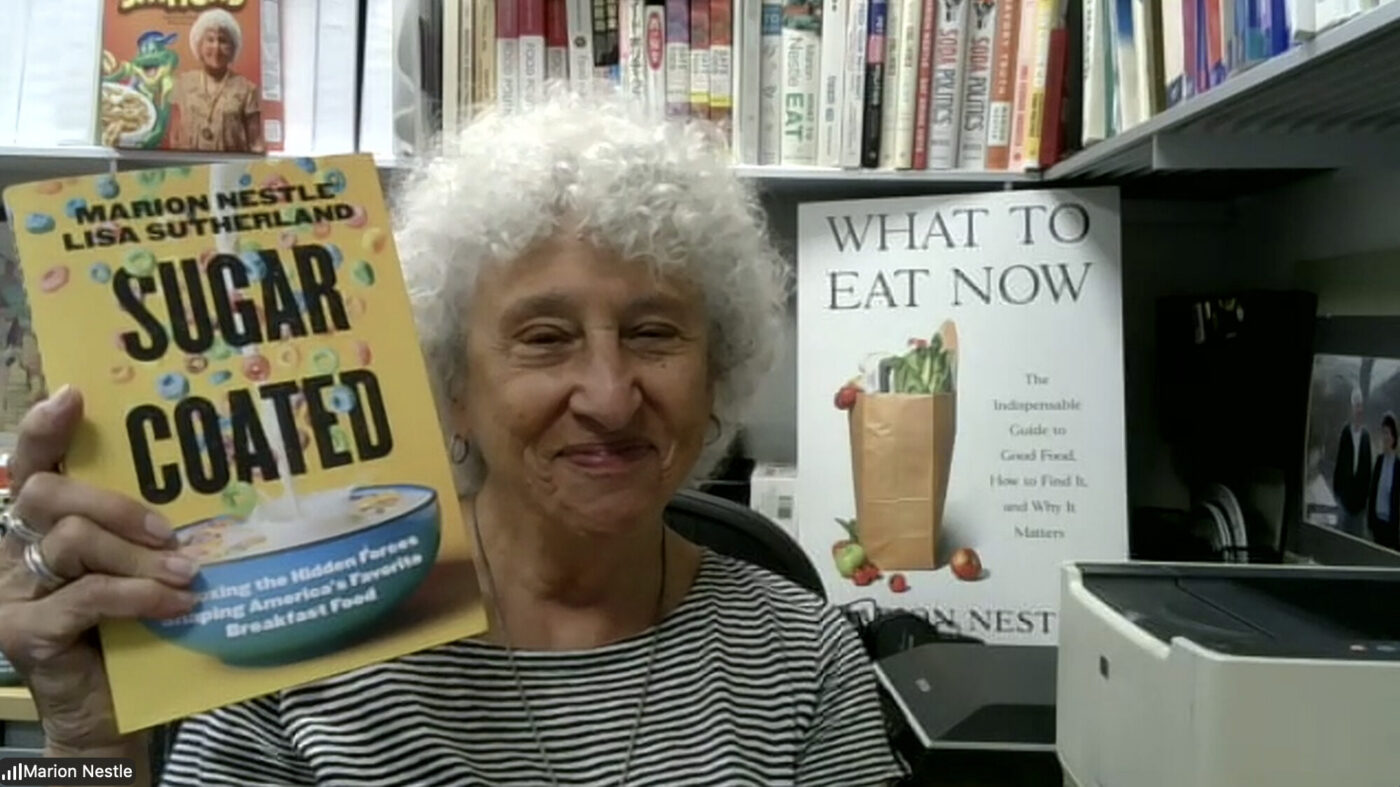
In search of some perspective, we turned to Marion Nestle, molecular biologist, nutritionist, author, NYU professor emerita, and author of over a dozen books, including What to Eat and Safe Food. We spoke with her about MAHA, supplements, GLP-1s, the long tail of the pandemic, the state of nutrition, and more.
Let’s talk about Make American Healthy Again (MAHA). A year and a half into Robert F. Kennedy Jr.’s tenure as secretary of the Department of Health and Human Services, what has and hasn’t he accomplished? How should we evaluate the dangers of his policies, and have there been any positives at all?
I was initially excited and optimistic that Kennedy was interested in a lot of the same food issues that I’ve been concerned about for decades. He said that ultra-processed foods were killing Americans and blamed the food industry. He promised to get glyphosate out of agriculture, petroleum dyes out of food, and mercury out of fish. All of this sounded terrific, although it came in the less happy context of attacking vaccinations. But I thought, Okay, maybe some good will come out of this.
But now I have to confess to disappointment that the best they’ve been able to do is to get companies to voluntarily agree to remove color additives. That’s happening. Go to a grocery store and look at cereals. Some still have petroleum dyes, but more are switching to vegetable dyes. How important is this? Those dyes should have been gone a long time ago, but removing them is not going to make America healthy again. The cereals will still be ultra-processed. It’s a step forward, but a baby step, particularly because this isn’t regulation; it’s voluntary.
Kennedy promised to set a definition of ultra-processed foods, as would be needed to regulate them. But this administration is not interested in regulation — they consider that to be nanny statism. The Food and Drug Administration (FDA) has proposed only one regulation: to close the Generally Recognized as Safe (GRAS) loophole, which allows food companies to decide for themselves whether or not new food additives are safe. Under the current system, companies do this voluntarily; the FDA looks at their determinations and only occasionally raises an objection. The FDA’s proposed rule requires companies to submit these determinations. Great, it’s about time. But this will increase the FDA’s workload. I’d like to know who in the FDA is going to be reviewing these submissions. The FDA has lost about twenty percent of its staff, either because they were DOGE-fired or resigned, and many of them had the greatest expertise.
The MAHA officials had a real chance to get stuff done. They didn’t use it. I have no idea whether they didn’t use it because they really didn’t care, or because they were blocked by lobbyists. There’s plenty of evidence that lobbying saved glyphosate; agribusiness lobbyists convinced President Trump that glyphosate is essential for food production. And, of course, this administration came in with an anti-scientific, anti-expertise agenda. Kennedy said, We’re not going to use experts. We’re going to count on people’s personal experience. But one of the reasons why you do studies and apply statistical tests to them is to try to account for the human beliefs and preferences that go into personal experience — the sense of, I feel better when I take this supplement, therefore, everybody should be taking it.
Meanwhile, Trump’s Environmental Protection Agency has reduced controls on coal-burning power plants, meaning that even more mercury is going to be getting into fish. I could go on and on about the other damaging things. We’ve seen thousands of cases of measles this year when there were practically zero cases a few years ago.
I’m especially concerned about food safety. The FDA just released guidance about how to prevent microbial contaminants in the plants that process produce by cutting lettuce for bagged salads, for example. The guidance covers hygiene for workers and the plant really well, but is explicitly non-binding: the companies don’t have to do it. It also doesn’t deal with anything that happens before leafy greens get to the plant, like the irrigation water, the most likely cause of the cyclospora outbreak that we’ve experienced this summer.
How worried should we be about cyclospora?
We should be very worried. We have plenty of food safety laws, but they are often ignored and aren’t well enforced. Essentially, nobody is minding the store. The CDC and the FDA have been decimated and are scrambling to catch up. Neither the president nor the secretary of Health and Human Services has said anything about the outbreak other than to dismiss it as being unserious. An advisor to RFK Jr. said that the hysteria about cyclospora was a food industry plot to stop people from eating vegetables. No, it is not. cyclospora is no fun and has killed at least two people. It’s particularly icky because it comes from human waste. State health departments have reported about 30,000 possible cases altogether, but for every sick person, another 83 are estimated to have contracted the parasite. So you have to multiply 30,000 by 83 to get a real estimate of the extent of this problem.
What could our next administration do to repair the food system and actually make America healthy again?
I’d want to completely revolutionize the agricultural production system to focus on food for people instead of feed for animals and fuel for automobiles and airplanes. Close to half the corn we grow is used to make ethanol fuel for automobiles, and another almost half is used for animal feed. We import more than thirty percent of our vegetables and close to sixty percent of fruit. Farmers who grow food for people can’t earn enough money to make a living. Those are the farmers who should be subsidized. Let’s stop polluting the land with agricultural chemicals. Let’s do something about the environment so that people can drink the water, and use the water for irrigation, and not poison everybody. If you really want to make people healthy again, you start by cleaning up air, water, and soil.
And please, let’s restrict the marketing of junk food to children. Let’s have universal school meals, and get rid of all the nonsense about means testing who gets to eat school meals. Let’s create a food assistance system that ensures that nobody in this country goes hungry for lack of resources. And let’s regulate ultra-processed foods so that companies can’t market them, especially to kids.
I’m completely aware that the probability of any of this happening is very low, because it requires getting money out of politics. If I were the tsarina of the food system, the first thing I would do would be to overturn Citizens United, stop corporations from contributing to candidates, and provide a public budget to all candidates so they all run on a level playing field. Unrealistic as these wishes might be, I think there’s real value in setting such goals (and there’s scientific literature on that, too). At least you know what you’re aiming for.
What do you think we should be doing to make healthy food more accessible, especially at a moment when grocery prices are at an all-time high? In New York, there have been debates about access and food deserts, in part because of Mayor Mamdani’s proposal for city-run grocery stores.
If you want to make healthy food more accessible, it has to be cheaper and more easily available. And it has to be safe. Basically, you want more local and regional food systems. You want to support local farmers with farm-to-school programs and farm-to-institution programs, all of those good things that food advocates have been working on for decades. You want people in low-income areas to have access to gardens. If you want people to eat real food, you have to make sure people know how to cook. I learned to cook in eighth-grade home economics. Bring back cooking lessons in schools. As for the city-run grocery stores, I want them to work. So far, there is only supposed to be one in each borough, and only a limited number of foods will be subsidized. How many people will these reach? We will find out. In the meantime, we need a broader approach — every store should make the healthy choice the easy and preferred choice, because everyone should be eating healthfully.
Concerns about health and natural foods versus processed foods were once the purview of the left and progressive thinkers. How did these become right-wing issues?
Left and right did not seem to be so far apart in the past, and the wellness movement has always had libertarian, if not right-wing, tendencies. The health benefit of most supplements, products, and devices has little scientific substantiation, but these products make buckets of money for the people who sell them. Social media has opened up the possibility of marketing these things in a way that is impossible for the FDA to control. Over the twentieth and early 21st centuries, the FDA made valiant attempts to control the marketing of supplements and other questionably healthy supplements and other wellness products, but Congress blocked those attempts. Now we have snake oil sellers running the government — officials in Health and Human Services are trying to sell products. They have conflicted interests, but don’t recognize it.
The food movement, such as it is, has never coalesced into anything with real political power, largely because there are thousands of groups with highly diverse agendas: health, environment, safety, hunger, and more. The groups see themselves as competitors rather than components of a larger movement working toward the same goal — to improve the food system. The anti-hunger people are probably the most unified, but even they are divided over some issues, like restricting certain foods on SNAP. Other food movement groups tend not to rally around hunger because they view it as a different issue than the one they care about.
Each group has its own founder and staff; they need to be paid. So all of these groups are competing for funding from the same sources. All of this works against the collaboration and coalition building which are essential for gaining real political power. And this is true even for the anti-hunger movement, the largest and most coordinated of the issue groups. I can go to any town in America and type in “food advocacy,” with whatever the name of that town is, and there will be at least three anti-hunger organizations, mostly staffed by dedicated volunteers. Meanwhile, the food industry pays lobbyists — and pays them well.
How did the American public’s relationship to science and medicine change during and after Covid?
The pandemic did a huge amount of damage to people’s faith in science and government. I don’t know what it’s going to take to reverse that damage, or if it even is reversible. Covid came as a huge surprise. The science behind its transmission was unclear, with lots of competing hypotheses about how to prevent it. In retrospect, it’s easy to complain about conflicting advice but it took time to understand what was happening. I can remember ordering groceries and washing the packages with disinfectant because we worried we could catch the virus from paper bags. It took months to realize that unless you were breathed on or were in a closed room with somebody who was infected, you were not likely to get Covid. Then there was the whole business over the vaccines. They were miraculous, but there was so much misinformation flying around. Again, it took time to understand that they didn’t keep people from getting Covid, but they did keep people from dying. I think Fox News has a lot to answer for in fomenting dissent, division, and distrust during the pandemic.
But science also has a lot to answer for. The lack of transparency and level of fraud in science has gotten completely out of hand, so the enterprise itself is responsible for some of the distrust. I got my degree in molecular biology in 1968, a different era. During my graduate training, we had beaten into us an ethical standard that was absolutely inviolable. You did an experiment, and you expected that experiment to be repeated by other people. And if other people couldn’t repeat it, you were in big trouble. The idea that anyone might fabricate figures for an article or make up data was inconceivable to us. Now it seems to happen all the time. We now have loads of predatory, pay-to-play journals that will publish anything and seem to have no scientific standards, as far as I can tell. The peer review system is broken. The demands are endless; nobody wants to do it; and there are way too many journals. Scientists need legitimate sources of funding, but also ethics and principles.
How do you restore respect for public health, science, and government regulatory agencies? If they want to be trusted, they have to behave in a trustworthy manner. They need to respect the intelligence of the American people. This means being one hundred percent honest, transparent, and straightforward. They need to say what they’re going to do, do what they say, and account for it. And if what they are doing isn’t working, admit it.
I was once on a public health work trip to Cuba and heard a speech by Fidel Castro that helped me understand why Cubans respected and admired him so much. There had been an incident in which an American ship interfered with a Cuban ship. In that speech, he gave a play-by-play account of everything that had happened: I learned about this from a phone call. The phone call was from this person. This person said this to me. I said this to this person. His speeches were famous for being hours long (I only listened to the first hour), and I could see why. He recounted the tiniest details: what got done, when, and by whom. By the end, everyone knew what had happened at an extraordinary level of detail — from his point of view, of course. Whatever you think of Castro, he appeared to be totally straightforward and utterly inspirational.
We did not see anything like that during the pandemic — except from New York Governor Andrew Cuomo, who gave extraordinary daily briefings about the pandemic that were just like Castro’s speeches: The Health Department gave me these figures this morning. This is how many cases. This is how many deaths. We’re really concerned. This is what we are doing. If you were listening to these briefings, you felt like you really understood what was happening and were reassured. Nobody at the federal level was doing anything like this. Nobody was saying: This is what we’re seeing. This is what we think it means, this is what we’re going to do about it, and this is why. If they had done that, they might have generated much more popular support. We all might have felt more included in the decisions. But, again, it’s easy to say all this in retrospect.
A lot of the current discourse about health and wellness is emanating from Silicon Valley, and is particularly associated with male podcasters who have a macho interest in longevity and strength. What do you make of these men who are drinking raw milk and eating only meat?
Good luck to them. I hope they enjoy the life they live. I’m reading a manuscript of a forthcoming book called The Longevity Trap. The authors argue that if you do too much of this kind of thing, it ruins your life. Maybe you’ll live longer, but you won’t have nearly as much fun.
Nobody wants to die. That’s humanity’s existential problem. Every one of us has to come to terms with our own inevitable mortality. We don’t know when or how, or how long we will get to live. We want to live long and healthy lives and maximize our chances of doing so. This is an entirely reasonable goal. It means eating a good diet, not drinking too much, not smoking cigarettes, not taking too many drugs, getting enough sleep, living in a community with good air and water, having a good education. Money helps too, a lot. These are well-established predictors of health and longevity and well worth the effort.
If you want to take twenty supplements, fine — but you’re going to be peeing out most of them. I’m not convinced they make healthy people healthier (and healthy people are the ones taking them), but most of them don’t do any harm. You want to wear a blood sugar tracking device? Fine, if you enjoy that kind of thing. You want to count steps? Also fine, if that motivates you to be active. But why not just do something that’s fun? The techno-food trend seems male and macho to me. I can’t understand why anyone would rather eat a concoction of ingredients than real food. Soylent? I don’t get it. I’d rather have a milkshake. Poor health is a social problem, not a technological problem. Social problems require social solutions, not technological solutions. Usually, there is no techno-fix for changing society. But now we have GLP-1 drugs. They may be an exception to that rule.
Tell us more. What do you think of GLP-1s?
They’re very important. I am a total believer in nutrition, diet, and physical activity for good health. (Note: physical activity, not exercise. Big difference. I don’t think anyone needs to go to a gym — just move. I live in New York, don’t have a car, and have to be active if I want to get anything done.) But for people who live with obesity and have never been able to diet and exercise their way out of it — and there are lots of people like that — these drugs are a miracle. It’s not just that they help people lose weight; people taking the drugs tell me they feel stronger, have more energy, feel livelier. They’re having more fun. They’re enjoying everything they are doing more — except eating. And they are no longer obsessing about food.
But these are lifetime drugs and I don’t think we know their long-term effects yet. If, as I’ve read, one in eight Americans is taking them, we will know a lot more soon. Even more people will be taking them as their prices come down and pills replace injections.
Alongside the rise of GLP-1s, we’re seeing a lot of other health fads and buzzwords. Obviously, protein is everywhere right now. Is there anything to it?
Protein is a wellness trend. As a nutritionist, it just seems weird to me. Protein has never been an issue for anyone who eats enough calories. Most Americans eat twice the protein they need, even if they’re vegetarian or vegan. The idea that you need to double your protein seems unnecessary. Do some people need more protein than others? Of course. Elite athletes, for example. But pushing protein is a great way to sell food products. My current favorite: Cookies & Crème Cheerios Protein cereal.
How would you evaluate the state of nutrition as a field? What role do you think nutritionists should have?
I’m very concerned about the state of the nutrition field. To me, the most important nutrition problems the world confronts are public health problems: hunger, malnutrition, obesity, chronic disease, food safety, and climate change. But the research focus of the nutrition enterprise is on personalized nutrition. This means evaluating the genetic makeup of individuals, and then tailoring diets to their specific personal needs. This is the antithesis of public health.
The nutrition profession is not unified around shared goals, definitions, or even which problems are important to work on. For example, I believe that the concept of ultra-processed foods is an extraordinarily useful one, and that people would be healthier eating less of them. I don’t really care if the definition of ultra-processed includes a small number of foods that have good nutritional value — commercial whole wheat breads and yogurts, for example. Most people I talk to get the concept right away. But there are prominent nutrition scientists who dismiss the entire concept because of those few exceptions. Their fight against the concept puts them on the side of the food industry.
I hope what I’ve said does not come across as depressing. One of the reasons why I became a nutritionist, love nutrition, and love talking about food is that food and nutrition relate to just about every important social, political, or economic problem. Everyone eats. Everyone gets the issues. Advocacy around food issues reaches people in ways that advocacy around other issues cannot. I want everyone who loves food to become an advocate for food issues. Don’t wait. Do it now!