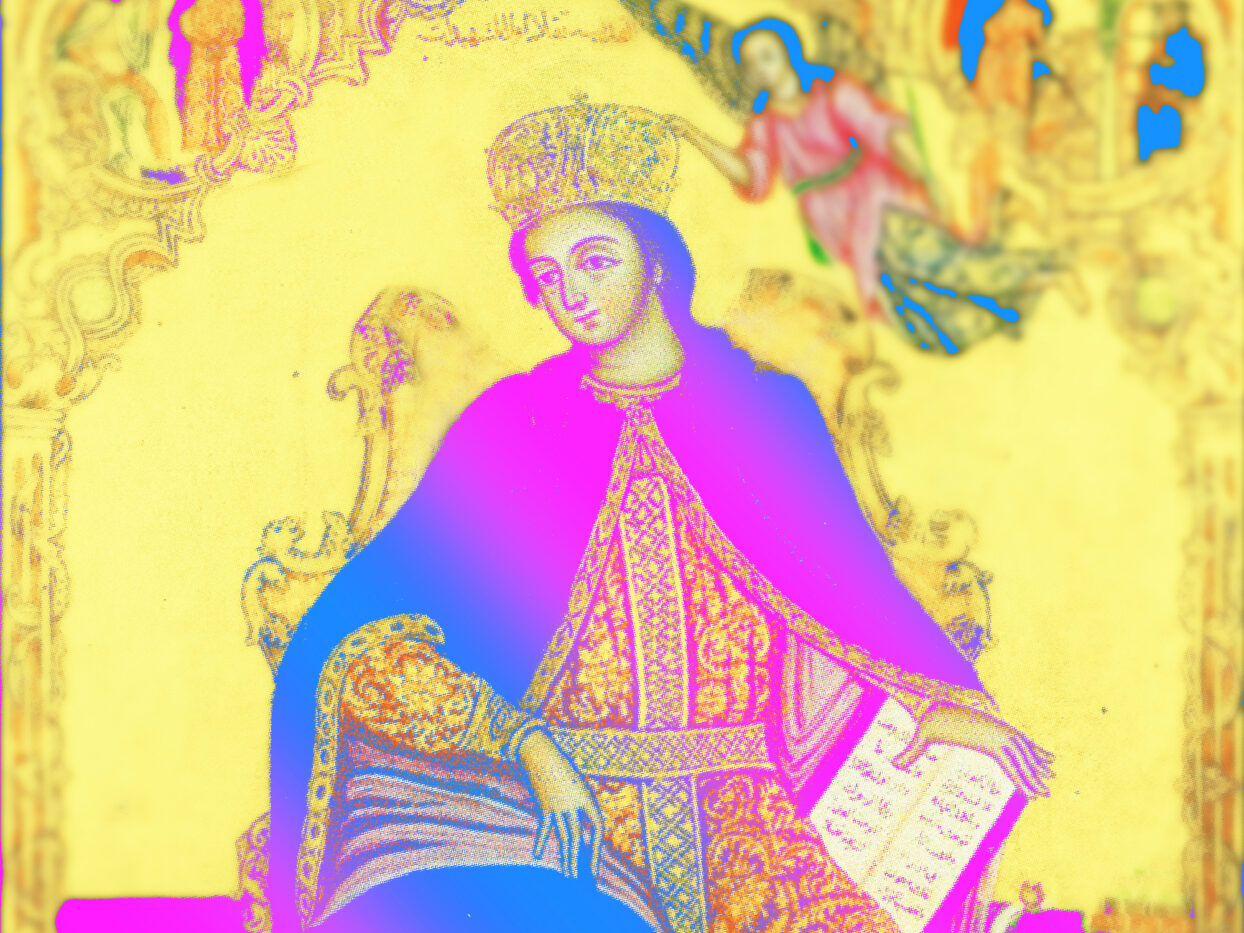
Much of what we know about Rabia Al-Basri is based on myth. The eighth-century Sufi mystic from what is now Iraq is said to have wandered the streets delirious with love of God. She was equally famous for rejecting other kinds of love: Rabia insisted on remaining unmarried. “It does not please me,” she proclaimed to one suitor, “that you should distract me from God for a single moment.”
As an early leader of Sufism (today she’s often considered the first female Sufi saint), her life-long abstinence was seen as radical in her time both as an act of extreme religious devotion and as a rebuke of established gender roles. Under the Umayyad and Abbasid empires that successively ruled her hometown of Basra, elite men had massive harems, and, according to the scholar Leila Ahmed, it was increasingly the case that “the vast majority of the women with whom they interacted, and in particular those with whom they entered into sexual relationships, were women whom they owned and related to as masters to slaves.”
Rabia, who was born into a poor family and by some accounts enslaved before her religious awakening, built relationships with men as their theological peer. “I passed one whole night and day with Rabia speaking of the Way and the Truth,” declared one male contemporary, “and it never passed through my mind that I was a man nor did it occur to her that she was a woman.” Her asceticism, which precluded her from playing the role of wife, mother, and even worker, challenged the “materialism, the exploitation of the labor of others, and unbridled sexuality for men” common in her day, Ahmed writes.
Celibacy was not only a Muslim practice. From Catholic nuns to Buddhist bhikkhunīs, religious women throughout history have chosen lives of abstinence, often at great personal risk. Take Thecla, an upper-class woman in the first-century city of Iconium, in modern-day Turkey, who decided to break off her engagement and commit to celibacy after hearing the preachings of Paul the Apostle. Her decision was so scandalous, the author of the second-century text the “Acts of Paul and Thecla” relates, that she was arrested and condemned to the stake. “Burn the wicked one,” her own mother proclaimed. “Burn her who will not marry.” (For his part, Paul was regarded as a pernicious influence. In one particularly colorful scene, a crowd chants, “Away with the sorcerer for he has misled all our wives!”) After escaping from multiple attempted executions, Thecla returned to her own community, then left again to found a new one and preach the gospel.
Two centuries after Thecla’s death, Christian women who established their own monasteries in and around present-day Turkey considered themselves “new Theclas.” In a time when women’s marriages and therefore futures were arranged at the onset of puberty, the vows of celibacy taken by early disciples of Christianity served as a “declaration of independence from the crushing pressures of tradition and of their families,” while also empowering noble women to baptize, preach, and live in a monastic community, explains the historian of Christianity Elaine Pagels. Those celibate women, devoted to their faith, also nurtured their communal connections, turning their newly abundant time and energy toward caring for the poor and women seeking refuge from their own families. “The ascetic did not lead a life of isolated withdrawal but was intimately involved with the larger Christian community, advising, exhorting, healing, exorcising, and guiding the faithful,” write Sebastian Brock and Susan Harvey in Holy Women of the Syrian Orient.
Today’s female celibates are less holy. Per The Cut, some even disavow the word “celibacy” because of “its religious connotations,” preferring instead to say they are “decentering men” or “boysober.” The latter term — a phenomenon that The New York Times called 2024’s “hottest mental health craze” — was coined by the influencer Hope Woodard, who hosted a podcast of the same name that chronicled her attempts to avoid apps, situationships, and sex. Despite the stringency of these rules, Woodard initially eschewed the word “celibacy,” because, as she told a Washington Post reporter, it “gives, like, chastity belt. It gives purity culture.” The actress Julia Fox, who in 2024 revealed on Watch What Happens Live with Andy Cohen that she hadn’t had sex for over two years, was eager to note a week later that “I’m not celibate because I’m a follower of Christ.” In 2016, Nicole Nadal wrote in Marie Claire that her celibacy “isn’t a religious thing whatsoever.” For her, it was “more of a zen thing.” (Never mind that Zen is a Buddhist tradition.)
These women are part of a growing cadre. Read any major publication, and you’ll find a breathless report on how young Americans of all genders are simply not having sex. “Is celibacy cool now?” a New York Times Opinion podcast asked in July. The purported culprits are many: social atomization, app dating, the omnipresence of screens, the prevalence of sexual violence, the many degradations of hookup culture. Regardless of the reason, the percentage of people aged 18 to 29 who have not had sex in the past year doubled from 12 percent in 2010 to 24 percent in 2025, per a survey by the conservative Institute for Family Studies. Much ink has been spilled on the plight of incels — involuntary celibates, often young men who have bonded online about their inability to get laid. But a growing number of women are now claiming their sexlessness is volitional: according to a “National Study on Modern Love & Dating” co-conducted by the Kinsey Institute last year, 21.8 percent of single American women describe their current sex life as “voluntarily celibate.”
Many are simply “burned out on dating,” as a 35-year-old San Francisco woman described herself to The Wall Street Journal in 2025. “Nothing good comes from sex with men,” Fox said. Lainey Molnar, a woman in her thirties, told The Cut that her period of celibacy began after years of sexual activity that made her feel that “I had no sense of my body. I didn’t own it anymore.” On a May episode of “Call Her Daddy,” the pop star Kesha described herself as “mostly celibate” after struggling with years of disordered eating and stress in response to the pressures of fame and a long-running lawsuit against the producer Dr. Luke, in which she accused him of sexual and emotional abuse. Also in May, the influencer and self-help author Tinx, who rose to fame primarily by doling out dating advice, announced that following a long stretch of exhausting and unfulfilling attempts to find love that were making her “miserable,” she had “decided to quit dating altogether.” Elizabeth Gilbert, author of the 2006 nonfiction phenomenon Eat, Pray, Love (which began with her taking a yearlong vow of celibacy after a divorce and ended with her falling in love with a Brazilian businessman), returned to the practice after another traumatic breakup led her to self-diagnose as a love addict. In her 2025 memoir All the Way to the River, she writes, “The very best gift I have given myself during these five years of recovery has been the celibacy that I’ve maintained throughout the entire process.” Melissa Febos, in her own 2025 memoir, The Dry Season, puts it simply: “I had given up sex because my life had fallen apart and I needed to change.”
In the absence of physical intimacy, many of today’s celibates are directing their time and energy toward their careers. “The best part of celibacy is that there aren’t any distractions,” another 23-year-old celibate told The Cut in 2018. “I have a fast-paced job and lots of personal projects in addition, so I don’t have the time to entertain a sexual relationship.” Nadal wrote that “getting rid of the distractions of casual dating and hooking up was the only way” to achieve her professional goals (a new job at an “e-commerce merchandising start-up company”) and buy a house. Tinx declared that she would use her newfound free time to “work harder and get hotter.”
Others have emphasized the desire to reconnect with themselves. “I’ve found self-partnership to be deeply gratifying,” Gilbert told Monica Lewinsky on a September 2025 episode of Lewinsky’s podcast, “Reclaiming.” Gilbert is attuned to celibacy’s religious context. Citing Elizabeth Abbott’s 1999 book A History of Celibacy, Gilbert explained that “celibacy has been an important part of men’s spirituality in certain spiritual practices, but it’s always about the man conquering lust, and it’s sort of a proof of strength.” On the other hand, she continued, “Women choose celibacy for freedom — women traditionally have entered into monastic settings so that they did not have to be a wife and a mother, so that they did not have to be in sexual service to anybody.” Her own journey in All the Way to the River involves the voice of God, who visits her in a dark moment. After that, “I began following that God voice whenever I could hear it,” she writes. But while Gilbert’s celibate year in Eat, Pray, Love included a stint at an ashram in India, the spirituality in All the Way to the River is mostly channeled through the framework of twelve-step addiction recovery. After decades of what she described to Lewinsky as “enmeshment and codependency with whoever I was with,” Gilbert’s work with Sex and Love Addicts Anonymous allowed her to regain “everything,” as she writes in All the Way to the River: “My vitality has returned; my financial security is steadily being restored; my self-esteem is growing; my friendships are deepening; my creativity is soaring; and peace of mind is mine to enjoy.” On the podcast “We Can Do Hard Things,” she characterizes the program’s “two-way prayer” method as “more important than reading spiritual texts.”
In The Dry Season, Febos, too, engages with celibacy’s religious and spiritual history. At the outset, she expresses disappointment when she discovers that the history of women’s celibacy is “overwhelmingly populated by religiously devout women,” whereas for her, “celibacy was certainly not a holy or pious act.” Words in the theological register, she writes later, “were a problem: good, evil, purity, sin, and, most of all, God.” Over the course of her yearlong experiment, though, Febos becomes fascinated with some of these devout women, particularly the Benedictine abbess Hildegard von Bingen and the Beguines, a group that formed in twelfth-century Europe and often lived in communes with shared expenses and incomes while preaching sermons full of sensual desire for God and love. Celibacy, she notes, allowed the Beguines to spend “their days among the poor,” working “in service as nurses, social workers, and teachers”; likewise, celibate Shakers in colonial America passed their time with “ecstatic worship, wild frenzied dancing, arduous labor, and creative pursuits.” But Febos doesn’t attempt to emulate their commitment to communal life. “Though I had always been passionate and convicted,” she writes, “I knew I did not possess that kind of maniacal fortitude. That was okay with me. I didn’t believe I could forge a path to a new society; I just wanted to change myself.” She does, however, imagine “that giving up sex would allow her to live in greater service to others,” inserting the telling proviso: “even if those others were only my future lovers.” Her lovers are mostly women, so her yearlong abstinence was not an effort to escape men, but her relationships still needed help. She expresses the hope early on that “interrupting the patterns in which my romances were entrenched might lead to better relationships in the future,” acknowledging another feature of contemporary celibacy: it is often expected to be temporary.
Crucially, in its current iteration, celibacy does not mean a lifelong pledge. Many celibates, in fact, seem to be adhering to something much closer to chastity — the custom of abstaining from premarital sex in order to render oneself suitable for marriage. Molnar’s rule for her own celibacy practice, per The Cut, was that she would “not engage in any partnered intimacy unless it is exclusive or committed.” Proponents of this kind of temporary celibacy often — inadvertently or not — cast it as a form of preparation for future relationships. As the influencer Mandana Zarghami shared with her TikTok followers, celibacy can help women “tap into the best version of yourself” in order to become “the best girlfriend, the best wife to your man, woman, whoever.” Key to Kesha’s period of abstinence is the reward she anticipates at its end: the new lover she is working on manifesting. “This is why I am celibate,” she told Alex Cooper. “It’s because I’m calling in a fucking king.”
Secular celibacy is hardly a recent invention; since the myth of Lysistrata, refusing sex has sometimes been a political tool. In the sixties and seventies, some second-wave feminists advocated for women to forgo sex with men. In a 1968 essay outlining her vision for woman-only communes, the feminist Judith Brown wrote that participating in periods of self-imposed celibacy (or “intelligent birth control”) would allow radical women to conduct “innumerable experiments in living, political forays, and serious and uninterrupted thinking.” In a 1969 essay for the feminist journal No More Fun and Games, Lisa Leghorn suggested that women should withhold sex “until men wake up and start to work toward overcoming their oppressive attitudes.” Others, like Sheila Jeffreys and Rita Mae Brown, felt that sex between men and women could never be equal under patriarchy, an idea that led to the development of political lesbianism. The way to abjure compulsory heterosexuality (defined by Adrienne Rich as the political institution that “forcibly and subliminally” maintains the idea that “marriage, and sexual orientation toward men, are inevitable”) the logic went, was by living in all-female communes and having sex only with other women. Shulamith Firestone, in The Dialectic of Sex, argued that procreation should be divorced from sex altogether, potentially through the widespread adoption of artificial wombs.
These women were responding to a sexual culture in which women were expected to remain pure until they inevitably became wives and mothers and essentially gave over their sexuality to their husbands. Rejecting sex entirely was one way out of this bind; another was to destigmatize casual premarital sex. “During your best years you don’t need a husband,” wrote Helen Gurley Brown in her controversial 1962 book, Sex and the Single Girl. “You do need a man of course every step of the way, and they are often cheaper emotionally and a lot more fun by the dozen.” In her 1970 polemic The Female Eunuch, Germaine Greer encouraged women to give up both traditional monogamy and abstinence; she saw all-female communes as too similar to medieval religious convents and not sufficiently transformative. Instead, to free themselves, women were to prioritize and fulfill their sexual desires as they wished. “Liberation will not happen unless individual women agree to be outcasts, eccentrics, perverts,” Greer wrote.
Ultimately, Gurley Brown and Greer’s school won out. In much of the post-sexual revolution West, it’s not considered taboo to have premarital sex; it’s actually considered taboo, and often shameful, not to. “In our current hookup-focused dating climate,” Laura Pitcher wrote in The Cut in 2022, casual sexual experiences like one-night stands “are encouraged and long-term commitment is often not discussed until well into a sexual relationship.” Women can choose to remain unmarried. They can partake in the life of the mind, and converse with men in scholarly, religious, and professional spheres. They can unlock their phones and access a seemingly infinite pool of sexual partners, with two or three taps of a thumb.
As gender and sexuality scholar Lisa Wade argued in American Hookup: The New Culture of Sex on Campus from 2017, while the sexual revolutionaries were more or less able to convince the public that women could have sex for fun, they were less successful in dislodging oppressive attitudes. “Hookup culture, strongly masculinized, demands carelessness, rewards callousness, and punishes kindness,” Wade wrote. Such callousness, Wade argued, makes sexual violence ubiquitous. In fieldwork conducted on college campuses throughout the 2010s, Wade found that one in three students described their sexual encounters as “traumatic” or “very difficult to handle,” while one in ten said that they had been outright sexually coerced or assaulted in the past year. Perhaps it’s unsurprising that many want to throw in the towel.
Today’s trend-piece celibacy bears little relation to the political celibacy of the second wave, let alone the religious celibacy that was practiced by Rabia and Thecla — and is still practiced by nuns of multiple religions. Gone is the idea that celibacy can function like a strike, forcing the patriarchy to meet women’s demands. Nor is celibacy seen as an unbreakable vow intended to bring the individual closer to God. Instead it’s an instrument of personal improvement, touted as a way to reset dating lives, avoid an exhausting and increasingly digitally mediated hookup culture, make more time for platonic relationships, and boost efficiency at work. A low-commitment, casual engagement with the practice is perhaps so appealing because it suits our atomized society better than the intense responsibility, sacrifice, and commitment that earlier iterations demanded.
Of course, celibacy is hardly the only formerly religious practice that has become a method of secular self-healing. Yoga, outlined in the earliest texts of Hinduism as a way to connect with divine knowledge, is just another alternative to Pilates, kickboxing, and Zumba. You can easily book an ayahuasca retreat or log your meditation on an app like Headspace, Breethe, or Calm. Celibacy, too, has become another tool for optimizing the private self.