Everywhere we read that we are illiterate. On Substack, Abundance coauthor Derek Thompson laments the “handoff from a culture of literacy to a culture of orality,” a “return” to the world as it was before the invention of writing enabled us to hold ideas at a distance and pin them down. He fears that this power of abstraction — which opened the way for science, philosophy, and much more — might soon be endangered by “cortical thinning.” Bloomberg’s Joe Weisenthal likewise warns that “the return to orality” will “fundamentally rewire the logic engine of the human brain.” James Marriott, of the U.K.’s Times, wrings his hands most vigorously in his newsletter: “We may be about to find out that it is not possible to run the most advanced civilisation in the history of the planet with the intellectual apparatus of a pre-literate society.”
All three writers frame this trend as the reversal of a process described by the Jesuit priest and scholar Walter J. Ong in his classic 1982 study Orality and Literacy: as cultures progressed from pure orality to writing and print, these technologies “transformed human consciousness.” Only after the arrival of the written word, Ong explains, did people begin to see the past as “itemized terrain” mapped by records they could consult, or to “fictionalize” an audience beyond their immediate context. Only with the dominance of print did they start to feel themselves situated “in abstract computed time” and to understand words as commodities in need of copyright.
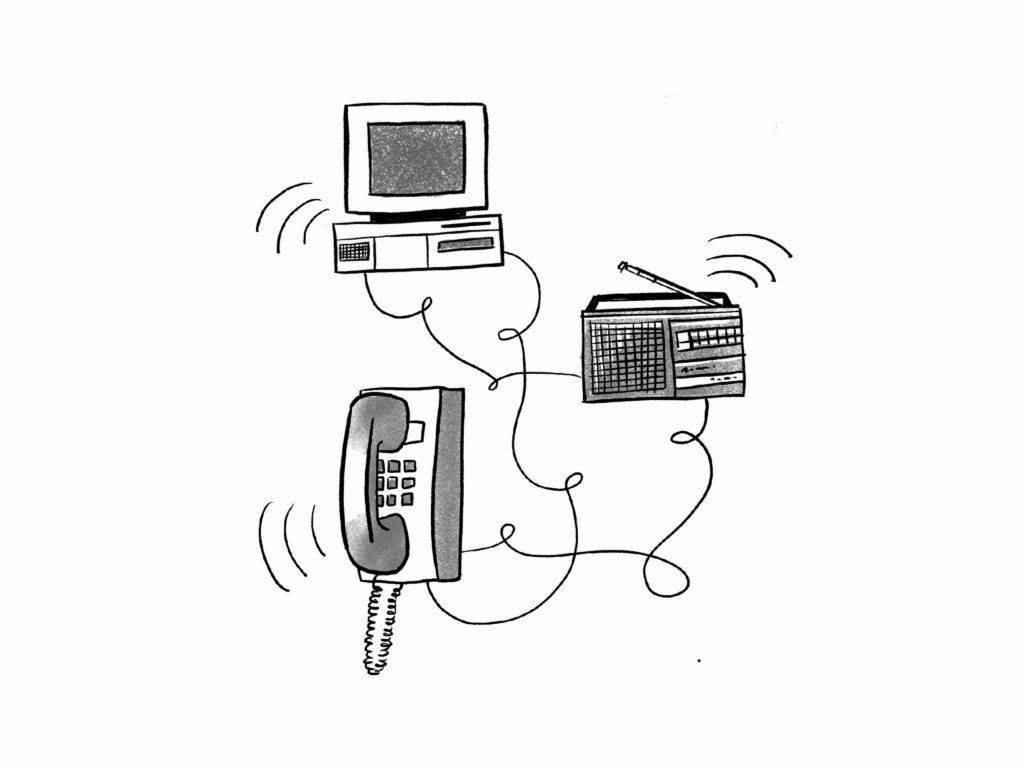
Today, Thompson, Weisenthal, and Marriott are among the most prominent of many commentators who use Ong’s concept of primary orality, meaning the condition of cultures prior to writing, to describe the conversational nature of online communication. But to use Ong to claim that we risk a “return” to “pre-literate” orality is to ignore the main thrust of his work. Ong took pains to emphasize that literacy and orality have been inextricably linked since writing began. Teachers in the Middle Ages lectured on texts but tested students orally. Renaissance humanists “invented modern textual scholarship” but “also harked back to antiquity and thereby gave new life to orality.” Print consolidated writing’s power, only for that power to eventually be diminished by phones, radio, and television. While his teacher Marshall McLuhan called these technologies “post-literate,” Ong preferred to discuss them in terms of “secondary orality,” stressing that they amplify speech but depend on writing for their existence: radio and television, for instance, rely on written scripts. Ong’s attentiveness to the interplay of orality and literacy is a good model for a world still replete with both spoken and written language. Even the videos Thompson blames for our oral regression are full of text. Where literacy spreads — and it has spread almost everywhere — there is no escaping its effects.
Ong himself gently objected to the now-popular idea that digital text is essentially oral. Online writing, he pointed out in a 1996 interview, “comes not in oral-aural format but through the eye, and thus is not directly oral at all.” Just as he had proposed “secondary orality” to describe electronic speech, he also saw the need for a term to describe electronic text. “To handle such technologizing of the textualized word,” he told the interviewers, “I have tried occasionally to introduce the term ‘secondary literacy.’”
The internet has in fact accelerated many effects of literacy. “Writing,” Ong argued, “was in a sense invented largely to make something like lists”: one of its most important early uses was account-keeping. A few millennia later, “typography had made the word into a commodity,” such that “the old communal oral world had split up into privately claimed freeholdings.” Today, the U.S. economy runs on typographic characters held in private databases, where they spell out the most intimate details of our interests, behaviors, and conversations. It is by translating our lives into written language, also called data, that many of the world’s richest companies generate their revenue. And this commodification of digital text extends from back end to front end. For many years now, writing has served as a means of economic disruption: tech companies have taken control of whole industries by converting oral transactions (ordering takeout, calling a taxi) into written ones. The thing this text allows us to hold at greater distance is not history or philosophy but the undercompensated labor of a person who otherwise would be speaking to us.
In The Rise of Writing (2015), literacy scholar Deborah Brandt argues that employers turned the production of text into a mass daily experience over the course of the twentieth century. “Knowledge workers,” now a majority of the U.S. workforce, tend to spend their days at keyboards, inserting text into emails, spreadsheets, slide decks, medical records, and so on. She concludes that the default expression of literacy has shifted from mass reading — which is “indispensable to liberty and to the workings of democracy” — to mass writing. Our literacy is rented to commercial interests and subject to kinds of “control that do not necessarily honor the integrity and freedom of the individual literate.” Brandt wrote all this before the rise of LLMs, which not only commodify text but entail a new type of writing that comes in the form of the prompt. You could call LLMs oral, because the chatbots simulate conversations with us. But such a claim, like all insistence that digital text is actually something else, would be, to borrow Brandt’s phrase, “a holdover from the social arrangements of a disintegrating print culture.” That written words aren’t what they used to be doesn’t mean they aren’t what they are. To acknowledge that literacy is still a vital force is to understand that it hasn’t been killed but taken hostage.