Issue 18 |
September 14, 2026
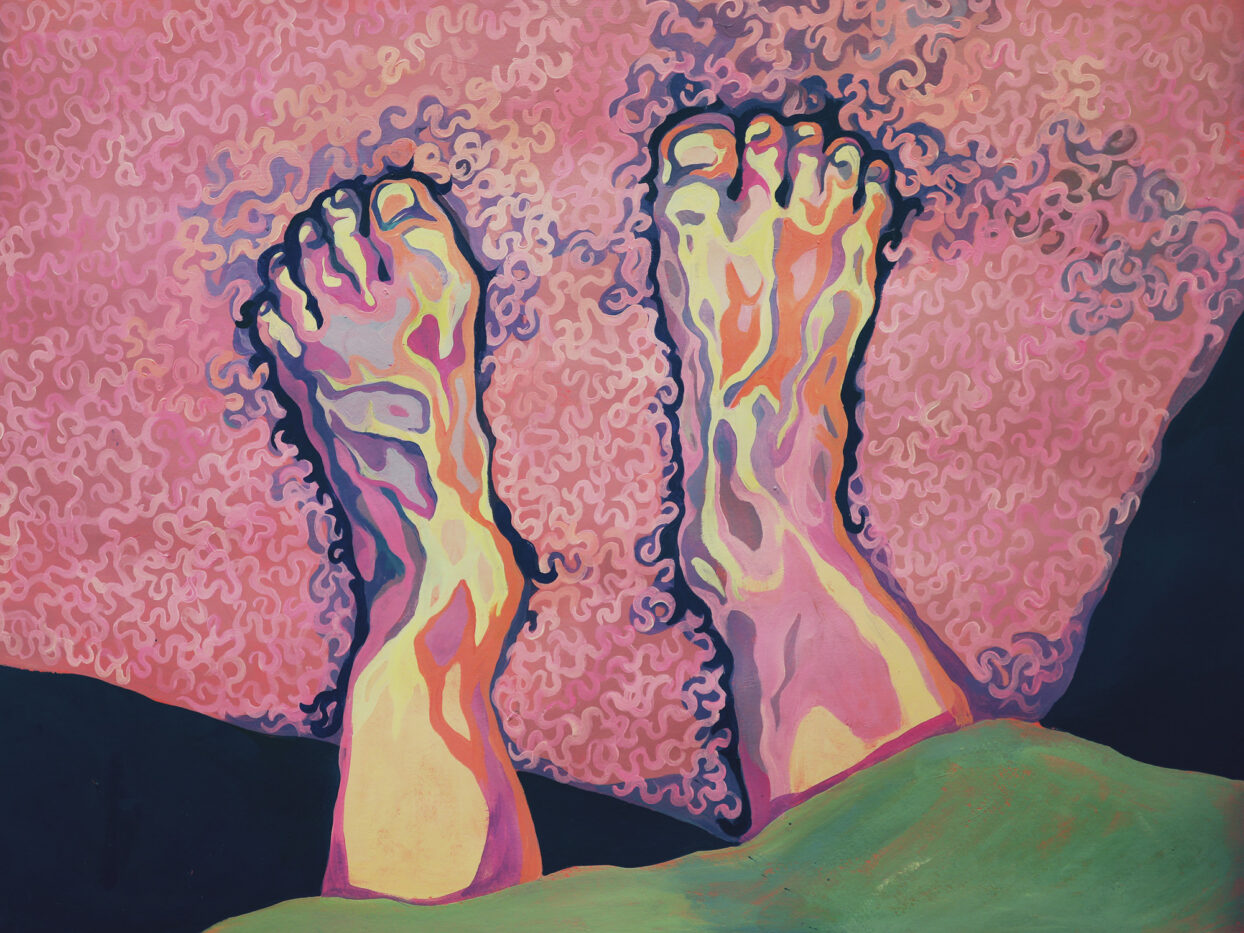
Image by Valentina Boeck

Image by Valentina Boeck
How might I explain my daily mission? I wake up and my first task is not to piss the bed. It’s me against my own piss. A formidable opponent: its urgency makes demands of me. I have no choice but to rise to the occasion. I am Achilles, aflame with the death of Patroclus, riding into battle.
I know the kinds of things they say about me. I said them myself, about my own mother, many years ago. If she’s stubborn it’s because she knows herself, Roger might start. Something kind: that is how I raised him. It’s what we love about her, she’ll say, Melissa, Roger’s Melissa, so pretty and quiet. Thank you, Melissa. But it’s maddening, Roger says, when she insists she doesn’t need help and we can see that she does. Melissa nods, the little bitch. She cannot see what’s good for her, Roger continues. Melissa nods again. I know what everyone thinks: that they know better.
Now my feet are on the carpet, which is mauve. I did not choose this carpet, the villains did. The villains who run this place, who keep me here. They try to placate me: Why don’t you come to any of the resident events, they say. You might even meet somebody. The resident events: asinine film screenings that start at 3:45 in the afternoon. When I could be reading a goddamned book. But the villains insist. They prod, they patronize. One of them will burst through the door at any moment, I’m sure, wielding a bouquet of palm-sized pills that must all be crammed down my throat.
The fibers of the carpet squish between my toes like mud. Like sand. I once made love on a beach in Mallorca. I told my grandchildren about that day, minus the sex, when they were small. I said that it was winter, the offseason, murky but mild, that their grandfather and I brought a picnic — olives and sandwiches and wine. That we were reading Baudelaire that winter, aloud. That we sat on a pier, that we went off in search of oysters and found, instead, that the national opera was in town, and so we went in our cutoffs and sandy shoes. Rigoletto. The sand on my back, the animal feeling of it, that I kept for myself. That is what’s mine.
I’m off now, God help me. Toddling across the carpet, my whole body clenched like a fist. That’s when the pain always comes. Ankles first today. Sometimes it’s the knees. I am a tree and my legs root me down to the earth, but in my roots, there is rot that grows. It is unfathomable, what can happen inside your own body without your permission.
The next obstacle is the bedroom door. I reach out with my good hand, though even that one shakes, misfires.
I open the door and there is this dark business again, the hall stretching out before me, Sisyphean: the mountain up which I must roll the boulder of my body.
I am running out of time. I ask things of my body and it tries its best. My bladder aches. My hips protest. I am Lear bearing up Cordelia’s body, trudging under dead weight. Howl, howl.
I brace my hand against the wall and see that the door to the study is ajar. I move toward it slowly, lean against the jamb, and look inside.
The computer. Open on the desk.
My papers, shuffled. A book on the chair, spine up. I would never splay a book like that. This is not the way I left any of it. Of this I am sure.
Blue light fills the room like a gas. My milky eyes blur the screen.
So, then: whoever comes at night has been here again. Maybe they are here still. My visitor. I don’t know why they come. I don’t know what they want from me. I step back and as my ankle gives, I hear the sound of a door opening. Then there is a voice. They’ve found me — they always do — and the voice shouts my name, sings it, as though I have chosen this, any of it, and as my hip hits the floor, my bladder whimpers its last apology. Warmth pools beneath me. The light in the kitchen clicks on and floods the hall, making a topography of the stucco ceiling.
I follow Roger off the elevator and down the hall with the dry cleaning held aloft in my right hand, shopping bag in my left, takeout wedged against my hip. He carries our overnight bags balanced one to a shoulder, letting them bump against his body as he walks. Roger didn’t think it was necessary for us to stay, thought we could just bring dinner as we do every Friday, but I couldn’t stand to think of her alone all night, in pain.
Before we reach the door, Priscilla, the nurse, opens it wide and says, “Oh, God bless you for coming.” She takes the food and the dry cleaning from my hands and busies herself putting things away.
“How’s the patient?” Roger shouts, smiling. The patient, propped up on the couch by the window, waves her hand dismissively and makes a face. I put the shopping bag down by the door: new pants, which she desperately needs. The ones I brought last time were too loose; the time before that she didn’t like the pockets.
“It is a miracle,” says Priscilla, who is fond of hyperbole. “God was with your mother, and with her hip, too,” she says. She’s already a few minutes past the end of her shift, and as she says this she gathers her purse and her jacket, which she zips over lavender scrubs. She frees her brittle hair and a cross necklace from beneath the jacket in one smooth motion. Her pale cheeks push against thick glasses as she smiles.
“Oh, for pity’s sake, I’m fine,” says Lee from the couch. She adds a “good lord” for good measure.
Priscilla lowers her voice and looks at us conspiratorially. “I thought she had gone to be with Jesus when I found her on the ground this morning. She had relieved herself, you know. Which is often a sign of — ”
“Yes,” says Roger, “you told us on the phone.”
“When the CT scan came back clean, I tell you, you could have knocked me over with a feather,” says Priscilla. Lee wouldn’t let us come to the hospital. “Would you stop your moaning,” we heard her shouting in the background when Priscilla called. “Just tell them to come later like we planned.”
Roger sets our bags down and crosses the room to his mother.
“Mom,” he says, “we were thinking of you last night because on the radio they were interviewing someone about a new book on the Spanish Civil War.”
“What?” Lee says.
“Anything we should know?” I ask Priscilla, who puts down the sponge she is wiping the counter with.
“She’s had some pain, but the doctor prescribed something that seems to be helping,” she says, picking up a pastel pink pill case and popping a compartment open, then shutting it again.
“Do you remember that story you told us, about the lecture you audited in Buffalo, when Dad was teaching there?” Roger is saying to his mother. She looks at him, nodding, reaching for it in her mind.
“Oh,” she says, “sure.”
“You said that the professor was a hack.”
“A hack,” Lee says, slowly. Then something connects.
“Yes,” she says, “Well. He was more interested in Orwell and Hemingway and all of these Americans with their toy swords gallivanting off to Zaragoza than in…” She seems to lose it again. “Than in.”
“If she complains before it’s time for the next dose, there’s an ice compress in the freezer,” says Priscilla.
“On the hip?” I ask.
“On the hip,” says Priscilla.
“Anyway, the book is on Franco in wartime,” says Roger. “A complex portrait of a complex leader. Thought it might interest you.”
“Franco,” Lee says. “The lecture.”
“I’ll bring you a copy when it comes out,” says Roger. He is always bringing her books, even though the cataracts have gotten so bad that she can’t really read anymore.
“Thank you, Priscilla,” I say. She wraps her arms around me. Priscilla is a hugger.
“So,” says Priscilla, “I’ll see you in the morning?”
“You’ll see us in the morning,” Roger says.
“Such a good son. God bless you,” says Priscilla. “AND MAY GOD BLESS YOU, HON,” she shouts toward the couch. The patient waves her hand in one rough arc, not looking away from the window.
When the door shuts behind Priscilla, Lee laughs a bitter laugh.
“How are you feeling?” I ask. I’m at the counter now, removing containers of lamb curry and saag paneer one at a time.
“You should see the way she puts a sweater on me,” she says.
“No, I mean your hip,” I say. Plastic silverware. Napkins. The bottle of wine we brought from home. Roger stands and offers his mother an arm.
“I’m fine, I’m fine,” she says, holding onto him and pulling herself to her feet. “It was ridiculous, carting me off to the hospital for a little stumble.”
I say, “Priscilla just wanted to make sure you were okay.”
“All of these people, all of these damn villains — ” she starts to say, and Roger interrupts:
“We’re glad you’re alright, Mom.” He embarks on a slow walk across the carpet to the kitchenette, Lee’s arm looped through his. I set out plates. When they reach the table, Roger helps his mother into her chair and comes to help me bring the food over from the counter.
“She yanks my arms into the thing,” she says.
“What thing?” says Roger.
“The sweater,” she says. Roger, setting down the takeout containers, looks at me, and I look at him.
“I’m sorry to hear that,” I say. Roger digs a spoon into the rice and doles a scoop onto his mother’s plate, then his own.
“And of course, she didn’t tell you about the visitor,” Lee says.
Roger puts the serving spoon down and sighs.
“Please, Mom,” he says. “Not this again.”
Most of Roger’s mother’s paranoia can be easily traced to one of the various indignities of her life in assisted living: her confusion, she says, is because her nurses deliberately confuse her; she insists that the cook puts something in the food that makes her incontinent. Just as readily as her litany of mundane complaints about the facility (the smell, the fluorescent lighting, the infantilizing programming), she offers these strange stories: so powerful is her disorientation that her reality begins to split from ours. This story, the one in which someone breaks in at night, uses her computer, and leaves, fixates her lately. It seems related to the increasing ubiquity of technologies whose operation baffles her, and to some nebulous sense that the facility’s aura is nefarious, threatening.
“Mom, no one is coming into your apartment.”
“Then why was my computer open?”
I say, “Is it possible you forgot to turn it off?”
She looks at me, clenches her jaw.
“Mom,” Roger says, before she can snap. “We are not having this conversation. Melissa, may I have a glass of wine please.”
We drink. We eat. Lee continues to tell us about her caretakers — “the villains,” she calls them — how they keep moving her into nearly identical replicas of her apartment to disorient her. She looks small as she enumerates her complaints. She looks scared. I try to listen. Roger asks her about her day. He tells her about the Truffaut marathon on TCM this weekend. Maybe we could watch it, he suggests: he knows she likes the New Wave.
Later, while Roger helps his mother get into bed, I lie down on the foldout bed in the living room and stare up at the ceiling. She hates this place so much, and it is so expensive. I suppose Roger’s right when he says we shouldn’t engage with her negativity. But I can admit to myself that there are some things she’s right about. It is sad here. The lighting is awful, and it does, always, smell faintly of cheese.
I remember her when I first met her, before the kids were born, and she was about the age that I am now. She had been an English professor. Erudite, intimidating. She was retired, but she still wore suit jackets. When our daughter was little, Lee used to come over to babysit so Roger and I could go out. Doting grandmother was not a role she took to naturally, but I could see her trying. Delighting in newfound softness. Laughing when Katie hugged her legs and smeared food on her perfectly pressed trousers. She was — she is — a mother, too.
On the end table, Roger’s phone lights up. A message from Katie. I doubt it’s about Grandma: Roger doesn’t like to bother our daughter with anything he thinks might make her anxious. But the two of them have a whole little world I’m not privy to. I don’t know how they have the time to read so many books I’ve never heard of.
Roger comes in quietly, sinks down on his side of the mattress, and reads the text. His thumbs start to fly, and then he is lost to me. I reach into my bag for my earplugs and the satin mask I wear to shut out the light.
“I forgot to show her the pants,” I say.
“Oh, Mel,” he says, looking up. He puts the phone down, swings his legs up, and squeezes my hand. He exhales, closes his eyes, opens them again.
“Forget the pants. She’s going to wear whatever pants she’s going to wear. You already do so much. It doesn’t matter.”
I know what he means, but I don’t agree. She should look nice. Her pants should not have holes in the knees or loose threads dangling. It matters.
The springs in the foldout wheeze as I reach to turn off the light.
I love everything. That’s my biggest problem. I love the way the grass hums at night. Hums — I love the way I’ve expressed that. It hums, it does! With the rhythm of the cicadas, with breezes, with the heat rising from the earth. That’s why I come out here. It’s not the same in the daytime.
Once I saw a woman beating herself in the street. She had an umbrella, and she was bringing it down, hard, on her left shoulder, then her right, left, right, and then on her knees. She was bleeding, and she was laughing. Why was she doing this? I don’t know, and I never will. She did not owe reason to anyone.
I love the way I move under the moon. It’s different, surprising. My arms are longer, my body slighter. And I don’t mean thin; I mean transparent. I can go wherever I want, and no one will see me. I wonder if there is anyone else like me in the world. Probably not.
I can go wherever I want, and I do. The asphalt is like velvet under my feet. I am lit orange under the streetlights. I love the streetlights, how they make me a new creature. The streetlight creature is clean and dangerous. But don’t worry. She is attuned to the mechanisms of kindness.
My transparency affords me the ability to rove undetected. It is delicious. I have developed ways of taking advantage of it on these nights, when the air is clear, when the moon is curved like a sickle.
Locks melt away in my hands. Security systems think better of their hysterical barking and go sweetly to sleep.
In this kitchen, the one in which I now find myself, I can be a doting wife, like the one in the photograph on the refrigerator. Once I saw her through the window: she was cleaning up after a party. She was so beautiful, so tired. I pick up a plate, feel its cool weight under my palm, set it down again, as quietly as I can. The moon lights the room and I become her: frazzled, lovely. Now, in a basement with a grassy pool table, a leather armchair, dented in the middle, I am a good man who needs a little peace. I sit in the chair; I pull the lever that makes it lean back. I sigh. My work is boring and stressful. I make a lot of money. I miss my son who moved away.
When I leave, I don’t take anything with me. These are lives I try on and leave behind. When I step again out into the night, I feel weightless, having shed the burden of having a self at all.
Again the streetlights. Again the night air. I think I am sparkling a little. That can happen when I feel too much joy. I try to think about sad things: someone opening a present they know they’ll never use, someone so lonely it starts to feel like peace.
The asphalt opens out, blooms into a field studded with cars. Everything shines.
Here is the service entrance. These locks are trickier, but they yield to me eventually. Then there is this dazzling stairwell, all white but slathered in yellow light, and I walk up up up, and when I get to the third floor I shimmy out through a window onto the fire escape, and from there I can slide myself into my favorite room, my favorite life of all.
This is a study. The study of someone who knows things. Or who used to. The people here are near the end of their days. It might make me sad, if it wasn’t all so beautiful: that after you spend your years working, there is time to rest. That you can know things and then let them go. The spines of the books lined up on the shelf. The computer I can open, and how it makes me glow like the streetlights, how I can ask it anything and it will tell me. The chair that I can sit in, spinning myself around and around and around, the mind I can feel, that lives on, here, in this room.
You are fairly sure you know what happens next. The computer open on the desk, the daughter-in-law who wakes so easily she needs earplugs, the person loosed from reality who wanders nighttime lawns and has mastered the art of breaking and entering: it is all converging.
You can see how it sounds. They’re not evil, all the people who call her crazy. It’s just that they are rooted, confident in their vision of reality. They have faith in it. It is what they stake their lives on: that generally speaking, with few exceptions, things are the way they are. You know this, too.
Still, you are prepared for a confrontation that changes everything. A final-act showdown, a true and profound surprise.
It happens around two o’clock in the morning. The sound. Not a loud sound, like a shattering of glass. The business of life: a body adjusting. So commonplace that you might not hear it.
But Melissa does. She hears it because she has woken up. She’s a light sleeper, remember? It’s two o’clock in the morning, Roger is asleep next to her, and Lee is asleep down the hall. There’s no one else here. So it’s odd, though perhaps not immediately alarming.
Melissa puts her feet on the floor. She looks over at Roger and sees him completely asleep, and for a just a moment she is in their bedroom, 25 years ago, and the sweet, high whine of a baby’s mewling is scratching through the monitor on the nightstand, and she is getting up to deal with it because the agreement they made, before the baby came, was that whoever woke up first would go and deal with it, which felt fair, only it seems that she is always the one who wakes up first.
The hall is prismed with shadow. Whoever chose this awful putty color, she thinks to herself, really is a villain. She smiles. But the smile goes away when she hears a soft thunk. Coming not from Lee’s room, not from some air vent carrying noises from another floor, but from the study. Unmistakable: it is an object falling to the ground.
A little shuffling sound. Like someone has picked up whatever it was that fell. Melissa stands completely still at the place where the hallway forks: to the right, the bathroom, and ahead of her, the study.
Just before she starts to move she thinks of her mother-in-law. The fear in her eyes the first time they left her here. They bought hangers for her clothes and Lee insisted that she didn’t need them, that she had hangers already, and Roger insisted that she didn’t have any, and he would not budge, and as they argued Melissa thought about how, when she and Roger packed up the house, they threw all the hangers in Lee’s closet away, without even asking her. The hangers were ancient, warped wire with yellowing paper from dry cleaners still crinkling under long-forgotten shoulder pads. But still, they had been hers. The face she made as Roger brushed aside her protest — her hangers, her hangers, she could have sworn — Melissa recognized it. A mother, ignored. It was the same face she felt herself make when Katie and Roger sparred, and she tried to chime in; it was as though they did not hear her. Finally, Roger shut down: “Mom,” Melissa can still hear him say, “we got you hangers, there are no other hangers, maybe you will choose to use them, and maybe you won’t, that’s up to you, but in any case we have to go, and we are leaving the hangers here.”
Melissa knows that this rigidity is how he holds himself together. It’s his way of surviving the slow loss of his mother, just like how, when it was her own mother, years ago, she let herself cry as often as she wanted to, even at her desk, even to her child. It became almost a ritual: the crying, a cleansing. She knows, too, that neither of them is wrong, that there is no right way to do it. Still, she wishes that he would — what? Weep? Talk about it? She isn’t sure. It would not change the outcome.
Before Melissa followed Roger out the door the day they moved her in, she turned back. Lee was small and brittle in her too-big armchair, and she opened her mouth as if to beg Melissa to stay, but couldn’t do it. Lee has never begged for anything.
You may have surmised by now the thought that Melissa, standing in the dim hall, listening to the strange sounds from the study, is allowing herself to entertain.
The visitor. It’s impossible, illogical. And yet.
What would it mean, Melissa asks herself, if it turned out that Roger’s mother was right all along, about this insane, unbelievable thing? If she was only ever trying to tell them the truth?
Maybe there will be other things that turn out to be true. Maybe Priscilla really is rough with Lee in the mornings, yanking her arms ruthlessly through her sweater sleeves. Maybe her medicine really has been tainted with something that renders her vision blurry.
Maybe Roger will relent in his approach: he will talk to his mother, ask her what she is afraid of, ask her why. Stop thinking of Melissa’s compassion as indulgence.
Maybe Melissa herself will relate to her mother-in-law differently. Maybe she will be less nervous, having uncovered this profound misunderstanding. She could talk to her about something besides logistics, pant styles. Melissa never asked her mother-in-law about her work. Maybe now she will.
She hopes her own daughter will learn something. Perhaps Melissa and Roger will decide to tell Katie the whole thing, from the beginning. How her grandmother told them that something was wrong, how they didn’t believe her. Maybe Katie will carry it with her, when Melissa’s time comes. Years after Lee is gone, after Roger is gone too, when Katie comes to her mother’s sterile rooms, bearing a reluctant husband, shy children of her own, when Melissa asks if they’ve had time to talk to the doctor about lowering the dose of her medication because she fears it is making her loopy and forgetful, maybe Katie will think of her grandmother, as Melissa does, of the dignity that escaped her, little by little, every day. Katie will take a moment before she responds, make her voice warm and comforting, say yes, Mom, I can do that.
As Melissa reaches for the study doorknob, her body tense with anticipation, her mind whirring, a memory arrives, unprompted: once, years ago, she dropped the children off at school and instead of turning back around for home, she just kept driving. She passed the thrift store, the megachurch, the endless phone-repair shops with their bright, beseeching signs. She was going to meet someone, an old friend from high school who had gotten back in touch via email. It was not exactly sexual, the meal they had together, at a strip mall steakhouse just outside the city limits, but there was something. A danger, a possibility. It was not that she wanted to explode her life, and in fact she knew that if the moment came she would not do it. The promise was enough: the idea that if she wanted to, she could change everything in an instant. It is clearer in her mind than almost any other memory. The silverware bathed in neon, the brush of fingers on booth vinyl. She has never told anyone about that. Not Roger, not her girlfriends even. She keeps it with her: it is hers.
Then Melissa pushes the door open, and she sees the source of the thunk and the shuffle: a little mouse, caught in a trap, still alive. Twitching, trying to get free.
Lily Felsenthal is a fiction writer living in Los Angeles. Other work of hers appears in The Kenyon Review, Gulf Coast, BOMB, and elsewhere. She’s at work on a collection of short stories.