Issue 18 |
September 9, 2026
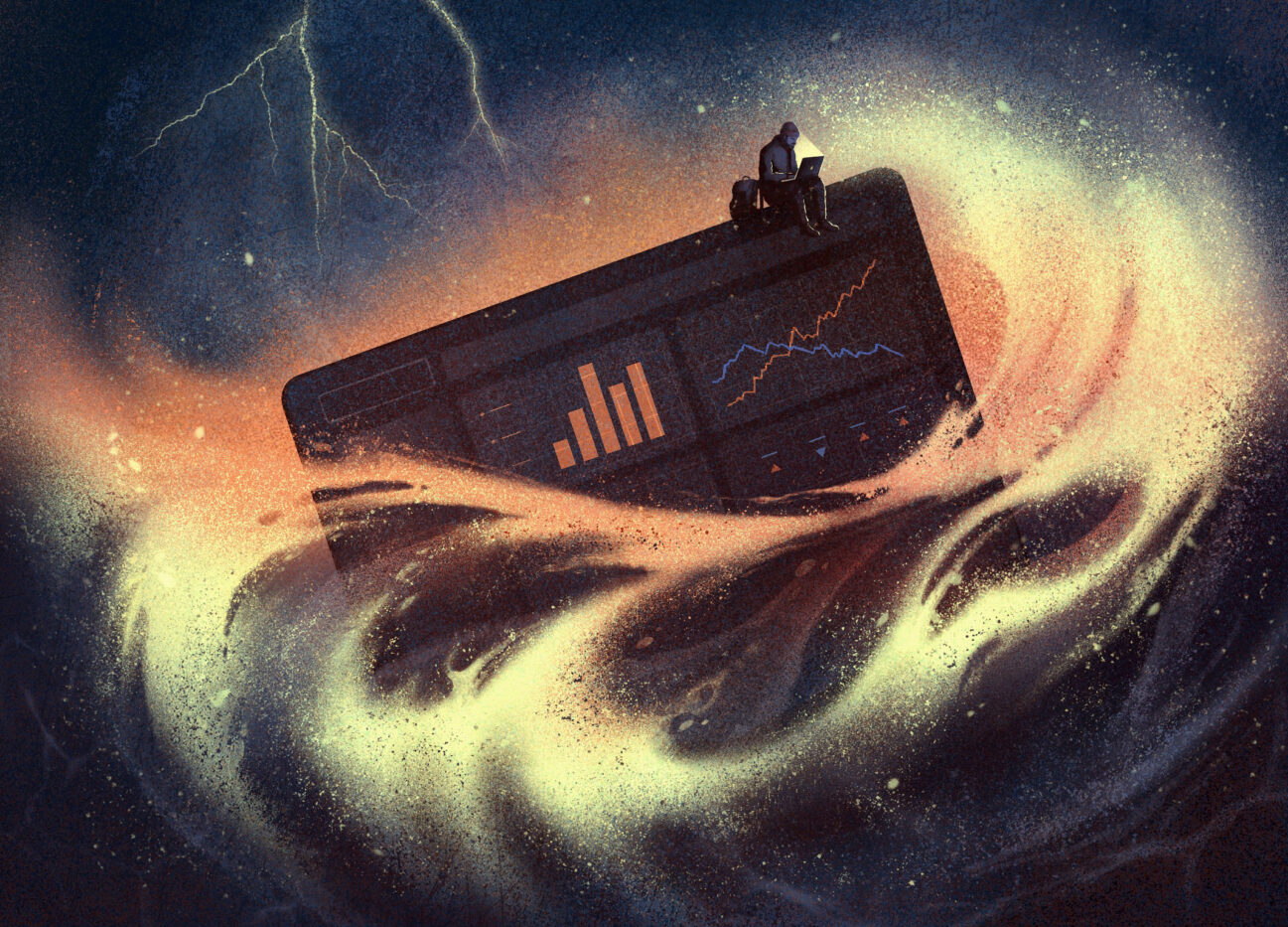
Image by Daria Lada

Image by Daria Lada
I worried about my organs, the ones involved in the processing of toxic substances. Cheap vodka and good wine, mushrooms incubated in cowshit, coke snorted through the U.S. currency I used to buy more coke, cigarettes and weed, pills and tabs and capsules — I had reoriented myself to reality through the self-administration of many expedient poisons. I worried about cortisol levels. I worried about hemochromatosis. I worried about my liver. If I’d known what a liver looked like, I might have been able to picture it floridly diseased, beset by tiny gnawing creatures. But I only recognize liver after it’s been chopped and blended and plated with dill, served with bagels at my in-laws’ break-fast. New York was a heat dome scented like Le Labo perfume. Deranged men with short attention spans and upset stomachs held the keys to our destruction, the air conditioner was acting up, and I could never keep my phone connected to the Bluetooth speaker. I worried about lead in the pipes and bugs in the beds. North Korea was too close to our front door, and the good grocery store was too far away. I flushed old antidepressants and the fish in the Hudson developed new mating patterns. I forgot my reusable mug and butterflies fell dead from the sky. I worried about the future and the past. There was too much continuity between unlike things.
I told Antonia, “Maybe it’s my appendix.”
“Treacherous fucker,” she said. “Just lying in wait.”
She always was a willing player in my theater of affliction.
Smart-slacked and crisp white-shirted, blazered in a lovely gray, Antonia was running late for work. Her wandering, curly hair was freshly cut and shaped — she called the look her “Second Bob.” I was her first. Robert to the world, Bob to her. I called her My Antonia, even though I’d only read Willa Cather in excerpt. Toni to the world, Antonia to me.
She said, “I’ll pick up some soup on the way home.”
“You’re a lifesaver.”
Antonia kissed my forehead, out the door before I could ask what her day held. She didn’t really like to talk about ongoing projects. Consulting was consulting, she said; there was nothing to say about her days spent massaging Excel formulas, refining organizational ergonomics, and eating kale and quinoa salads at her desk. Still, she liked to be asked.
I connected my phone to the kitchen radio and queued up the morning’s Democracy Now!
We go to West Virginia, where a collapsed coal mine has trapped 23 men and 4 women below ground for nearly 36 hours.
I ran hot water over the dishes. Amy Goodman brought on a guest to situate the disaster in its historical context.
It is crucial that we not lose sight of this fact, Amy, the guest said. Our new president’s policies may not be helping, but they are not the real reason why we’re seeing these kinds of events with such increasing frequency. Donald Trump did not invent despoliation. These decisions were made decades ago. Rupture dynamics take ages to develop and even longer to alter. Flooding, hurricanes, seismic disruptions. What we’re seeing now may be the new normal, but it’s not some spontaneous occurrence — what we’re seeing is the past.
The brick outside the window seemed to glow with absorbed heat. I moved to the couch and opened my computer. A family friend who did pro bono work with a local climate NGO had set me up with a freelance job editing communications for their newsletter. The laptop made a low whirring noise as it emitted a comforting warmth that spread down my thighs and resolved in an almost imperceptible tingle at the tip of my penis. I fixed a comma splice and changed the word dire to urgent to avoid intra-paragraph repetition. I highlighted a flourish of metaphorical language that suggested continuity between unlike things. I made myself egg tacos and coffee and wrote the final two-thirds of an email, which I didn’t send. I changed the word urgent to crucial. I closed my laptop and went out to meet Ray for drinks.
Kids smoked cigarettes on brownstone stoops. Men yelled toothlessly at each other over a rattling bag of cans. A bundle of rags shivered in the heat. A man drank coffee from a mason jar. A woman advertised her homemade pies, and I was running late.
Ray and I were meeting this time in his neighborhood, an alluring pocket of Brooklyn where fit dads with stubble pushed strollers faster than I jogged and beautiful moms lounged at bar patios, nursing babies. Antonia was never comfortable at places like these, always looking sideways at the swaddled creatures as if they were unleashed dogs. The moms smiled vague and friendly challenges at the world.
Ray waved away my apologies and launched into the latest installment in an ongoing, uncommissioned series on the way the world really worked. He felt that reports of civilization’s sudden decline and fall had been greatly exaggerated.
“Consider Obama’s drone program,” he said, waving his Juul. I considered my Pilsner. It was the pale, grassy yellow of a Midwestern cash crop, and excellent. Ray said, “You think it’s an accident that the same tech that delivers toothpaste also happens to be really good at surveilling Arab families in Jersey?”
“I don’t think that’s true,” I said.
“Whatever,” Ray said. “You understand what I’m saying.”
The hip-hop on the outdoor speakers enjoined us to fight the power. According to Bill de Blasio, tobacco products were New York City’s public enemy number one. This was before every deli in the city was a Borgesian library of Zyns, and I’d left my Juul at home to avoid temptation. I shot an apologetic look at the dog beside me and helped myself to a hit of Ray’s.
I wondered whether I was in the mood to follow the Pilsner with a chocolate stout or a hazy IPA. I flagged the server down and surprised us both by ordering a funky sour.
Ray turned to face me head on. “Hey, Boberto. Something I need to talk to you about.”
Cancer, I thought. Pancreas.
“But you can’t tell anyone. Not even Toni.”
“Of course,” I said.
“No,” Ray said, “actually.” We usually operated under the unspoken agreement that whenever he told me something in confidence, I would swear secrecy and then immediately repeat it to Antonia. For many years she was the only person in the world from whom I had no secrets. But that was before Ray employed new linguistic defamiliarization technologies — projection matrices with plus or minus five percent accuracy, variability ratios and proportional adjustments, desolation indices, and mortality coefficients — to make the practice of betting on natural disasters sound like something it wasn’t.
It was greenhouse hot under the psychedelic smog sunset.
“This could actually be really good for you,” Ray said. “Just think about it.” He stood to leave. He had to be at work early the next day to prepare his classroom for a new batch of third graders. He was thinking a pink and yellow motif this year.
Antonia was asleep on the couch when I returned. I woke her with a kiss and guided her to bed. She asked about my evening with Ray, and I said there was nothing to report. She left it there. She and Ray had never found a way to get along. They stayed on opposite sides of a fault line that ran through my life. I worried about territorial disputes and geographical dynamics.
I had ordered sushi to the apartment while Ray and I were waiting for the check, and I could still hear Antonia trying to get comfortable in bed when the buzzer sounded and a screen on the wall displayed a person in a motorcycle helmet with a reflective visor waiting in the vestibule downstairs. Something was wrong with our door, so I had to go down and open it myself. The delivery person didn’t raise their visor, even as I accepted the order with a small ceremonial bow and a silent smile and a cash tip. The rite was over before it had begun; there was no need for anyone to say a word.
Rain rapped against the window pane like nervous fingers. My phone buzzed with an emergency bulletin. Warning: flash flooding in your area. I showed Antonia.
“Yikes,” she said.
I sipped my coffee and mentioned West Virginia. “Seems like there’s a pretty good chance the Republican base will be a little smaller by the end of all this,” Antonia said. A typical response. She’d learned this phony callousness from her dad, a trauma surgeon who even at the dinner table described collapsed lungs and festering sores with relish. He had recently texted our group chat to show us a piece of his own colon, which he had smuggled out of the hospital after a biopsy that had come back positive for metastatic cancer. When I saw the photo, I felt a clenching sensation in my abdomen.
My phone strobed again: Amber Alert. Missing girl, silver Toyota, Minnesota plates.
My head throbbed. “Just think about it,” Ray had said. “What else do you have going on?” And I was thinking about it, was thinking and thinking about it. I thought about it as Antonia kissed me goodbye, and I thought about it as I started on the dishes. I turned on the radio to stop thinking about it.
— Reckless approaches could lead to further cave-ins; mismanagement of the situation could occasion any number of unforeseen risks to the miners. Meanwhile, officials at FEMA say the agency is overtaxed, as Hurricane Apollo hit the coast of South Florida last night. Some experts are projecting that Apollo will be the largest offshore hurricane in U.S. history. Numbers are speculative and official sources have not shared their data —
The faucet ran until the sink flooded, and the kitchen filled with water. The water was rising; it rose. It rose so high I had to hold my breath. The kitchen became an aquarium filled with detritus, sandbags, bodies. My hippocampus bulged, and I had to close my eyes. What did a hippocampus do? My father-in-law would know. I turned off the faucet to save water. I turned off the radio.
Email from Ray. Subject: Your new passion. The only content was a URL. I closed the email and cracked my neck. I stretched my hamstrings, checked my RSS feed, sipped my coffee, and peed. I activated a productivity program that temporarily disabled my computer’s internet connection, replaced a semicolon with an em dash, resolved a number of proposed changes in a Microsoft Word document, went to the kitchen and ate an apple with peanut butter, drank a glass of water, washed the glass, filled my water bottle, emptied the dishwasher, checked The New York Times cooking newsletter for the day’s featured vegetarian recipe, shaved, combed my hair, masturbated, pooped, watched highlights of the Nadal-Federer tiebreak on my phone, went to the corner deli for toilet paper, read a review of a video game for a platform I didn’t have, checked a 350.org climate action volunteer’s Slack thread on my phone and weighed in on messaging in anticipation of an upcoming conference, put a pot of water on the stove and took eight eggs from the fridge, washed and destemmed kale and spun it twice and wrapped it in a linen towel, checked my news alerts, read about a marketplace bombing in Eritrea, Googled Eritrea, dropped the eggs in the pot to boil for seven and a half minutes, watched a video of a little girl who had been dragged by a sea lion into the water at an aquarium in Canada and emerged unscathed, plunged the eggs into an ice bath, changed into shorts and did a seven-minute bodyweight workout I found on YouTube, responded to a text from my therapist asking if I could reschedule an appointment, read a chapter of a book about the financialization of the world economy and the pernicious externalities of foreign aid, restarted my computer in order to deactivate the program that had deactivated my internet connection, read the first two paragraphs of an essay in The New York Review of Books about a recently rediscovered Hungarian writer who seemed newly relevant in the context of resurgent fascist impulses, texted Antonia’s father to wish him well as he went into the UT MD Anderson Cancer Center in Houston for more tests, texted Antonia the open hand emoji, opened Ray’s email, and clicked the link.
404 Error. Page not found.
The territory of the internet easily available to the general public is called the Surface Web. The Surface Web is indexed by standard search engines; it’s where you find your state-sanctioned commerce, your social media sites, and your Joe Rogan clips. In terms of sheer informational volume, this piece comprises a tiny portion of the internet. Through a series of simple adjustments to privacy settings and a few computational tricks you can learn on YouTube, it is possible to delve beyond the Surface Web and into a new kind of place: the Deep Web. That’s where you find your private web services and unsearchable databases. Googling the phenomenon yields diagrams of icebergs. It is possible to go still farther. In the Deep Web’s bowels is the Dark Web — your underage girls, your weapons markets and DIY bomb making tutorials, and your ISIS recruitment channels. The Dark Web also hosts hidden marketplaces and encrypted communication services. The exponentially increasing need for information storage below the Surface Web means that the iceberg’s tip grows smaller every day, as icebergs seem consigned to do. In college, Ray and I had briefly considered buying coke through a black-market interface that was hosted on Dark. Our decision to find our drugs in the dark corners of campus instead of the internet turned out to be a good one: the website was scrubbed for data and many of its users were subpoenaed after the founder paid to have a friend-turned-enemy murdered.
I closed my browser.
The rain was getting in through a crack in the bedroom window, so I closed that, too. My back ached numbly. I stretched and used the giant foam rolling pin Antonia got me to dig painful healing into my tender hamstrings. AccuWeather showed a break in the rain, so I got up, took two Advil, and went for a walk. I called Ray.
“Ray,” I said.
“Uh oh.”
“I’ve thought about it,” I said. “I’m not down.” The entanglement of money, suffering, and entertainment made me queasy, I said. Plus, the URL hadn’t even worked.
“Download Tor,” he said. His mic picked up the giddy, piercing sound of children shrieking. “And listen to me. We’ve been talking for months about these feelings of yours. What was it you said? That you felt like a ghost in a movie, watching things happen without any contact, seeing loved ones walk by with no way to touch them, no way to make yourself seen?”
“That’s not really what I meant.”
“What did you mean then? You want to live in the world, you need a way in. This can be it.”
“This is illegal. I think. Is it?”
“I’m not interested in your legislated morality. You want to keep feeling helpless? Sit around and scroll. I’ve never been more engaged in politics, current events, you name it. You’re too smart to sit by idly and watch history happen. Get involved! Vote with your dollar. And you’ve got dollars to vote with. This is your chance. When you think about it, it’s basically your civic duty.” A particularly bloody shriek sounded, and Ray said, “I have to go. I love you very much, Bobert, but please do not get all Bobertian on me here.”
Back at the apartment, I refreshed the news. An unarmed teenager shot by a cop in what they were somehow still calling the inner city. A suicide bomber undoing more progress in the human enterprise at an outdoor market in Budapest. I didn’t know they had suicide bombers there, I thought without meaning to. I sent Antonia the video of the sea lion dragging the little girl into the water. A few minutes later, I sent it to Ray. Antonia responded first: Thank you for bringing this to my attention!
I asked how her day was going. Just spent my lunch break teaching my mom how to use Google Maps to find a toll-free route to the radiation center for Dad. Off to review diagrams of mountaintop removal and plans for mining infrastructure. If I slip into a stress coma, DNR.
Later, from Ray: Your life is sad and empty.
I chewed on a Tums anti-gas candy and wrote Ray back: And your face is asymmetrical. I had been underemployed and underwater for months, even years, living on family money and spending the days moving bullet points around my resume and asking for permission to move punctuation around in other people’s work. I was aware at the time that I lived in anticipation of a single direct message from the outside world that would hold in it the promise of change, the possibility of something springing forth from nothing, the answer to my questions, the freelance assignment that would rescue me from limbo, deliver me into life, and lead inexorably to the deferment and eventual abolishment of death.
I had just dipped into a case study on tuna fishing practices in the South Pacific when I glimpsed that Pavlovian flash in the corner of my screen.
One new email.
I had a chicken roasting with potatoes and leeks when Antonia got home. She covered my face with kisses of gratitude and flumped onto the couch. I asked about work.
“It’s so bad,” she said. “It’s so scary and so bad.”
“What is?” I said. “What’s going on?” Just then her phone vibrated; a photo of her mother appeared on the lockscreen. She paused, stared at it for a moment, and shook her head. She took a breath and left the room. I turned on the radio.
Someone was talking about a mid-grade scandal involving the secretary of the interior. It seemed that he, or his deputy, or maybe the entire agency, or maybe the nation’s expanses of precious old-growth woodlands, were on their way out.
Of course, there were rules. Ray’s group had established a set of guiding principles to which any new member had to commit before placing their first bet. Human-incited events — mass shootings, spasms of stochastic violence, extrajudicial killings by the police — were beyond the pale, which was a boundary that could be intuited but not defined, like with porn. A percentage of the winner’s profits were to be donated to disaster relief charities. Whenever a notable disaster occurred, we would log on, place bets in a range of actuarial categories (property loss, duration, population displacement, population diminishment), and then follow the news until the moderator decided that the round was “closed.” Who was this moderator? Where did the final numbers come from? We didn’t know. We agreed to trust the moderator. We hand over far more than just our money to anonymous people — pilots and mechanics and lawmakers and taxi drivers and surgeons — every day.
I signed the agreement and bet four hundred dollars on a flood in Kerala. I decided that it would be best to meet the world with a spirit of optimism, and took the under in every category.
In the chatroom, players exchanged ribaldries and touted esoteric methods. OptimusGrime ran a complicated regression based on numbers whose algorithmic provenance he would not reveal. Hasshanti heard voices. WindInTheWeathervane seemed truly to believe that his smallest life choices had an impact on planetary vicissitudes. He claimed to have once won a bet by strictly limiting his and his family’s showers in order that excess water would accrue over the Eastern Seaboard, thus resulting in more damage off the coast of Bermuda. What crazy, magical thinking, I thought to myself as I sorted recycling and disposed of batteries and put banana peels in the compost bucket we kept in the freezer to prevent it from stinking up the apartment.
I put my freelance opportunities aside and spent the workday doing research on international development standards, effective altruism, and Caribbean tidal patterns. I followed the news and weather closely. I stayed informed. I canceled a monthly contribution to the Red Cross and donated the money to a direct cash aid startup instead. I had never been more engaged with the world. I was becoming a better citizen.
I had a lentil salad with pecorino and walnuts marinating on the counter when Antonia got home. She went straight to the fridge and opened a jar of cornichons. I felt a sudden flush of anger and went to the bedroom to check my bet. I performed the procedure to access the Dark Web and navigated to the betting interface. They called Kerala, and I had lost. It was worse than even our most aggressive bettors had predicted.
Ray texted me that he’d nevertheless won a few hundred dollars on this one, and wished me better luck next time.
A vague feeling somewhere between shame and pleasure held me for a moment. I had a half-memory of an episode from my childhood when my parents had chastised me for failing to complete a homework assignment we all knew I could easily have finished. I closed my laptop and resolved to do better.
After dinner and a bottle of chilled red, Toni and I got in bed to watch our show. Without thinking, I opened my laptop. I was still on Dark. The betting interface and chat window were both visible. I closed my laptop. Antonia was pecking at her phone. She looked up at me with half-seeing eyes.
“Ready to obliviate?” she asked. I said I was having issues with the WiFi on my laptop — could we use hers instead?
We signed in to a friend’s account in order to access our content without further enriching the then-richest man in the world. Brutal murders, beautifully choreographed, bookended scenes of political intrigue. Men discussed matters of war as insinuations of desire. Antonia fell asleep in the first ten minutes, so I switched over to Dark and bantered with my new friends until the sun came up. When Antonia’s alarm sounded, I yawned and stretched alongside her.
At breakfast, Toni showed me articles about the targeted drug therapies her father’s doctors were considering. I wanted to say something helpful and sensitive, to offer determinative solutions. But my stomach fizzed and wriggled and I couldn’t really think. My phone buzzed with another flash flood warning. I showed Antonia. She grimaced. She sipped her tea, a rich Irish breakfast blend from the mountains of Assam by way of Kerala.
“So close the windows,” she said.
My phone buzzed, and the hurricane in South Florida headed west for Texas. I steamed a Japanese sweet potato, and the results came in for the mudslide in Honduras. The event had precipitated secondary flooding, which meant that my conservative estimates lost me every category: Total Damage ($). Damage Per Day ($). Area Affected (hectares). Federal Expenditures ($). State Expenditures ($). Municipal Expenditures ($). Medical Costs ($). Injuries (people). Injuries ($). Deaths (people).
It would cost me more than twice what I’d put in, more than I had ever spent without a plan, far more than I could convince myself to ignore. I opened my banking app and made some adjustments to the configuration of my finances as I chewed on the papaya enzyme tablets I’d bought online to counter indigestion. I had never tasted anything like them, and I enjoyed their fruity, medicinal chalkiness. They made me feel better. I had come to believe that the most potent forms of relief were to be found not in continuity but in novelty.
Antonia was annoyed. We were working on a crossword puzzle, and she couldn’t see my laptop from her spot beside me on the couch. I had installed a privacy filter on my screen that made it appear blacked out from oblique angles.
“Why did you do that?” she asked.
“Nosy people at the coffee shop,” I said. I liked the sense of privacy. I liked that you couldn’t really see what I was doing unless you looked at it head-on.
The leaves of the oak outside our window nodded and shook in the wind as if they were enraged.
There was no way I could have canceled dinner without telling her I’d lost the money. It was our anniversary, and we’d made the reservation weeks before. We sprayed ourselves with fragrances and took the subway to Manhattan and ordered champagne priced like furniture and cocktails garnished with fruits that had been manipulated to look like jewelry. I suggested that we split the caraflex cabbage with miso chili butter as our main for the sake of thrift and the environment, but Antonia was feeling an uncharacteristic hankering for meat. The steak for two cost more than the leather Oxfords I was wearing, but our waiter assured us that the cow had lived the life of a French king and somehow suggested that if we ordered right our lives would thenceforth be similarly blessed. Antonia assured me that we would eat vegetarian for the next two weeks in penance. I used my veto on the chicken livers.
The steak was on the table but Antonia kept looking at her phone. “Work?” I asked. She shook her head. “Dad.” She excused herself to use the bathroom. I took my phone out and searched for news from West Virginia. There were no updates, so I read a summary of a climate bill. Still no Antonia, so I reviewed the box score of the Lakers game. Waiters hovered by my shoulder, refilling my water glass. Soon I had to pee, but I held it to avoid crossing paths with Antonia. I didn’t want her to think I was checking on her. I squirmed, waited, and drank so much New York City tap water that my stomach swelled.
Antonia returned with fresh red lips and preempted my questioning.
“Nothing to report from Houston’s finest oncology lab,” she said. I squeezed her hand and looked into her eyes. Antonia’s eyes were the exact color of Irish breakfast tea. Their rims were unusually pink, like the steak that arrived slathered in a chunky salsa verde and made me salivate so hard my jaw ached.
Antonia let her hand brush against my dick on the F train home. When we got there, I lit a candle and tried not to think about how the player with the username WindInTheWeathervane made his family eat dinner by candlelight in order to mitigate strain on the grid. I knelt beside the bed as if in prayer. I prayed with my tongue and teeth and nose and chin. As I raised Antonia’s hips in the air, I wondered whether my aching knees anticipated the flu and whether I could pick up more freelance work. I tried not to think about how WindInTheWeathervane expected me to transfer, in the next two banking days, a piece of bitcoin worth slightly over four thousand dollars to the group pool. I moved my face from side to side in careful observation of the geometries of Antonia’s pleasure. I searched for a way to improve my angle.
Afterward we lay there, empty and warm, our bedsheets creased and pleated like the surface of the sea.
After work the next day, I asked Antonia how her day had gone. She surprised me by brightening at the question. They were finished with their contract: her firm had finally presented its risk report on West Virginia.
“West Virginia?”
“That’s what I’ve been working on.”
“Why didn’t you tell me?”
She looked puzzled. “Tell you what? FEMA always hires us when they need numbers crunched. And they needed a whole shitload of numbers crunched before they start the rescue. Early financials. Actuarial preempts. Number of people directly affected. Indirectly affected. Property damage. Totals in aid from state and federal government. Local expenditures. Donations. Deductions. Net gains,” she intoned. “Hazard tables. Prognostications. Prophecies.” With this work done, FEMA planned to break ground — “an unfortunate phrase, to be sure,” Antonia said — within 72 hours.
Her phone rang. She tossed her laptop onto the couch beside me and went to the bedroom to take the call.
I opened The New York Times cooking app on my phone and found a recipe for a broccoli rabe and white bean stew. It was difficult to make out on my phone, so I grabbed Antonia’s laptop, keyed in her password, and opened Chrome. As I typed in my search terms, the browser showed suggestions based on previous searches.
American Oncology Center — Caring for an ailing parent
Reddit — r/CancerFamilySupport
The Guardian — I have Parkinson’s but my partner claims that he’s the one who is suffering. How can I find support?
Reddit — r/Depression_Partners
UK Mental Health Foundation — Supporting a partner with depression
Wikipedia — Depression
Cleveland Clinic — Psychosomatic Disorder: What It Is, Symptoms and Treatment
Wikipedia — Anxiety Disorder
Wikipedia — Appendix
I closed the browser.
I navigated to Antonia’s recent files and opened an encrypted spreadsheet titled WVA__Proj_Final. A range of numbers, in dollars and hectares and years and lives, was appended to every category she had mentioned and many she hadn’t. I had improved my angle through a chance encounter with concealed geometries. Still, I managed to stay calm. A lifetime of opportunity had taught me poise in the face of improbably good news.
West Virginia was my idea. The proposition was met with mild resistance, at first. The question of whether the collapse of a coal mine constituted a “natural” disaster presented a semantic knot that needed worrying. It was easy to see continuities between victim and perpetrator when they were the same. Humanity had never been more powerful, especially in the art of its own self-destruction. The Earth had responded to foreign attacks in ancient, recognizable ways, but there was nothing natural about the conditions of its despoilment. Generations of technological advancements and pillaging by the miners — by their fathers and their fathers’ fathers — meant that it was possible to argue that those 23 men and 4 women had, in effect, buried themselves in the ground.
But hurricane season was drawing to a close, and who could say no to another round? It was my position that accelerated deregulation did not necessarily suggest causality. It was a butterfly wingflap, I argued: no gun had been fired, no fuse lit. I pressed, I problematized, I reduced the argument to the absurd.
Ray messaged me in a private chat: Impressive sophistry, you sick sick fuck.
No one knew about Antonia’s project, not even Ray. We added West Virginia.
I made some adjustments to the configuration of my finances in my normal browser and opened incognito mode to watch a tutorial video on how to convert U.S. currency into bitcoin. I slid down the iceberg, past the Surface Web and into Dark. I transferred the bitcoin into the group account. I had to ask for an advance on my allowance in order to pay off my credit card, and my checking account was nearly overdrawn. My liver was prickling, but I couldn’t tear myself away from the interface.
My debts were settled and an encrypted copy of the file was open on my laptop. I isolated the worst-case estimates. Surely this was the optimal situation: if things went badly, at least something good would come of it. In a way, I was betting against Antonia, but I was doing it for us.
The rescue turned out to be its own disaster. The administration cut costs and flouted Antonia’s firm’s recommendations and opted for a maximalist intervention with minimal planning. When our moderator called West Virginia, I declined Ray’s invitation to get together, and instead sat in bed and watched for the results on my laptop, where only I could see them.
Total Damage ($). Damage Per Day ($). Area Affected. Medical Costs ($). Injuries. Deaths. Injuries to Death Ratio. Federal Expenditures ($). State Expenditures ($). Municipal Expenditures ($). The numbers were worst case, just as I’d wagered they would be. Antonia’s most pessimistic estimates proved almost equal to reality, and category after category was called for me.
For me. I felt like a stained-glass window.
We were at the table having breakfast, and I had to tell her that by the end of the business week a quantity of bitcoin worth over fifty-thousand dollars was going to be transferred to my account. It was more money than I’d ever earned myself, way more than I could keep secret from Antonia. I had to tell her. I had to hope she’d understand.
My phone buzzed and I ignored another text from Ray. He asked if Antonia and I were celebrating. He assumed I’d told her already.
Antonia said, “I think I’m going to have to fly there.”
I said, “To West Virginia?”
“What? No. Home to Houston. To my parents. I need to be with Dad.”
I felt a twinge somewhere near my colon. “Should I come?”
“No, no. It will hopefully only be a couple days. In case they need me.”
“You’re a lifesaver,” I said. It was briefly possible to believe that the small, pink noise that came out of Antonia’s mouth was nothing but a grunt of exertion as she pushed herself up from the table, but the moment I heard it I knew it was really the catch of her breath.
I held her in my arms as she shook. I knew that this was not the time for me to tell my Antonia what we had done together, and I also knew that I had to. But I couldn’t think of anything to say, so the decision made itself. I needed to make her feel better before I made her feel worse. I kissed her cheeks until my mouth was full of tears. Her skin was coated in an ultrathin layer of the sootlike grit that blew in from West Virginia. The slurry had a strange but familiar taste, bitter, spiced, and briny, like the ocean spray that whipped the faces of those people in India and Honduras and Mexico and North America, people so real I could almost picture them, huddling together on the shores of faraway beaches, waiting to be saved.
Antonia had packed and taken the train to JFK and checked in and read half of the most recent New Yorker and sat on the tarmac for over four hours before they disembarked the plane and sent the passengers home. All flights to Houston were grounded in anticipation of the largest offshore hurricane in U.S. history. Antonia had returned home — our home — and we were sitting in the kitchen with our heads in our hands. I had to tell her what we’d done together.
“At least I won’t miss the operation,” Antonia was saying. “Dad’s doctor couldn’t get to the hospital.”
I had an idea for a vegetable dashi, so I pulled a bag of mushroom stems and vegetable detritus from the freezer and added it to a stockpot full of water. I took out the compost and put it on the counter, so that someone would remember to take it down if the rain ever stopped. I was reaching for the radio knob when the doorbell bleated its eight-bit jingle. The console video showed Ray, shaking water from his umbrella and waving at the camera. He was holding something; I looked closer. It appeared that he’d attached a shiny, golden bow to a bottle.
“What is he doing here?” Antonia said. “Is that champagne? What’s the occasion?”
“I don’t know what this is,” I said. “I’ll tell him to leave.”
“Don’t be silly,” Antonia said. “He’s standing at our door. I’ll get him.” The stove flame sputtered as the water in the stockpot boiled over. I cut the heat and reached past Toni for a ladle. I needed to skim the foam to prevent bitter compounds from leeching into the dashi, spoiling my work.
“Make your broth,” Antonia said. “I need to take that compost down, anyway.” She was out the door before I had the chance to stop her. I watched as she appeared on the screen. She and Ray hugged. Ray held up the bottle of champagne. Antonia took the bottle. She cocked her head. Ray raised his palms. Antonia crossed her arms. Ray looked at the camera. Antonia put her hand to her mouth. Ray looked at the front door. Antonia looked at the camera. Ray looked at the camera. Ray and Antonia looked at the camera. Ray and Antonia put their hands on their hips. Ray and Antonia disappeared from view. I wanted to fill the kitchen with noise, but the radio wasn’t working, so I opened my laptop. It was still on Dark. I couldn’t help myself; I scanned the chat for mention of my victory. Instead I saw another piece of news.
Houston had been added, and they were taking bets.
Henri Lipton’s writing has appeared in ZYZZYVA, The Paris Review, and the Columbia Journal. He is in training to become a psychotherapist and working on a novel about Havana Syndrome.