Issue 16 |
December 2, 2025
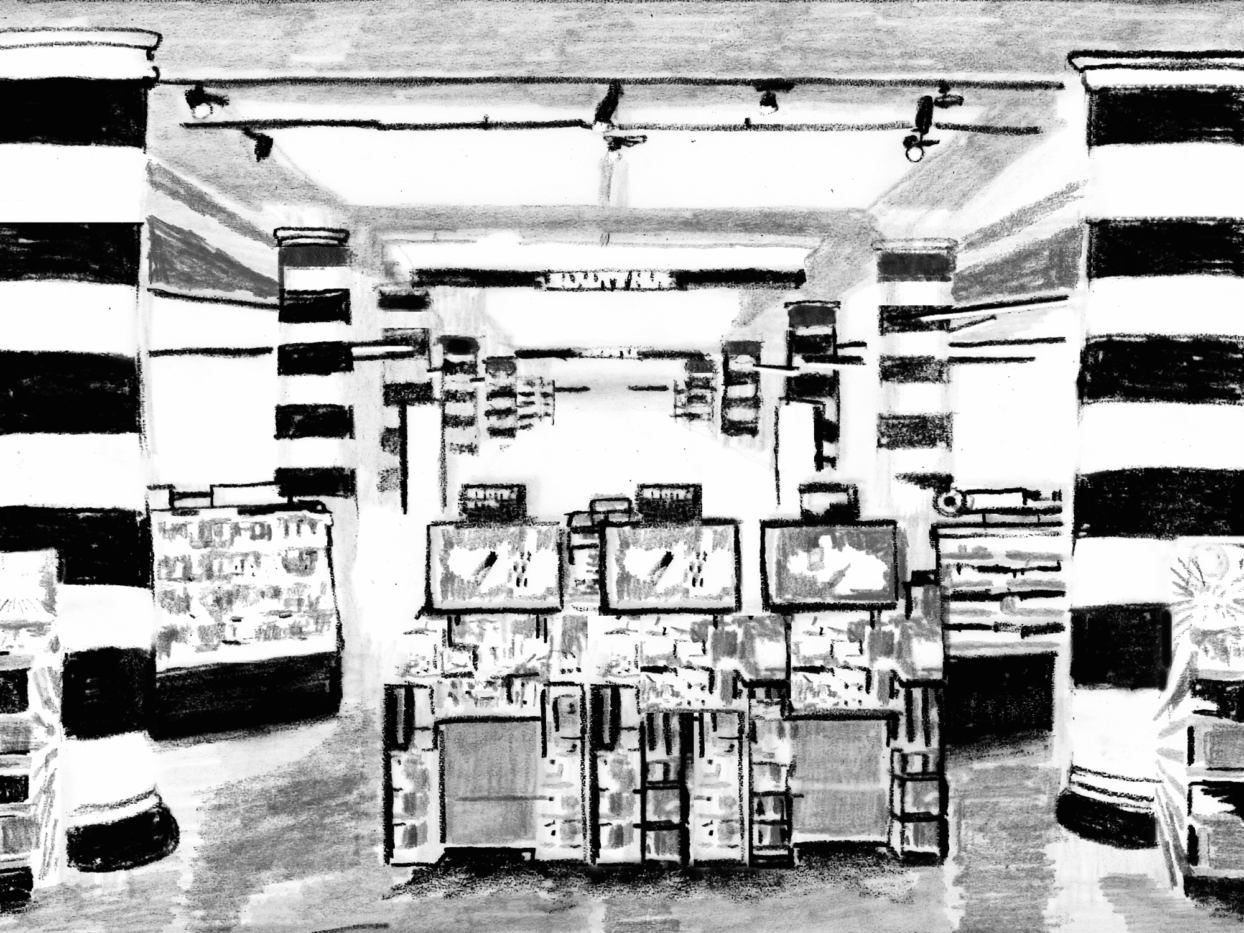
Image by John Kazior

Image by John Kazior
Marie recognized his wife the way she used to recognize her mother in a crowd of other mothers. Absolute certainty based on the scantest evidence: how she toyed with her hair, or untwisted a skirt. Marie had never met his wife, but fame, it seemed, could stand in for intimacy. She’d seen her in Vogue, arms akimbo, collarbones vamped, and in The New Yorker, staring down the lens with an auteur’s steadfast arrogance. She’d seen her in motion, too, in that one film in black-and-white, which emphasized her cheekbones. In other movies. In countless clips on YouTube, back when Marie was still searching for corroboration that what had happened didn’t have to have happened. That, their roles transposed, Marie could have succeeded as the wife.
His wife was umbrellaless, like Marie. Maybe she had also detoured into Sephora to escape the sudden downpour. Swarms of teenagers babbled winter, spring, glass skin into phones that seemed to grow out of their arms. Bearable only compared to the rain battering Broadway. As if no one else existed, his wife examined a beveled case of Dior lipsticks, hundreds of them.
“My wife,” he’d said that first night, after the opening, when they sat in the hotel bar, his arm heavy on Marie’s shoulders. The pause after those two words gave them the heft of a full sentence. “My wife and I have been married too long to not be honest with each other.” After that, his voice smoothed out. They’d married young, they loved each other with a placid adherence uncommon in their industry (he was a screenwriter, his wife’s frequent collaborator), so they would never divorce, but both marriage and life could become, for certain years or decades, exercises in endurance: of tedium, or of everything being perfectly good, even great. Still, the infinitude of each other’s faces…. She wouldn’t know anything about that, he’d added, being so young.
That was five years ago, when she’d been 24. And now he would be 54, just turned. His wife a luminous, needled 49. Aging, for her, a process of crystallizing into an image of herself.
“So your wife knows?” Marie had already decided to sleep with him. Yes, his wife, too, wielded her freedom when work kept them apart. They didn’t discuss the particulars or the people. His wife thought it wiser.
All those months he and Marie had been together, they’d talked this way: my wife, your wife. Marie came to believe that something weighty, foundational even, depended on that attenuation. Only twice did she hear his wife’s name in his voice.
The opening featured paintings of the artist’s mother, dead of cancer, in the style of various exalted portraits of women. Mona Lisa, et al. She was also launching a grief memoir. She balanced on a stool in the gallery’s front window, beside a writer known for books about women and illness. Asymmetries of renown did odd things to people: the writer was gaspingly eager, like a dog, while the artist exuded calm. When she saw the size of the audience, she smiled and shook her head. At the end, the writer asked what the artist would say to her mother, if she could speak to her right now. The artist’s tears shone in the white light. Phones rose. “I’d give anything to be able to talk to her again,” she said. A gallery assistant ran up, bowed so that her torso and legs achieved a right angle, and laid a tuft of tissues in the artist’s lap. “Mommy,” she said, “I love you.”
Marie had come for the free food. Two months of unemployment — a mammoth publishing house had bought then shuttered the imprint for which she’d worked as an assistant — had taught her creative solutions to the dilemmas of enforced frugality. She heaped toothpicked chicken bits (high in protein) onto a plate and moved from one painting to another. At ersatz Girl with a Pearl Earring, an editor who had been laid off at the same time as Marie joined her. The editor didn’t pretend to care about the art; she chatted with Marie while facing the wider room, alert for important entrances and promising knots of conversation. Marie made eye contact with the girl in the painting, who was actually middle-aged. The artist had referred to photos of her mother at different stages of life. The cheeks sagged and creased, like birthday balloons a week after the party. The eyes glared at Marie. A remnant of the photograph? The editor said, “Oh, look, that’s what’s-his-name, you know, he’s married to —”
Marie had shaken his hand, then the artist’s, nodded hello to the writer. The conversation progressed as if she weren’t there. When she excused herself, they sent fuzzy smiles in her direction. She ate a fresh plate, bacon-wrapped figs, in front of Madonna and Child with Pear. The mother was young again.
A man’s hand floated over Marie’s shoulder to point at the baby’s fist, which was brandishing a brown nub on a stem.
“How would you rate it?” The plate jumped. A fig fell to the floor. His laugh seemed to tear out of his chest. Overdoing it, she thought. “Personally, I’d give it a six out of ten,” he said, then introduced himself again. Paul. It was a boring name, not like his wife’s, which would be ludicrous on a math teacher, a flight attendant.
The way Paul told it later, he’d realized quickly that Marie’s quiet concealed intriguingly spiky thoughts. Treats that could be coaxed out by the right person. Her face was so reactive: an actress’s face — which, she assumed, would be the kind of face that appealed to him, a habit, even if he didn’t realize it. He was in the city for days of meetings and nights of socializing. He was tired, worn down most of all by other people’s talk. Watching her pricked him awake.
The pear looked more like a sad grape, she thought.
“I’d give it a zero,” she said. “I hate these.”
“What? Why?” Someone called his name once, then again, more vehemently. “Fuck,” he said. “Wait here, I’ll be right back.” She plucked the fig off the floor, threw the plate away, got her coat and scarf. Had there not been a line at the coat check, had she not paused to check directions on her phone, he might not have caught up with her outside. Later, they’d gloried in how close they’d come to not knowing each other. He’d once ventured the word fate. When he said that, she’d felt briefly ancient, amazed at his innocence.
Men, older men — you had to feel sorry for them when they brightened at the sight of you, pummeled you with courtesies and compliments, corrected your martini order, kissed the air beside your hair to snuffle at the scent of girl.
The head of marketing at her old job had declared, at a party, that watching her walk across the room had changed his life. He said this to a whole table of people, so it had the character of an oration. The listeners laughed and nodded. She wanted to vanish, ashamed, but not for herself. He was thirty years older, at least. He believed that she could desire him, wattled neck and all, and might willingly lick the penis that dangled below his belly like the cord tugged to inflate a life vest.
Yet women, young women, blushed at the compliments, switched martinis, pumped up the life vest. At another party, a newly divorced editor had issued drunken advice: “You’re still young enough to marry rich,” she said. She was trying to force both of her eyes to focus on Marie’s face at the same time. “Get Botox now, before you really need it.”
Paul hadn’t struck Marie as pathetic. Maybe he was just very tall, which concealed a multitude of sins in men. But he had the attitude of someone better looking now than in his twenties, and on her way out of the gallery she saw women hovering around him, their faces like pools of water, ready to reflect whatever flickered in their direction. Still, her age, or the chasm between her age and his, was part of what drew him to her. It couldn’t be otherwise.
In college, to avoid all men, she’d tried being a lesbian. After, she’d lapsed into bisexuality. Never a lover of men, though, the way some girls were, like if they never saw one again they’d feel robbed. Something deep inside her had always bridled at their fictions. The accommodation required. Maybe that’s all it was, not so deep after all: she didn’t want to be her mother.
Over a drink in the bar at his hotel, she quoted his own words back to him: “‘I think you and I might have some unfinished business.’ Do you normally say things like that to strangers?”
There was no venom in her voice. She felt his laughter in her ribs. They’d crushed into a blue velvet loveseat, more of an ambitious chair, rather than squaring off across a wide marble disc. His left arm settled on her shoulders, and she didn’t squirm away.
“So you do this a lot.”
“Oh, well,” he said. “My wife.…”
Upstairs Paul pulled out the wrong keycard, from some hotel in London, before he found the right one, and when he kissed her for the first time, he said, as if surprised, “You’re so little.” Maybe she’d misjudged, she thought, and this would end in awkwardness or erectile dysfunction.
“I’m sorry,” she said. His wife was tall. Why she knew this, why her brain supplied six feet, she couldn’t remember. It was that way with celebrities: knowledge colonized you, like mold.
“No, no. Don’t. Sorry. Just… let’s have a drink.”
Without waiting for her answer, he walked through the far doorway into another room — she saw a sliver of a bed — and returned a moment later with a small remote. Like an old man texting, he punched at it with his index finger. The lights lowered and an inoffensive piano tune, Chopinesque, started to play through speakers disguised as cabinetry. While he chose a bottle of wine, she removed her boots. Now she was even littler. One toe poked through her sheer black tights. If only she could afford pedicures. He stood facing a mirror that ran the length of a massive sideboard. She watched his elbows draw up, his reflection scowl down at the bottle. His hair was entirely silver in the back. He twisted the cork out in one violent motion.
He was trying to make this good. It was difficult to be the man in this situation. But the right gesture or phrase could ease them both, if she could find it. It was so rare to really have an effect on another person — even to know that you could, for better or worse, which might be the best reason to go to bed with anyone. Rather than little, she felt magnified by the curation he was attempting. She could smash it up. She could leave. She could tell him that she assumed seventy percent of the men who claimed open marriages were lying. She could call him a pervert or a cheater. The memory would lash him for a few days, at least. Instead she approached carefully, one foot in front of the other, as if walking a balance beam, and wrapped her arms around his waist. His shirt rasped against her cheek, and her toe dug into the plush carpet. One of his hands came up to grip her arm. In the mirror, she saw two minute letters, t and j, inked near his elbow. His wife’s initials.
It stung, though she chastised herself. She was no strict monogamist. Who could be, these days? She should feel as she had downstairs: that she was participating in an enlightened expression of human sexuality, wife and husband appropriately downgraded from spiritual identities to legal terms. You did have to give some kind of structure to love.
Sex is not a monologue, the R.A. had instructed the room of freshmen chewing on pizza. It’s a conversation.
Against the astonishing vastness of the bed, they kissed, as languorous and dedicated as eighteen-year-olds. Marie had surrendered any drive to accelerate in the other room, when he slapped her hand away from his belt buckle — hard enough to make a point. Now they were naked; he’d undressed them both. Two of his fingers inside her, her hand idling on his cock as she sucked his lower lip. She helped him rearrange her. Spread out on her back, he could touch her all over, his palms oddly calloused for someone whose job was typing — now was not the time to ask why — and he kept touching, first with his hands only, then his mouth, too, now gentle, now with teeth. Her thoughts were fading away. The image of a small boat adrift in a wide sea. Then nothing. Her voice cried out. A shock traveled through her legs and left them limp and useless. Then nothing again. An animal exchange, fuck the only word, and she understood only after, when they lay in the blue dark: this was sex, not discourse.
She had no idea what time it was. Some very late or early hour.
“Why didn’t you like the paintings?” he asked.
“They were too much. The whole thing was too much. It felt fake.”
He turned and pulled her against him.
“I just don’t think you’d be able to talk about something like that, much less make a whole show about it,” she went on. “You wouldn’t have anything to say.”
“Are you saying she didn’t love her mother?” He sounded amused. She wiggled against him, elbowed him lightly in the belly. He caught her arm. “I’m too tired to play. Tired and old.”
“I think people don’t let themselves feel what they really feel,” she said, “and instead they feel what they think they’re supposed to feel.” He hummed into her hair. Agreement or dismissal? Both? He must think she was so young. “If you really felt something, it would be awful to sell it to people.”
“I don’t know if you’re very cynical or very idealistic.”
She said nothing. She, too, was tired.
“What else do you hate? I get the sense there’s a lot.”
A long silence. She closed her eyes before answering. “I hated your wife’s movie, the one where she makes dollhouses.”
He supplied the title before kissing the back of her head, then the edge of her ear. “Why do you hate it?”
Marie had watched the film in a theater, alone, during that part of her adolescence when she was usually alone. It was a coming-of-age story about a young woman who aspired to be an artist: she staged scenes in the dollhouse rooms. She had a complicated relationship with her mother, and for most of the movie she dated a man who was a good artist and a bad boyfriend. He told her that her art wasn’t really art, just toys, because the dollhouses didn’t include anything real, by which he meant violent or evil. There was a famously uncomfortable scene at a dinner party hosted by the mother and a famous montage of the protagonist in her studio: dancing, painting dolls, singing, gluing, tapping a tiny hammer, creating. She broke up with her boyfriend and invented a miniature world populated only by women. She got a gallery show, a new man. Marie had begun to cry somewhere around the final triumphant turn and kept crying through the credits, one of those silent torrents that you wish would break into actual sobs. A teenage boy entered, jabbing a broom in front of him. She could still picture the red scurf on his cheeks, redder still when he recognized that most terrifying of figures, a weeping woman.
Marie wished she could explain to Paul the rage that had come after the tears. The conviction had trailed after her like a bad mood: that women were fated to be pathetic, even when they were artists, who should have more power than other people.
“I just do.”
“It’s not one of my favorites.”
A small disloyalty, at which she thrilled.
The next morning, he walked naked into the bathroom and grinned when she drew her fingertip along the chain of bruises that mottled her neck and shoulders. “I couldn’t help myself.” He bent from his great height to kiss one of the hickeys.
Then he addressed her reflection with such seriousness that she had to stop herself from laughing. He was flying to Athens that evening and would stay for a couple of months, to adapt a novel into a screenplay. It was best to write a place when you were in it. Did she want to come along? His penis prodded her back. It reminded her of a dog nosing at a hand. His wife would be filming far away.
The wife was sending an unpleasant text. The army of lipsticks reminded Marie of the huge Crayola boxes she’d always begged her mother to buy, with varying success. Somehow his wife projected displeasure without rumpling her face. Brow smooth, mouth even. There would come a year, Marie realized, when money would supersede biology, and the two decades separating them would vanish. They would look the same age, and then she would rocket ahead while his wife bobbed in place. What would Marie look like, when she was finally old? Like her mother, she supposed, though that seemed impossible. It also seemed impossible that the woman she saw when she closed her eyes and thought mother, the mother of childhood, was the same woman she saw whenever she forced herself to visit. Changes accreted almost imperceptibly. You had to keep constant watch to have any hope of spotting what was happening to you.
What if she said something unhinged? Your husband is good in bed. Asked if it was nature or nurture. Said, You don’t know me, but… You don’t know me. The truth opened into a void.
Paul’s wife slid her phone back into her bag — a Birkin, of course, in a piercing emerald. Her gaze glided over Marie as if she were a clearance rack. Back to the lipsticks. His wife didn’t recognize her, though she had seen a photo, once. A couple of weeks in, Paul had asked if he could send one, at his wife’s request. Marie, wanting to seem nonchalant, had stifled the urge to dictate which photo. When his phone buzzed a few minutes later, he’d reported, “She says, ‘very Gen-Z.’” A damning verdict, though he’d insisted it wasn’t.
“I’m a millennial,” Marie had protested.
“She just means you look young.”
So young she’d left no impression on the other woman. So young she would go with someone, just like that, because her ability to imagine herself altered by another person had been limited. And there was something nihilistic in youth — something depleted by 26 or 27 — as if so much had yet to happen that it didn’t really matter what did. Now, looking at Paul’s wife, she wondered if, for her, life had ever been so drab that recklessness morphed into wisdom. No: the wife had almost definitely never felt anything like that.
Not that Marie had been totally stupid about it. She hadn’t given Paul an answer right away. While he’d showered, she’d contemplated her options. Her room would have to be paid for, which was already tricky, given her lack of a job. She didn’t know he wasn’t a murderer, either. Her mother would worry. She could lie and say it was an internship at a publishing company abroad. Valuable experience. Paul, his hair damp, had paced around almost laughing at her objections, like the problems were imaginary. He would pay her rent in advance. He did laugh outright when she asked if he was a murderer, which hadn’t convinced her so much as let her convince herself that being even a little bit famous would make killing someone less appealing than paying them to go away. She texted a few friends with the internship excuse, and to her roommates, acquaintances at best, she offered no explanation whatsoever, just assurances about Venmoing the rent. It wouldn’t be long. It would be shorter than the study abroad program she’d wanted to do but hadn’t been able to afford. She would speak to her mother later. As soon as he’d issued the invitation, a vision had appeared. She would be a different person in a far-off place. She would claim something by seizing this chance. She wasn’t sure who she’d be or what the something was, but both would be an improvement on the present state of things.
The machinery constructed to manage Paul’s life processed her effortlessly. She didn’t have to do anything except retrieve her passport and pack a suitcase with the few items of clothing she could picture wearing in front of him. In the car on the way to the airport, he took several calls. None from his wife. To let her know he was thinking of her, he kept one hand on her thigh and rubbed it every so often, a little too hard. Each time, she smiled, taking care to look him in the eye.
At the airport, she called her mother. She had even looked up a publishing company, but her mother didn’t suspect any falsehood. After her mother got through the anxieties, she allowed herself some excitement: “I’m so glad you get to travel. I always wanted that for you. And you’re such a good worker, maybe they’ll keep you on, and someday I’ll visit you when you’re fancy and — speaking Greek.” Her mother didn’t have a passport. The future didn’t usually feature in their conversations. Usually they talked about Marie’s daily life, which she embellished with friends and accomplishments for her mother’s sake, and Marie’s childhood, which her mother liked to rehearse. She would cover her own life, or, more accurately, Marie’s father’s life, in a few quick sentences at the end of the call. “Your father’s new thing, the eBay thing, is going well, and he thinks…” her mother began. From across the first-class lounge Paul caught Marie’s eye and gestured to the full glass of champagne beside his empty one. “I have to go,” she said. “It’s time to board.”
In Athens the letters on the signs made Marie remember, or imagine she remembered, being so young she couldn’t read anything. A world organized by rules that no one bothered to explain, assuming, perhaps correctly, that she wasn’t ready to live by them.
The early days there were free — gone, all at once, the successive constraints of childhood, school, employment, unemployment — and circumscribed. While he was working, she walked large loops and played tourist. Her favorite room at the National Archaeological Museum was lined with faces smashed not by time but by the hands of people long dead. When she returned to the hotel, Paul would close the curtains against the stinging light and take her to bed. Afterward, she recounted everything she’d seen that day. Not things like the smashed faces. She couldn’t even say why they fascinated her, and, anyway, he liked stories about people. Two West African boys plashing in a puddle while their mother held a lump of dark cloth under the hydrant’s drip and scrubbed hard with the heel of her hand. A man shoving his phone toward a woman’s face, saying, “I told you it was Archaic,” in a French accent. The woman’s manicured hand — red nails — bashing the phone to the cobblestones.
After Marie’s recitation, she and Paul would have sex again, a lazier version, and then it would be evening. “Far away” meant Hawaii, a twelve-hour time difference. Paul took his wife’s calls on the balcony, the door shut. Through the glass, Marie watched his lips move.
“Tell me the story of you,” Paul asked once. She talked about West Virginia, trying to make the pervasive bleakness funny, which must have worked, since he responded with laughter and disbelief, as if he thought she might be inventing, when in fact she was sanitizing. He had grown up in L.A., his parents both involved in the mysterious financial back end of movies, careers as alien to Marie as her parents’ jobs — home health aide, church handyman — were to him. She told him about her father’s many, many side ventures, the moneymaking schemes that never made much, and her mother’s unflagging support for his ambitions, despite decades of chronic failure. She talked only a little about her mother. “She’s a small woman,” she said, trying to sum up her mother’s character, and Paul said, “Like you.” But Marie wasn’t even short. She was average; she’d checked. She could have said more about her past, but after she got to college on a scholarship, he treated the story of Marie as complete. His incuriosity didn’t bother her, though. Compared to his, her autobiography seemed barren, and she didn’t want him to see her as small, not in that way. In his company, she believed that interesting experiences would sprout up.
One afternoon, as Marie crossed a square that some guides recommended travelers avoid, a man’s voice shouted, “Hey, hey, hey! Hey! You! Lady!” She didn’t stop. A couple hours later, she crossed it again. The same voice yelled, this time louder, louder, till the man stood right beside her. “Sorry, sorry lady.” He was out of breath from jogging to catch up. “Are you American? I tried calling you in Greek and Arabic, but you didn’t answer. I thought you were Syrian. My friend says you are American.”
The man, Hama, was himself Syrian, though he’d been in Greece for seven years. In heels she would be taller than he was, and when he turned to point out a dry fountain, inviting her to join the men lounging there, she was exactly eye level with the snaking line of a wound, messily stitched, on the back of his head. The hair around it had been shaved, also messily. It gave the impression of a parasite, some mutant centipede, taking up residence on his skull.
The men’s eyes skated up and down her body. Though no one greeted her, she felt their awareness of her presence. By being there, she changed everything. A facet of her gender. She sat down in the space that Hama graciously offered to her. He opened a crumpled bag of Doritos and held it out even after she declined, so she took it. Inside, smaller bags of marijuana lay on a bed of chip fragments. “On the house,” he said. She tucked one into her tote, more out of politeness than desire. Her fingers came away caked with yellow dust. Hama smiled at her. “Are you thirsty? My friend is at the shop. He’ll be back soon. I’ll tell him to buy beer for you.” His phone stayed in his pocket. He leaned back on his elbows, beaming contentment. “You have a boyfriend? Husband?”
“A husband.” The hotel staff addressed her as “Mrs.” When this happened, Paul would raise his eyebrows at her, smiling, as if they shared a joke, and she would smile back, as if she got it.
The arrival of a man laden with grocery bags caused a flurry of delight. He handed bottles of beer around, bantering with each man. A few words of Arabic, a few of Greek, mostly English in an American accent. When it was his turn, Hama clasped the man’s hand with both of his and shook it. “My friend Matt. You are right, she is an American.”
“Of course she is.” Matt sat down on her other side, so that she was sandwiched between the two men, and she wondered if it was a performance they’d run before. “Your walk. I just knew. Fast, like you had places to be.” Hama, who had taken two beers, levered the caps off with a lighter and presented one to Marie. Her hand closed around the cool glass automatically. The two men clinked their bottles against hers.
“There’s nowhere to be,” Hama said. “Nowhere in this piece-of-shit country.”
“He’s had a hard week,” Matt said. Another man came up to them, and after a short exchange Hama rose, the Doritos bag still balled in one fist. They went to stand a ceremonial distance away, near enough to be understood, if you knew the language.
“Are they arguing?”
“Hm? Oh no. Just doing business.”
This was her chance to leave, while the only person to whom she felt she owed something was occupied. Instead she listened to the burr of the men’s voices. She felt Matt’s attention as if it were a hand on her thigh.
“Studying abroad?”
She shook her head and changed the subject. “Do you live here?” He did live here, after stints in Paris, Kosovo, Thessaloniki. He was a documentary filmmaker from Los Angeles. He planned to make a documentary about these men, in this square, but first he needed to earn their trust.
“Hence the beer,” she said.
“I also buy cigarettes.”
She laughed, as she knew he meant her to. He might announce he was leaving soon, and she might, too, and when they were far enough away from the men, she might fall in step with him all the way to his apartment. Afterward, he would play her clips from films he’d made. The possibility hovered like cigarette haze.
“I’m here with a friend. He’s a filmmaker, too. Or he’s trying to be. He hasn’t made anything yet.”
“Liars!” Hama said. “Why do they think they can lie to me?” He pulled a slightly crushed joint from a coat pocket and lit it. The wheezing inhale shook his whole body.
“What’s up, man?” Matt asked.
Marie scooted away from him and toward Hama, who talked between angry puffs. Last week he’d been attacked in the street. He didn’t see the person who hit him over the head with something hard and sharp enough to kill him. The doctor who stitched him up said his survival was divine intervention.
“I’m so sorry,” Marie said. Hama had such wide, sorrowful eyes. If she stretched out a hand in sympathy, he would accept. She could follow him, too, to a desolate room, a thin mattress on the floor. Surely he carried some kind of weapon. A knife. He would lay it beside the mattress when he stripped. “I should go,” she said. “My husband is waiting.”
On the streets that led to the hotel, she shrank from the men she passed.
When she walked in, Paul was still at his laptop. She knelt down to lean, almost nuzzle, into him, and he stroked her head. He lifted weights every morning; that’s why he had the calluses. “Baby,” he said.
Later she tried to tell the story the usual way she told her stories.
“What? You went with him? A drug dealer.”
“I mean, I didn’t go anywhere. I just stayed. Nothing bad happened. We just sat for a little while and talked.”
“Right. Of course. Nothing happened.”
“Why are you angry?”
“Why are you acting like it’s normal to hang out with strange men who accost you on the street?”
“I was never in danger.”
“How could you know that? You can’t know that.”
His phone rang. It lay in the middle of the bed, between them. She was faster, and for an instant she thought he might hit the phone out of her hand, like that woman with the red nails, who’d cursed and cursed. But he simply took it. The balcony door slammed.
Through the glass, she could see him smiling, talking, all normality and cheer. Anger swelled, first obscure and then blisteringly certain: he was leading a real life while she wandered around and waited for him to have sex with her. She brought back anecdotes like a dog dropping dead birds at a master’s feet.
At dinner, Marie counted four other couples mired in silence.
“I need a life,” she said. “I need things to do. I need a house.”
He surveyed her, looking older than before. This, she thought, was a face new to her, but not to his wife: a face experienced with, exhausted by, a woman’s demands. The impulse surged to sweep it all — sashimi, sake cups, soy sauce and wasabi curls — off the table.
“Okay,” he said. “Sure. A house.”
Not a house: an apartment that came furnished, with the amenities she specified to the broker. My husband needs an office, my husband likes a lot of light. For the first week she felt as if she were squatting. But the sense of unreality faded as she familiarized herself with the apartment’s beauties. It was strange how quickly it began to feel like hers. In the presence of ruins, her mind flitted back to those rooms, and she would have to rush home, as she thought of it, to move a mirror from the hall into the dining room, or adjust the angle of a lamp. Her outings became shorter, more focused. The organic grocery that sold one excellent and expensive version of anything you could want. The wine shop that each time sent her away with what the proprietors promised was truly special.
So she took over day-to-day logistics. She had his credit card, and the internet, to help. Meals required careful planning and sometimes hours of preparation. The whole day could be filled without leaving, though whenever he asked her what she’d been doing, the tasks never seemed to justify the hours. She never disturbed Paul’s writing, but he would periodically burst out of seclusion to kiss her or to pace in her vicinity, talking as if to himself about whatever he’d been puzzling over in the room they dubbed the library for its three sad shelves of books. The story of the script emerged piecemeal. At first Paul had been reluctant to talk about it, as if the idea could be spoiled by expressing it. He was adapting a book he’d loved for decades. A complicated, postmodern novel about violence and language and fraught love, set in Athens and Delphi. Someone else’s attempt to adapt it had been stuck for years before he’d gotten his hands on the rights. His wife — many people — didn’t think it could be done, or was worth doing. He believed in it, still, and Marie tried to show that she did, too. The apartment, she certainly believed, would make everything better. There she would smooth away the annoying bits of life and he would finally finish his script. He would thrive in a way he’d never been able to, at his real home with his wife.
When she called her mother, to distract from the fake internship, she confessed she was dating someone. Paul became Pavlos, age-appropriate, sweet but nothing serious. It wasn’t hard to invent anecdotes. Marie was a better storyteller than she’d realized.
On the street one day, a bus stop poster read “χιπ χοπ.” Hip-hop, she translated. An ad for an American music night. Errands had taken longer than she’d expected, dinner would be later than she’d planned, and she noticed only a few blocks on that she could now read a new alphabet.
Did she need help finding anything?
“Oh, no, thank you, sorry,” Marie said.
The Beauty Advisor moved on to Paul’s wife, who did not look up from the lipsticks and said, as if it were obvious, “No, I don’t need any help.”
Marie wished she could dismiss people so definitely. This need to apologize for imaginary sins, that was her mother in her. It slipped out if she relaxed her guard, just as when, in moments of shock, she seemed to always find her mother’s voice in her mouth.
“What’s wrong?” Marie asked.
Paul was stalking around the room. In certain moods, he made her think of a bear stomping through brush. Too large to notice the small things getting crushed.
“Nothing.” He unlatched the glass doors of a cabinet and fiddled with the knickknacks inside. Marie knew them all intimately, and knew he’d probably never paid attention to them before. He chose a small china doll, hair black and stiff as the bristles on a toothbrush, who leaned against a vase. “As usual I do all the work and she has a lot of opinions.”
“Your wife?”
“I hate this thing.” He held the doll up by her hair. “Can we get rid of it?”
“You can break it,” she said. “I don’t mind.” She had purchased it at a stall near the fish market. She’d liked the roundness of the mouth, caught in eternal surprise.
He let go.
“Thank you, baby.” He kissed the top of her head. “That’s what I needed.”
That evening, he received an invitation to a sculptor’s opening. She was lying in his arms on the sofa. His phone buzzed just as they were about to watch Jules et Jim, one of the films on the list he’d made for her cultural education. She had many gaps.
“Fuck,” he said, holding up his phone to show Marie. “They found me.”
“Who?”
“Them. The world. Everyone.”
“You don’t have to go.”
“He’s an asshole, but he’s an old friend.” The sculptor had perfected a process, involving sand and plaster, invented by Cy Twombly at the beach.
The show where she’d met Paul had some of the haze of childhood around it, a faint implausibility — because, she thought, now she fell asleep and woke up beside him, she’d seen him spit out wine from laughing, she knew which parts of his body chagrined him (his right foot, plantar fasciitis; his belly’s slackening skin, impervious to crunches). In two days, it would be two months since that night.
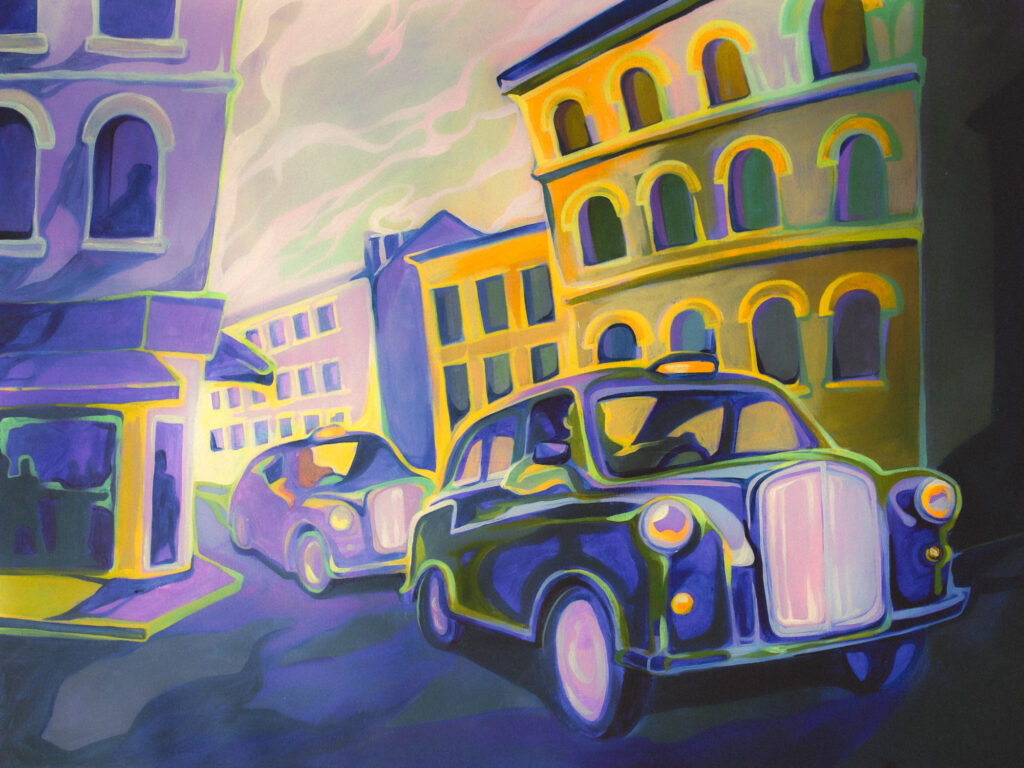
In the taxi on the way to the opening, Paul pressed kisses into her neck, nipping at it, even. She pushed his head away. Then he slid a hand up her dress. His way of expelling any urge toward tenderness, she realized, because as soon as they arrived, he changed. Now he was a married acquaintance, almost a stranger, who held himself a safe and impenetrable distance away, as if she might contaminate him. Each time he said a friend of mine, she pictured a blot slowly being rubbed out. Not even my friend.
She pretended to go to the bathroom and instead gulped down two flutes of champagne beside one of the largest sculptures. About the size of a milk carton, it resembled a driftwood hut except for the bubbling eruption of plaster, dyed a urinary yellow, that crowned it.
The sculptor must have been lying in wait. Not for her, necessarily. Any of the black-clad young women circulating would have suited. “Is that for me?” He nodded at the empty glasses. “No, no, I’m kidding. I’m glad you’re enjoying yourself.”
She shouldn’t be rude to Paul’s friend. “It’s a wonderful show. Congratulations.”
“Thank you, thank you. You know, it’s really just luck that no one did this sooner. Twombly was killing time while he stayed with Rauschenberg, he didn’t really care about sculpting. But for some reason I was the first to take his process seriously.” He continued describing his accidental genius. Nearby, a woman’s voice, brittle and English, asked, “And how’s your better half?”
“Excuse me,” Marie began. “I’m —”
The sculptor’s palm settled on her lower back. Thumb and index finger flicked down to brush across her ass, so briefly it could have been a mistake. She stiffened. “Sorry,” the sculptor breathed into her ear. “It’s the artist in me, I have to touch.”
You got married to your own marriage, too. Everyone did. But the fidelity required was higher if either partner was a public figure. People had an image of the union that Paul and his wife took pains not to betray. There were the real individuals, and the real marriage, and then the popular fantasy of all three. That’s why he’d been so cold all night, and yes, he should have warned her. He’d just thought she understood.
But Paul couldn’t help launching into action when he saw his friend touching her. All he could think about, he explained, was the time that the sculptor had boasted about getting a free blowjob from a Polish prostitute, which proved he was irredeemably stupid (one of the other men on the bachelor trip had paid for it) as well as being an asshole. Paul’s rage over the sculptor undid thirty years of time, as if he could once again row at dawn or run six miles hungover, and it was, in fact, with muscle memory from his college days as a bartender that he had yanked her away by one arm and stepped into the space where her body had been. “Don’t even look at her.” The restraint of middle age. Once, he’d have thrown a punch.
Wouldn’t it be easier — she asked the same night, in the tranquility after sex — to tell the truth? Open marriages, polyamory, nonmonogamy. Everyone was doing it.
“Oh baby girl.” Her purity, her naivete, he loved it. It shouldn’t have felt so good, this being claimed because another man had tried to claim her. Yet, like the kinds of sex that she couldn’t imagine he had with his wife, it made her feel like the goddess of something.
“I love you,” she said.
“Oh no,” he said, “you can’t.”
She didn’t argue. During, he’d sometimes called her “love,” which she thought verged on a confession.
In the night, she half-woke to a blue glow throbbing away the dark. Low, unrelenting buzz. Paul’s body flailing upright. Thud of his feet on the floorboards. Murmuring into the phone: his wife’s name, hold on, hold on. The door whispering shut.
“Did someone call really late? Or did I dream that,” Marie asked over breakfast. She’d risen early to bake an asparagus quiche.
“Oh, yeah, sorry for waking you up. My wife just wanted to talk about some things we’ve been having trouble figuring out.”
“Things?”
“The timeline on this project. What comes next. She’s finishing up soon. She… gets impatient.”
The quiche counted as a success — neither greasy nor turgid.
“Does that mean you’ll go back very soon?” she asked lightly, as if her presence weren’t inextricable from his. Her joblessness menaced again.
Paul hesitated. “Well, we talked about it, and I’m going to stay for at least another month. Maybe two. I want to finish the script before I leave. So we… negotiated more time.”
“Why are you being so weird?”
Next, a broccoli quiche. Or a galette. What was the difference? She would look it up.
“I don’t know.” He shrugged. “Am I being weird?” Behind him, through the balcony doors, light flooded the rooftops and that white church on the top of the hill that they’d never climbed up to, though they’d said they would. “She wasn’t happy, but she understood.”
That was the thing about wives — wives weren’t happy but they understood.
As Marie loaded the dishwasher, she imagined his wife lying on her side, knees pulled up, her mouth open in a soundless roar. A scene from one of her films, and then replicated in a YouTube video titled THIRTY-SEVEN SADDEST WOMEN CRYING SCENES — HOLLYWOOD MOVIES!! The fruits of Marie’s Google searches. Another video: if there’d been a single moment when she fell in love with Paul, his wife said into the camera, it would have to be when she first shared something she’d been writing in secret, unable to admit, even to herself, that she thought it could really be something. It was hard, she continued, to go from being an ingenue to being a creator. People didn’t take you seriously. They thought you should know your place. You’re an actress, she’d been told. If he hadn’t supported that first script so fiercely, would she have fought her way through? She didn’t know. It was so nice to believe that some artistic drive and self-confidence would have kicked in, but…. And — his wife laughed, a beautiful laugh in a beautiful mouth — he’d returned it to her all marked up.
The interviewer covered her own mouth to demonstrate shock.
Yes, he gave the script back full of edits. That was still how they worked. One person writes, the other edits. “Symbiosis,” she said. “That’s the biological term. We call it marriage.”
She shouldn’t have started Googling the wife. Once she did, however, she felt liberated. Maybe Paul’s wife had never felt that thrill.
Famous people were real people. Still, it was hard to imagine his wife searching the name of a rival and scrolling, clicking endlessly, till she found the clip, a sliver from Chicken Shop Date or Jimmy Fallon, that proved the rival was radically worse than everyone said, an utter fraud, and probably a bitch, too.
At least Marie had gleaned a lot from the searches. His wife had casually volunteered in interviews things she was sure that Paul would have never told her had she inquired. Why they had no children, for instance. The wife had felt, when they considered it, that there existed an irreconcilable conflict between art and womb. She was too obsessive. A monomaniac. But she loved children! She was lucky enough to be a godmother and an aunt several times over. Her own, though — only in another life.
Marie saved that interview to watch again, and again.
A week after the middle-of-the-night call, Paul asked Marie to climb to the church and watch the sunset from the top of the hill. “It’s for a scene,” he admitted. She liked that he couldn’t meet her gaze. She would have done anything for him, right then.
Their path led around the hill’s base. They would ascend from the opposite side. That was roughly the route taken in the novel.
“It’s giving me trouble, this scene where the main character is running here and almost gets shot.”
“What’s wrong with it?”
“I don’t know, I really don’t know.” They were rising quickly now, following a mulched path that would become mud in the lightest rain. “It’s not even complicated. But something’s off.”
The path veered left, and up. Then some pitted steps, the same limestone as the hill, the last of which pitched you forward onto a wide cement staircase that wound around the eastern side all the way to the church. She was lagging behind. Even her relative youth couldn’t compete with such long strides.
“Go ahead,” she said. “You’re working.”
“Sorry baby. I’m a dog with a bone.”
“See you at the top.”
He saluted, and was gone before she caught her breath. She turned around to try to get a sense of the geography below. From this side of the hill, she could see the neighborhood where she’d met Hama and Matt. If she went a little higher, she would be able to pick out that square and the park beside it, a clump of green.
When she turned back, a man stood there smiling as if he’d been expecting her. His arms were shoved into the front pocket of his oversized hoodie. “Are you lost? Need help?”
“I’m fine, thank you.”
“I can show shortcut.” From out of its burrow slid one arm, startlingly white, like the rocks on the slope above, which he pointed to. It would be a bit of a scramble. Above, she could see larger slabs of rock and a thickening of trees. No sign of a path. “Best view.” His hand, she noticed, was covered in scratches. From the rocks and brambles?
“I think I want to take the long way.” She was edging by, and he was still smiling, still pointing, like some fairy-tale creature. “It’s my first time.”
“This is much better way,” he said. “Pretty, fast.”
“My husband went this way,” she said, and then she ran.
When she found Paul at the top, she tried to make the encounter funny, but it was another story he didn’t like. “Fuck,” he said for the fourteenth time. “I can’t believe it.” They were at the bar on the terrace just below the church. An odd contrast, but even people who rode up in the funicular, the ultimate shortcut, wanted a reward besides the view. He’d ordered rakomelos. Strong ones. The smell burned. “Are you really okay?”
“Yes, just a little freaked out.”
“How does this always happen to you? I mean, I leave you alone for one minute, someone’s trying to kidnap you or something.”
“Too bad it didn’t happen to you.”
“It is too bad. It’s exactly what I needed.” Tourists spilled down the stairs. A man photographed two children so that they loomed like giants against the distant Acropolis. Strobe lights pulsed to the music, a palpitation of drums behind a violin. The blue-and-white flag stuttered down the pole into the soldiers’ stiff arms. “It’s the danger. In the book, you get the feeling that any moment someone could die. I need to find the tension. But with this light.…” He swung his glass in the air. A glow seemed to rise from everything around, not just the red sun perched over the mountains. “It’s tough.”
She knew what he meant. Wasn’t that scarier, though — seeing the acts and desires normally confined to darkness? The man who tries to lure you off the path in broad daylight is worse than the one who lurks in the shadows.
“That’s good, really good.” He was scribbling in a tiny notebook. “I think I know what the problem is,” he said finally, looking over what he’d written. “I need to make the protagonist a woman. The relationship to violence changes.”
She laughed. “It really does.”
“Sorry, baby,” he said. “I know you’ve been through a lot.”
An average amount, for a woman her age. Childhood, by its restrictions, made girl a governing word: what girls did versus what they didn’t, each a category requiring diligent attention. A church that demanded constant penitence given the body’s sticky propensity to sin. A father who exerted plenty of malice, more through words than fists. From outside the home, an ordinary dose of suffering. Mild bullying from teenage girls whose yearning and self-hatred were as obvious, in retrospect, as her own. Paying the standard tax for walking around woman-shaped: catcalling, groping, unwanted kisses, different varieties of forcing and squeezing. Grown-up variations on the old Do and Don’t lists. But no rapes, no great tragedies.
If she opened her mouth, she might cry. “Okay,” he said. “I see the shock is setting in. This time you’re with me. No running off.”
The trip to Delphi would last a day and a night and most of another day. It wasn’t far from Athens, only two-and-a-half hours by car. Like going ten miles in L.A., Paul had joked. But he wanted to be sure to get a feel for the place and to hike up to the Corycian Cave, above the ruins. That would occupy the second day.
They had to set alarms for an unnaturally early hour. Getting out of the city was hell. They nearly hit or were hit by at least a dozen mopeds. Marie forgot a cornucopia of snacks and drinks at home. At the gas station where they bought cheese pies and bad coffee, she thought mournfully of the sandwiches she’d crafted on hefty slices of sourdough. By the time they returned, everything would have gone bad. The sky blued briefly, then attained a steady gray. The earth began to rise and so did they, following the signs to Mount Parnassus. The clouds drew closer, as if the sky were lowering itself onto the small white car. Paul drove — he didn’t enjoy driving but rejected her offers to take over — and she sat quietly. “Awful day,” he muttered.
“The weather app says it will clear up.”
“If the weather app says.”
Silence for the rest of the drive.
Only one road seemed to run through Delphi, though on the map it was an actual town, large enough to have a hotel where they would spend the night. One side of the road tipped into a huge valley. Its depth and position, between three peaks, made it look oddly fake, a landscape invented for a film. A strange place to choose as the birthplace of civilization, or the earth’s vagina, depending on how literally you took the nomenclature and geography. It had an unhappy feeling, like you might get trapped forever.
He’d hoped that by leaving so early, they would avoid the worst of the crowds. This dream died as soon as they entered Delphi. They drove up and down the same stretch of road for half an hour before a spot opened up. “At least we know where to go,” she said. Everyone streamed in the same direction.
At the ticket booth, they learned it was a minor holiday, the birthday of some famous Greek actress, so entrance cost nothing. “Maybe that’s why there are so many people here,” she said. He fed the remnants of a cheese pie to a stray dog swollen by untrimmed fur. A sweetness she wished she could redirect.
In the twenty minutes it took them to reach the gates of the ancient site, his mood blackened further. The merciless chatter and signs of commerce. You could buy anything, everything. He complained as they spiraled uphill into the ruins.
“It’s not worse than any other place like this,” she said.
“It’s hardly spiritual, is it?”
All the other visitors, it appeared, were portioned out by nationality into large groups. The two of them forced their way through knots of German, Italian, Chinese. When Paul tried to photograph the ruins of Apollo’s temple, some Russians got in the way. He swore. Marie paused, pretending to be absorbed by a sign, so that he and his anger would go on ahead. Many theories existed, she read, as to what, exactly, made the oracles oracles. Drugs, effusions of underground gases, priestly fakery, genuine inspiration…. They knew so little that they didn’t even know the ages of the women who had served. Some thought they were barely teens, others that they were older women, in their thirties, who resigned from marriage and family to take on the position. Still others favored a synthesis: the oracles had been young at the start of the tradition; the eventual switch to older women was a response to the inevitability of rape. Whatever the ages, no one knew whether the women volunteered or were conscripted.
Paul was out of sight and, she hoped, mollified by some unanticipated discovery. An epiphany he could share with her would help. Her mind returned to the oracles. She pictured them as artists, basically: women who chose their paths and knew what they were doing. Not girls blacking out after men poured spiked drinks.
She found him sitting on a large flat stone far enough off the prescribed path to be defiant. She leaned against him and draped his arm around her shoulders. He let her — simply allowed it to happen, and the fact that she was touching him quickly felt like a violation, but she couldn’t withdraw without saying something. His wife would know, she thought. Not just what to say but whether to cajole now, or mock, or ignore. It wasn’t fair. None of it was fair. The clarity of the wife’s role. The limitations of Marie’s knowledge.
The inn’s decor aped that of a ski lodge. Their bedframe appeared to be constructed of trussed logs. It all offended Paul’s sense of the beautiful, but Marie put her faith in wine and sleep. At dinner, Paul asked the server — the son of the woman who ran the place, Marie guessed, fleshy the way teenage boys could be, but somehow handsome in his blunt youth — for advice on the hike. Was the cave hard to find? How long did it take, there and back? The discussion required summoning an older brother and then an uncle, both of them less handsome and more hirsute, to offer competing opinions on length, difficulty, and route. Afterward, Paul turned to Marie as if she hadn’t sat through the whole thing: “We’ll need to set out no later than seven.”
“I heard.”
“And,” he continued, “next week we’ll get you a flight back to New York.”
“What?” she said, too slowly.
“Baby, don’t be upset. You look like I killed someone. It’s just time. You knew this wouldn’t last forever.” Her head was roaring. “Besides, I need a little while alone.”
“Before your wife comes.” He sighed as if no worse suffering had ever befallen a man. “Jesus,” she said. “She is coming.”
“No, not for a while. Not for a few weeks, maybe a month.”
“She’s coming here so I have to leave.”
“It’s not like I can just have her in our apartment. I have to move, I have to write….” He paused. “I have to write. It’s been amazing, with you, but I took this time so that I could work. I’m not getting anything done. It’s all garbage.”
She would have preferred he punch her in the face with the full strength of his twenty-year-old self. “And that’s my fault.”
“It’s not your fault, it’s a — a side effect. I just need to clear my head. You understand, don’t you.”
“I’m sure your wife will be able to clear it.”
“Baby, you have no idea what being married is like.”
Her mother’s face, her father’s — glaring as if they sat at dinner wishing death at each other. “Isn’t that why you chose me?”
“God. You don’t know. My whole life is —” The wife’s name, spat out, the way he might say it when they fought. “Her ideas, her projects. I just wanted one thing for myself, and it’s probably not even going to work out. She doesn’t think it is…. Fuck. I need to be done with this. I’m sorry. You’re great, baby.”
The pieces of the broken doll, Marie had swept up and placed in a cardboard box before setting the box inside the garbage can. What fruitless care.
Every relationship had a wife. Anyone could be a wife. The role was defined by its functions. The wife’s essential function was to ease the husband’s passage through the world. The other functions followed from that. A wife played many roles within the overarching one; her vocation demanded ingenuity and adaptation. But a wife was never an artist. To be an artist was to be selfish. A selfish wife was an oxymoron. The wife would no longer be a wife. Marie, it turned out, was neither artist nor wife.
They’d gone to bed silently. She expected his breathing to become snoring while she lay awake for hours, but suddenly he wrenched her to him. Then wordless, resentful fucking. Nothing like ever before in her life. It was as if Marie both acted and watched every movement, both was and wasn’t herself, the byproduct of straining not to let the pressure behind her eyes slip into tears or worse, whatever that would be. He wanted her on her knees, his hand shoving her head into the mattress, but he let her wriggle out and flip them both. Smoothly she slid down, a now-familiar motion, and leaned forward. He gripped her face tightly and then she gripped his and they rocked like that, eyes open. It was so strange, sex’s way of seeing — like a conversation, truly, but one in a language as untranslatable as the logic of a dream.
What did he tell you? Am I part of the story of your marriage? Without thinking, Marie stepped closer to the wife, brushing the back of her hand against the long camel coat, softer than anything.
Maybe it was time to admit that if Marie were the kind of woman who would make it as a wife, she would have done it by now. A couple years ago she’d tried cohabitation with a man who believed all problems could be solved by talking about them. When she left, he said that she repelled intimacy. The commitment, while it lasted, had been a surrender to mutual convenience. Not that old kind of marriage, which caught you young.
Paul’s film had never been made. For the first couple years she’d looked out for it. She wouldn’t have missed the news, and periodically she wondered if it really had been bad, or if it had never even gotten to the stage of being declared bad or good. Which was worse, awful or unfinished? Some unaccountable loyalty, still, made her shrink from contemplating his failure. Even if Marie were to approach his wife, she wouldn’t ask about that. Bad luck, industry caprices — that was the most likely story in any case. He and his wife still collaborated. Marie had spotted him in a “Green Flag Hollywood Husbands” Reel and flicked up fast to make the image disappear. He’d racked up writing credits with other people, too, even doing a crucial rewrite for a superhero movie that earned billions.
Remembering his desperate concentration on the hike up to the cave, she couldn’t believe that kind of triumph would satisfy him. But people do become unrecognizable. That day had been spent with a new man. He’d been set free by his revelations and decisions. He was free, even, to be kind to her. All she’d wanted was for him to feel an agony that matched hers. On a particularly steep section of the trail, over which they had to scramble on hands and feet, a rock slipped from under his boot. He slid down a couple of feet. She pictured him falling, falling, till his head slammed into a boulder. Laughter, sudden and incongruous. But he laughed, too, and planted his foot on more reliable turf.
Marie bent toward the reds, as if seriously contemplating a purchase, a pretense that must have been convincing because his wife’s diamonded fingers flicked toward her Birkin and away again, this time without the two lipsticks she’d been holding, as if they’d never been in her hand. But Marie was sure they had. His wife straightened and while nothing about her had seemed indistinct or uncertain before, now she became solid — that was the only way to describe it. She cast a glance around the store, over the top of Marie’s head, and found it all as she expected, not worth further attention. She turned toward the glass doors. The rain had stopped. An excess of light pooled on the sidewalk, right where someone had carved UR NEXT into wet concrete.
It was a relief to follow, just to follow. His wife headed north. Her stride was confident, unhurried; she seemed blessed by the secret she thought belonged to her alone. Marie, who knew that secret, could afford to be generous. His wife, too, was a person.
“My wife would hate this,” Paul had said at the cave mouth. Marie didn’t ask why, and he didn’t elaborate. They had to bend to enter the dark triangle, but only for a moment. Then a vault soared above them and they were in the first chamber. There were many more, he told her, some so skinny and low you’d have to crawl and pray. He’d watched videos. On a flat rock near one wall, bits of rock and, she guessed, bones had been arranged in a circle. He crisscrossed the chamber manically. He needed to see everything. Away from even a hint of sun, the cold deepened. She hated it.
Marie zipped her jacket and sat down against the wall across from the creepy circle. Better to keep it in sight and far away. She didn’t know how long she sat there; it felt like hours. The cold made her sleepy. She nodded and clasped her knees when he announced he was going to the next chamber. “Poor baby,” he said, “I’ll be quick.”
In the novel, a cult of sorts conducted rituals in this cave, reinventing practices from thousands of years ago. This cult worshipped language, though, not ancient gods. As Marie waited, the shadows began to dance in a way that made no sense, given the single source of light. Then people bearing torches emerged from the deep shadows. Men and women, all naked. So many of them, now standing in a circle, waiting. Preparation, she sensed, but for what.
When Paul woke her, she didn’t tell him about her dream. Already they were detaching from each other. When he helped her jump a patch of loose dirt on the way down, he dropped her hand right away. Just a man doing a good turn.
His wife took a left on Prince Street. At the next light, other pedestrians, dressed to be photographed, like everyone in this neighborhood, cast curious glances at the wife, as if they thought they ought to recognize her or would only after she’d passed. She didn’t acknowledge them, didn’t look anywhere but straight ahead or down at her phone. Marie expected her to disappear at any moment into a black SUV, away from plebeian ground.
My wife and I have been married too long to not be honest with each other. Even then she’d thought it was a strange formulation, as if truth and longevity automatically coincided and marriage arced bullet-like toward transparency. Could you ever stop concealing the parts of yourself that are only yours — dispense with the last fictions anyone maintains? Maybe Paul did know that his wife shoplifted. Maybe that was a secret the three of them now shared.
His wife swiped at her phone and raised it to her ear. Whatever she said flew ahead of her, and Marie heard nothing. The wife sped up into the intersection just before the light changed. Marie had to run to make it. Half a block, less, and then she suddenly wheeled around, walking just as quickly back toward Marie, who froze. Their eyes met. Inexorably, the wife approached, and then, grimacing away from Marie — the weird woman in the street, that’s how she must appear — she ducked into a restaurant. She had simply overshot her destination and had to turn around.
A window with gold lettering. Inside, little more than a bar counter and four tables. It emanated expense. A suspendered man was taking the camel coat. Marie could step inside, too, and sit at the empty corner of the bar. It was eminently possible, no one could say she didn’t belong. She was already approaching the door when another man rose from a table. It took too long to recognize Paul. He could see her now, if he looked out. He might have already seen her. Marie felt old and wearied, like an oracle to whom the couple’s future gleamed as clear as its past. Recognition changed nothing. The structure of their love held. Like she wasn’t there — like she never had been — he bent his head, only slightly, and kissed his wife.
Elisa Gonzalez is the author of Grand Tour.