

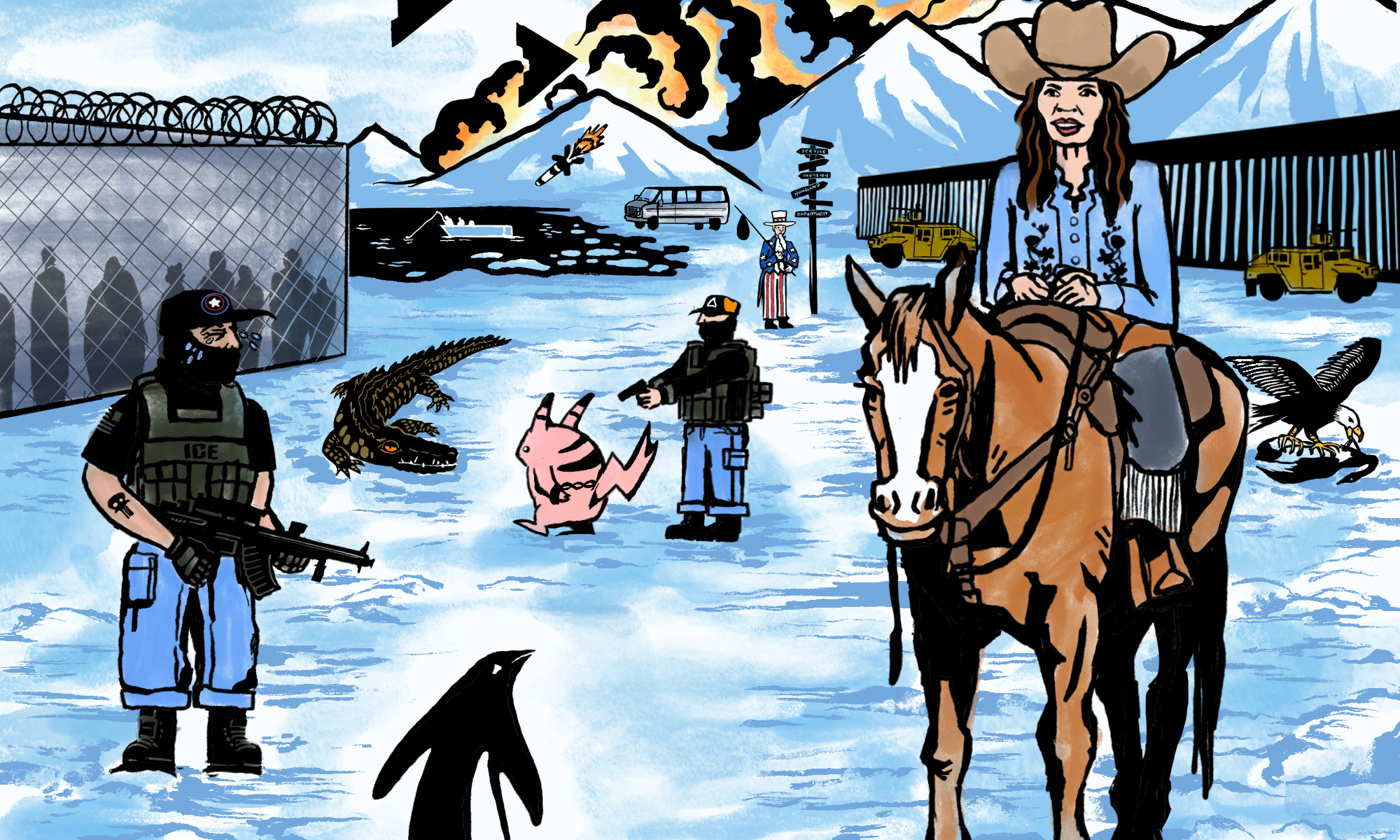
In the video, the penguin waddles across a frozen expanse. He is heading away from his colony, into Antarctica’s vast interior, alone. Nothing can stop his solitary march: even if he were caught and returned to the colony, we learn from the sandpapery, Teutonic voice of Werner Herzog, he would set right back out toward the mountains. “But why?” Herzog asks. The video’s caption answers: “Americans have always known ‘why.’” The organ music swells, fugue-like, and suddenly here is Donald Trump, smirking and holding up an executive order, or perhaps a bill. Dissolve again, into some scenes from the new world this document seems to have conjured into being. A man in a vest marked POLICE scans a Southwestern landscape with binoculars, while a blurry corrugated-metal structure — a wall, or the promise of one? — looms just out of focus. Supercops in full military gear pose in front of Humvees; Secretary of Homeland Security Kristi Noem (not yet fired) lowers her face in contemplation, almost melancholic in the flashing police lights, as agents carry out what looks like a home raid in the background. “God bless ICE,” a homemade sign reads. Prison gates open to swallow up a crowd; assault vehicles mobilize; people are hauled away; a politician pumps his fist. In the final frames, the logo of the Department of Homeland Security appears, superimposed over a clip of a lone trooper jumping from a great height. His parachute has not yet deployed, and he is free-falling into the void.
The video, which was posted to official DHS social media accounts late this January, got mixed reactions. Many commenters were fired up: “God bless ICE ❤️🔥,” one wrote. “Manifest Destiny,” wrote another. A third: “Unfathomably based.” The penguin, it seemed, was supposed to be an icon of American individualism. He is seen carving his own path, striking out into the wilderness that both terrified and beckoned to the Puritans. “It’s a metaphor for going your own way & exploring and doing things outside of the pact [sic],” one commenter helpfully explained. Around the time the first video appeared, Secretary of Health and Human Services Robert F. Kennedy Jr.’s accounts shared what appeared to be an A.I.-generated video of the secretary and the penguin headed for a range of snowy mountains, beneath the text: “The mainstream made us sick. Choose the healthier path.” The White House chimed in with its own riff: an image of Trump and the penguin, hand in flipper, the Greenland flag waving in the distance.
Before the DHS posted its video, according to Fox News, right-wing TikTokers had already seized on the penguin, editing the original clip from Herzog’s 2007 documentary, Encounters at the End of the World, to include “images of Western heroes: Joan of Arc, Alexander the Great, Aragorn, Jesus Christ, King Baldwin IV, and Luke Skywalker.” These figures did not just go their own way; they also, at least within the memes’ logic, rallied the people against the enemies of faith and country. The penguin answers the call, subordinates himself to the higher cause. One of the most-liked comments on the DHS’s Instagram post tellingly features a GIF of an endless army of cute cartoon penguins marching storm-trooper-like, brandishing American flags.
Outside the hothouse atmosphere of the extremely online right, many were puzzled by the DHS post. Did the staffers who run the government’s content mill somehow miss the setup for the penguin clip — in which Herzog poses the question, “Is there such thing as insanity among penguins?” — or the commentary that immediately follows it, in which he says that rogue penguins are “heading toward certain death”? Even without this context, how could anyone take a “nihilist penguin,” as the clip’s widely memed subject had already come to be known, as a symbol of the American frontier spirit? How could this figure embody both that rugged individualism and the self-sacrifice of a totally mobilized society? Is it cucked and soy to point out that Greenland and Antarctica are on opposite sides of the globe? Opposites converge: insanity and reason, self-actualization and self-annihilation, Jedi and Stormtrooper, bootstraps and jackboots, North Pole and South.
For the past year and a half, it has been someone’s job to generate and post content like this on behalf of the government. We have seen clips of deportations set to pop music soundtracks. These videos often contain jokes or puns or rhymes, through which some aspect of the soundtrack takes on new meaning when paired with footage of the state bringing down its might on non-white people: the Pokémon theme song playing as agents break into homes and haul people out; Sabrina Carpenter’s “Juno,” with its mention of “freaky positions,” over shots of officers cuffing and manhandling people. We have seen supercuts of drones, boats, and other vehicles; these clips are more like car commercials, complete with active-rock guitar riffs. A more recent innovation has been silent, night-vision footage of soldiers commandeering oil tankers; these posts feel more like leaks, the kind of secret material previous administrations may not have wanted the public to see, and certainly did not want to distribute themselves. The “Macarena” pops up often — another unofficial anthem for a president who loves a line dance. Only when something particularly egregious happens, as with the murders of Renee Good and Alex Pretti in Minneapolis, is the carnival of memes interrupted for a dull press conference.
If the first Trump administration was a regime of words — the years of presidential tweets and unfiltered musings; of covfefe, grab ’em by the pussy, not sending their best — the second is a regime of images. Of course there were totemic visuals in those earlier years: tiki-torch-wielding neo-Nazis, gas-masked cops streaming out of burning precincts, face-painted hordes descending on the Capitol. (Crowds and fire were notable motifs.) But for the most part, the novelty of the first administration’s political style lay in its desublimation of speech. How could he say that, liberals were always asking. Today’s unofficial MAGA slogan, in contrast, is You can just do things — that is, the government can flood the streets with murderous federal cops, or start a war with Iran without waiting for Congressional approval, let alone making any real effort to manufacture the public’s consent. Funnily enough, this change mirrors a reverse development, a shift from an administration of professional doers to one of professional talkers: from career bureaucrats like Steven Mnuchin and Jim Mattis to the posse of podcasters, news anchors, and health influencers who stalk the halls of government today.
We hardly need a decoder ring to see the images produced by this cadre as crude, jingoistic, and bloodthirsty. The images wear their malice openly, with shit-eating grins. One recent video shared to the White House’s X account — in which a clip of SpongeBob asking, “Wanna see me do it again?” is followed by night-vision footage of a drone strike, apparently on Iran — seems to respond tauntingly to Iranian cleric Shahab Moradi’s 2020 statement that SpongeBob and Spider-Man are the closest things the U.S. has to national heroes. Everything is right there on the surface. Already in the first Trump administration, debunking the government’s false claims was a losing game. Today it is utterly nonsensical: the penguin image cannot be “brutally fact-checked,” as one news organization purported to do to the post; it is not a claim to be awarded “Pinocchios” or designated “Pants on Fire.” It is something altogether different.
What are these images if not false pictures of the world? One answer has been that they are enforcement tactics. Noem, the now-fired Secretary of Homeland Security tasked with overseeing the second Trump administration’s mass deportation program, brought the style of the right-wing internet to the DHS. Last year, she posed in a military-chic outfit, complete with a fifty-thousand-dollar Rolex, in front of a cell full of prisoners at CECOT, the now-infamous Salvadoran prison to which her department has been sending people more or less indiscriminately. She invited Chaya Raichik, of “Libs of TikTok” fame, to ride along with her and document ICE raids. She ran “Alligator Alcatraz,” a prison hastily conjured from the muck of the Everglades, which mostly seemed to function as a set for producing content, while detainees faced conditions that according to Amnesty International constitute torture — “the concentration camp reimagined as a hype house,” to use Ryan Broderick’s apt phrase. This flood of content served a strategic purpose. As Melissa Gira Grant wrote last year, circulating these images of cruelty allows the DHS to “terrorize many more thousands of people than they can deport.” The image is deputized, put to work.
But the administration and its images often work at cross-purposes. Noem, to the extent that she had creative control, couldn’t seem to stop inserting herself into the DHS’s content. This self-promotional frenzy culminated with a video depicting her in a cowboy hat, riding a horse through a stretch of big-sky country. “Why do I love these wide-open spaces?” she asks. “They remind me of why our forefathers came here. Not just for its beauty, but for the freedom only America provides. I’m Kristi Noem.” A choreography of promise and threat follows: stock footage of skyscrapers and rocket ships and wine bars for those who “come here the right way,” in Noem’s words; platoons of armored cops for those who do not.
This video, which was part of a broader $220 million ad campaign with vague goals, seems to have drawn the president’s ire and likely contributed to her eventual firing. In a March hearing before the Senate Judiciary Committee to address concerns about her leadership, Republicans like John Kennedy and Thom Tillis took Noem to task for her dizzying expenditures on ads in which she “featured prominently,” as well as for making decisions primarily “for the expedient [sic] of social media.” There was a general sense among Noem’s Republican critics that the map had overtaken the territory, that she had prioritized making content over doing her job. Even in an administration of grifters, each official has only so much latitude for their own hustle. Noem had perhaps taken too seriously her mandate as chief nativist influencer. She had girlbossed too close to the sun, waddled too far into the icy wilderness.
Another way to describe the problem the Republican senators had with Noem’s videos is that they were both not doing enough and saying too much, more than they intended to say. Which is to say, they seemed to have an unconscious. Watching the Cowboy Noem ad, which seems to have been made for TV by a different group than the one in charge of the DHS social media accounts, I was struck by how closely the first shot — the secretary on horseback, facing away from the camera, heading out into the wild interior — mirrors the Herzog clip. The lone figure hoofing it, flippering it, into a terra nullius. Headed for destruction, but not knowing or caring. The second-term content we have seen so far tends not to advance a coherent argument so much as establish a chain of vaguely suggestive equivalences. The penguin is the archetypal American frontiersman, is Trump, is the squadron of ICE troopers, is Aragorn and Luke Skywalker and Jesus, is Kristi Noem.
The associations also ramify outward, away from the references that the images’ creators intend. The penguin clip rhymes obliquely with another video that circulated during the Minneapolis protests, in which a Viking in what appears to be a bathtub equipped with skateboard wheels speeds down a snowy street, ICE agents in hot pursuit. This, of course, was an A.I.-generated video meant to mock the DHS operation in the Twin Cities. But there is a way in which the DHS’s own content anticipates and incorporates this humiliation. If the hero is the one who walks or runs away, who evades capture by the representatives of enforced homogeneity, surely the penguin is also, peripherally, a figure of the people pursued and victimized by ICE.
We have a name for the type of logic where multiple people and situations congeal into one figure, where opposites converge, where the unconscious bubbles up and we are confronted with desires we have not admitted to ourselves that we have. It is called dream logic. Often a group finds itself inhabiting the same dream, turning aimlessly down its blind alleys and submitting to its altered laws of physics. At the turn of the millennium, the philosopher Susan Buck-Morss argued that the project of the twentieth century had been “the construction of mass utopia,” of societies that would enable human flourishing on a mass scale. In both Soviet communism and Western liberalism, Buck-Morss wrote, this project produced “dreamworlds,” woozy and often confused clusters of hopes for a better future. When these better futures didn’t come to pass, or did but in distorted photographic negative, the result was catastrophe.
It perhaps goes without saying that the project of the twenty-first century so far has been the selling of mass utopia for scrap. American liberalism’s dreamworld has shriveled and collapsed: the horizon of its better future is interest-free loans for Pell Grant recipients starting small businesses in majority-minority neighborhoods, and unlimited support for Israel’s genocidal campaign in Gaza. The new right-wing configuration that has taken shape in Trump’s second term is palpably casting about for its own horizon. “It makes America dream again,” said Charlie Kirk of Trump’s designs on Greenland, which the two men visited together shortly before Kirk’s death. Indeed, with a reality TV president heading up an administration of podcasters and Gen-Z memelords, it is clear that the construction of a new, right-wing dreamworld is a priority for the government. And yet without a clear vision of a better future, the dreams the propaganda machine is straining to produce feel especially murky and confused, less like oracular revelations than the convulsive firings of an addled collective mind in the grips of a terminal fever.
Today’s right-wing dreamworld is made from salvaged pieces of old, wrecked ones. One of these wrecked worlds is fascism. As Kate Wagner recently wrote, it is beside the point to argue over whether the political style of today’s American government “is” fascist: “Today there is not a ‘return’ to fascism so much as an integration of fascist tendencies and practices — the fetishization of youth and violence, annihilationism, policies of racialized extermination, etc.”
Some of these tendencies are incorporated smoothly into the present moment; others are like lumps of unmixed batter. Among the latter are the intentional white-nationalist dog whistles that pepper today’s government propaganda. The soundtrack in the DHS penguin clip is different from Herzog’s original one. It is an organ cover of the 1990s Eurodance song “L’Amour Toujours,” a piece of sentimental kitsch that in recent years has been repurposed by German far-right groups into a nativist anthem. Over the recording’s syrupy strings, members of AfD shouted a new refrain: “Ausländer raus, Ausländer raus, Deutschland den Deutschen, Ausländer raus” (“foreigners out, foreigners out, Germany for Germans, foreigners out”). When the initiated hear that crescendo and those stepwise chords in the organ cover featured in the penguin video, they know to substitute the unspoken words.
“L’Amour Toujours” is an especially esoteric in-joke for the truly far gone. Often the dog whistles are easier to hear. “WE’LL HAVE OUR HOME AGAIN,” promised an image posted to DHS social media accounts following the killing of Renee Good, above the URL for ICE’s jobs page. Beneath the text, a lone shadowed figure — stop me if you’ve heard this one before — travels a frozen expanse on horseback. He is headed for the mountains in the distance. Above the text, the sleek black V of a stealth aircraft cuts across the gray sky, pointed in the opposite direction. Here are the two faces of American empire, the cowboy and the TIE fighter. The message is clear enough. The fact that “we’ll have our home again” is a lyric from a song by the far-right band Pine Tree Riots (another choice line: “In our own towns, we’re foreigners now”) does not serve as a hidden meaning so much as a redundant layer beneath the image’s obvious surface.
Other features of fascist aesthetics have been melted down, denatured, and transformed. Nothing demonstrates this process as well as an ICE recruitment image posted by DHS last summer. Under the caption “Which way, American man?” — a riff on William Gayley Simpson’s Which Way Western Man?, the 1978 doorstopping screed against “World Jewry” — a dismayed Uncle Sam finds himself at a crossroads. Signs bearing the labels CULTURAL DECLINE and INVASION point in one direction; HOMELAND and OPPORTUNITY lie in the opposite direction; SERVICE, in a third. Are SERVICE and OPPORTUNITY incompatible? If the INVASION is headed away from the HOMELAND, why does the HOMELAND need protecting? Where is Uncle Sam standing if not the HOMELAND? If he is undecided, what are we supposed to do about it? Isn’t Uncle Sam supposed to embody civic duty rather than stand in for the recruit? Isn’t the whole point that he isn’t just some guy? Dream logic: at the crossroads between mythic fascist notions of collective will and dully literal American individualism, today’s right-wing imagination chooses both. It is apparently the grand destiny of white America to hang out in a van and, in the words of another ICE recruitment image, “deport illegals with your absolute boys.”
What about the agents themselves? In the videos, they are everywhere and nowhere. We see their equipment, the text on their uniforms identifying them as POLICE, their hands cuffing suspects, occasionally a glimpse of a gaitered neck or a masked face. (If they were to appear in these propaganda videos as they usually do in the streets, wearing superhero T-shirts and Wranglers, presumably they would not be identifiable as heroes.) We are told that the anonymity is for their protection. This produces some curious effects. For one thing, the only distinct faces on the government propaganda feed are the brown faces of the captured “worst of the worst” and the white faces of DHS leadership. To show your face is either to take credit for a victory or to stand as an example, a head on a pike. But the crowd is not celebrated above the individual. So much of twentieth-century fascist aesthetics was about the coordinated pulse of the mass: crowds waving and saluting, marching in formation, individual bodies dissolving into one People, united in ecstatic submission to the leader. In today’s right-wing dreamworld, especially following the George Floyd protests in the summer of 2020, crowds are a threat. The masses that appear on the DHS feed are bad and lawless: protestors marching against ICE, putting their bodies between justice and its targets. Where are the People? They are at home, praying that the masked warriors will keep the hordes from breaking in.
The masked warriors want the public to stop antagonizing them, stop confronting them while they’re shopping, stop DMing their spouses things like “your husband, the ice man is a fuck and retribution will come your way eventually.” A screenshot of this message, apparently sent by a man in Massachusetts last year, was included in an official DHS press release that rounded up evidence of officers’ being “doxxed and threatened.” Another press release, written in the Trump-pastiche voice that echoes throughout so many of this administration’s official communications, decries the “lies being spread to demonize our brave ICE law enforcement who risk their lives to remove criminal illegal aliens.” One of the most telling videos on the DHS feed, posted jointly with the White House account, features a montage of protestors demonstrating against ICE, followed by a shot of JD Vance proclaiming his and Trump’s support for the agency. The sequence suggests that they may be the only two: twin penguins turning away from the brainwashed masses. This clip rhymes less with the administration’s triumphalist footage of kidnappings and more with the music videos for recent conservative protest songs, where the singer’s voice screams out, in the wilderness, at a world gone crazy. In a video for a 2021 solo song, Aaron Lewis, frontman of the hard rock band Staind, stands alone in front of a green screen as footage of Black Lives Matter protests rolls, juxtaposed with scenes of threatened small-town idyll. “Am I the only one not brainwashed?” he sings. And: “Am I the only one sittin’ here / Still holdin’ on, holdin’ back my tears / For the ones who paid with the lives they gave” — tears spilled for troops and cops, the fallen and the harassed.
One crying man against the world: this is a new type of hero for today’s maudlin right, with their increasingly sentimental death spectacles, from Charlie Kirk’s pyrotechnic memorial service to the White House’s ceremony for “Angel Family Day,” in honor of those with family members killed by undocumented immigrants. The forever wars introduced us to the figure of the operator, the technologically advanced supersoldier who works in the shadows, carrying out assassinations around the globe. Cinematic heroes like Iron Man of the Marvel Cinematic Universe and Christopher Nolan’s Batman were avatars of this new kind of warrior. These figures, Richard Beck has argued, embodied a national fantasy that “the special ops soldier’s synthesis of training, human ingenuity, and cutting-edge technology would make the United States all but invulnerable in the fight against terrorism.” In the wake of the War on Terror, and all the wars following it, this sort of hero seems to have cracked up, gone rogue, gotten weepy. He is no dispassionate killing machine; he takes everything personally. He gets a psychosexual rush from violence, but what really gets him off is his own persecution, his own suffering. The war has come home, and he is a DHS agent.
We are just beginning to see this new type in film. The great hero of ICE cinema so far is Jim Caviezel’s character in 2023’s Sound of Freedom, a heavily fictionalized account of former DHS officer Tim Ballard’s apparent efforts to rescue children from a Colombian sex trafficking ring. The movie is less remarkable for its botched accent work and fanciful Rambo-esque climax — our hero poses as a doctor to infiltrate a FARC camp deep in the jungle, kills the group’s commander, and steals away in the night with the child that the jefe had been keeping as a sex slave — than it is for what could be called its erotics of crying. Caviezel in front of a computer, a single tear in his eye reflecting the glow from the screen, where what we presume to be footage of child exploitation is playing; police lights catching Caviezel’s misty eyes as he surveys the aftermath of a successful raid; Caviezel giving a weepy sermon about how “you can sell a five-year-old kid five to ten times a day, for ten years straight, and everyday, ordinary people, they don’t want to hear it.” The tears are visible proof of the burden he has assumed, caring about the children the world has abandoned. Caviezel is once again playing Jesus, as he did in 2004’s The Passion of the Christ. And as in Passion, his suffering and submission are made rapturous, ecstatic.
The real Tim Ballard briefly found himself a MAGA-sphere celebrity during the Biden presidency, especially in the wake of the film’s surprise success. Within right-wing circles, it became one’s patriotic duty to watch Sound of Freedom. Ted Cruz exhorted his followers to “GO SEE” it. Trump, the once and future president, hosted a private screening. The film’s distributor used an app called “Pay It Forward” to allow viewers to buy tickets on others’ behalf — a strategy that generated a lot of revenue but also reports of empty theaters. QAnon followers, encouraged by statements from true Q-believer Caviezel, latched onto the film, and it provided grist for right-wing conspiratorial thinking more broadly. A video posted to the “Senate Republicans” social media accounts seemed to draw inspiration from Sound of Freedom, accusing Joe Biden of creating, in his supposed reticence to enforce immigration law, “the largest child trafficking ring in U.S. history.” Meanwhile, Operation Underground Railroad (OUR), the group Ballard founded after leaving the DHS, claimed to work around the world rescuing children and helping law enforcement arrest predators. In one case, donors could even watch the sting operations they had funded play out on live feeds. “With the help of OUR,” Meg Conley writes, “a rich person can become a vigilante hero for the day, their living room transformed into a personal situation room.” The raids were real, but they were also staged for consumption as spectacle, prefiguring the tactics of the Noem regime. In 2023, Ballard stepped down from OUR (now called OUR Rescue) amid several allegations of sexual misconduct from women who had worked for the organization.
The creepy side of the crying warrior was played for dark laughs last year in Paul Thomas Anderson’s One Battle After Another. Sean Penn’s character, Colonel Steven Lockjaw, is a border patrol officer pursuing a multiracial group of revolutionaries during the late aughts. He is merciless, but he is also sentimental. Penn plays Lockjaw as if he is constantly holding back tears, marshaling all his self-discipline to lock his passions inside. His clenched hobble, not altogether un-penguin-like, is one of the all-time great cinematic walks. He gets his kicks from torturing others, but even more so from being humiliated — in one scene, we see him rapt as Teyana Taylor’s character, the leader of the revolutionary cell, seemingly penetrates him with a pistol. Half a century ago, Susan Sontag pointed out the curious postwar association between fascist style and S&M. “Sadomasochism has always been the furthest reach of the sexual experience,” she wrote. “It should not be surprising that it has become attached to Nazi symbolism in recent years. Never before was the relation of masters and slaves so consciously aestheticized.” Anderson shows us the backwash of this cabaret-fash aesthetics: the fascist warrior is not the sadist, but the masochist, the one whose subjection and debasement are made erotic. If he is crying, he is crying in ecstasy.
In the right-wing dreamworld, the ultimate form of sexy self-abasement is suicide. What the accelerationist philosopher Nick Land once called “the thirst for annihilation” runs throughout conservative culture. There are some overt expressions of this longing, such as the A.I. cultists who have enthusiastically taken up Land’s psychedelic edgelord writings, and who not only prophesy the techno-enslavement of humanity but also welcome it, indeed work to hasten it. “My prediction,” Land recently told the musician and occasional A.I. evangelist Grimes in a public conversation in San Francisco, “is that A.I. will persuade you that technology eating the universe is more beautiful” than human-made art.
Less abstractly, there is also suicide on the human scale. In a perceptive recent essay on “suicide rightism,” Max Read enumerates a cast of suicides who have become unlikely heroes for the online right. There is Richard Russell, an airport ground crew worker who stole a plane and crashed it into Puget Sound. He became known in the digital MAGA-sphere as “Sky King,” a mythic champion of the downtrodden masses who dream of an escape from their everyday suffering and long to do one last barrel roll on their way out. And there is Marvin “Killdozer” Heemeyer, who in 2004 became so embroiled in a municipal zoning dispute that he destroyed a sizeable portion of a Colorado town with an armored bulldozer, then shot himself. He has been hailed online as a “true Patriot,” a “quiet man pushed to the edge,” and an embodiment of the all-American principle of “FAFO,” or “fuck around and find out.” This is to say nothing of perennial fascist favorites like the Japanese writer and right-wing militia leader Yukio Mishima, who committed seppuku after failing to overthrow the government.
Often, though, the thirst for annihilation bubbles up unexpectedly and unintentionally. At this year’s Turning Point USA Halftime Show, the conservative group’s counterprogrammed white alternative to Bad Bunny’s Super Bowl performance, country singer Lee Brice debuted a new song that began with these lines:
I just wanna catch my fish
Drive my truck
Drink my beer
Not wake up
To all this stuff I don’t wanna hear
Brice almost seemed to pause after singing “Not wake up,” before finishing out the line tremulously, as if on the verge of weeping. In that microscopic moment of hesitation, intentional or not, the void beckoned. And why not? When the enemy has breached the gates and usurped even the Super Bowl, wouldn’t it just be easier to catch your fish, drive your truck, and drink so much beer that you don’t wake up? “You can’t outrun the emptiness”: so speaks the Void, the villain in Thunderbolts, Marvel’s latest swing at reviving the old Avengers magic. The best path is the way of the martyr: martyred for protesting lost enjoyment, Christmas outlawed, burgers turned to woke lab-grown slop cooked in seed oil, a country somehow still controlled by a pro-pedophile, pro-immigration cabal, despite Donald Trump’s being president.
Then again, the full version of Brice’s line arguably gets closer to the truth of right-wing annihilationism. The oblivion Brice seeks, the oblivion the penguin seeks, is above all a form of shelter from history. The penguin traverses the same snowscape, perhaps, that appears in a photo of a playground posted by an X account called “Daily Nostalgia,” featuring the caption: “POV: it’s the last day at school before winter break in the early 2000s.” Quoting this post, another user chimed in with the most brutally distilled expression of the annihilationist position: “I literally don’t give a single shit about anything other than ensuring our country returns to this. The majority of the world can burn for all I care, as long as I get my homeland back.” (As of this writing, this user’s account no longer exists.)
Here is the wounded child at the center of the right-wing dreamworld. In the same way that the physical sensations we experience in the sleeping body are registered obliquely in our dreams, the right-wing imagination senses that history is coming for our treats: our conveniences and little indulgences. It senses, in other words, that the diminished horizon of its own political vision is entertainment, enjoyment, and consumption, insulated from the surplus populations that the American empire has produced around the world. And if Americans can’t have our treats, nobody can. As Nikhil Pal Singh writes of the second Trump administration’s spasmodic foreign policy strategy, “Maybe this is what happens when the actual, functioning empire enters its terminal, attritional phase: construction, growth and visions of progress are replaced by pyrotechnic convulsions.” The dreamworld summons hellfire out of desperation and spite.
It will make the world burn, and there will be no more enemies left alive, and there will always be a dusting of snow on the jungle gym and cups of hot cocoa waiting, and it will be recess. Frank Sinatra will be singing: “From now on, our troubles will be out of sight.” And they will be, because we won’t be able to see anything through the smoke.