

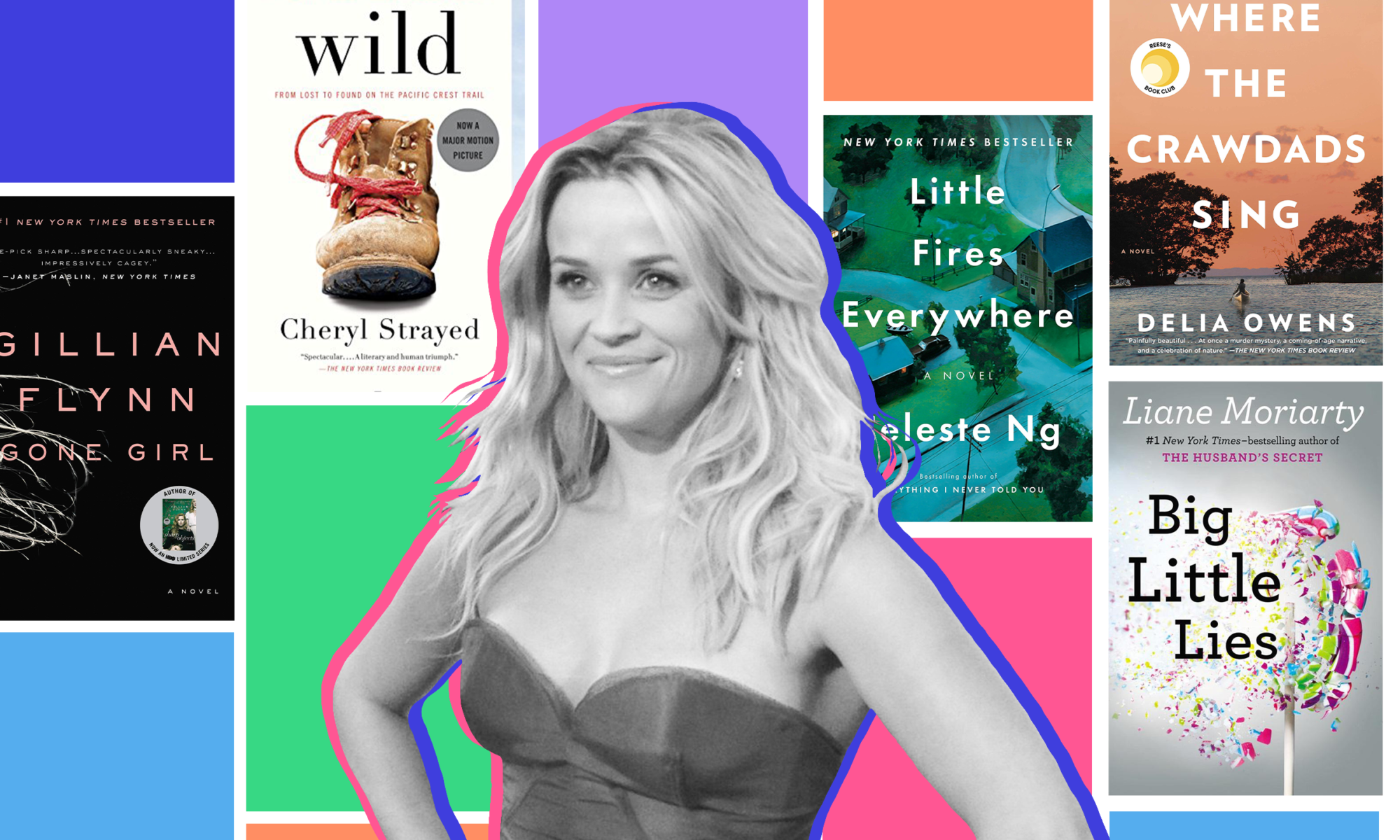
Strong Female Leads

In 2012, Reese Witherspoon was thirty-six years old and sick of Hollywood. Her acting career had slowed since her Oscar win in 2005; she had filed for divorce in 2006 and appeared in a few box office duds, and she wasn’t encouraged by the sexist, stultifying scripts she was receiving. Witherspoon requested meetings with studio bigwigs, and was disappointed to find that they didn’t care about developing stories with female leads. She decided that if she wanted big roles — challenging, substantive ones — she would have to create them herself. So Witherspoon, a prolific reader with an eye for woman-led page-turners, created a production outlet, and started looking for books to adapt. Two galleys caught her attention: a hiking memoir called Wild, and a thriller called Gone Girl. Enthralled by their gnarly depictions of femininity, she optioned both, and Witherspoon was reborn as a big-budget producer. 

In the years since, Witherspoon has established herself as a media juggernaut, best known for her adaptations of dark, twisty books by and about women. Business Insider declared her the “queen of streaming” in 2020, referring to the increasing ubiquity of Hello Sunshine, her company dedicated to “shining a light on female authorship and agency,” on digital video platforms. “Women weren’t going to movies,” Witherspoon told the business magazine Fast Company in 2018. “Digital was winning. The only way was to go where women are, instead of expecting them to come to us in theaters.” One of Hello Sunshine’s most successful ventures has been Reese’s Book Club, which anoints new releases written by women with a buzzy social media campaign and a distinctive Hello Sunshine cover decal. The club has nearly two million followers on Instagram, and being chosen has been compared to “winning the publishing lottery.” For especially fortunate writers, the selection comes with a screen adaptation. 

The most famous picks have been Celeste Ng’s Little Fires Everywhere, which Witherspoon chose for the book club and later adapted into a Hulu miniseries, and Where the Crawdads Sing, a debut novel by a retired scientist named Delia Owens, which held the Times bestseller list by the balls for more than a year. (The adaptation for that one is still in the works.) Few other selections have seen the level of commercial success that Fires and Crawdads have enjoyed, but like Oprah Winfrey before her, Witherspoon has the ability to transform authors’ careers with her stamp of approval. 

In the many profiles that have chronicled her second act, Witherspoon has emphasized that her enterprise is not a fanciful vanity project, but instead the product of long-simmering exasperation. Though she embarked on her second career as a bountifully resourced industry veteran, her story has been written as something like an underdog narrative. Hello Sunshine and its wares are designed for women tired of “people thinking you’re something that you’re not,” or “incapable of something you are,” Witherspoon told The Hollywood Reporter. Comparing Witherspoon to Tracy Flick and Elle Woods, Ng told Fast Company, “People who underestimate her learn their mistake really fast.” 

Witherspoon’s producing career predates the 2016 election, but the Trump presidency and its attendant conflagrations have supplied much of the affective atmosphere for her projects. Many books in the Witherspoon orbit are propelled, to varying degrees, by the much-discussed phenomenon of “women’s anger” — anger with idiotic men and the hollow promises of domestic life, with the traitorous cruelties enacted by other women, with the indignities of being overworked and underestimated. Witherspoon’s creative endeavors found a natural compatibility with the liberal feminist energy that animated the Women’s March, #MeToo, and Time’s Up, the last of which included Witherspoon as a prominent member. (The book club pick for July 2019 was Chandler Baker’s Whisper Network, a #MeToo workplace murder mystery that Witherspoon describes as “honest, timely, and completely thrilling.”) After the downfall of Hollywood’s most notorious predator-producer, she was poised to rise as a refreshing alternative.       

Nearly a decade after she produced her first big-budget movie, it’s clear that Witherspoon has anticipated and mastered several major forces in the pop-cultural landscape: the book-to-streaming pipeline, the inexorable rise of the celebrity lifestyle entrepreneur, the widespread desire for narratives about women doing ugly things, attractively. The market for Witherspoon’s flavor of woman-led media has become impressively saturated, and her winning formula is best encapsulated by some of her splashiest book selections — Little Fires Everywhere, Where the Crawdads Sing, Gillian Flynn’s Gone Girl, Liane Moriarty’s Big Little Lies, and Cheryl Strayed’s Wild. What makes these five texts exemplary of Witherspoon’s broader creative endeavor is not just their commercial success but their conception of “female authorship and agency.” They draw their authority, and sense of urgency, from the intimation that women haven’t had the chance to tell the whole story. At first, the journey of the Witherspoon protagonist tends to align with Witherspoon’s producer origin story: she is dissatisfied with the roles society has provided for her, and itches for a different life. The stories diverge, of course, because the characters aren’t movie stars with a preternatural intelligence for the tides of women’s entertainment — their frustrations find release, not in career comebacks, but in acts of destruction and disappearance.  


“Everyone in Shaker Heights was talking about it that summer,” begins Little Fires Everywhere, “how Isabelle, the last of the Richardson children, had finally gone around the bend and burned the house down.” The first chapter establishes the novel’s chatty suburban milieu and follows members of the Richardson family as they survey the remains of their home. Of particular interest is Elena Richardson, the matriarch, who observes the conflagration from her lawn, “clutching the neck of her pale blue robe closed.” From that moment alone, we know who Mrs. Richardson is. (Being cold in some sort of robe or shawl is the consummate rich lady gesture.) 

Ng situates the incident within the economy of motherly work: Elena “had slept in on purpose, telling herself she deserved it after a rather difficult day.” The preceding day, we learn, involved some drama with Mia and Pearl Warren, the tenants of the Richardsons’ rental property down the road. The unexplained saga culminated with Mia and Pearl wordlessly leaving their keys in Elena’s mailbox and disappearing into the night. “Now it was half past twelve,” Ng explains, “and [Elena] was standing on the tree lawn in her robe and a pair of her son Tripp’s tennis shoes, watching their house burn to the ground.” 

Like several books in the Witherspoon canon, Little Fires Everywhere operates in a quasi-forensic mode, beginning at the scene of a crime and tracing the perpetrator’s steps backwards. Gone Girl commences from the point of view of the titular character’s husband, Nick, in a chapter dated “The Day Of.” Big Little Lies starts in the home of a witness, Mrs. Patty Ponder, who hears screams and crashes from the school next door. (“That doesn’t sound like a school trivia night,” she remarks to her cat.) The prologue of Where the Crawdads Sing narrates the discovery of a dead man in a marsh. “A swamp knows all about death, and doesn’t necessarily define it as tragedy, certainly not a sin,” Owens writes. The reeking marsh, an inverse image of a lush, motherly earth, is personified as the murderer’s accomplice. 

Even Cheryl Strayed’s memoir Wild, a book whose criminal activities are minor offenses relegated to flashbacks, adheres to this template. The book opens with the author explaining her decision to spend several months hiking the Pacific Crest Trail alone, in a passage that reads like she’s emptying her conscience. “There was the first, flip decision to do it, followed by the second, more serious decision to actually do it, and then the long third beginning, composed of shopping and packing and preparing to do it,” Strayed writes. She leaves her job in Minneapolis, finalizes her divorce, bids her friends farewell, and drives across the country to finish the deed, “at which point, at long last, there was the actual doing it, quickly followed by the grim realization of what it meant to do it, followed by the decision to quit doing it because doing it was absurd and pointless and ridiculously difficult and far more than I expected doing it would be and I was profoundly unprepared to do it.” 


In Witherspoon’s chosen books, the question at hand is rarely, “Who did it?” but rather, “Why did she do it?” The texts are permeated by a certain weariness: women chafe under ideals of family and femininity, tire of the performances that their positions demand, and snap under the pressure. (Think of the iconic “Cool Girl” monologue, arguably the most enduring legacy of the Gone Girl franchise.) The universal grievance is the tyranny of types — this type of girl, that type of woman — and the struggle to define oneself in excess of their constraints. It often comes down to mothering, or in some cases, a lack thereof.    

A subset of Witherspoon picks belong to a category that one might call the diminutive gothic, whose ironic suggestions of smallness (Gone Girl, Big Little Lies, Little Fires Everywhere) and closely observed depictions of middle-class family life offer answers to the implicit question: “Why would women with such nice, boring lives make such crazy decisions?” In these texts, suburban discontent is sinister rather than melancholy. “Mothers took their mothering so seriously now,” observes a witness in Big Little Lies. “Their frantic little faces. Their busy little bottoms strutting into the school in their tight gym gear… And they were all so pretty.”  

Both Big Little Lies and Little Fires Everywhere allow us into the mind of the overzealous mother figure, whose compulsions belie her deep dissatisfaction with her own life. In the screen adaptations of both books, Witherspoon gamely portrays the shrill busybody — in Little Fires Everywhere, Elena, in Big Little Lies, Madeline. Both franchises also provide her with a free-spirited opposite — in Little Fires Everywhere, it’s Mia, the mysterious new artist in town, and in Big Little Lies, it’s Bonnie, the ex-husband’s second wife — and the two figures circle each other like magnets, with the insider straining to discern the interloper’s intentions. Neither book explicitly characterizes this dynamic as one of racial animus, but both screen adaptations introduce the possibility by casting black women — Kerry Washington as Mia, Zoë Kravitz as Bonnie — as the foils to Witherspoon’s alpha-moms. The Witherspoon characters embody some of the most grating stereotypes about affluent white moms: artificial niceness that barely masks overbearance, obsession with matters that seem trivial to everyone else. In these tense, gossipy settings, mothering is an object of endless scrutiny, but it also supplies a disciplinary, censorious way of seeing: women and girls are assigned their types in the matrix of motherly judgment.  

Moriarty, who is Australian, takes a bitchy, satirical approach to her subjects (“That’s enough now, Mummy,” says a precocious girl in Big Little Lies), while Ng writes clear-eyed parables of American life. Elena serves as the standard bearer for white suburban orthodoxy in Little Fires Everywhere, and every other character is subject to her assessment. She hates her younger daughter, Izzy, for being a rebellious teenage jerk. She hates Bebe Chow, a Chinese immigrant fighting for custody of her baby in family court, for being poor and making bad decisions. Most of all, Elena hates Mia for being insufficiently jealous of her life and for making art that she doesn’t understand. (“Artists, [Elena] reminded herself, didn’t think like normal people.”) Lest you dismiss Elena’s resentments as petty and ineffectual, she does everything she can to corral the people she deems unfit, including hiring Mia as a housekeeper — indeed, Elena hates Mia so much that she decides to become her boss in addition to being her landlord. By the end of the book, Mia, Bebe, and Izzy have all fled the suburb, or have been successfully purged from it, depending on how you look at it. The twist, of course, is that even Elena suffers under her own stringent paradigm, though she doesn’t realize it until it’s too late.

Yet the absence of the mother figure threatens a similar encroachment of type: the motherless protagonists of Where the Crawdads Sing and Wild are reduced under stereotypes of the fringe and marginal. The original sin of Crawdads is an act of maternal abandonment: after the prologue, the book jumps back several decades, to a six-year-old girl named Kya Clark watching her mother leave their family’s backwater shack in fake alligator high heels, “her only going-out pair,” never to be seen again. After Kya’s mother leaves, other family members follow suit until Kya is left to raise herself. She forgoes formal schooling, survives on the charity of Jumpin and Mabel, a black husband and wife who clothe and feed her with donations from their church in “Colored Town,” and becomes something of an urban legend among children in town — the “Marsh Girl.” In the absence of a mother figure for Kya — Mabel is more a flat stereotype than a real character — Owens directs us, again, to the personified swamp: “Kya laid her hand upon the breathing, wet earth, and the marsh became her mother.”  

Strayed, who ventures into the wilderness as a way of coping with her mother’s death, never identifies such a substitute, but it’s implied that she is exercising freedoms that were never available to her mom.I’ve always been someone’s daughter or mother or wife,” Strayed remembers her mother saying after the fatal diagnosis. “I’ve never just been me.” On the trail, Strayed is no one’s wife or daughter, but she quickly becomes aware of her new role in a diffuse society of hikers — she is a woman traveling alone, which invites both suspicion and concern. Strayed readily classifies the men she meets as recognizable types — the New England blue blood, “charmingly sure of his place at the very top of the heap,” or the northern Minnesota guy, “searching and open-hearted” — but balks at being categorized herself. She spars with a hippie journalist named Jimmy Carter (no relation) who insists on describing her as a hobo. (“Being a hobo and being a hiker are completely separate things,” she insists.)  When a trucker asks, “What kind of woman are you?,” she squirms. 


Strayed’s thousand-mile hike might be best understood as a quest for narrative control. (The poetically apt “Strayed” is not the author’s given or married surname; she chooses it while filling out divorce paperwork.) She is a writer, and makes room in her heavy pack for books, burning chapters as she finishes reading them in order to lighten the load. It’s fitting that many of the women Witherspoon canonizes have literary and artistic ambitions: their deceptions are acts of creation, and vice versa. We first meet Amy Dunne, a writer and the titular “gone girl,” through her diary entries, which we later learn are fictionalized to frame her husband for her disappearance. Elena and Mia of Little Fires Everywhere are opposites in both disposition and creative output: Mia, the nomadic artist, makes “eerily beautiful” objects out of doctored photographs, reassembled furniture, and secondhand stuffed animals, while Elena inexplicably wears “high-heeled pumps” to work as a reporter for a free community newspaper, covering “city council meetings and zoning boards and who won the science fair.” 

Elena feels unfulfilled by her work and pursues something she sees as more rewarding: digging into Mia’s past under the guise of journalistic investigation. She tracks down Mia’s estranged parents and learns that Mia conceived Pearl as a surrogate for a wealthy couple. (She lied about having a miscarriage and has been hiding from the adoptive parents ever since.) This discovery, among other intrusions, drives Mia out of Shaker Heights for good. When she flees, she leaves behind an envelope of symbolic photographs, one for each of the Richardsons, all images of repurposed objects they have discarded: a modified reproduction of Lexie’s discharge form from an abortion clinic, a hockey chest pad with plants growing from it for the perennially guarded Trip, a flock of origami birds for forgotten middle child Moody, a magnetic compass made from one of Mr. Richardson’s collar stays, and, for Elena, a shattered birdcage, cut from one of her articles in the newspaper, with a single golden feather in the center. Ng depicts Mia’s climactic work of art as therapeutic and didactic, a moving last act of service for the Richardsons, as well as a way of getting the last word.

Perhaps the most poignant artistic journey is that of Crawdads’s Kya, who learns to read as a teenager, thanks to the kindness of a young man named Tate Walker. They start their lessons with an almanac, and Kya reads her fateful first sentence: “There are some who can live without wild things, and some who cannot.” Tate and Kya’s relationship quickly becomes romantic, and literacy gives Kya new mastery of her circumscribed world. She learns her parents’ proper names when she sees them inscribed in the family Bible, and she is finally able to label her vast collection of marsh specimens. She also discovers a passion for poetry, and the rest of the book is punctuated with Kya’s recitations of thematically appropriate verses by a writer named Amanda Hamilton.

The drama that carries the second half of the novel involves a love triangle, a death, and a book deal. When Tate breaks up with her, she attempts to fill his absence by dating the boorish Chase Andrews, who lies about his engagement to another woman and attempts to rape Kya when she ends the relationship. After returning from college, Tate leverages his new connections to score Kya a contract for writing reference books about seashells and the two of them reconcile. The book advance subsidizes a makeover for Kya’s decrepit shack, and everything seems to be perfect, until Chase’s body is discovered in the marsh, and Kya is accused of pushing him to his death. Kya has an alibi — she met with her book editor in Greenville on the night Chase died — and her lawyer convinces the jury that the prosecution is weaponizing the community’s prejudices against the “Marsh Girl” to convict an innocent woman.   

The ending, which takes place after Kya’s elegant natural death at the age of sixty-four, can only be described as “you have to be fucking with me.” Looking through his deceased wife’s possessions, Tate discovers a shell necklace that proves Kya did, in fact, kill Chase. He also learns that Kya had been secretly publishing poetry under — you guessed it — the pseudonym Amanda Hamilton, and reads one last verse that narrates the murder: “Down, down he falls, / His eyes still holding mine / Until they see another world.” Kya’s science writing supplied the alibi for her revenge; in her posthumous poetry, she gloats that she got away with it. Through this revelation to the reader, the author gives Kya the recognition she never received in her lifetime. It’s a baldly ridiculous plot twist, but it’s also a redemption arc for the female artist: to be recognized is good, and to be underestimated and recognized later is even better. When Tate burns all of Kya’s papers in a fit of disbelief, it almost seems beside the point. 

The ending of Crawdads is similar to those of Gone Girl and Little Fires Everywhere in its deployment of a particular trope: the woman whose genius is kept secret. Gone Girl concludes with Amy writing a book, but her true masterpiece is the fiction of her married life: Amy makes herself pregnant by stealing Nick’s sperm sample from a fertility clinic and threatens to keep his child away from him if he doesn’t meet her demands, which include the destruction of a memoir that would have incriminated her. (“He is learning to love me unconditionally, under all my conditions,” she writes.) In Little Fires Everywhere, when the Warrens drive away from Shaker Heights, Pearl asks her mother, “What if those were the pictures that were going to make you famous?” Ng intimates that Mia eventually achieves renown for another work, — something that’s “just a wisp of an idea” at the moment of the family’s escape — but the Richardson photos are, of course, the most valuable to us as readers. We are meant to relish the knowledge that the photos become “uneasy family heirlooms,” sitting in the attic to be discovered by later generations.              

In pop-feminist discourse, there are few motifs more salient than the secret knowledge of women — the men whose names have coasted through the whisper networks, the slights that would be undetectable to the untrained eye. Unfortunately for women, it’s a rather sexy motif. The highly lucrative project of telling women’s narratives seems to work in direct opposition to the systems that keep women silent, but really, the two shakily move in tandem. Women’s stories matter because women’s stories have never mattered; the endeavor of telling them would carry less weight were it not attended by the threat of the alternative. Show me a tale about a woman almost forgotten by history, and I’ll click it. There’s no better way to sell a story than to say it nearly went untold.

Not All Millennials

Peddlers of self-help and pop-psychology are quick to assure us that we’re each our own toughest critic. In fact, it’s often our peers who will exact the harshest judgments, being best positioned to sniff out the social cues and latent hierarchies that are most legible within a shared milieu. Last year, Pete Buttigieg, the only millennial candidate in the Democratic Presidential field, failed to win the support of other members of his generation (which is also mine) — a February 2020 poll of 18-34 year olds placed him at a pitiful 6%. The résumé stacked with institutional achievement felt a little too polished, and he was widely regarded with the kind of disdain reserved for teachers’ pets. Columbia students called him “the old man’s millennial,” the kind of ideal young person that our parents measure us against: Harvard, Rhodes scholarship, military service, McKinsey, not quite so politically radical. 

Pitted against AOC for the title of Anointed Millennial Politician, he simply didn’t stand a chance. Setting aside the charisma differential, Ocasio-Cortez is an avatar of the leftist politics that has become de rigueur for a large chunk of our economically disenfranchised generation. Her commitment to progressive issues is the product of a lived experience that can’t be replicated by the shrewdest political strategists: famously, she was working as a bartender when she was elected to Congress; when she moved to DC, she struggled to afford rent. Critics have investigated the value of her childhood home and other such clues in an effort to challenge this narrative of precarity, but the specifics hardly matter. Where Buttigieg represents an outdated fantasy of meritocratic accomplishment, Ocasio-Cortez’s story is millennial realism. 

Our parents were born in an era of expansive American appetites — for global influence, for fossil fuels, for personal advancement — and presented with a broad horizon of individual and collective possibilities. They proceeded to mine the productive economy for everything it was worth and then sell it for parts, and millennials’ capacity for their brand of youthful optimism has been blunted by the historical rejoinders that followed. The crises that shocked the first decade of the 2000s — and then settled into a state of apparent permanence — shaped our era into one of contracting possibilities, scarcity, and skepticism about the future. 

Widening income and wealth inequalities, and millennials’ dim economic prospects, have led the media to reevaluate its initial verdict on the generation. First, we were entitled, distracted avocado toast addicts who couldn’t budget. But the past few years have seen an increasingly sympathetic shift, as even the bootstrap scolds have been forced to admit that structural factors might be impacting our generation’s failure to meet expected benchmarks of middle-class adulthood. Publications that were once obsessed with admonishing us became obsessed with declaring our economic prospects hopeless. “The Coronavirus Means Millennials Are More Screwed Than Ever,” wrote The Daily Beast in May, a month after The Atlantic declared, “Millennials Don’t Stand A Chance.” Definitively, from The Washington Post: “Millennials are the unluckiest generation in U.S. history.” 

Generational insiders have worked hard at narrativizing this predicament: Anne Helen Petersen most recently posited “burnout” as the dominant affective response to skyrocketing precarity and worsening prospects amid constantly multiplying demands on our time, attention, and labor in her viral article-turned-book Can’t Even: How Millennials Became the Burnout Generation. If our toothbrushes (Quip), mattresses (Casper), suitcases (Away), and novels (Sally Rooney) match, so too, we are given to believe, do our emotional states. “The weight of living amidst that sort of emotional, physical, and financial precarity is staggering,” she writes, describing a condition of exhaustion battling the steady impetus to do more. In 2017, Malcolm Harris’s Kids These Days: Human Capital and the Making of Millennials offered the most thorough accounting yet of the structures underpinning millennial psyches. He explains the way that the forces of neoliberalism, with its imperative to optimize profitability in every facet of life, have set millennials on an impossible and unending racecourse. His book is now frequently cited alongside Petersen’s; in The Nation in November, Jeremy Gordon wrote that the two “draw on a similar body of evidence to demonstrate how and why we got here, because the facts aren’t really up for debate.” Many bleak statistics, which hardly need repeating at this point, bear that sentiment out. Millennials control 4 percent of aggregate wealth, compared to the Baby Boomers’ 21 percent at the same age, and in the era of precarious employment (47 percent of millennials freelance either some or all of the time), we can’t and won’t earn our way out of that hole. 

These books, and the slew of accompanying articles, have illuminated the millennial experience and identified the structural barriers we face, drawing a direct line from our debts, wages, and shattered expectations to policy choices made in the last few decades. They have also been used in service of a flattening narrative that creates a frame around our generation and a shorthand for a shared experience that is frequently gestured at, even when it’s not necessarily earned. Last summer, Rachel Connolly put her finger on the way that a distinct “we’re all in this together” ethos papers over intra-generational class distinctions. “Those who stand to inherit substantial wealth will complain they are crippled by the high cost of rent,” she writes, “and those with rich and famous parents will speak, darkly, of “hustling” their way into the industries in which their relatives work.” I immediately recognized in her description the discreet millennial landlords and “broke” trust-funders I’ve met, and I’d venture to guess that I’m not alone.

The millennial social condition is analogous to the one that has arisen during the pandemic: despite a wildly unequal material reality, essential workers, the unemployed, and those with cushy remote jobs have all experienced a brutal lifestyle disruption, a severe narrowing of options, and a blow to mental health and happiness. Almost across the board, millennials will do worse than their parents, inheriting a harsher and more difficult world, but not all of us will experience this in the same way. For a generation that has developed a complex language and conceptual rubric for privilege, it’s curious that this phenomenon has yet to receive as much attention, that the authenticity tests we’ve administered to Buttigieg and Ocasio-Cortez have not yet translated to a broader reckoning with what’s coming. 


Some millennials are already receiving financial help from their parents (in fact, many: the Times reported one estimate that “more than half (53 percent) of Americans ages 21 to 37 have received some form of financial assistance from a parent, guardian or family member since turning 21.”) Others can soon expect a life-altering infusion of cash, either in the form of posthumous bequests or transfers — like help with a down payment — made while parents are still alive. These gifts have become more significant than ever now that the wage labor market can no longer serve as a corrective to unevenly distributed parental wealth. Yet another group may see its economic position shift later in life: after struggling to pay the bills until age 50 or later, outcomes will suddenly diverge even among those who hold the same job. 

The financial industry is calling the coming shift a “great wealth transfer.” Morgan Stanley has referred to it as the “$30 Trillion Challenge” after one study specified that amount as the sum of wealth that will pass into millennials’ hands between 2031 and 2045. Their advisors are standing at the ready: “Morgan Stanley is committed to helping this generation prepare for its inheritance and achieve the amazing,” reads their website. CapitalOne/United Income predicts $36 trillion; Cerulli Associates places their estimate at $68 trillion; PNC Bank predicts $59 trillion; Wealth-X says $15 trillion by 2030. Regardless, The Economist wrote in October, “Wall Street will soon have to take millennial investors seriously.” Forbes wrote in 2019 that “Millennials Will Become Richest Generation In American History As Baby Boomers Transfer Their Over Wealth,” the same year that the Times asked, “A ‘Great Wealth Transfer’ Is Coming. What Will It Mean for Art?” 

Quantifying exactly how much of it will go where is difficult. Certainly, many boomers will have their own economic challenges to contend with in the coming decades, particularly if they continue, with such blind insistence, to block the millennial left’s attempts to make healthcare more affordable. Much of boomer wealth is already concentrated among a small number of people, and it will remain so. The share of households that have received inheritances of any amount has remained stable over the past few decades, but it’s more than likely to rise for millennials thanks to the Baby Boomers’ inordinate share of wealth. A recent survey showed that 40 percent of Boomers planned to leave something behind, and United Income/Capital One’s study predicted that the wealth transfer will benefit, to some extent, one out of five American households. While the wealthiest are inheriting more thanks to growth at the very top, the median amount bequeathed has also risen by $15,000 over the past 30 years.

The distribution of this inheritance will fall along the lines of existing inequalities, deepening the fractures in any millennial program of economic solidarity. Homeownership rates are a useful measure of these faultlines. A staggering 92 percent of millennial millionaires already own property. For the average non-millionaire millennial, the number is 39 percent; for Black millennials, it’s only 14.5 percent. An Urban Institute study found that the Fair Housing Act, passed in 1968, has had no effect in narrowing the gap between Black and white homeownership, and that Black communities have been much slower to assimilate the effects of the post-2008 recovery. With Black households averaging one-tenth the wealth of white families, this resource gap will not only persist but widen within our generation as money is passed among white families who have had the opportunity to accrue it over the course of decades, if not centuries. 


Placing income and employment status at the center of class analysis makes intuitive sense, and it is part of the conditioning one typically receives during the course of an American education. The narrative of self-fashioning remains shockingly bulletproof, and perhaps this cultural delusion has helped guide our attention towards the problem of income inequality. A new book, The Asset Economy, provides a forceful argument against using wages as a measure of economic fates. The Asset Economy is a collaboration between Lisa Adkins, Melinda Cooper, and Martijn Konings, three sociologists based at the University of Sydney. Their work synthesizes concurrent trends across Australia, the U.S., and the U.K. to argue that asset ownership — particularly property — has supplanted income, education, and occupation as the key determinant of class position, a reality that is set to become especially salient during millennials’ lifetimes.

Neoliberal policies, they point out, have been deliberately designed to inflate the value of real estate over the past several decades. This inflation has in part been an effort to pad out the fortunes of the very wealthiest, but it has also served to encourage broader buy-in to the “asset economy” — in other words, the speculative realm in which wealth is built over a long period of time, and with the help of credit. Here, the usual risks involved in speculative investments have been artificially mitigated. Property assets enjoy more protections than ever — the housing market rebounded even after the 2008 crisis — and investing in appreciating property has become essential to the possibility of accruing wealth. At the same time, soaring prices, combined with the simultaneous decline in wages, have locked out new buyers, except for those with access to parental help. As a result, the patterns of wealth accumulation that were set in motion while real estate was still up for grabs are being cemented in place. 

The 1980s are well recognized as the era that ushered in a policy regime favorable to those who participate in the financialized economy, earning income through capital gains. Adkins et al. link this trend with a desire to protect the value of property assets, which had been threatened by the inflation of the previous decade. “Throughout the 1970s,” they write, “wealth holders were at a loss to find safe avenues of investment.” This led central banks to a new commitment to rigorously police inflation when it came to wages, but not assets. Adkins and co. write that this “would very likely have generated significant social unrest,” but policymakers shored up enough popular support with the promise of at least some broad access to the wealth-generating engine of asset appreciation.

In England, Margaret Thatcher debuted a scheme for allowing residents of public housing to purchase their homes from the government; in the U.S., Reagan touted pension plans for the masses. He also resuscitated the “stock option,” which would regain popularity during the dot-com boom of the 1990s. The Clinton era saw the extension of this fealty to the financial sector with the advent of the idea of the individual as an investment that would appreciate over time as it was traded on and monetized through education and training. Clinton’s program remained couched in the language of jobs even as he oversaw the continued dominion of assets and capital. Adkins and co. note that his first inaugural promised “good-paying jobs,” a classic example of the way that Democratic sloganeering often sounds like something that was poorly translated from a different language, but which the party nevertheless remains mystifyingly attached to — my spam folder is full of political fundraising emails that use this phrase. 

The promise of future payoff kept shifting. While Clinton began by promoting education and skills as the most viable path to the middle class (the antecedent of today’s “learn to code”), he and other “Third Way” governments ended up “reverting to housing or stocks as the most practical route to policy change.” The Asset Economy argues that the expansion of subprime mortgages was partially an attempt to create widespread shares in the asset economy via housing. Policymakers foresaw a future in which “everyone could borrow their way into the asset economy with the help of unusually cheap and abundant credit,” but “only at the price of unprecedented levels of household debt.” Over time, part of the justification for suppressing wages has been the promise of alternate streams of wealth — even a modest portfolio padded with property and pensions. Now, the bait-and-switch that substituted democratized asset ownership for livable wages has left a new generation without the prospect of either. 

The asset paradigm is not, of course, entirely new: here, Adkins et al. have systematized the truism that upward mobility no longer exists. Their work is explicitly situated in the tradition of Piketty, who wrote in Capital and the Twenty-First Century, “inequalities of wealth exist primarily within age cohorts, and inherited wealth comes close to being as decisive at the beginning of the twenty-first century as it was in the age of Balzac’s Père Goriot.” However, they argue that Piketty’s analysis was not, even across 696 pages, thorough enough in outlining the ways in which generational wealth is decisive. The inheritance of, or relation to, property is so crucial that, on its own, it will increasingly shape class status at every level, not just for the super-rich. At the top of their organizational chart are the investors who have priced themselves out of the asset economy by dint of extreme hoarding. They’re followed by outright homeowners and homeowners with mortgages, renters, and, finally, the unhoused. (Each of these classifications is further subdivided.) The authors describe this new class logic as a kind of neofeudalism — “neo” because relations are shaped, rather than by static inheritance of property, by the fluctuating value of investments over time, and specific interventions like assistance with a down payment.

Unexplored in the book, due to its scope, are the clear racial implications of an asset-based formulation of class. Given the history of racist housing discrimination in America, Black millennials face an incredible disadvantage in an economic field where having parents who are homeowners increases a child’s likelihood of becoming the same by 8.4 percentage points. If relationship to property is as powerful, at every level, as The Asset Economy posits, the unequal situation begins to appear even more dire. Ultimately, “what distinguishes successive generations today is less a difference in absolute wealth holdings,” they write, “than a difference in modes of access to wealth. In time, millennials will end up with even more wealth than the Baby Boomers.” The Asset Economy both supports and undermines the possibility of generational analysis. In their view, this powerful vector of inequality differentiates our experience from that of our predecessors. But asset-based wealth is not an age- or generation-based metric of inequality; it doesn’t cordon off millennials as a distinct group. Rather, it delineates categories within the millennial generation based on family relationships and resources. 

The book also helps us fill out analyses of the way that millennials work, or the way that they feel after work, by unlocking a new dimension to career burnout. Forget fulfillment and passion — chasing stability through employment becomes a fool’s errand if wages increasingly fail to keep pace with the cost of living, or are offset by the educational debt required to qualify for them in the first place. But we may be even more stymied by the fact that the locus of economic stability has been shifted somewhere else entirely — to a housing market that’s out of reach for all but those with inherited wealth. The much-discussed “end of work” may have already come if the function of employment has been peeled off from any possibility of building wealth or even basic security. 


An awareness that employment is being decoupled from wealth and class position has crept into millennial culture. Much of the recent backlash to the “girlboss” has been born of the recognition that hustling and leaning in will not be enough to climb the ladder. Each year, Forbes’s “30 Under 30” list seems to garner more and more contempt. But the narrative of universal millennial precarity has risen alongside a tendency towards the obfuscation of class. 

This trend has been accelerated by the democratization of certain traditional class markers — still only for a select group of millennials, but a group that nevertheless becomes highly visible, particularly in media. The expansion of financial aid at elite educational institutions, the growing accessibility of travel, and the convergence of taste towards a set of midrange consumer goods have all helped make the appearance of wealth more slippery for more of us. The pastel millennial design aesthetic has been thoroughly catalogued; in April, Amanda Mull wrote about the way that a proliferation of knockoffs and high-end approximations can allow us to feel like we’re “slipping through a tear in the fabric of capitalism.” It’s my suspicion that one of several reasons that millennials have gravitated toward certain ubiquitous brands is that they function as a form of class camouflage. Jia Tolentino aptly described the pricing of popular dressmaker Reformation as “just the right amount to blur the lines between those who thought of a two-hundred-and-eighteen-dollar jumpsuit as an affordable basic and those for whom it would be an impractical splurge.” 

Working in urban creative industries has always required a delicate balance between the performance of affluence and the performance of poverty; Daisy Alioto recently referenced the “middle class kids who move to New York City in their 20s and are careful to describe themselves as ‘broke’ and not ‘poor.’” Perhaps this is truer for more millennials, in more ways; perhaps it’s the same old story. But for a group famously enamored with socialism, being publicly outed as a beneficiary of unearned privilege is particularly excruciating and creates another set of incentives to muddy the water. In December, the Times published “The Rich Kids Who Want to Tear Down Capitalism,” revealing its subjects’ eye-popping fluency with once-radical language (“When I think about outlet malls, I think about intersectional oppression,” declares the heir to an outlet mall fortune). Not all wealthy millennials will be quite so proactive about offering up their fortunes, however. And since there are a great many gradations between the poorest millennials and these extraordinarily wealthy ones, it seems urgent to further develop our understanding of the factors that will continue to drive millennial inequality at every level in the coming decades, and how we can effectively mitigate them. 

The millennial consensus is valuable as a method of community-building, but it’s not always a durable means of solidarity-building — or crafting effective policy remedies — when it obscures class differences among us. Sharpening our analyses of shifting inequality will help us make more ethical demands of each other, without only resorting to complaints about the previous generations who shaped our apocalyptic present.