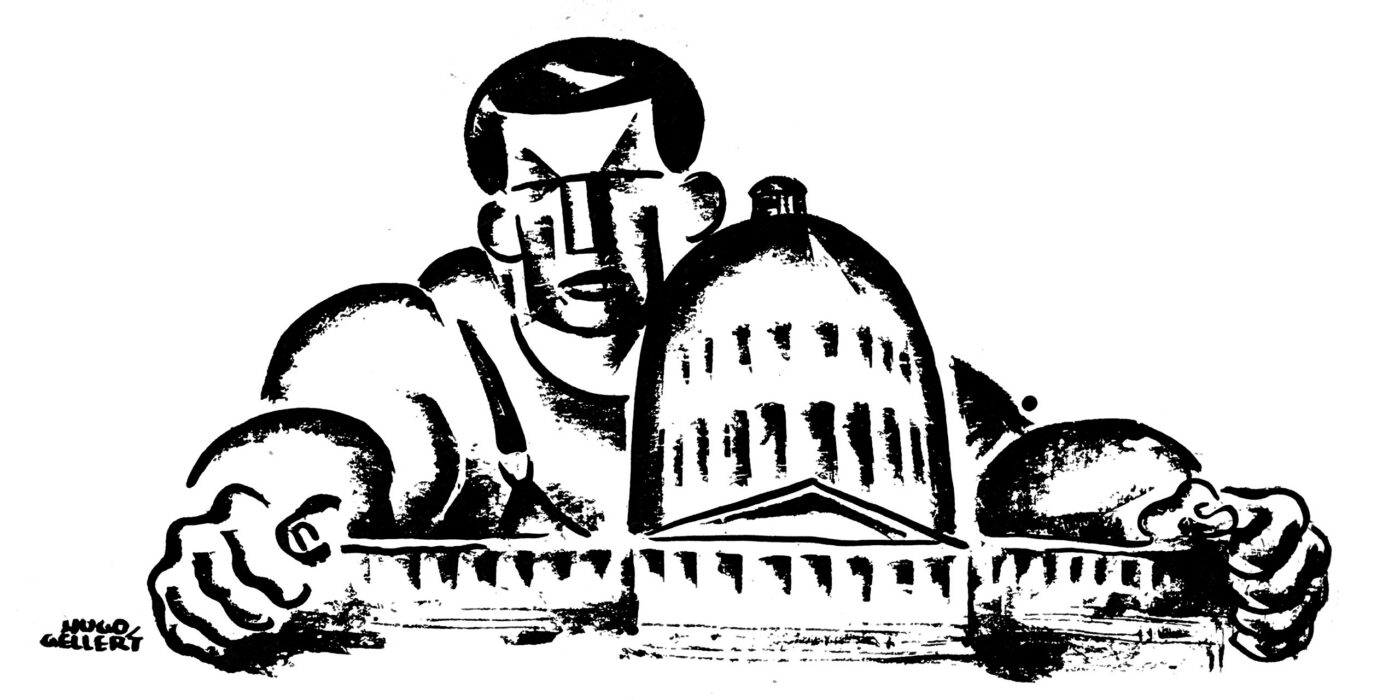
Remember Graham Platner? A couple months after the rape allegations that put the final nail in the coffin of his Senate bid, it feels like the black hole of the news cycle has already sucked the ex-Blackwater mercenary and his doomed campaign past the event horizon. Democrats’ hopes of picking up Susan Collins’s seat in November now rest with progressive gubernatorial also-ran Troy Jackson. The party has upgraded from an oyster farmer to, as The New York Times dubbed Jackson, an “honest-to-God lumberjack.”
Jackson sufficiently resembles the image Platner tried to project — calloused hands, unfussy masculinity, straight-shooting populism — that if he succeeds in felling Collins, those pundits like Robert Reich who christened Platner “the future of the Democratic Party” earlier this year may still be able to claim some vindication. If Collins dulls Jackson’s axe, on the other hand, the centrists who have rushed to wield the demise of Platner’s campaign as a cudgel against the left will surely canonize the race as proof that any deviation from the Clintonite line on economics and Israel spells electoral doom, notwithstanding countervailing evidence from any number of recent races around the country.
But the quest to use the Maine Senate contest to figure out which type of guy Democrats ought to offer up to voters misunderstands the actual dynamics on display in our politics today. In an editors’ note shortly after Donald Trump’s second election, we warned that Democratic strategists might soon be “crossing out Barbie in their playbooks and writing in Yellowstone.” Nearly two years later, Platner’s collapse shows that the right call to central casting won’t suffice to mask the decay of this whole cynical ad-agency simulacrum of democracy, the reduction of political participation to fandom and channel surfing. Republicans are learning an analogous lesson: Trump may have played a populist disruptor on TV, but his cratering approval ratings show that even voters suckered in by the act have begun to despair of his repressive, hawkish, and single-mindedly self-enriching rule. There is a real hunger for an alternative to a system in which citizens are asked to do no more than rubber-stamp the decisions of our leaders, which so far has found expression only in ephemeral and occasionally fraudulent forms: the Trump-sponsored prediction market that promises to “democratize information,” the meme stocks that offer the appearance of financial vigilantism, pseudo-populist promises by some elites to stick it to others. Whoever succeeds in constructing a durable alternative may well control the direction of American politics.
What might that look like? Two major reported essays in this issue of The Drift cover a pair of ideologically opposed efforts to translate radical criticisms of the status quo into broad overhauls of our politics. In her contribution, Piper French charts the transformation of the New York City chapter of the Democratic Socialists of America into a formidable electoral force — including, but by now going far beyond, the ascension of Zohran Mamdani. DSA is so well equipped to win elections in today’s New York, French shows, because it has devoted years of principled grassroots organizing to proving that it cares about more than just winning elections. The question of how best to pursue those radical priorities while making the compromises necessary to retain and effectively deploy the power of elected office remains open, and has begun to divide the left in New York and beyond.
On the other side of the political spectrum, a transnational network of intellectuals has been working no less patiently to build a disciplined movement out of right-wing discontent with mainstream liberalism. For years the headquarters of “postliberalism” were in Viktor Orbán’s Hungary, and especially Budapest’s Danube Institute. In his essay, Brian Goodman recounts his experience insinuating himself into the Danube milieu and getting to know postliberalism from the inside. He cautions against strains of wishful thinking that assume Orbán’s defeat this spring spells doom for the thinkers until recently under his patronage. Postliberals may have overestimated their ability to build a durable regime in Hungary, Goodman warns, but we underestimate their ability to offer seductive (if sinister) explanations for the failure of status quo politics at our own peril.
The quest for an alternative, any alternative, to a social order at once desiccated and calcified — the search for new ideas and for a space in which people may take back a modicum of control from the invisible hand of the market and the all-too-visible hand of elite bureaucrats — finds expression far outside the realm of electoral politics. A.I. boosters, like Trumpian prediction market moguls, often frame their imagined utopia in terms of democratization. “Delivering personal superintelligence to everyone,” Mark Zuckerberg wrote in The Wall Street Journal in July, “has the potential to begin a new era of personal empowerment, in which individuals have greater freedom to pursue their interests and reach their full potential.” Collecting anonymous reports from workers in a wide range of industries, our Dispatches section presents a more measured picture of the landscape A.I. is creating, one in which the prospect of unfettered access to computerized expertise is often eclipsed by the technological intensification of business as usual.
Other essays also dwell in the gap between imagination and reality. Lora Kelley reflects on a recent spate of fiction that centers content moderators, and how these stories do and don’t deviate from journalistic accounts. Séamus Malekafzali explains the obstacles the United Arab Emirates has confronted in its struggle to become a regional power on par with Israel and Iran. Saliha Bayrak examines the reemergence of celibacy as a self-help trend, and what people today are hoping to get out of not getting some. Hanson O’Haver guides readers through the desolate netherworld of music biopics, questioning the genre’s future in a world whose biggest pop stars are uncinematically risk-averse. We also interviewed nutritionist and public health advocate Marion Nestle, who explains what it would really take to make America healthy again.
In fiction by Chidima Anekwe, Ismail Ibrahim, Henri Lipton, and Lily Felsenthal, a linguistics student differentiates Nigerian from Nigerien, a recovering addict heads West, an underemployed boyfriend places bets on the Dark Web in the days before Polymarket, and an old woman has a mysterious visitor. Poems by Steve Roberts, Lev Xue, Sam Bailey, Ben Purkert, Rosanna Young Oh, grace (ge) gilbert, and Park Soran ask what else to do but slumber and what to do with all the chairs we’ve built. Our Mentions contributors supply extremely abbreviated reviews of, among other things, an ersatz rainforest, an unlikely Georgist, and one leopard-spotted miracle creature.
Like our formal government, the fourth estate has long since ossified, with the pseudo-democracy of social media gaining ever more purchase on our discourse. In this issue of The Drift, we’ve tried to present an alternative.